
Kannon Bosatsu
The One Who Hears
Kannon Bosatsu
観音菩薩
A bodhisattva whose name means the one who perceives the sounds of the world. He is invoked by the drowning, the barren and the dying, and carried in Japan into a statue sealed in cloth, a hidden gold image in Asakusa and a pilgrimage of thirty-three temples.
Identity card
Know him at a glance
- The crown and its small Buddha. Most images wear a crown with a tiny seated Amida set into it (kebutsu), the sign of Kannon’s lineage and the most common way to identify him (Art Net Users System).
- The willow. In the right hand in some forms, a branch used to sprinkle water. Wikipedia notes that the willow bends without breaking.
- The vase. A water vase, usually in the left hand, holding pure water said to relieve suffering.
- The lotus. Purity. Kannon often sits or stands on an open lotus bloom, and in many Japanese images holds a bud.
- The halo. The disc of light behind the head that marks a bodhisattva of high rank.
The one who hears

Japan, Asuka period, mid-600s to early 700s. Gilt bronze, 32 cm.
Look closer: This is one of the oldest Japanese images of the bodhisattva one can see in a museum. Look at the slender body and the long, flat folds of the scarves, which belong to the first age of Buddhist sculpture in Japan.
Cleveland Museum of Art, John L. Severance Fund (1950.392). CC0, Open Access.
The name is an instruction as much as a title. Wikipedia glosses the Chinese Guanyin as “[the one who] perceives the sounds of the world”, and the earlier Sanskrit Avalokitasvara, found in fifth-century fragments, as “sound perceiver”. The usual Sanskrit form is Avalokiteśvara, which the Japanese Architecture and Art Net Users System takes to mean “Lord who regards” sentient beings with compassion. In Japanese the bodhisattva is Kannon, formally Kanzeon, and also Kanjizai. The origin is unclear. The Art Net Users System proposes a popular Indian deity absorbed into Buddhism, and notes possible artistic sources in a princely lotus-holding attendant of the Buddha, and Shiva.
The scripture that made Kannon a figure of daily appeal is chapter 25 of the Lotus Sutra, the Universal Gate. Wikipedia says the chapter is devoted to the bodhisattva who hears the cries of sentient beings and helps those who call on his name, that it describes thirty-three manifestations of which seven are female, and that the Lotus Sutra is generally accepted as the earliest literature teaching Avalokiteśvara’s doctrines. In Japan the chapter circulates by itself as the Kannon Sutra. In the Heart Sutra, Wikipedia adds, Avalokiteśvara is the speaker and explains emptiness to the arhat Śāriputra.
This chapter sits inside the Buddhism and Zen Almanac, on the Bosatsu rank. Kannon stands beside Amida in the Pure Land, and several of his forms have their own chapters: Jūichimen, Senju, Nyoirin, Batō and Juntei.
Lord who looks down, name that listens
Two Sanskrit names lie beneath the one Japanese word. The older is Avalokitasvara, “sound perceiver”, which turns up in Sanskrit fragments of the fifth century. The later is Avalokiteśvara, “the Lord who looks down”, built from ava (down), lokita (looked at) and īśvara (lord). Wikipedia notes that the ending -īśvara does not occur in Sanskrit before the seventh century, and that scholars once supposed early Chinese translators had misread the later name for the earlier one. The present view runs the other way. Avalokitasvara was the original, and Guanyin, “perceiving sound”, is its exact equivalent (Wikipedia, “Guanyin” and “Avalokiteśvara”). Kumārajīva pushed the name one step further. He read the syllable lok as meaning both “to look” and “world”, so that his Guanshiyin comes out as the one who perceives the world’s lamentations. In Japanese that is Kanzeon, and the shortened Kannon is what a temple signboard or a roadside shrine says.
Where the devotion began is unsettled. Wikipedia reports that Western scholars have reached no consensus. Some have seen a borrowing from Hinduism, in particular Shiva or Vishnu, an idea that rests largely on the name. The Japanese scholar Shu Hikosaka argues from scripture, ancient Tamil sources and field surveys that Mount Potalaka, the bodhisattva’s mountain home in the Gaṇḍavyūha Sūtra and in Xuanzang’s account, is Mount Potigai at Ambasamudram, on the Tamil Nadu and Kerala border. On his account it was sacred to the local people long before Buddhist hermits settled there, and the mixed Tamil and Buddhist cult culminated in the figure of Avalokiteśvara. The Art Net Users System, written for Japanese art historians, offers a different guess: a popular Indian deity absorbed into Buddhism, with possible artistic sources in a lotus-holding princely attendant of the Buddha and in Shiva.
Whatever its parentage, the cult was real and old. Around 400 CE the Chinese monk Faxian saw monks at Mathura making offerings to Avalokiteśvara, and in the seventh century Xuanzang described statues venerated by everyone from kings to laypeople (Wikipedia, “Avalokiteśvara”). The bronzes from the Swat Valley shown below belong to that seventh century, the same century in which Xuanzang was writing.
A cosmic body that is not a creator
The Kāraṇḍavyūha Sūtra, which Wikipedia dates to the late fourth or early fifth century, is the first text to join Avalokiteśvara to the six-syllable mantra, and it gives him a body of cosmic size. From his eyes came the sun and the moon, from his forehead Maheśvara, and so on down the body, as the table below sets out. Wikipedia reports that the Encyclopædia Britannica cites him as the creator god of the world. Wikipedia’s fuller account, drawing on Alexander Studholme’s study of the sutra, reads the passage differently: the myth only has him give birth to the gods, and he is not depicted as a true creator of the cosmos. He is a great cosmic being who appears in many forms as skilful means to lead beings to Buddhahood. The mainstream of those who revered him, Wikipedia adds, upheld the Buddhist rejection of any creator god.
| From the body of Avalokiteśvara | Born as | Also among his thirty-three guises? |
|---|---|---|
| Eyes | Āditya (the sun) and Candra (the moon) | No |
| Forehead | Maheśvara | Yes: Maheśvara (Shiva) is one of the guises in the Lotus Sutra list |
| Shoulders | Brahmā | Yes: King Brahmā is a guise in the same chapter |
| Heart | Nārāyaṇa | No |
| Canine teeth | Devī Sarasvatī | No |
| Mouth | Vāyu | No |
| Feet | Dharaṇī | No |
| Stomach | Varuṇa | No |
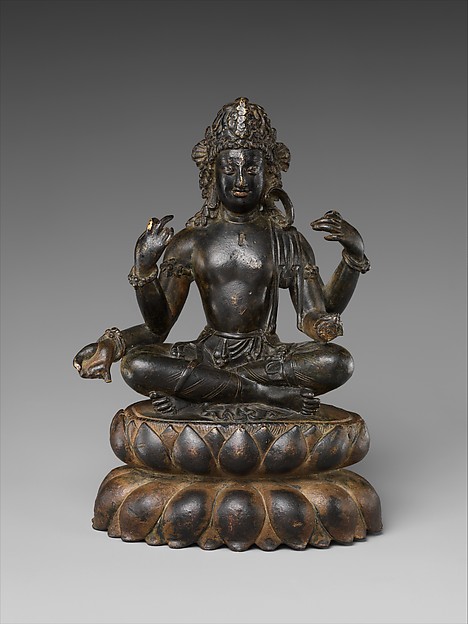
Pakistan (Swat Valley), 7th century. Brass with silver and copper inlay.
Look closer: Swat, in the north-west, is the old Gandhāran borderland where the cult took shape. Look at the extra arms, the raised hands and the layered lotus seat.
The Metropolitan Museum of Art, Purchase, The Vincent Astor Foundation, Anonymous, Mr. and Mrs. Gilbert H. Kinney, and Nancy Fessenden Gifts; John Stewart Kennedy and Rogers Funds, by exchange; Gifts of Cynthia Hazen Polsky, Mrs. Jacob M. Kaplan, and Samuel Eilenberg, by exchange, 2012 (2012.247). Public domain, Open Access.

Pakistan (Swat Valley), 7th century. Bronze inlaid with silver and copper.
Look closer: A companion piece from the same region. Look at the hand at the cheek, the relaxed seat and the lotus bud; the pose of thought lasted for centuries.
The Metropolitan Museum of Art, Harris Brisbane Dick and Fletcher Funds, 1974 (1974.273). Public domain, Open Access.
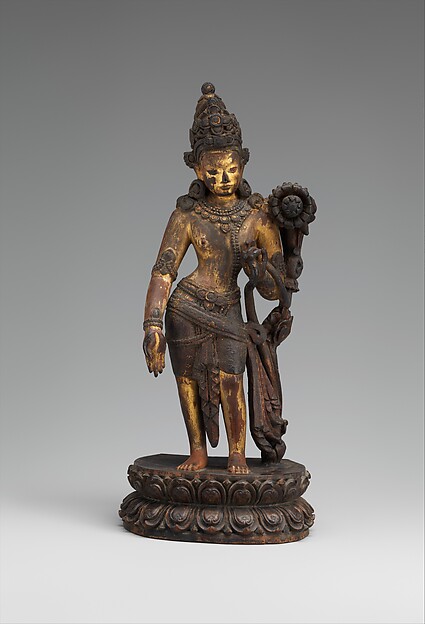
Nepal (Kathmandu Valley), 16th century. Sandalwood, traces of polychrome and gold.
Look closer: Nepal keeps the bodhisattva as Lokeśvara. Look at the lotus held at the shoulder, the narrow waist and the tall crown.
The Metropolitan Museum of Art, Rogers Fund, 1947 (47.108). Public domain, Open Access.
One bodhisattva, many hearths
Outside East Asia the figure keeps its male form and many of its older names. In Tibet he is Chenrézik, the name built from spyan (eye), ras (continuity) and gzig (to look): the one who always looks on all beings. The Dalai Lamas and the Karmapas are held by many Tibetan Buddhists to be his manifestations, and in one Tibetan account Tārā came into being from a single tear he shed, which made a lake from which a lotus opened. In Sri Lanka the bodhisattva is Nātha, the one Mahāyāna figure to have entered the worship of ordinary Theravāda Buddhists, and his image, with an Amitābha on the front of its crown, is usually found in the shrine room near the Buddha image. In Myanmar he is Lokanat, in Thailand Lokesvara, and in Nepal Seto Machindranath, the White Fish Lord, a name that joins him to the Hindu saint Matsyendranātha.
Wikipedia places him among the Four Great Bodhisattvas of Mahāyāna, with Mañjuśrī, Samantabhadra and Kṣitigarbha, and calls him a close assistant of Amitābha. It also records two further claims that sit uneasily beside the usual picture. According to the Nīlakaṇṭha Dhāraṇī Sūtra, the Buddha told Ānanda that Avalokiteśvara had become a Buddha countless eons ago, under the name Samyaka Dharma-Vidya Tathāgata, “Tathāgata who clearly understands the right Dharma”, and appears as a bodhisattva out of compassion. The Chinese tradition of Guanyin gives a matching title, the Tathāgata of Brightness of Correct Dharma. Some schools of Mahāyāna and Vajrayāna regard him as a manifestation of Amitābha, and as an emanation from Vairocana embodying the Wisdom of Miraculous Observation. In other words, a bodhisattva who postponed Buddhahood may already have attained it.
A small Buddha in the crown
The quickest test is the crown. The Art Net Users System says Kannon most commonly wears a crown bearing a small seated Amida, which it calls a kebutsu, a transformation Buddha, and that he usually holds a lotus or a water vase. Wikipedia’s summary of the Chinese iconography agrees on the crown, which it says contains an image of Amitābha as Guanyin’s teacher, and adds the willow branch in the right hand, used to sprinkle water, and the vase in the left. The Art Net Users System gives the earliest Japanese type as the Guze Kannon: the earliest bronzes, which typically show a crowned figure, often holding a jewel.
The Met’s standing Kannon of about 1050 is a useful example of the classical Heian form. It is carved from a single block of cypress in the ichiboku-zukuri method. The tall crown is simple, and the right hand lifts a lotus bud.
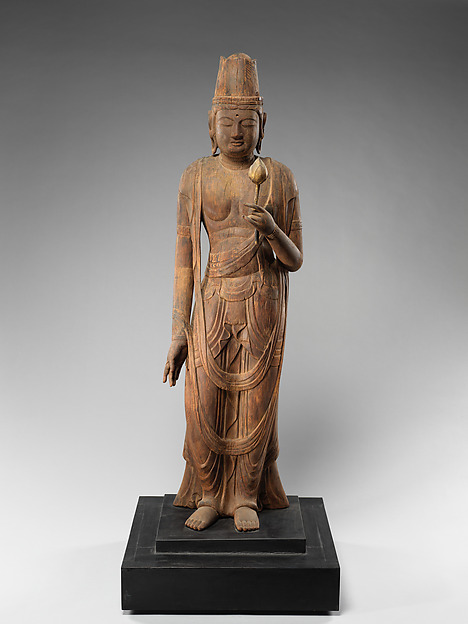
Japan, mid-11th century. Cypress wood, single-block construction (ichiboku-zukuri); height 150 cm.
Look closer: Look at the right hand, which lifts a lotus bud to the chest, and at the lowered left hand. Then follow the scarf and the long under-robe, which fall in shallow, even folds. The wood is left bare, so the grain of the single block shows.
The Metropolitan Museum of Art, Purchase, Bequest of Mary Stillman Harkness, by exchange; Henrie Jo Barth Bequest; and funds from various donors, 2021 (2021.116a, b). Public domain, Open Access.
| Feature | What it means | Where to look |
|---|---|---|
| Kebutsu | A small seated Amida: his teacher and lineage | In the crown |
| Lotus | Purity; a bud or an open bloom | In a hand or under the feet |
| Water vase | Pure water that relieves suffering | Usually the left hand |
| Willow branch | Sprinkling water; bends without breaking | Usually the right hand |
| Jewel | Often held by the Guze Kannon, the earliest bronzes | Held at the chest |
| Scarves and jewellery | The dress of a bodhisattva | Shoulders, neck and wrists |
Chapter twenty-five and its thirty-three guises
The earliest literature that teaches the doctrines of Avalokiteśvara, Wikipedia says, is generally accepted to be chapter 25 of the Lotus Sutra, the Universal Gate (普門品, Pǔmén pǐn in Chinese). It opens with a question. The bodhisattva Akṣayamati asks the Buddha to explain the character of Avalokiteśvara, and the Buddha answers that if beings in distress hear of Avalokiteśvara and call his name with a whole heart, the bodhisattva will perceive their voices at once and free them from their suffering. Wikipedia’s summary of the chapter is plain: a compassionate bodhisattva who hears the cries of sentient beings and works tirelessly to help those who call on his name. It has a prose half and a verse half.
The text has a history of its own. Wikipedia’s account of the Lotus Sutra records that the “Supplemented Lotus Sutra” of 601, translated by Jñānagupta and Dharmagupta, carried the concluding part of chapter 25 that was missing from Kumārajīva’s earlier translation, and that those verses were later added back to Kumārajīva’s text. The chapter also travels alone. It circulates as the Avalokiteśvara Sūtra (觀世音經, Guānshìyīn jīng), is recited at temples across East Asia, and is the Kannon Sutra of Japanese devotion. The same article says that chapter 25 has been very influential on Asian devotion to Guanyin.
The chapter’s great teaching is not the rescue but the shape-shifting that lies behind it. To teach each being in the form that being can hear, Avalokiteśvara may appear as a Buddha or as any god, as a king or a householder, as a monk or a nun, as a boy or a girl, as a dragon or a spirit, and, last on the list, as Vajrapāṇi. Wikipedia counts thirty-three such manifestations, of which seven are female, and says the list was known to be very popular in Chinese Buddhism as early as the Sui and Tang dynasties.
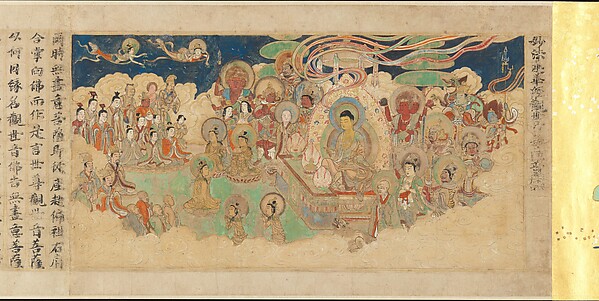
Japan, dated 1257. Handscroll; ink, color, and gold on paper.
Look closer: Chapter 25 of the Lotus Sutra, copied in 1257. Find the enthroned Buddha at the centre, then the bodhisattvas around him and the columns of text that make up the chapter.
The Metropolitan Museum of Art, Purchase, Louisa Eldridge McBurney Gift, 1953 (53.7.3). Public domain, Open Access.
The thirty-three, set out
The list below follows the order in Wikipedia’s account of the chapter. The Śūraṅgama Sūtra gives a close parallel of thirty-two forms, omitting Vajrapāṇi and replacing Vaiśravaṇa with the Four Heavenly Kings. In both China and Japan the manifestations became, in Wikipedia’s phrase, a traditional list of iconographic forms, one image for each. That list is the reason for the number thirty-three in the pilgrimage circuits described further down.
| Group | The manifestations in the chapter | Number |
|---|---|---|
| Awakened beings | A Buddha, a pratyekabuddha, an arhat | 3 |
| Gods and great protectors | King Brahmā, Śakra (Indra), Īśvara, Maheśvara (Shiva), a great heavenly general, Vaiśravaṇa, a deva | 7 |
| Rulers and officials | A cakravartin, a minor king, a chief minister | 3 |
| Householders and elders | An elder, a householder, a Brahmin, a wife | 4 |
| Monastics and lay devotees | A monk, a nun, a layman, a laywoman | 4 |
| Children | A young boy, a young girl | 2 |
| Other classes of beings | A nāga, a yakṣa, a gandharva, an asura, a garuḍa, a kinnara, a mahoraga | 7 |
| Human and not human | A human being, a non-human being | 2 |
| The last guise | Vajrapāṇi | 1 |
Kanjizai speaks to Śāriputra
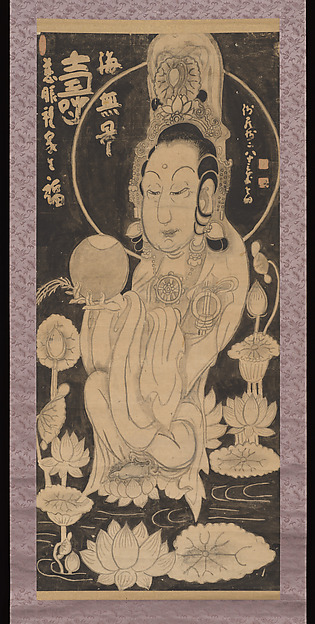
Japan, 1767. Hanging scroll; ink on paper.
Look closer: Hakuin, the Zen master who wrote on the Heart Sutra, painted Kannon as a face rising out of a lotus pond. Look at how few lines build the head.
The Metropolitan Museum of Art, Purchase, Miriam and Ira D. Wallach Foundation and Jane and Raphael Bernstein Gifts, 2025 (2025.92). Public domain, Open Access.
In the Heart Sutra the bodhisattva does the speaking, and the Buddha appears only in the long version. Wikipedia describes it as the single most commonly recited, copied and studied scripture in East Asian Buddhism, and notes that the Heart Sutra is ascribed entirely to Guanyin, which is unusual, since most Mahāyāna sutras are attributed to Śākyamuni and describe the bodhisattvas from outside. Here Avalokiteśvara, called Kanjizai in Japanese, “the Lord of Contemplation”, tells the arhat Śāriputra what he saw while practising the perfection of wisdom: that the five aggregates of human existence are empty, and that form is emptiness and emptiness is form. He then runs through the basic teachings, among them the Four Noble Truths, and says that none of them is found in emptiness. The text ends with a mantra, gate gate pāragate pārasaṃgate bodhi svāhā, which Japanese readers know as gyatei gyatei haragyatei harasōgyatei boji sowaka. Wikipedia says it is recited by adherents of Mahāyāna schools of every affiliation, with the exception of Shin Buddhists and Nichiren Buddhists.
The Chinese engraving at Mount Putuo, the bodhisattva’s mountain in China, is dated 1723. It carries the Heart Sutra in black characters beneath five very large red ones: guān zì zài pú sà.
The earliest witnesses
The oldest dated copy of the Heart Sutra is a stone stele of 661, three years before the death of Xuanzang, carved by patrons from Yueyang County near Chang’an. It belongs to the Fangshan Stone Sūtra at Yunju Temple outside Beijing, and a second stele at Yunju follows in 669. A third, dated 672, stands in the Beilin Museum at Xi’an and was formerly thought to be the oldest. All three carry the same note: Xuanzang was ordered by Emperor Taizong of Tang to translate the sutra. A palm-leaf manuscript at Hōryū-ji, now in the Tokyo National Museum and dated by the museum to the seventh or eighth century, is the earliest undated extant Sanskrit manuscript of the text, and it was the Hōryū-ji manuscript that Max Müller used when he published a Sanskrit text and English translation in 1881. The first English translation, by Samuel Beal, was presented to the Royal Asiatic Society in 1863 and published in 1865 (Wikipedia, “Heart Sutra”).
| Witness | Date | Where | Note |
|---|---|---|---|
| Fangshan Stone Sūtra stele | 661 | Yunju Temple, near Beijing | Earliest dated text; the inscription credits Xuanzang |
| Second Yunju stele | 669 | Yunju Temple | Same descriptive inscription |
| Beilin Museum stele | 672 | Xi’an | Formerly believed to be the oldest; calligraphy in the style of Wang Xizhi |
| Palm-leaf manuscript | 7th to 8th century | Hōryū-ji; now Tokyo National Museum | Earliest undated Sanskrit manuscript |
| Putuo engraving | 1723 | Mount Putuo, China | Opens with five large red characters for the bodhisattva’s name |
Who wrote it?
The origin is disputed. Edward Conze estimated that about ninety per cent of the sutra can be derived from the larger Perfection of Wisdom sutras. Jan Nattier argued in 1992 that the evidence points to a Chinese composition: the text was first put together in Chinese, partly from Kumārajīva’s translation of a treatise on the Perfection of Wisdom, with only about forty per cent a quotation and the rest newly composed, and then back-translated into Sanskrit. She also pointed out that it is unusual to find Avalokiteśvara at the centre of such a text, since the early Perfection of Wisdom sutras feature Subhūti and not him. Harada and Siu answered that Avalokiteśvara was already blended with the Perfection of Wisdom in Mahāyāna belief by the time of Faxian and Xuanzang, and that the Eight Thousand Line sutra already has speakers other than the Buddha. Red Pine allows an Indian original. Jayarava Attwood, in 2021, still found Nattier’s case the most convincing. The question remains open, and this chapter leaves it so (Wikipedia, “Heart Sutra”).
The commentaries are a history of Buddhist schools in miniature. Two of the earliest, by Xuanzang’s pupils Kuiji (632 to 682) and Woncheuk (613 to 692, born in Silla), read it through Yogācāra and Madhyamaka. In Japan, Kōbō Daishi (774 to 835) wrote a Shingon commentary that treats the text as a tantra, and Hakuin Ekaku (1686 to 1768) wrote a Zen commentary called Zen Words for the Heart. Hakuin also painted Kannon, and the Met’s hanging scroll of 1767, a year before the end of his life, is shown here.
Eleven heads, a thousand arms and a horse
Kannon is the bodhisattva with the most faces. The Art Net Users System sorts the Japanese forms into three families. The simplest is Shō Kannon, the sacred or basic Kannon. The henge or transformation forms, with many arms and heads, entered Japan before esoteric Buddhism was formally introduced, in the early eighth century, and include Jūichimen (eleven-headed), Senju (thousand-armed), Nyoirin (jewel-wheel), Batō (horse-headed), Juntei and Fukūkenjaku. The robed, solitary forms, White-robed and Willow Kannon, came with Zen in the late twelfth century. The Art Net Users System also names the six Kannon, each a means of salvation across one of the six realms, and the thirty-three forms derived from the prose of the Lotus Sutra.
The oldest dated text on one of the forms is the Jūichimenkyō of 733, and in 753 the Fukūkenjaku shinpen shingonkyō enters Japanese records. Emperor Shōmu, the same patron as the Tōdai-ji Great Buddha, sponsored Kannon images. Wikipedia adds the forms that answered particular needs: Jibo Kannon, the “compassionate-mother” Kannon, a woman holding an infant; Koyasu Kannon for safe childbirth; and Mizuko Kuyō Kannon, the memorial-service Kannon for newborns.
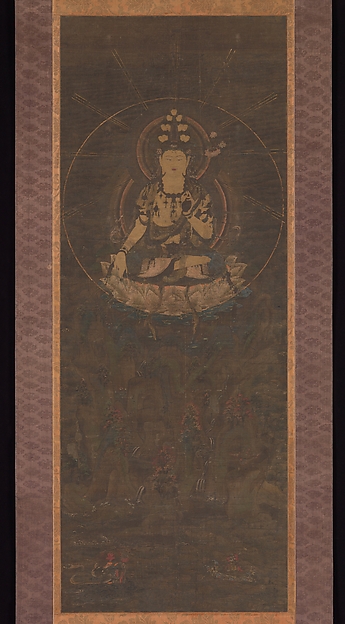
Japan, 13th century. Hanging scroll; ink, color, and gold on silk.
Look closer: The eleven-headed form on Mount Fudaraku, the mountain in the sea. Look for the small heads in the crown and the water below.
The Metropolitan Museum of Art, The Harry G. C. Packard Collection of Asian Art, Gift of Harry G. C. Packard, and Purchase, Fletcher, Rogers, Harris Brisbane Dick, and Louis V. Bell Funds, Joseph Pulitzer Bequest, and The Annenberg Fund Inc. Gift, 1975 (1975.268.20). Public domain, Open Access.
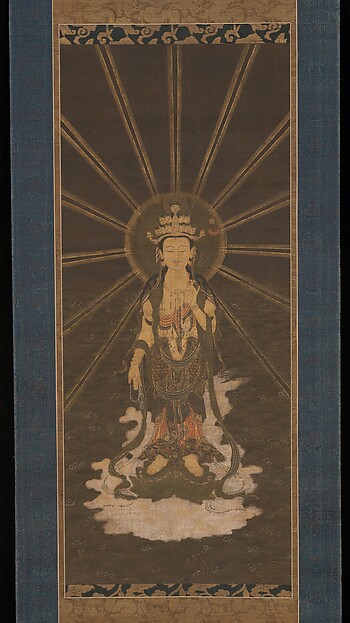
Japan, mid–late 16th century. Hanging scroll; ink, color, and gold on silk.
Look closer: A later scroll of the same form. Count the small faces in the tiers of the crown.
The Metropolitan Museum of Art, H. O. Havemeyer Collection, Gift of Mrs. J. Watson Webb, 1930 (30.72.3). Public domain, Open Access.
| Form | Read as | Chapter |
|---|---|---|
| Shō Kannon | The basic, sacred form | This page |
| Jūichimen Kannon | Eleven heads | Jūichimen Kannon |
| Senju Kannon | A thousand arms | Senju Kannon |
| Nyoirin Kannon | The jewel and the wheel | Nyoirin Kannon |
| Batō Kannon | A horse’s head in the crown | Batō Kannon |
| Juntei Kannon | The mother of the Buddhas | Juntei Kannon |
| Byakue and Yōryū Kannon | White-robed and Willow forms, late 12th century | This page |
| Maria Kannon | Used in secret Christian worship in the Edo period | This page |
A Kannon for every road of rebirth
The Japanese forms most often found in temples were sorted, long ago, by the place in the wheel of rebirth that each is said to reach. Wikipedia traces the grouping to the Mohe Zhiguan of the Tiantai patriarch Zhiyi (538 to 597), and notes that it is attested in other texts, including the Essential Record of the Efficacy of the Three Jewels. In the Chinese Tiantai and Tangmi traditions and in Japanese Tendai and Shingon, the bodhisattva takes six forms, one for each realm. The Art Net Users System speaks of the same six Kannon, each a means of salvation across one of the six realms. The correspondence is set out below, with the Japanese names that follow the table.
The six are not equal in fame. Wikipedia says that in China the Thousand-Armed manifestation is the most popular among her esoteric forms, and the Japanese temples described in Kannon in Japan show how many of the other forms entered Japan early, before esoteric Buddhism was formally introduced.
A discrepancy worth noting
The Wikipedia article on Avalokiteśvara says that the Infallible Lasso form, Amoghapāśa, known in Japan as Fukūkenjaku Kannon, is categorised as one of the six forms in the Tendai school. That does not match the list above, which gives the human realm to Cundī, or Juntei. Wikipedia carries both statements, and the pages read for this chapter do not reconcile them, so both are recorded here. Fukūkenjaku Kannon is nonetheless no minor figure. A late eighth-century image, flanked by the gods Brahmā and Indra, stands in the Hokke-dō of Tōdai-ji at Nara, and the Art Net Users System lists it among the earliest Kannon in Japan.
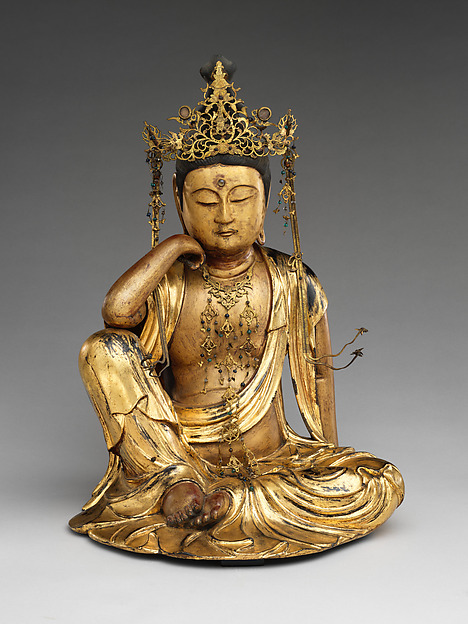
Japan, dated 1693. Wood with gold, gold leaf, lacquer,and crystal inlay.
Look closer: Nyoirin, the wish-fulfilling form. Look at the hand at the cheek and the raised knee, which give the figure its look of thought.
The Metropolitan Museum of Art, Rogers Fund, 1956 (56.39). Public domain, Open Access.
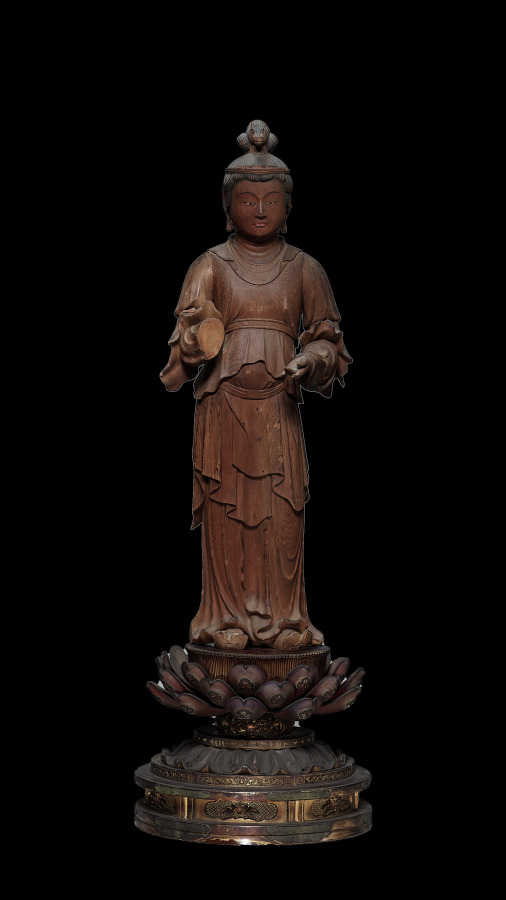
Japan, Kamakura period, early 1300s. Wood with traces of colour and gold.
Look closer: The Cleveland Museum catalogues this as a Batō, Horse-headed, Kannon. Look at the high topknot and the hands held out at the waist, and compare with the attributes in the reading section.
Cleveland Museum of Art, John L. Severance Fund (1981.1). CC0, Open Access.
How he came to have eleven heads and a thousand arms
The best known story of the two forms appears in both Wikipedia articles. Avalokiteśvara vowed never to rest until he had freed all beings from rebirth. He worked until, with hell almost emptied, he saw that countless unhappy beings still remained. In the version told in the Complete Tale of Guanyin and the Southern Seas, he had reformed almost all of hell’s denizens before the Ten Kings sent him out. Struggling to understand so many needs at once, his head split into eleven pieces. Amitābha, seeing his plight, gave him eleven heads with which to hear the cries of the suffering. He then reached out to all who needed help and found that his two arms shattered. Once more Amitābha came to his aid and gave him a thousand arms. Many Himalayan versions give him eight arms instead, each with its own implement, and the Chinese accounts vary the number.
The Kāraṇḍavyūha Sūtra goes further, describing the Thousand-Armed and Thousand-Eyed form as superior to all the gods and buddhas of the Indian pantheon, and saying that it is easier to count all the leaves of every tree in every forest, and all the grains of sand in the universe, than to count the blessings and power of Avalokiteśvara (Wikipedia, “Guanyin”). In Chinese temples the two forms are often combined, so that a statue has a thousand arms as well as eleven heads. A colossal bronze of the Song dynasty at Longxing Temple in Hebei and a wooden statue of the Ming dynasty at Longshan Temple in Fujian, 4.2 metres tall with 1,008 arms and more than twenty-five heads, are the examples Wikipedia gives, and it adds that in Japan statues of this kind can be found at Sanjūsangen-dō in Kyoto.

China, Tang dynasty, early 700s. Sandstone.
Look closer: A Tang-dynasty bust from the early 700s. Look at the tiers of small heads over the main face.
Cleveland Museum of Art, Gift of Severance and Greta Millikin (1959.129). CC0, Open Access.
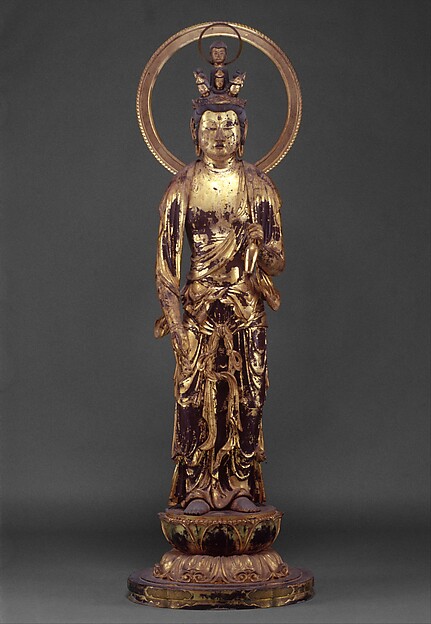
Japan, mid- to late 14th century. Wood with lacquer, gold leaf, and metal decoration.
Look closer: The Japanese counterpart, in gilded wood. Look for the small heads at the top of the crown and compare them with the Chinese sandstone beside it.
The Metropolitan Museum of Art, The Harry G. C. Packard Collection of Asian Art, Gift of Harry G. C. Packard, and Purchase, Fletcher, Rogers, Harris Brisbane Dick, and Louis V. Bell Funds, Joseph Pulitzer Bequest, and The Annenberg Fund Inc. Gift, 1975 (1975.268.167). Public domain, Open Access.
The blue-necked form
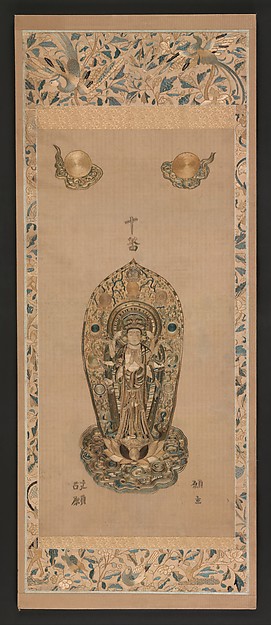
Japan, probably late 15th–early 16th century. Hanging scroll remounted on a panel; embroidered silk appliquéed to cotton backing.
Look closer: Every thread-line in the halo is an arm. Look at the way the small hands fan out behind the principal ones.
The Metropolitan Museum of Art, Purchase, Sue Cassidy Clark Gift, in memory of Terry Satsuki Milhaupt, 2013 (2013.114). Public domain, Open Access.
One further form deserves a mention. Nīlakaṇṭha, the Blue-Necked Avalokiteśvara, is a form whose throat is blue because the bodhisattva swallowed poison sprayed by a demon, in order to protect living beings (Wikipedia, “Avalokiteśvara”).The Nīlakaṇṭha Dhāraṇī, the eighty-two syllable Great Compassion Mantra, is one of the best known chants in East Asian Buddhism, and Wikipedia ties the Great Compassion Dhāraṇī to the Thousand-Armed, Thousand-Eyed form. It adds a cautious note: the dhāraṇī also names Hindu deities, Nīlakaṇṭha and Harihara among them, who may be forms of Avalokiteśvara or associated bodhisattvas, though the text is not clear.
| Japanese name | Title in the Tiantai list | Realm | Chapter |
|---|---|---|---|
| Shō Kannon | Great Mercy; Noble Guanyin (大慈觀音, 聖觀音) | Hungry ghosts (preta) | This page |
| Senju Kannon | Great Compassion; Thousand-Armed (大悲觀音, 千手觀音) | Hell | Senju Kannon |
| Jūichimen Kannon | Universally Shining Great Light; Eleven-Headed (大光普照觀音, 十一面觀音) | Asuras | Jūichimen Kannon |
| Juntei Kannon | The Divine Hero; Cundī (天人丈夫觀音, 準提觀音) | Humans | Juntei Kannon |
| Nyoirin Kannon | Mahābrahmā the Profound; Cintāmaṇicakra (大梵深遠觀音, 如意輪觀音) | Devas | Nyoirin Kannon |
| Batō Kannon | Fearless Lion; Hayagrīva (獅子無畏觀音, 馬頭觀音) | Animals | Batō Kannon |
Standing beside Amida
The Art Net Users System says that the Contemplation Sutra, the Kanmuryōjukyō, makes Kannon an attendant of Amida, and that he is the more prominent of Amida’s two attendant bodhisattvas. He appears in paintings of Amida descending to welcome the dying, the raigō, and in Kannon raigō. Wikipedia adds that, with Amitābha and Mahāsthāmaprāpta, Guanyin temporarily leads beings to the Pure Land, and is usually shown to the left of the Buddha, with Mahāsthāmaprāpta on his right. The Japanese name of the second attendant is Seishi.
Gandhāra to Hanoi, by century
The record below follows Avalokiteśvara across the continent before turning to Japan, using the sources I read. Where those sources date an object differently, that is stated.
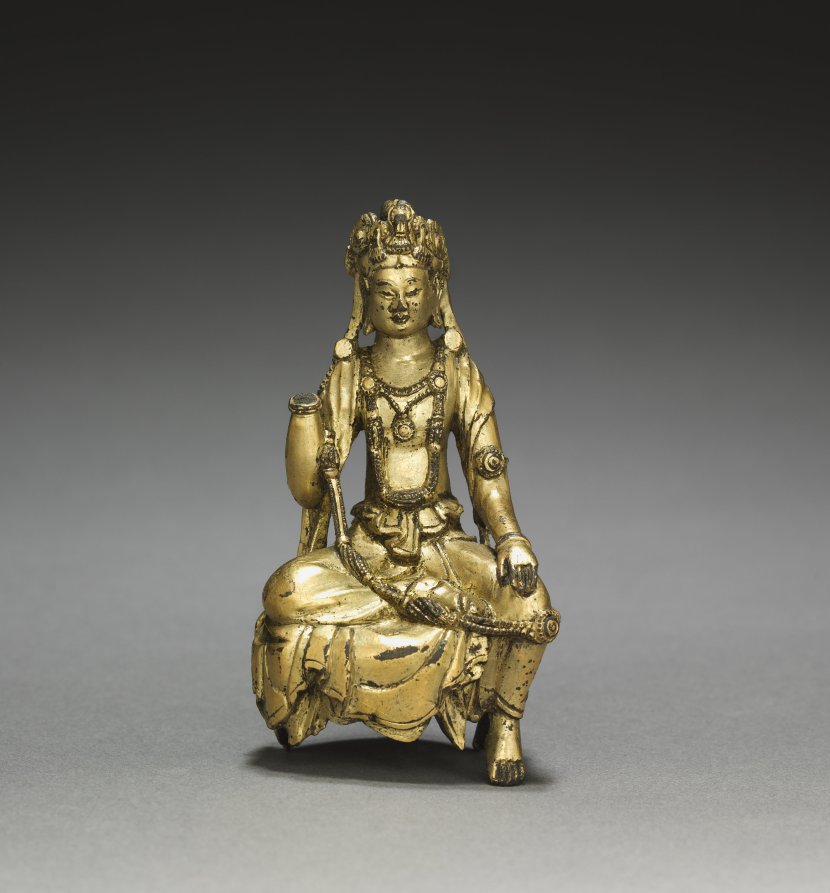
China, Sui dynasty, 581 to 618. Gilt bronze, 8.3 cm.
Look closer: Barely eight centimetres tall, this Sui-dynasty figure is a pocket shrine. Look at the crown, the jewellery and the easy seat.
Cleveland Museum of Art, Gift of Mrs. John Lyon Collyer in memory of her mother, Mrs. G. M. G. Forman (1962.217). CC0, Open Access.
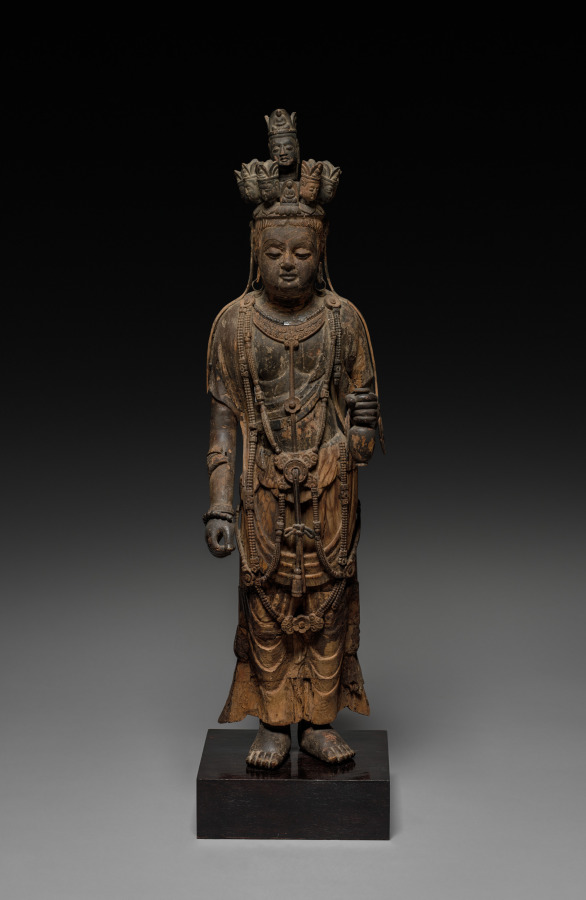
China, Tang dynasty, late 600s. Wood.
Look closer: A Tang-dynasty carving. Look at the small faces in the crown.
Cleveland Museum of Art, John L. Severance Fund (1970.66). CC0, Open Access.
- Third centuryA Gandhāran statue of Avalokiteśvara in the fearlessness gesture is among the earliest images Wikipedia shows. The bodhisattva’s earliest literature, chapter 25 of the Lotus Sutra, is generally accepted to precede any other (Wikipedia, “Guanyin”).
- Fourth to fifth centuryThe Kāraṇḍavyūha Sūtra is composed, late fourth to early fifth century, and brings the six-syllable mantra and the Cundī dhāraṇī. Sanskrit fragments from the fifth century keep the older name Avalokitasvara. About 400 CE Faxian sees offerings at Mathura.
- Sixth to seventh centurySui China (581 to 618) makes bronze figures small enough to hold in one hand; the Cleveland Museum’s Sui Guanyin is 8.3 centimetres tall. Xuanzang describes devotion to statues at every level of Indian society. The Swat Valley bronzes of the Met belong to this century. The earliest dated Heart Sutra is cut in stone in 661. A late seventh-century eleven-headed Guanyin in wood, in Cleveland, is a Tang piece.
- Seventh to ninth century, Southeast AsiaWikipedia’s gallery places a seventh-century sandstone Avalokiteśvara in Cambodia, an eighth-century bronze torso at Chaiya in southern Thailand, a Padmapāṇi at Plaosan in Java of the eighth to ninth century, and an andesite figure at Mendut of the early ninth.
- Eighth centuryThe Cundī Dhāraṇī Sūtra is translated into Chinese three times between about 685 and the eighth century. A Tang sandstone eleven-headed Guanyin in Cleveland is dated to the early 700s. Amoghavajra translates an Avalokiteśvara dhāraṇī (Taishō 1033).
- Tang to SongBefore the Song dynasty, which began in 960, Chinese images of the bodhisattva are masculine. Around the twelfth century the figure becomes increasingly female, and the white-robed woman descended from Pāṇḍaravāsinī becomes the commonest image. A Song bronze Thousand-Armed Guanyin at Longxing Temple in Hebei and the Liao clay eleven-headed Guanyin at Dule Temple, Tianjin, show the scale of the esoteric forms.
- SongSiming Zhili creates the Great Compassion Repentance, still performed today. The Great Compassion Dhāraṇī is among the most popular chants in East Asian Buddhism.
- Ming and QingThe parrot story is first recorded in the Ming dynasty. The thousand-armed Longshan statue in Fujian dates from the Ming, and Chen Hongshou paints Cundī as Buddha-Mother in 1620. Ding Guanpeng paints two forms in 1750. In 1723 the Heart Sutra is engraved at Putuo.
- Seventeenth century onward, Vietnam and KoreaA Joseon image of Gwaneum is carved at Beopjusa in 1655. In 1656 the Thousand-Armed, Thousand-Eyed wooden Quan Âm at Bút Tháp, in Bắc Ninh province, northern Vietnam, is restored.
- Twentieth centuryThe Migjid Janraisig of Gandantegchinlen in Ulaanbaatar, 26.5 metres tall, is rebuilt in 1996 after an earlier statue of 1913. The Taiwan-based Tzu Chi organisation commissions a portrait of Guanyin holding a baby for its hospitals.
Asuka bronze to Tsushima’s return
The Japanese record is the best preserved of any, because so many of the images are still in the halls they were carved for. The dates here come from the Art Net Users System, Wikipedia’s pages on the temples, the Japan Travel account of Hōryū-ji, the Met and the Cleveland Museum, and the news items read for the recent entries.
- Asuka period, 538 to 710Kannon arrives with the Buddhist court. The Cleveland Museum’s gilt-bronze Kannon of the mid-seventh to early eighth century, about thirty centimetres tall, is among the oldest in an American museum. Late in the century a Shō Kannon is carved for the Tōin-dō of Yakushi-ji (Art Net Users System).
- Eighth centuryA Fukūkenjaku Kannon is carved for the Hokke-dō of Tōdai-ji in the late century. The Jūichimenkyō of 733 is the oldest dated text on an eleven-headed form, and in 753 the Fukūkenjaku shinpen shingonkyō enters Japanese records. The Guze Kannon is enshrined in the Yumedono at Hōryū-ji in 739. In 721 and 736 the Hase-dera legend places the two camphor images. In 778 Kenshin finds the hermit at Otowa, and the next year or two later Tamuramaro converts to Kannon.
- Ninth centuryA Jūichimen Kannon is made for Hokke-ji in the mid-century in the danzō tradition (Art Net Users System). Emperor Saga recognises Kiyomizu-dera in 810, giving it the name Kita Kannon-ji. Ennin is said to have visited Sensō-ji and carved a front image; the dates in Wikipedia are 828 and 857.
- Tenth centuryIn 941 and 942 Taira no Kinmasa builds the Kaminarimon and the Hōzōmon at Asakusa. By the end of the century Hase-dera and Kiyomizu-dera are widely visited, and the mountain temples are held to be sites of Fudaraku, the Kannon paradise.
- Eleventh centuryThe Saigoku pilgrimage begins to take shape in the eleventh and twelfth centuries. The Pillow Book mentions the festival at Kiyomizu Kannon, and the Tale of Genji and the Konjaku Monogatarishū mention the temple, which shows how well known it was by the mid-Heian period. Kiyomizu-dera has its first recorded fire in 1063. A mid-eleventh-century single-block cypress Kannon is now at the Met.
- Twelfth centuryIn 1164 Taira no Kiyomori founds Sanjūsangen-dō for the retired emperor Go-Shirakawa, and in 1165 Kiyomizu-dera burns. The solitary White-Robed and Willow Kannon arrive with Zen late in the century (Art Net Users System).
- Thirteenth centuryA fire in 1249 destroys most of the buildings at Sanjūsangen-dō; only 124 of the thousand Kannon are saved. The hall is rebuilt between 1251 and 1266, and 876 new statues are made by the Kei, En and In schools over sixteen years. In 1257 the Lotus Sutra chapter 25 handscroll now at the Met is written. After the Kamakura shogunate is established a second circuit of thirty-three temples appears in the Kantō.
- Fourteenth to sixteenth centuryKiyomizu-dera is burned in 1469, in the Ōnin War, and rebuilt with the help of the fundraiser Gan’ami; the pictorial scroll of its founding is made in 1520. Toyotomi Hideyoshi grants the temple an estate. In 1590 Tokugawa Ieyasu designates Sensō-ji as an official place of prayer for the shogunate.
- Edo periodKiyomizu-dera’s hall burns in 1629 and is rebuilt in 1633 with a gift from Tokugawa Iemitsu. Sensō-ji’s pagoda and hall are rebuilt in 1648 and 1649. In 1606 the Tōshiya archery tournament begins at Sanjūsangen-dō. The Nakamise shops are established in 1685. Christians under the ban pray before Jibo Kannon, the Maria Kannon. At Kiyomizu 234 recorded jumps are made from the stage.
- Meiji and TaishōThe jumping is prohibited in 1872. On 16 August 1884 Ernest Fenollosa has the Guze Kannon unsealed at Hōryū-ji. In 1923 the Great Kantō earthquake destroys much of Asakusa, but the temple is saved by a bucket brigade.
- 1945 to 1989On 10 March 1945 the firebombing of Tokyo destroys Sensō-ji’s main hall and pagoda. The hall is rebuilt in 1951 to 1958, the Kaminarimon in 1960 with a gift from Matsushita Konosuke, the Hōzōmon in 1964 and the pagoda in 1973. In 1973 the conservation of the thousand-and-one Kannon of Sanjūsangen-dō begins. In 1978 the statues of Tenryū and Kinryū are added to the back of the Kaminarimon.
- 1990 to 2017Kiyomizu-dera is inscribed as part of the Historic Monuments of Ancient Kyoto in 1994 and starts its annual Kanji of the Year ceremony in 1995. The Great Renovation of Kiyomizu begins in 2008. The Kaminarimon’s fifth lantern is made in 2013, and on 22 December 2017 the last of the restored statues at Sanjūsangen-dō are re-enshrined.
- 2017 to 2025The roof of Kiyomizu-dera’s main hall is re-thatched between 2017 and 2019, and the scaffolding comes down in February 2020. The stage floor is rebuilt from May 2020. In 2025 the seated Kanzeon Bosatsu of Kannonji on Tsushima returns from South Korea after nearly thirteen years.
A statue unwrapped in 1884
The Guze Kannon of the Yumedono at Hōryū-ji is the most famous of the early images. The Japan Travel account says it was enshrined in the octagonal Yumedono in 739, in the Eastern Precinct, and then kept sealed. On 16 August 1884 the American scholar Ernest Fenollosa, visiting at the government’s request, persuaded the priests to let him remove the seal; he wrote that a rusted chain came off and the closed altar finally opened. The statue was wrapped in white cotton cloth that had gathered a thick layer of dust, and Fenollosa described removing a 500-yard piece of cloth from it. The statue is 178.8 centimetres high, in camphor wood coated with lacquer and gilded, and is shown to the public twice a year, in spring and autumn. The same page records a theory that it was modelled after Prince Shōtoku.
The Art Net Users System lists other early pieces: the first painting of Kannon, on a wall of the Hōryū-ji Kondō; a Shō Kannon at the Tōin-dō of Yakushi-ji and a Fukūkenjaku Kannon in the Hokke-dō of Tōdai-ji, both of the late seventh to eighth century; and, from the mid-ninth century, a Jūichimen Kannon at Hokke-ji, a wood sculpture in the danzō tradition. By the late tenth century, the same entry says, major Kansai temples such as Hase-dera and Kiyomizu-dera were widely visited. The mountain temples were believed to be sites of Fudaraku, Kannon’s paradise, and many were built near natural features.

Japan, 1856. Woodblock print; ink and color on paper.
Look closer: Hiroshige’s view of Asakusa in the snow. The lantern dominates the picture; the five-storey pagoda stands at the right.
The Metropolitan Museum of Art, The Howard Mansfield Collection, Purchase, Rogers Fund, 1936 (JP2519). Public domain, Open Access.
| Image | Place | Note |
|---|---|---|
| Guze Kannon | Yumedono, Hōryū-ji | Enshrined 739; unsealed 16 August 1884; 178.8 cm |
| Shō Kannon | Tōin-dō, Yakushi-ji | Late 7th or 8th century (Art Net Users System) |
| Fukūkenjaku Kannon | Hokke-dō, Tōdai-ji | Late 7th to 8th century (Art Net Users System) |
| Jūichimen Kannon | Hokke-ji | Mid-9th century; wood, danzō tradition |
Six syllables, eighty-two, and a ten-line sutra
A bodhisattva named for hearing is approached by sound, and the chants are as much a part of him as the statues. East Asian and Tibetan Buddhism use different ones, and the two overlap at a few points.
The best known is the six-syllable Mani mantra, oṃ maṇi padme hūṃ. Wikipedia calls it the most popular mantra in Tibetan Buddhism, and it is also familiar in Chinese Buddhism. It is first connected to Avalokiteśvara in the Kāraṇḍavyūha Sūtra, dated to the late fourth or early fifth century, in which the Buddha tells a bodhisattva that reciting it while focusing on the sound can lead to the attainment of eight hundred samādhis. A form of the bodhisattva takes the name Ṣaḍākṣarī, “Lord of the Six Syllables”, from it. The most common variant adds hrīḥ, the seed syllable of the Lotus family and of Amitābha. In Tibet, saying it on prayer beads is the most popular religious practice, and spinning prayer wheels clockwise, wheels holding many repetitions, is said to benefit everyone within reach of the practitioner.
In Japan the Shingon school uses a shorter one. On arori kya sowaka (oṃ ārolik svāhā) is a heart-mantra of three and a half syllables that appears in many forms in Indian texts before the tenth century. Wikipedia reports that it is the main mantra for Avalokiteśvara in Shingon and the main mantra of the Lotus family, and that in Chinese monasteries it is recited every day as the mantra for eradicating karmic obstructions during the Mengshan food-bestowal ritual. One text, number 1031 in the Taishō canon, prescribes a visualisation on the meaning of its four letters after seven recitations.
The chants at a glance
| Chant | In the sources | Where it is used |
|---|---|---|
| Oṃ maṇi padme hūṃ | Six syllables; first tied to Avalokiteśvara in the Kāraṇḍavyūha Sūtra; eight hundred samādhis | Tibetan Buddhism above all; also East Asian Mahāyāna |
| Oṃ ārolik svāhā (On arori kya sowaka) | Three and a half syllables; widely attested before the tenth century; also found engraved on sculptures in north India | Shingon; daily in Chinese monasteries |
| Cundī Dhāraṇī: oṃ cale cule cunde svāhā | First appears at the end of the Kāraṇḍavyūha, where 77 koṭīs of Buddhas answer in one voice; the sutra of the dhāraṇī was translated into Chinese in 685, 723 and the eighth century by Divākara, Vajrabodhi and Amoghavajra | One of the Ten Small Mantras recited in the morning liturgy in most Chinese temples |
| Cintāmaṇicakra Dhāraṇī | The wish-fulfilling wheel dhāraṇī | Also among the Ten Small Mantras |
| Nīlakaṇṭha Dhāraṇī (Great Compassion Mantra) | Eighty-two syllables; the Great Compassion Repentance (Dabei Chan) was created from it in the Song dynasty by the Tiantai monk Siming Zhili | Still performed in mainland China, Hong Kong, Taiwan and overseas Chinese communities |
| Eleven-Faced Heart Dhāraṇī | Linked to the eleven-faced form, one of the six | East Asian Buddhism |
| Namu Kanzeon Butsu | Homage to Avalokiteśvara; Chinese Námó Guānshìyīn Púsà, Korean Namu Gwanseeum Bosal | Everyday invocation across East Asia |
| Divine White-Robed Avalokiteśvara Mantra | About the eleventh century; opens “Homage to Guanyin who delivers from suffering” | Chinese devotional practice |
The Kannon sutra in ten lines
A longer chant used in Japan, Wikipedia reports, is the Jikku Kannon-gyō, the Ten-Verse Kannon Sutra. Its lines in Japanese are short enough to carry in the head, and the table gives six of them with Wikipedia’s translation, lightly shortened. Despite the name, it is a poem of a few phrases, and the last two lines sound like Zen.
| Line (Japanese) | Reading | Meaning, per Wikipedia |
|---|---|---|
| 觀世音 | Kan ze on | Kanzeon |
| 南無佛 | Na mu butsu | Homage to the Buddha |
| 佛法僧縁 | Butsu hō sō en | A karmic affinity with Buddha, Dharma and Sangha |
| 常樂我淨 | Jō raku ga jō | Thus attaining permanence, ease, selfhood and purity |
| 念念從心起 | Nen nen jū shin ki | Thought after thought arises from mind |
| 念念不離心 | Nen nen fu ri shin | Thought after thought is not separate from mind |
A masculine name, a mother’s face
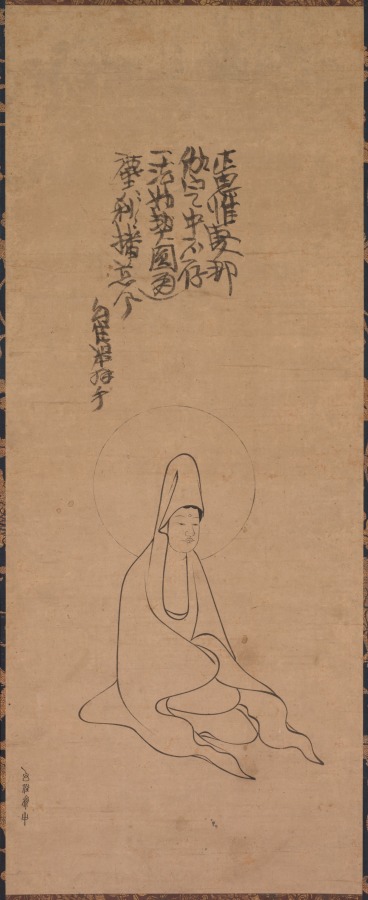
China, Yuan dynasty, late 1200s to early 1300s. Hanging scroll; ink on paper.
Look closer: By Jueji Yongzhong, c. 1300. The bodhisattva is drawn as a woman in a white veil. Look at the soft outlines.
Cleveland Museum of Art, Purchase from the J. H. Wade Fund (1978.47.1). CC0, Open Access.
The Art Net Users System says the name Kannon is masculine, that the bodhisattva was often thought female in China, that in India and Tibet he had female attendants, and that in Japan Kannon was not shown as a woman. Wikipedia reports that before the Song dynasty, which began in 960, Chinese images were masculine, that around the twelfth century the figure was increasingly shown as female, and that in modern times the commonest image is a white-robed woman. It also notes that some depictions are androgynous. The same article lists the White-robed Guanyin, linked to prayers for children, and the Water-Moon Guanyin, who sits beside a pond with the moon reflected in the water, as a metaphor for emptiness.
The two accounts do not fully agree. The Art Net Users System says Japan did not show Kannon as a woman, while Wikipedia lists the mother-and-child Jibo Kannon among the forms in Japan. This page leaves the difference as the record has it.
Small facts worth the detour
- The Guze Kannon of Hōryū-ji was wrapped in cloth for centuries and unsealed in 1884. It is shown to the public only twice a year (Japan Travel).
- The earliest dated copy of the Heart Sutra, from 661, comes from a stele at Yunju Temple near Beijing, which is why scholars quarrel about whether it was composed in China (Wikipedia, “Heart Sutra”).
- In Edo-period Japan, when Christianity was banned on pain of death, hidden Christians prayed to figures of Kannon holding a child. Many of these Maria Kannon had a cross concealed somewhere on them (Wikipedia, “Guanyin”).
- A Catholic sculptor, Choi Jong-tae, modelled the Gwanse-eum statue at Gilsangsa in Seoul on the Virgin Mary, hoping to encourage religious reconciliation (Wikipedia, “Guanyin”).
- Thailand’s King Ananda Mahidol used an Avalokiteśvara as his privy seal. See the origin section for the detail.
One bodhisattva, a dozen names
Kannon is among the most widely honoured figures in Asia. The rows below record the names given in the sources I read.
| Where | Form and name | What the record shows |
|---|---|---|
| India | Avalokiteśvara; earlier Avalokitasvara | The earlier form is found in fifth-century Sanskrit fragments. |
| Japan | Kannon (観音); Kanzeon (観世音); Kanjizai (観自在) | Kwannon is an older spelling. |
| Vietnam | Quan Âm; Quan Thế Âm; Quán Tự Tại | The Vietnamese forms. |
| Tibet | Chenrézik (spyan ras gzigs) | The Tibetan form. |
| Cambodia | Preah Mae Kun Si Im, “Goddess Mother” | The Khmer name given by Wikipedia, “Guanyin”. |
| Myanmar | Kwan Yin Medaw, “Mother Kwan Yin” | The Burmese name given by Wikipedia, “Guanyin”. |
| Hmong communities | Kab Yeeb | The Hmong name given by Wikipedia, “Guanyin”. |
| Mongolia | Migjid Janraisig | A 26.5-metre figure rebuilt in 1996 at Gandantegchinlen Monastery, Ulaanbaatar (Wikipedia, “Avalokiteśvara”). |
| Nepal | Seto Machindranath | A local hearth of the same bodhisattva, described in the origin section. |
The bodhisattva everyone meets
Among the bodhisattvas Kannon is the one most often met in daily life, from a roadside shrine to the temple at the end of a pilgrimage. In the Thirteen Buddhas sequence of memorial rites he presides over the hundredth day after a death. The table below sets him between Yakushi on the forty-ninth day and Seishi at the first anniversary.
| Memorial occasion | Figure | Role |
|---|---|---|
| 49th day | Yakushi Nyorai | The Healing Buddha, seventh of the thirteen |
| 100th day | Kannon Bosatsu | Compassion, eighth of the thirteen |
| 1st anniversary | Seishi Bosatsu | Ninth of the thirteen |
| 2nd anniversary | Amida Nyorai | Tenth of the thirteen |
Where to see him
| Place | What to look for |
|---|---|
| Hōryū-ji, Ikaruga | The Guze Kannon of the Yumedono, wrapped for centuries and unveiled in 1884, shown twice a year. |
| Metropolitan Museum of Art, New York | The cypress Kannon of about 1050, a Lotus Sutra handscroll of 1257 and several White-robed scrolls, in the public domain. |
More Kannon in scroll, shrine and print
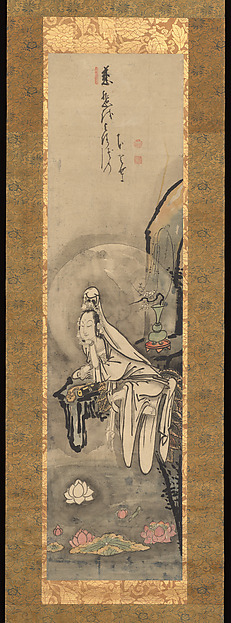
Japan, 1750s. Hanging scroll; ink and color on paper.
Look closer: Another of Hakuin’s Kannon, from the 1750s. Look at the brush lines that make the figure.
The Metropolitan Museum of Art, Purchase, Jane and Raphael Bernstein Gift, 2025 (2025.91). Public domain, Open Access.
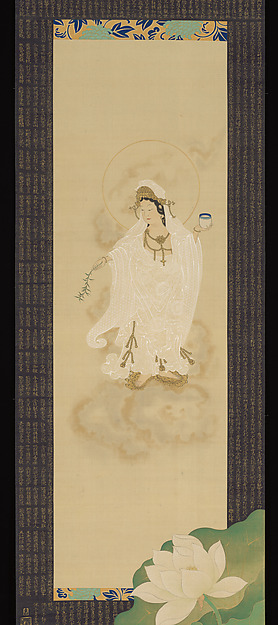
Japan, mid- to late 19th century. Hanging scroll; ink, color, gold, and silver on silk.
Look closer: The willow branch is the sign of this form. Look for it in the bodhisattva’s hand.
The Metropolitan Museum of Art, Purchase, Sue Cassidy Clark Gift, 2023 (2023.753). Public domain, Open Access.
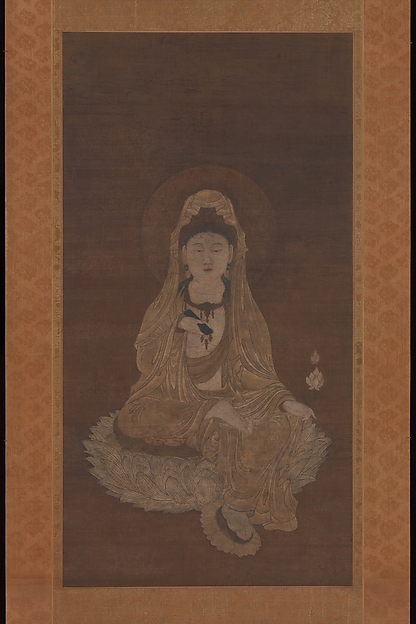
Japan, 13th century. Hanging scroll; ink and color on silk.
Look closer: The thirteenth-century White-Robed Kannon, with a lotus bud at the right.
The Metropolitan Museum of Art, The Harry G. C. Packard Collection of Asian Art, Gift of Harry G. C. Packard, and Purchase, Fletcher, Rogers, Harris Brisbane Dick, and Louis V. Bell Funds, Joseph Pulitzer Bequest, and The Annenberg Fund Inc. Gift, 1975 (1975.268.19). Public domain, Open Access.
In the house
The house keeps Kannon figures in wood, bronze and porcelain. The strip below reads the live shelves, so it shows what is available now.
A short dictionary of Kannon
Terms are given in Japanese with the Sanskrit or Chinese root where the sources supply one.
- Kannon (観音)
- The Japanese name for the bodhisattva, short for Kanzeon; the same figure as Guanyin.
- Kanzeon (観世音)
- The longer Japanese name, “the one who perceives the sounds of the world”.
- Kanjizai (観自在)
- The Heart Sutra’s name for the bodhisattva, “free in contemplation”; Chinese Guanzizai.
- Avalokiteśvara
- The Sanskrit name, usually read “the lord who looks down”; the earlier Avalokitasvara means “sound perceiver”.
- Guanyin (觀音)
- The Chinese name, short for Guanshiyin.
- Chenrézik
- The Tibetan name of the bodhisattva.
- Bosatsu (菩薩)
- A bodhisattva, a being who delays final nirvana to help others.
- Karuṇā
- Compassion, the quality the bodhisattva embodies.
- Universal Gate chapter
- Chapter 25 of the Lotus Sutra, devoted to Kannon, in which the thirty-three guises are named.
- Thirty-three guises
- The thirty-three manifestations Kannon takes to teach different beings.
- Hannya Shingyō (般若心経)
- The Heart Sutra, which opens with Kanjizai Bosatsu.
- Rokkannon (六観音)
- The six Kannon, one for each realm of rebirth.
- Shō Kannon (聖観音)
- The “Sacred” or standard Kannon with two arms.
- Kebutsu (化仏)
- The small seated Amida in Kannon’s crown.
Answered plainly
What does Kannon mean?
Kannon is the Japanese reading of Guanyin, short for Guanshiyin, “the one who perceives the sounds of the world”. The Sanskrit is Avalokiteśvara, which the Art Net Users System glosses as “Lord who regards” beings with compassion.
How do I recognise Kannon?
Look for a crown with a small seated Amida set into it, and for a lotus or a water vase in the hands. Scarves and jewellery mark him as a bodhisattva.
Is Kannon a man or a woman?
The name is masculine and the figure has no fixed sex. Chinese images grow increasingly female from about the twelfth century, and the Art Net Users System says Japan did not show Kannon as a woman, though mother-and-child forms such as Jibo Kannon exist.
What is chapter 25 of the Lotus Sutra?
The Universal Gate chapter, devoted to Kannon, who hears the cries of beings and helps those who call on his name. It describes thirty-three manifestations and circulates in Japan as the Kannon Sutra.
What is the difference between Kannon and Jizō?
Both are bodhisattvas of compassion. Kannon hears the cries of beings and appears in many forms, and in the Thirteen Buddhas rites presides over the hundredth day. Jizō is the guardian of the dead, children and travellers, and is shown as a monk with a staff.
Why does Kannon have eleven heads?
The Eleven-headed form is one of the six Kannon in the Tendai list. A legend retold in the six-realms section says the bodhisattva’s head split into eleven pieces when he struggled to understand so many needs at once, and Amitābha gave him eleven heads to hear the cries of the suffering.
Why does Kannon have a thousand arms?
The thousand arms, each with an eye in the palm, let the bodhisattva reach every being in distress at once. In practice a statue shows a halo of small arms behind forty-two main ones, and Sanjūsangen-dō has 1,001 such statues in one hall.
What is in Kannon’s crown?
A small seated Amida, the Buddha who is the bodhisattva’s teacher. It is the most reliable way to recognise a Kannon.
What is the Kannon mantra?
The best-known is the six-syllable mantra, Oṃ maṇi padme hūṃ, in Tibetan practice. In Japan, chants include the Heart Sutra, the Universal Gate chapter and the ten-verse Kannon Sutra. See the chant section for the full list.
Where next
Sources and image credits
- Wikipedia, Guanyin (names, Lotus Sutra, Heart Sutra, gender, iconography)
- Wikipedia, Kannon (Japanese forms and pilgrimage)
- Wikipedia, Sensō-ji
- Japanese Architecture and Art Net Users System, Kannon
- Japan Travel, Sealed Buddhist statue of Hōryū-ji
- Butuzou, How Avalokiteshvara became Kannon in Japan
- Wikipedia, Thirteen Buddhas
- Wikipedia, Avalokiteśvara
- Wikipedia, Heart Sutra
- Wikipedia, Lotus Sutra
- Wikipedia, Nakamise-dōri
- Wikipedia, Kiyomizu-dera
- Wikipedia, Sanjūsangen-dō
- Wikipedia, Hase-dera (Kamakura)
- Kyoto Shimbun, Sanjūsangen-dō statues return
- Buddhistdoor Global, 1,001 Bodhisattva statues restored at Kyoto temple
- Kiyomizu-dera, the main hall renovation
- The Star, former chief priest sees recovered statue in South Korea
- Associated Press (Irish Examiner copy, 12 May 2025), a Buddhist statue stolen from a Japanese temple is returned
- Cleveland Museum of Art, Kannon (1950.392)
- Cleveland Museum of Art, Eleven-Headed Guanyin (1959.129)
- Cleveland Museum of Art, Batō (Horse-Headed) Kannon (1981.1)
- Cleveland Museum of Art, Bodhisattva Guanyin (1962.217)
- Cleveland Museum of Art, Eleven-Headed Guanyin (1970.66)
- Cleveland Museum of Art, White-Robed Guanyin (1978.47.1)
Last reviewed 28 October 2026. Pictures are public-domain or openly licensed, each credited beneath it. Diagrams on this page are drawn by Japonista.
Looking for a Kannon, a hanging scroll or a small altar figure? Tell us what you have in mind and we will look.
Private concierge
Looking for something in particular?
Describe the piece or the project you have in mind. A senior advisor in Tokyo reads every case file personally and replies within two business days, with fees set out in writing before any work begins.