
Batō Kannon
Wrathful Compassion
Batō Kannon
馬頭観音
The one Kannon who is angry. A white horse’s head rises from his crown, fangs show, and the sources agree he rules the animal realm. For centuries travellers set a stone for him wherever a horse had died.
Identity card
Know him at a glance
- The white horse’s head. A horse’s head worn on the crown is the sign by which JAANUS says the figure is known. In Cleveland’s Kamakura statue it is a small head set in the topknot.
- The sword. JAANUS notes that the held objects differ from image to image; swords, axes, sticks and lotus buds are recorded, and swords are often held by eight-armed figures.
- The wheel. The five-metre statue at Kanzeon-ji holds an axe, a sword, a bead garland, a staff and a dharma wheel in its eight arms (MLIT).
- The extra arms. Eight arms in the most common form. This diagram draws only four of them behind the body.
- The lotus. Most statues stand, a few sit, and the figure rests on a lotus base.
A bodhisattva who wears a horse
Kannon is usually serene. The Japanese Architecture and Art Net Users System, known as JAANUS, begins its entry on Batō Kannon by saying the opposite: this is an angry form of Kannon, recognised by a white horse’s head worn like a crown. It gives the Sanskrit as Hayagrīva and says he is counted among the six Kannon and, in some lists, among the eight great wisdom kings, the hachidai myōō. Another Japanese name is Batō Myōō. The entry calls him the wrathful form of the Buddha Muryōju, which is Amida.
The Met’s catalogue note on a small lacquered shrine explains why a compassionate figure would look this way. The multiple faces and arms signify the bodhisattva’s supernatural powers, the museum says, and the form looks fierce but was popular in warrior society, where Kannon was seen as a protector of animals, especially horses. Cleveland’s catalogue adds the plain doctrinal fact: he presides over the animal realm, one of the six realms of rebirth.
This chapter sits inside the Buddhism and Zen Almanac, under Kannon on the Bosatsu rank, beside Jūichimen, Senju, Nyoirin and Juntei.
Three faces, eight arms, one white head
JAANUS gives the range. The figure may have one to three faces and two to eight arms, and the attributes differ among images. Three faces and eight arms is the most common form. In the Womb Realm mandala, the Taizōkai, he appears in the Kannon section with three faces and two arms, red in colour, and makes the root gesture, konpon-in, before the chest.
A translated Japanese reference adds more. The typical form has a red body, a white horse’s head on top, three faces, three eyes and eight hands, with a vertical third eye on the forehead; the expression is fierce, with angry eyes and bared fangs. Other forms are recorded with one face and two or four hands, three faces and two or six hands, or four faces and eight hands. Most statues stand, though some are seated. At the chest the hands may form the batō-in, a gesture said to represent a horse’s mouth. The same source gives his symbolic objects as a white horse’s head and a club within a triangle.
The Cleveland statue shows how quiet the form can be. It is a Kamakura-period wooden figure, 82.6 centimetres tall without its base, in long layered robes on a lotus pedestal. Nothing in the face is angry. Only a small horse head set in the topknot tells you who it is.
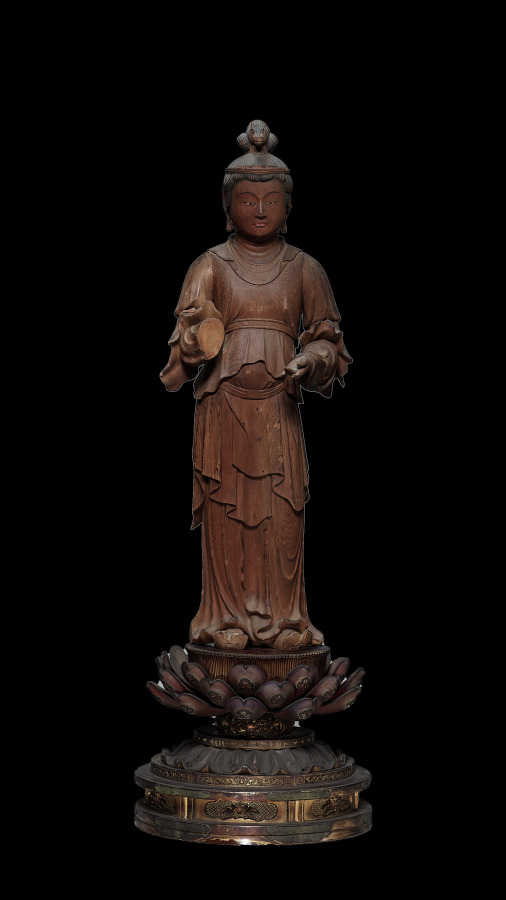
Japan, Kamakura period (1185–1333), early 1300s; pedestal 17th–18th century. Wood with traces of colour and gold; figure 82.6 cm.
Look closer: Look at the topknot. The small horse head there is the only sign of the horse-headed form. Cleveland notes that it is this small head that identifies the figure.
Cleveland Museum of Art, John L. Severance Fund (1981.1). CC0, Open Access.
| Form recorded | Faces and arms | Source |
|---|---|---|
| Most common | Three faces, eight arms | JAANUS |
| Womb Realm mandala | Three faces, two arms, red, root gesture at the chest | JAANUS |
| Other forms | One face with two or four arms; three faces with two or six arms; four faces with eight arms | Translated Japanese reference |
| Kanzeon-ji, Dazaifu | Eight arms; the Chinese text of the national guide adds a fourth face | MLIT multilingual guide |
The horse that came from India
The name is older than the image. Wikipedia’s article on Hayagrīva says the name means having the neck of a horse, and that he began as a yakṣa attendant of Avalokiteśvara in India before the early Buddhist ritual traditions absorbed him. He matters in Chinese, Tibetan and Japanese Buddhism alike.
In Tibet he grew fiercer still. The article describes an extremely wrathful male deity, a wrathful manifestation of Avalokiteśvara, who with his consort Vajravarāhī removes obstacles and is known for conquering the god Rudra. In its simplest form he has one face, two arms and a horse’s head above his own, three glaring eyes, fangs, a bulging belly and snake ornaments; a sword in the right hand and a threatening gesture in the left. The same article reads that wrathful look as compassion’s fierce resolve to overcome inner ego and outer obstacles.
JAANUS gives the Japanese reading of the horse. It stands for the dominion of the ideal king, the wheel-turning ruler, the category JAANUS names kyōryōrinjin. The translated Japanese reference gives the rest: he is said to remove ignorance and worldly desire as a hungry horse devours grass, and to range over the ocean of life and death with the vigour of a ruler’s treasure horse.
Five metres in Fukuoka
The largest surviving Batō Kannon in Japan stands at Kanzeon-ji in Dazaifu, Fukuoka Prefecture. The national multilingual cultural guide published by Japan’s Ministry of Land, Infrastructure, Transport and Tourism says the wooden statue is about 5.03 metres tall, dates to around 1130, and is an Important Cultural Property. Of its eight arms, five hold ritual objects: an axe, a sword, a bead garland, a staff and a dharma wheel. The guide reads the horse head as a symbol of consuming worldly desires and negative emotions, much as a horse eats grass and drinks water.
The guide records how the statue is used. Travellers pray here for safe journeys, and the Chinese and Japanese texts add that Batō Kannon is believed to protect livestock and ensure safe childbirth. Traffic-safety amulets are placed in front of the statue.
Dating differs by source. JAANUS places the standing Kanzeon-ji image in the Kamakura or Muromachi period; the MLIT guide says around 1130. This page gives both and does not choose.
A shrine the size of a hand
The Metropolitan Museum owns the form in miniature. A lacquered portable shrine, a zushi, dated about 1620, stands 19.7 centimetres tall; the fruitwood statue inside is about six centimetres. Its doors are painted with lotus plants on a gold ground, and when they open the multi-armed figure sits on a lotus throne before an openwork halo. The Met says the shrine protects a miniature statue of Kannon and is not currently on view.
Such a shrine could be carried. That small fact fits the form’s long association with journeys: a figure meant to guard animals and travellers is also one that could travel in a pack.

Japan, Edo period, about 1620. Fruitwood with lacquer, pigments, gold and metal fittings; shrine height 19.7 cm.
Look closer: Look at the doors, painted with lotus flowers and leaves on gold, and at the many arms fanned about the tiny seated figure. The Met identifies it as Batō Kannon.
The Metropolitan Museum of Art, Purchase, Friends of Far Eastern Art Gifts, 1985 (1985.96). Public domain, Open Access.
Stones where horses fell
For most people the image was never a temple statue. JAANUS says that in the Edo period he was worshipped as a protector of horses, and that stone images were set up to guard travellers and their horses on dangerous paths. It adds that the figure merged with a folk horse deity, the mount of a kami who moves between this world and the sacred realm, and that Batō is the Buddhist counterpart of the deities enshrined at the komagata, horse-shaped, shrines found across Japan.
The translated Japanese reference describes the practice. From the early modern period, statues were often placed by roadsides where a horse had died suddenly, or at the places where dead horses were dumped, and stone markers inscribed with the words Batō Kannon were often erected in place of statues. The photograph below shows such a row at a forest pass in Kanagawa Prefecture: small stones, grey and green with moss, standing in a line on the leaves among cedars.
One stone in Tokyo shows the image itself. At Honju-in in Nerima, a stone relief about 40 centimetres tall shows a seated figure in monk’s form with a horse’s head, one hand raised to the chest. The Commons description records an inscription on the side dated Bunsei 6, 1823, and the name of the donor, Mikawaya Yasujirō. Someone paid for this stone almost two centuries ago, and it still sits under its small shelter.

Photograph by Mzaki, 16 February 2026.
Look closer: Look at how low the stones are, set in a line on the slope. The Commons caption places them along the Yagurasawa road towards Zenba Pass, Isehara, Kanagawa.
Mzaki, “Roadside Batō Kannon stones at Zenba, Kanagawa”, Wikimedia Commons, CC0. Source: commons.wikimedia.org (file page listed in the sources below).
A horse-headed monk in granite
The Nerima relief repays a slow look. The slab is arched like a halo. The figure sits cross-legged with the left hand resting in the lap and the right hand lifted to the chest. The long muzzle, the ears and the mane are unmistakably a horse’s, set above a human body in a plain monk’s robe. The translated Japanese reference notes that some sutras describe a human body with a horse’s head, and that few such statues exist in Japan; the roadside stones are the place most people met him.
Racecourses and traffic
The translated Japanese reference says that in modern Japan statues are placed near racecourses, where memorial services are held for horses that died during races. In China the same figure, Mǎtóu Guānyīn, is described by Wikipedia as a protector of travel and transport, especially cars: some temples enshrine visitors’ license plates before his image, and images are sometimes placed at temple entrances and exits. At Kanzeon-ji, traffic-safety amulets sit before the great statue. The horse has changed; the vow has not.
Names across the Buddhist world
Wikipedia’s article on Hayagrīva gives the following.
| Where | Form and name | What the record shows |
|---|---|---|
| India | Hayagrīva (“neck of a horse”) | A yakṣa attendant of Avalokiteśvara, absorbed into early Buddhist ritual. |
| Tibet | Hayagrīva, a wrathful manifestation of Avalokiteśvara | A wrathful protector with consort Vajravarāhī; said to conquer Rudra. |
| China | Mǎtóu Guānyīn (馬頭觀音); Mǎtóu Zūnzhě (馬頭尊者) | A Guanyin of travel and transport; counted among the 500 arhats as the Venerable Horse Head. |
| Taoism | Mǎ Wáng (馬王), the Horse King | Absorbed into the Taoist pantheon; associated with fire. |
| Japan | Batō Kannon (馬頭観音) | One of the six Kannon; animal realm; guardian of horses. |
The fierce one among the six
Batō is the Kannon of the animal realm. The table gathers the images the sources name.
| Image | Place | What the sources say |
|---|---|---|
| Saidaiji | Nara | An image recorded as enshrined in the late eighth century (JAANUS) |
| Kanzeon-ji | Dazaifu, Fukuoka | Wooden standing statue about 5.03 metres; the largest surviving (MLIT) |
| Jōruri-ji | Kyoto | Standing statue, Kamakura or Muromachi (JAANUS); Kamakura, by Nara sculptors (translated reference) |
| Puzai-in | Ishikawa | Wooden standing statue, late Heian (translated reference) |
| Mago-ji | Fukui | Wooden seated statue, late Heian (translated reference) |
| Museum of Fine Arts | Boston | A painted seated image (JAANUS) |
Where to see him
| Place | What to look for |
|---|---|
| Kanzeon-ji, Dazaifu, Fukuoka | The five-metre statue; traffic-safety amulets are placed before it (MLIT). |
| Jōruri-ji, Kyoto | A Kamakura standing statue (JAANUS). |
| Along old roads | Stone markers inscribed Batō Kannon, set where horses died or travellers needed protection. |
| Cleveland Museum of Art | A Kamakura wooden statue, not on view at the time of the catalogue entry. |
| Metropolitan Museum of Art, New York | The portable shrine of about 1620, not on view at the time of the catalogue entry. |
The horse-headed monk in granite

Photograph by Asanagi, 2 May 2024.
Look closer: Look at the muzzle and the ears set above a seated human body. The shelter and the leaves behind show that it still receives care.
Asanagi, “Batō Kannon at Honju-in, Nerima, Tokyo”, Wikimedia Commons, CC0. Source: commons.wikimedia.org (file page listed in the sources below).
In the house
Pieces of Batō Kannon appear on the shelves from time to time. The strip below reads the live shelves and appears when one is in the house.
Answered plainly
Why does Batō Kannon have a horse’s head?
The name Hayagrīva means having the neck of a horse. JAANUS says the horse stands for the dominion of the ideal king, and the Met notes the form was popular in warrior society as a protector of animals, especially horses.
Is Batō Kannon male or female?
None of the Japanese sources read here assigns a gender to the figure. Wikipedia calls the Tibetan Hayagrīva a male deity.
Which realm does he rule?
The animal realm, among the six realms of rebirth. Cleveland and Wikipedia both say so.
What are the stone Batō Kannon along roads?
JAANUS and a translated Japanese reference say stones were set to guard travellers and horses on dangerous paths and where horses had died. Stones inscribed with his name often stood in place of statues.
Where is the largest statue?
Kanzeon-ji in Dazaifu, Fukuoka. The national multilingual guide gives its height as about 5.03 metres and its date as around 1130.
Is he a bodhisattva or a wisdom king?
Both lists name him. JAANUS counts him among the six Kannon and among the eight great Myōō; this chapter keeps him on the Bosatsu rank.
Where next
Sources and image credits
- The Metropolitan Museum of Art, object 42591
- Cleveland Museum of Art, Batō (Horse-Headed) Kannon (1981.1)
- Wikimedia Commons, Road-side Bato-kannon statues in Zenba.jpg (Mzaki, CC0)
- Wikimedia Commons, Honju-in Bato-kannon 2024-05-02.jpg (Asanagi, CC0)
- Japanese Architecture and Art Net Users System, Batō Kannon
- MLIT multilingual cultural guide, Bato Kannon (Skt: Hayagrîva), Kanzeon-ji
- Wikipedia, Hayagriva (Buddhism)
- Japanese Wiki Corpus, Bato Kannon (horse-headed Kannon)


Last reviewed 28 October 2026. Pictures are public-domain or openly licensed, each credited beneath it. Diagrams on this page are drawn by Japonista.
Looking for a Batō Kannon, a small altar figure or a travel shrine? Tell us what you have in mind and we will look.
Private concierge
Looking for something in particular?
Describe the piece or the project you have in mind. A senior advisor in Tokyo reads every case file personally and replies within two business days, with fees set out in writing before any work begins.