
Senju Kannon
Hands Without Number
Senju Kannon
千手観音
Kannon with a thousand hands, and an eye in every palm. Sculptors rarely carve them all, so most images show forty-two, and one Kyoto hall holds a thousand and one figures. Japan has prayed to him for sight and for the relief of the hungry dead.
Identity card
Know him at a glance
- The crown of faces. Most images carry eleven faces. JAANUS says the mandala form shows 27, and a few images have one face with a third eye.
- The fan of arms. The arms spread behind the body like the rays of a wheel. Sculptors carve a few dozen; the Met notes that the word senju literally means one thousand arms.
- The joined hands. Two principal hands meet at the chest in gasshō, the gesture of greeting and reverence (JAANUS, the Met).
- The held objects. The side hands hold attributes. On the Met embroidery they carry a hand drum, a pilgrim’s staff, a trident, a Dharma wheel, wish-granting jewels, a bow and arrows, a bell and prayer beads.
- The lotus. He stands or sits on a lotus. This diagram draws a standing figure with only a few of the arms.
A thousand hands, forty-two on show
The Japanese Architecture and Art Net Users System, known as JAANUS, gives the Sanskrit as Sahasrabhuja-arya-avalokiteśvara and the Japanese names as Senju Kannon, Senbi Kannon and Daihi Kannon, the Kannon of Great Compassion. The long form is Senju-sengen Kanjizai Bosatsu, the thousand-handed, thousand-eyed lord who sees freely. In theory every hand has an eye, JAANUS says: the eyes see suffering and the hands relieve it.
The idea is easier to feel than to carve. The Met’s curators note that senju literally means one thousand arms, but that sculpted and painted versions reduce the number to a finite figure. The usual figure is forty-two, and the sources on this page explain how a thousand can be folded into it.
This chapter sits inside the Buddhism and Zen Almanac, under Kannon on the Bosatsu rank. He is one of the six forms of Kannon alongside Jūichimen, Nyoirin, Batō and Juntei.
Forty hands, twenty-five worlds
JAANUS gives the sum behind the standard figure: each hand saves beings in twenty-five worlds, and forty hands times twenty-five makes one thousand. Most sculptures therefore show two principal hands joined at the chest in gasshō and forty side arms, forty-two in all, holding attributes or forming mudrās. In the Taizōkai mandala, in the Kokūzō court, JAANUS says he has twenty-seven faces and forty-two main arms, with countless small arms fanning out behind.
The nippon.com feature on the Tōshōdaiji image adds that from the Heian period on, Kannon images commonly have forty-two arms, two held in prayer and forty at the sides. A tradition of the full thousand exists, but it is rare. The same feature names only three images in Japan that approach it: the one at Tōshōdaiji in Nara, one at Fujiidera in Osaka Prefecture and one at Juhōji in Tanabe, Kyoto Prefecture. JAANUS names Tōshōdaiji and Fujiidera as early attempts to carve all the hands.
What the hands hold is part of how a viewer reads the figure. The Met’s embroidery names a hand drum, a pilgrim’s staff, a trident, a Dharma wheel, wish-granting jewels, a bow and arrows, a bell and prayer beads. In a Tang painting discussed by Yale, the largest arms nearest the body hold a sutra, a mirror, a water vessel, an alms bowl and a willow spray, with a tiny Amida in the headdress.
| Hand holds | Where recorded | Source |
|---|---|---|
| Hand drum, pilgrim’s staff, trident, Dharma wheel | Embroidered hanging scroll, Japan, late 15th to early 16th century | The Met |
| Wish-granting jewels, bow and arrows, bell, prayer beads | The same scroll | The Met |
| Sutra, mirror, water vessel, alms bowl, willow spray | A Tang-dynasty painting from China | Yale MAVCOR |
| Joined hands in gasshō | The two principal hands of most images | JAANUS, The Met |
Arms that shattered under a vow
Wikiwand’s article on Chenrezig tells the myth as follows. Avalokiteśvara vowed never to rest until every sentient being was freed from saṃsāra. Seeing that many remained, his head split into eleven pieces, and Amitābha gave him eleven heads to hear the cries of the suffering. When he then tried to reach everyone who needed help, his two arms shattered, and Amitābha invested him with a thousand arms. Yale’s essay gives a plainer account, saying only that the thousand arms and eyes were the result of his vow to save all suffering beings.
The textual source is a dhāraṇī sutra. In the version translated by the Indian monk Bhagavaddharma, dated by the source to about 650 to 661 at Khotan, Śākyamuni sits in Avalokiteśvara’s palace on Potalaka and sees a great light. Avalokiteśvara then recounts how, countless eons ago, a Thousand-Light King Tathāgata entrusted him with the dhāraṇī. On hearing it he rose from the first stage of the bodhisattva path to the eighth, and gained a thousand hands and eyes. He then leads ten vows and lists fifteen kinds of good rebirth and fifteen kinds of evil death from which the dhāraṇī protects.
The Karandavyūha Sutra, Yale notes, already imagines Avalokiteśvara with one hundred thousand arms and hundreds of thousands of eyes, and says the sun and moon were born from his eyes. The sutra is likely composed in Kashmir around the late fourth to early fifth century.
A blind monk and a lacquer giant
JAANUS ties the devotion to sight. The bodhisattva is prayed to for relief from eye troubles and blindness, and it recalls that Ganjin (688 to 763), who carried the Ritsu discipline to Japan, lost his sight during the hard voyages from China. A Senju Kannon image was enshrined at Tōshōdaiji, where, JAANUS says, Senju was a principal devotional image.
Nippon.com describes the standing image there. It is 5.36 metres tall and dates from the Nara period. It has 953 arms today and is thought to have had a thousand. The main face looks sorrowful, ten smaller faces rise above it, and a third eye is carved on the forehead. The statue is built in the wood-core dry lacquer method: a cypress core was carved and then covered with a lacquer mixed with wood powder. The same feature says Ganjin founded Tōshōdaiji in 759, and that in the Kondō, the main hall, the Rushana Buddha sits at the centre, Yakushi stands at the right at 3.36 metres, and the Thousand-Armed Kannon stands at the left.
A Japanese government tourism database entry on the same statue gives the arms as forty-two large and nine hundred and eleven small. It places the figure beside the Rushana Buddha but its English text says to the right where its Japanese text says left, so this page follows nippon.com on the position.
The long hall of 1,001 figures
JAANUS records that Senju is the lord of the lotus seal (renge-in) of the Taizōkai mandala and that the hall of Rengeō-in, better known as Sanjūsangendō, houses a thousand Senju Kannon sculptures attended by the twenty-eight followers. The detail below comes from Wikipedia and from the World History Encyclopedia.
Wikipedia says Taira no Kiyomori founded the hall in 1164 for the retired emperor Go-Shirakawa. World History Encyclopedia gives the founding to Go-Shirakawa and notes that some sources credit Kiyomori. A fire in 1249 destroyed the complex, and the emperor Go-Saga ordered the hall rebuilt. Wikipedia says work began in 1251 and both sources say it was completed in 1266. The hall is 120 metres long.
The central seated Kannon, a National Treasure, is eleven feet tall. World History Encyclopedia credits the sculptor Tankei, giving his age as eighty-two when he finished it in 1254; Wikipedia credits Tankei without the age or date. Around him stand a thousand standing Kannon in ten tiers: Wikipedia says ten rows and fifty columns. Of these, 124 are original and survived the fire, while 876 were made in the thirteenth century by the Kei, En and In schools. World History Encyclopedia gives the work as fifteen years where Wikipedia gives sixteen, and says each figure is about 1.7 metres tall. About five hundred of them are signed.
Twenty-eight guardians stand in a row in front, about 1.6 metres tall according to World History Encyclopedia, with Fūjin, the wind god, and Raijin, the thunder god, at the ends. All the statues are cypress, joined from pieces, lacquered and gilded, with quartz eyes.
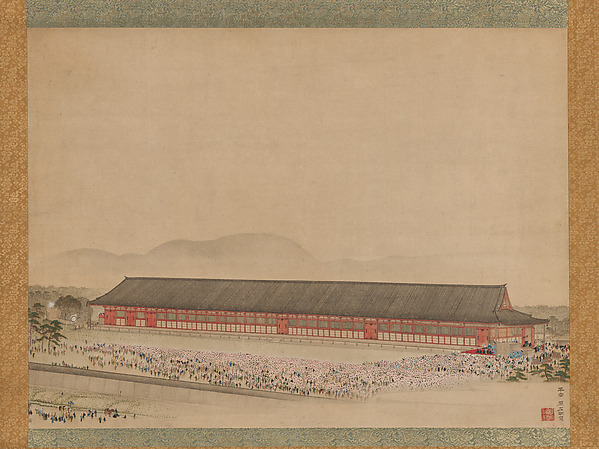
Japan, first half of the 19th century. Hanging scroll; ink and color on paper; image 41.9 × 57.3 cm. Hara Zaimei (1778–1844).
Look closer: The Met titles it Archery Contest at Rengeō’in (Sanjūsangendō) and dates it to the first half of the nineteenth century. Look at how the hall runs almost the full width of the sheet, and how small the crowd is beside it. World History Encyclopedia says archers shot the full length of the veranda.
The Metropolitan Museum of Art, Mary and Cheney Cowles Collection, Gift of Mary and Cheney Cowles, 2025 (2025.981.32). Public domain, Open Access.
| Fact | Value | Source |
|---|---|---|
| Founded | 1164, for Go-Shirakawa; Wikipedia credits Kiyomori | Wikipedia; World History Encyclopedia |
| Burned and rebuilt | Fire in 1249; rebuilt by 1266 | Both |
| Hall length | 120 metres | Both |
| Central Kannon | Seated, 11 feet, National Treasure, by Tankei | Both |
| Standing Kannon | 1,000, of which 124 are original and 876 thirteenth-century | Both |
| Guardians | 28, with Fūjin and Raijin | Both |
The dhāraṇī monks recite daily
The sutra also lives in the voice. The Great Compassion dhāraṇī, which Sōtō Zen calls the Daihishin darani and Rinzai names Daihi shu among other titles, is chanted daily by Zen monks and used at funerals and in the hungry-ghost offering ceremonies called segaki. That use echoes JAANUS’s assignment of Senju to the realm of the hungry ghosts. In the early twentieth century, the source says, the Shingon school counted it among three dhāraṇīs it especially revered.
The Vietnamese text, Chú Đại Bi, is nearly identical to Bhagavaddharma’s version but divides it differently, into eighty-four verses against eighty-two.
Names across the Buddhist world
The rows record only the names the sources I read give.
| Where | Form and name | What the record shows |
|---|---|---|
| India | Sahasrabhuja Avalokiteśvara | The Sanskrit form. JAANUS assumes an Indian origin in the seventh century, though no examples survive. |
| China | Qiānshǒu Guānyīn (千手觀音) | Surviving images date from about the tenth century (JAANUS). The Met holds a sixteenth-century Chinese silk embroidery. |
| Japan | Senju Kannon (千手観音); Daihi Kannon | Also Senbi Kannon, and Senju-sengen Kanjizai Bosatsu in full. |
| Tibet | Chenrezig (the general name) | Wikiwand gives no separate Tibetan name for this form. The Met has a fourteenth-century thousand-armed Chenresi painting and a small clay plaque. |
| Korea | Gwaneum (the general name) | The sources I read give no separate Korean name for this form. |
| Vietnam | Quan Âm (the general name) | Wikiwand mentions a thousand-armed statue at Bút Tháp temple. |
The Kannon of great compassion
Senju is the second of six forms in the esoteric list of the Shingon monk Ningai. The table gives that list as Wikipedia records it. Tendai kept the list but, the same source says, replaced Juntei with Fukū Kensaku. The six forms correspond to the six realms, and Senju’s is the hungry ghosts.
| Esoteric form | Japanese | Aspect |
|---|---|---|
| Āryāvalokiteśvara | Shō Kannon | Great Mercy |
| Sahasrabhuja | Senju Kannon | Great Compassion, the hungry ghosts |
| Hayagrīva | Batō Kannon | The horse head |
| Ekādaśamukha | Jūichimen Kannon | Great Light |
| Cundī | Juntei Kannon | Divine Hero |
| Cintāmaṇicakra | Nyoirin Kannon | Mahābrahmā |
Where to see him
| Place | What to look for |
|---|---|
| Tōshōdaiji, Nara | The 5.36-metre standing image in the Kondō, beside the Rushana Buddha and Yakushi (nippon.com). |
| Sanjūsangendō (Rengeō-in), Kyoto | The central seated Kannon by Tankei and the thousand standing figures (Wikipedia, World History Encyclopedia). |
| Fujiidera, Osaka Prefecture, and Juhōji, Tanabe | The other two images named as approaching the full thousand (nippon.com). |
| Metropolitan Museum of Art, New York | A late fifteenth or early sixteenth-century embroidery, a small portable shrine, a Chinese embroidery, and a Tibetan clay plaque, all in the public domain. |
The hands in thread and lacquer
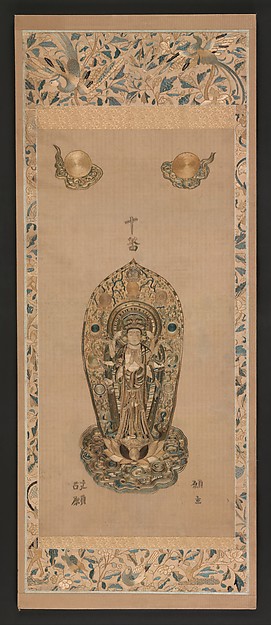
Japan, probably late 15th–early 16th century. Embroidered silk appliquéd to cotton backing; 195 × 79 cm.
Look closer: The Met titles it Embroidery of a Thousand-Armed Kannon and dates it probably to the late fifteenth or early sixteenth century. The characters above the figure read jūban, tenth, for the tenth temple of the Shikoku pilgrimage, the Met says. It describes the figure with eleven heads, gasshō hands and orbs of the sun and moon above.
The Metropolitan Museum of Art, Purchase, Sue Cassidy Clark Gift, in memory of Terry Satsuki Milhaupt, 2013 (2013.114). Public domain, Open Access.

Japan, late 18th–first half 19th century. Wood with lacquer, gold, pigments, metal fittings; shrine height 10.7 cm.
Look closer: The Met titles it a portable shrine with Senju Kannon and dates it to the late eighteenth to first half of the nineteenth century. The figure is only 4.2 centimetres tall; look at the arms fanned around the body.
The Metropolitan Museum of Art, Bequest of Susan Dwight Bliss, 1966 (67.55.62). Public domain, Open Access.
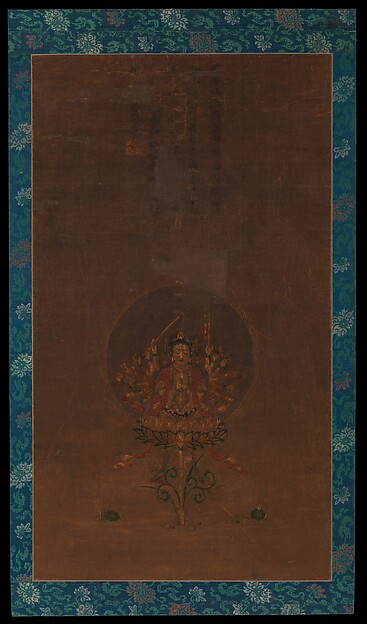
China, 16th century. Silk embroidered in colored silks; 79.4 × 45.1 cm.
Look closer: The Met titles it Thousand-armed Guanyin seated on lotus and dates it to the sixteenth century. Look at how the arms are stitched as a ring behind the seated body.
The Metropolitan Museum of Art, Fletcher Fund, 1927 (27.176.1). Public domain, Open Access.
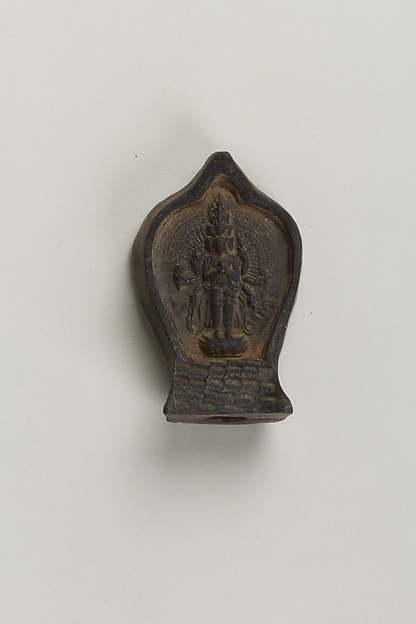
Tibet, ca. 16th–18th century. Clay; 6.3 × 4.1 cm.
Look closer: The Met titles it Votive Plaque with a Thousand-Armed Avalokiteshvara and dates it to about the sixteenth to eighteenth century. It is only 6.3 centimetres tall and was made in Tibet.
The Metropolitan Museum of Art, Fletcher Fund, 1938 (38.80.5). Public domain, Open Access.
In the house
Pieces of Senju Kannon appear on the shelves from time to time. The strip below reads the live shelves and appears when one is in the house.
Answered plainly
What does Senju Kannon mean?
The thousand-armed Kannon. Senju is a thousand hands, and the full title adds a thousand eyes. The Sanskrit is Sahasrabhuja Avalokiteśvara.
Why does he have forty-two arms in most statues?
JAANUS gives the sum: each hand saves beings in twenty-five worlds, and forty hands times twenty-five makes a thousand. Two principal hands join in prayer and forty side arms hold attributes, forty-two in all.
How many statues are in Sanjūsangendō?
A seated central Kannon by Tankei and a thousand standing Kannon, 1,001 figures in all. Of the thousand, 124 are original and 876 were made in the thirteenth century after the fire of 1249.
Which realm does he govern?
The hungry ghosts, among the six realms of rebirth, as both JAANUS and Wikipedia’s list of the six Guanyin record.
What do people pray to him for?
JAANUS says for relief from eye troubles and blindness, a tradition it links with the blind Ganjin and Tōshōdaiji.
Does the Tōshōdaiji statue really have a thousand arms?
Nippon.com gives it 953 arms today and says it is thought to have had a thousand. It is one of only three Japanese images that approach the full number.
Where next
Sources and image credits
- The Metropolitan Museum of Art, object 78211
- The Metropolitan Museum of Art, object 49110
- The Metropolitan Museum of Art, object 916567
- The Metropolitan Museum of Art, object 60529
- The Metropolitan Museum of Art, object 38848
- Japanese Architecture and Art Net Users System, Senju Kannon
- Wikipedia, Sanjūsangendō
- World History Encyclopedia, Sanjusangendo
- nippon.com, Encounters with Buddhist Art (Tōshōdaiji)
- Ministry of Land, Infrastructure, Transport and Tourism, The Thousand-Armed Kannon
- Yale MAVCOR, Thousand-armed and Thousand-eyed Avalokiteshvara
- Wikipedia (mirror copy), Nīlakaṇṭha Dhāraṇī
- Wikipedia (Wikiwand copy), Chenrezig
- Wikipedia (mirror copy), Six Guanyin
Last reviewed 28 October 2026. Pictures are public-domain or open-access, each credited beneath it. Diagrams on this page are drawn by Japonista.
Looking for a thousand-armed Kannon, a small altar figure or a shrine? Tell us what you have in mind and we will look.
Private concierge
Looking for something in particular?
Describe the piece or the project you have in mind. A senior advisor in Tokyo reads every case file personally and replies within two business days, with fees set out in writing before any work begins.