
Yakushi Nyorai
The Healing Buddha
Yakushi Nyorai
薬師如来
A Buddha of the eastern lapis-lazuli land, invoked by emperors for sick wives and by monks for the cure of body and mind. Japan gave him a temple built as a prayer, a bronze that weighs twenty tons, and twelve armoured generals who carry the animals of the zodiac.
Identity card
Know him at a glance
- The ushnisha and monk’s robe. Like Shaka, Yakushi wears a monastic robe and the rounded crown-bump. Early Japanese images look almost identical to Shaka.
- The urna. The white tuft between the brows, a mark of every Buddha.
- The raised right hand. Early Japanese images show the fearlessness gesture, semui-in, as Shaka does. Other traditions rest the right hand on the knee.
- The medicine jar. The attribute that settles it: a jar of medicine in the left hand. The Art Net Users System notes that the sutras do not describe it.
- The two attendants. Nikkō and Gakkō, Solar and Lunar Radiance, stand on either side in the Yakushi triad.
A temple built as a prayer
In 680 Emperor Tenmu ordered a temple built so that his consort, the future Empress Jitō, might recover from illness. He died in 686 with the work unfinished. It was Jitō who finished it and consecrated the great image in 697 (Yakushi-ji official site). The image is a bronze triad, roughly twenty tons of metal, originally gilded. Its central Buddha stands 2.55 metres tall at Yakushi-ji in Nara. His name is Yakushi.
The Sanskrit is Bhaiṣajyaguru, usually rendered “Medicine Guru, King of Lapis Lazuli Light”. Yakushi is the Japanese for “medicine master”, and he is the Buddha of healing and medicine in Mahāyāna Buddhism. In the Medicine Buddha Sūtra, as a bodhisattva, he made twelve great vows. They include healing the sick and disabled, relieving poverty and hunger, freeing beings from evil thoughts and saving prisoners who have truly repented and the victims of disaster. After he attained Buddhahood he became the Buddha of the eastern Pure Land, Vaiḍūryanirbhāsa, “Pure Lapis Lazuli” (Wikipedia, “Bhaisajyaguru”).
His chapter sits inside the Buddhism and Zen Almanac, on the Nyorai rank. He is the Buddha of the east, as Amida is the Buddha of the west, and his picture is often hung beside the other Nyorai, Shaka and Dainichi.
Finding the jar
Look for the jar. Yakushi is usually identified by a medicine jar in his left hand, although, as the Art Net Users System points out, the sutras do not describe it. Early Japanese images are almost indistinguishable from Shaka: the right hand raised palm out in semui-in, the fearless gesture, and the left lowered palm out in yogan-in, the wish-granting gesture. If a plain-robed Buddha holds a small covered jar, it is Yakushi.
Wikipedia’s survey of the Medicine Buddha gives a wider picture. He is usually seated in monastic robes, holding a lapis-coloured jar of medicine nectar in the left hand, with the right hand resting on the right knee and holding the stem of an aruna fruit, the myrobalan. Some versions show him with blue or deep green skin, and in China he is sometimes shown holding a pagoda. So a Japanese Yakushi with his right hand raised differs from the Indian pattern the article describes.
The triad completes the identification. On either side stand Nikkō and Gakkō, the bodhisattvas Solar Radiance and Lunar Radiance, who represent the light of the sun and the moon. Behind them, the sutra sets twelve divine generals who vow to protect his devotees and scriptures.
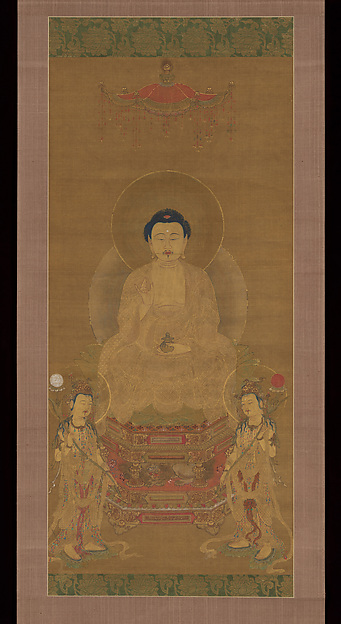
Japan, 17th or 18th century. Hanging scroll; ink, color, metallic paint, and kirikane (cut gold) on silk; image 102 × 48 cm.
Look closer: Find the jar in the left hand at his lap, and the right hand raised. Then look at the two attendants at the base of the throne. Each holds a staff crowned by a disc, one white and one red: the moon and the sun of their names.
The Metropolitan Museum of Art, Gift of Sue Cassidy Clark, in honor of Barbara Brennan Ford, 2021 (2021.396.3). Public domain, Open Access.
| Feature | What it means | Where to look |
|---|---|---|
| Medicine jar | Healing medicine, the attribute that identifies him | In the left hand |
| Raised right hand | Fearlessness; the early Japanese form | Right hand, palm out |
| Monk’s robe | The plain dress he shares with Shaka and Amida | Whole figure |
| Nikkō and Gakkō | Sun and moon light; his two attendants | Left and right of the throne |
| Twelve generals | Protectors who vow to guard his devotees | Around the base or in a separate hall |
| Lapis blue | The colour of his Eastern Pure Land | Skin or jar, in some images |
Twelve promises of a physician-king
Every Buddha begins as someone who has not yet become one. Before he was the Medicine Master, he was a bodhisattva who stood before the assembled Buddhas and made twelve great vows, each a promise about what he would do for living beings once his own awakening was complete. The Medicine Buddha Sūtra records them, and Wikipedia’s article on Bhaiṣajyaguru summarises them in the order given below. The vows read less like doctrine than like a hospital charter that happens also to include a prison, a famine and a mosquito net.
The first two concern the Buddha’s own body. He vows that it will shine so brightly that it dispels the ignorance and worries of beings, and that it will be as pure and flawless as crystal, strengthening the wisdom and the spiritual and physical energy of those who see it. Only after that do the vows turn outward, and from the third onward they are almost entirely practical: that beings shall have what they need, and be freed from the suffering that material desire brings; that those who have strayed shall be led back to the right path; that those who keep the precepts and fall short shall be guided to repentance and forgiveness.
The sixth vow is the one at the heart of his healing role: that beings who are disabled or sick, in body or in mind, shall be blessed with good health. The seventh extends it to the very poor, since poverty and illness feed each other. The eighth, which modern readers often stop over, promises to help women who suffer hardship and who wish to be reborn as men, so that their wishes are granted and they come at last to Buddhahood. Wikipedia reports it as the sutra states it, in the language of its own period, and it is best read that way: as a statement of the ancient world’s idea of misfortune, set beside the other eleven.
The last four are the widest. The ninth frees beings from evil thought and leads them to the path of light. The tenth saves prisoners who have sincerely repented, and the victims of natural disaster. The eleventh saves those who starve, including those who stole in order to eat, by giving them food and leading them to the Dharma. The twelfth saves the poor who are tormented day and night by mosquitoes and wasps, so that their wishes are fulfilled through practice. When the vows were all made he attained Buddhahood and became lord of the eastern Pure Land of lapis lazuli, which is why the sutra calls him the King of Lapis Lazuli Light.
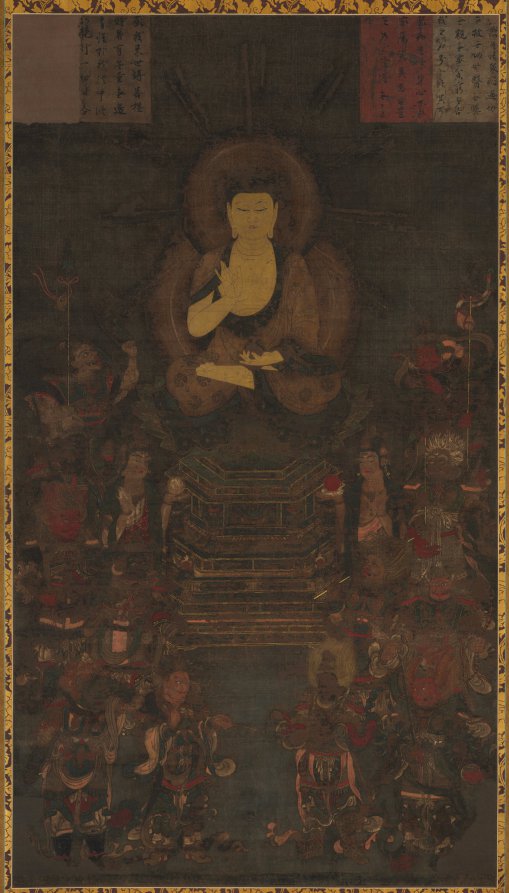
Japan, Kamakura period, 1200s. Hanging scroll; ink, colour, gold and silver on silk.
Look closer: Find the Buddha at the centre, his right hand lifted and a jar in his left. Then look at the top of the painting, where small rectangles imitate paper slips inscribed with lines from the sutra: the vows are written into the picture. Round the lower half stand the twelve generals.
Cleveland Museum of Art, Edward L. Whittemore Fund (1938.422). CC0, Open Access.
| Vow | What the Buddha promises | Plain reading |
|---|---|---|
| First | His body will shine and dispel the ignorance and worries of beings | Light as the first medicine |
| Second | His body will be pure as crystal and strengthen wisdom, spiritual and physical energy | A healer whose own health is the proof |
| Third | He will grant what beings need and relieve the suffering of material desire | Food, clothing, and a lesson in sharing |
| Fourth | He will lead those who have strayed back to the right path | A way home |
| Fifth | He will help beings keep the precepts and guide those who fail towards repentance | Forgiveness built into discipline |
| Sixth | The disabled and the sick, in body or mind, will be blessed with good health | The healing vow |
| Seventh | He will relieve the pain and poverty of the very sick and the very poor | Illness and want treated together |
| Eighth | He will help women who suffer hardship and who wish to become men, so that they reach Buddhahood | A vow of its period; read in context |
| Ninth | He will free beings from evil thought and lead them to the path of light | Medicine for the mind |
| Tenth | He will save repentant prisoners and the victims of natural disasters | Relief for law and for weather |
| Eleventh | He will save those who starve, including those who stole food, and lead them to the Dharma | Hunger comes before doctrine |
| Twelfth | He will save the poor tormented by mosquitoes and wasps | The smallest suffering, not forgotten |
Birchbark, four translators and a lamp ritual
The sutra that carries the vows is one of the best-travelled in the Buddhist canon. Wikipedia records that birchbark fragments of the Bhaiṣajyaguru-vaiḍūrya-prabha-rāja Sūtra, among other Mahāyāna texts, were found at a monastery in Bamiyan, in what is now Afghanistan. A Sanskrit manuscript from Gandhāra, written in upright Gupta script and dated to before the seventh century, shows how popular it was in the north-western kingdoms. The text is not a Japanese invention imported late; it arrived in Japan already old.
It was translated into Chinese four times that survive, and every translator left a different Medicine Buddha. Śrīmitra rendered it in the fourth century, Dharmagupta in 615, Xuanzang in 650 and Yijing in 707. Yijing’s version adds the vows of six other healing Buddhas. In Japan, the Art Net Users System dates the cult to at least the later seventh century, which is the period of Yijing’s translation.
The mantra is the form in which most devotees meet him. Wikipedia gives the long Sanskrit form: namo bhagavate bhaiṣajyaguru-vaiḍūrya-prabha-rājāya tathāgatāya arhate samyaksaṃbuddhāya tadyathā: oṃ bhaiṣajye bhaiṣajye bhaiṣajya-samudgate svāhā. Wikipedia counts it among the Ten Small Mantras. In the Art Net Users System the esoteric seed syllable is bei, from the Sanskrit bhai, and the esoteric symbol is the medicine bowl or jar.
The oldest ritual attached to the sutra is a lamp offering. Wikipedia describes an altar with forty-nine lamps, called long-life lamps, and banners in five colours, with the sutra recited throughout; it was recorded in the early Tang dynasty and remains widespread, especially in the eighth lunar month. A household practice is also described: the long mantra is recited 108 times over a glass of water, which the sufferer drinks daily until the illness is cured. These are Chinese practices recorded by Wikipedia, and they show the shape the cult took before and beside Japan’s own: a prayer for the sick said aloud, a light kept burning, a drink made holy by sound.
The Seven Medicine Buddhas
Yijing’s translation names the Buddha of the east in company with six others, and the grouping is called the Seven Medicine Buddhas in later art. This chapter does not supply names it did not read in a source. Wikipedia’s article on Shin-Yakushi-ji records that the great hall of the Nara temple founded in 747 was designed to enshrine a set of Seven Buddhas of Healing, which makes that site the clearest Japanese memory of the group.
Sun and moon at his shoulders

Japan, Heian period, about 800. Japanese nutmeg-yew wood with traces of colour and gold.
Look closer: Look at the bare torso and the soft folds of the robe over the legs, then at the calm face under the high topknot. This is the single block of nutmeg-yew the museum describes. The figure is thought to have stood at one side of a Yakushi.
Cleveland Museum of Art, John L. Severance Fund (1961.48). CC0, Open Access.

Japan, mid-12th century. Page from a book mounted as a hanging scroll; ink, colour and gold on paper.
Look closer: Look at the lower lotus: it carries a crescent moon, the symbol that names this bodhisattva. Gakkō is shown here in the esoteric form, among the figures of the two great mandalas, with a Siddhaṃ inscription beside the halo.
The Metropolitan Museum of Art, The Harry G. C. Packard Collection of Asian Art, Gift of Harry G. C. Packard, and Purchase, Fletcher, Rogers, Harris Brisbane Dick, and Louis V. Bell Funds, Joseph Pulitzer Bequest, and The Annenberg Fund Inc. Gift, 1975 (1975.268.8). Public domain, Open Access.
A Yakushi seldom sits alone. On either side stand two bodhisattvas whose names are the oldest weather report in Buddhism: Nikkō, “Sun Light”, and Gakkō, “Moon Light”. The Art Net Users System explains that in the Yakushi context they are Sūryavairocana and Candravairocana, who lead the bodhisattva assembly in his eastern realm and form with him the Yakushi triad, Yakushi sanzon. In the esoteric scheme they take other forms, Sūryaprabha and Candraprabha, and appear in the Womb and Diamond mandalas with different duties; the Met’s album of Buddhist deities from both mandalas, of the mid-twelfth century, includes a page for Gakkō alone.
Their iconography is not fixed. The Art Net Users System says they often hold a red solar disc (Nikkō) or a white lunar disc (Gakkō), either in the palm or on a lotus stem; Nikkō may be paired with a three-legged bird, Gakkō with a hare or a frog. They are usually standing and may be fully robed or bare to the waist, and some wear armour under their robes. The same source cites the Yakushi-ji Kondō as an example of the bare-to-the-waist type, and lists two other famous triads in which they appear without Yakushi: with Senju Kannon at Dōjō-ji in Wakayama, and with Fukūkenjaku Kannon in the Sangatsudō of Tōdai-ji in Nara.
The Cleveland Museum of Art owns a seated Nikkō of about 800, carved from a single block of Japanese nutmeg-yew, kaya. Its note says the flowing robes and the curving posture were inspired by Chinese sculpture, while the interplay between the wood grain and the carving is a Japanese development, and that the figure was originally paired with a Gekkō (Gakkō) and probably flanked a Yakushi. Kaya, the museum adds, was used in place of the sandalwood of which small imported Chinese images were made.
Twenty tons of bronze

Photograph. Bronze, late 7th or early 8th century.
Look closer: The central Buddha sits between his two attendants on a high platform in the dim hall. Look at the three figures as a group: the symmetry of the triad is the form described in the attendants section above.
Zairon, “The Yakushi triad in the Kondō of Yakushi-ji, Nara”, Wikimedia Commons, CC BY 4.0. Source: commons.wikimedia.org (file page listed in the sources below).
The Japan Tourism Agency’s multilingual database says the Yakushi-ji triad is cast in about twenty tons of bronze. The figure is praised for its elegant posture, symmetry and pleasing features. The jewels and ornaments were lost to fires and other disasters, but the triad is nearly complete and is a National Treasure. The Art Net Users System dates the Yakushi-ji image to the late seventh century or to 718 to 726, so the exact date remains a subject of scholarly debate.
The temple has had a hard history. Wikipedia records that fires destroyed most of its buildings in 973 and its main hall in 1528, and that the main hall was rebuilt in 1976. The East Pagoda, completed in 730, is the only original eighth-century structure; it has three storeys but appears to have six because of the small roofs between them. The temple was long believed to have moved to its present site in 718, though later evidence complicates that account. It is now the headquarters of the Hossō school and part of the UNESCO site Historic Monuments of Ancient Nara.
An older prayer survives at Hōryū-ji. Its Golden Hall holds a Yakushi that, according to the Japan Tourism Agency, was completed in 607. Emperor Yōmei had commissioned it after falling ill in 586, but died before work began, and his sister Empress Suiko and his son Prince Shōtoku carried out his wishes. An inscription on the back of the halo records Yōmei’s vow. The scene is the same as at Yakushi-ji: a sick ruler and a Buddha asked for recovery.
A million sutras, one pagoda
Yakushi-ji’s own account of itself is a story of loss and slow repayment. The temple’s official site says the original complex was built in the Dragon Palace style, ryūgū-zukuri, and that over the centuries natural and man-made disasters destroyed every building except the East Pagoda. In 1968 the head priest, Takada Kōin, began raising funds to rebuild the Hakuhō-period complex by asking supporters to copy sutras by hand. The goal was one million copies. It was reached in 1976, the year the Main Hall was finished. The temple marked the fiftieth anniversary of the start of the project in 2018, by which time the West Pagoda, Inner Gate, Cloister, Great Lecture Hall and Dining Hall were nearly complete.
Wikipedia fills in the dates of the other buildings: the West Pagoda rebuilt in 1981, the central gate in 1984, and the east and west gates in 1995. Of the old buildings the East Pagoda alone remains. It was completed in 730, stands 34 metres high, and has three storeys that look like six because of the small mokoshi roofs that sit between them. It was taken apart and put together again in 1898 to 1900, and again in the twenty-first century.
The second dismantling is the one visitors can still talk about. The Tokyo National Research Institute for Cultural Properties records that the work began in June 2012, with a memorial service on the fourth of the month before the sacred gem was lifted from the top of the finial; it was the first complete dismantling in about 110 years, and the work included an underground excavation survey. A news report of the completion ceremony, which does not carry a date in the text read here, says the pagoda was reassembled from about 13,000 parts, that more than 2.8 billion yen was spent, and that about two thousand guests attended. The temple’s chief abbot, Katō Chōin, is quoted as saying they would like to pass the pagoda on to future generations as a world treasure.
The sources disagree about the calendar, and the disagreement is worth setting out. Wikipedia says the pagoda was dismantled in 2012 and that a seven-storey scaffold stood round it until 2018; the research institute’s note gives June 2012 as the start and spring 2019 as the planned finish; and a visitor-information article written in October 2019 says the full restoration began in 2009 and that a completion ceremony was planned for April 2020. The simplest reconciliation is that preparatory work began before the dismantling, and that the ceremonies slipped from 2019 to 2020. None of the sources says so outright, so the chapter does not state it as fact. The same visitor article adds one detail: the finial, more than 180 centimetres tall, with four bronze panels of the dancing deity Hiten, each about 100 kilograms, was judged unlikely to last another 1,300 years and was replaced by a new one.

Photograph. Completed 730; repaired in the 2010s.
Look closer: Count the roofs: there are six, but only three storeys. The little skirt roofs, mokoshi, make the pagoda look like a stack of alternating large and small roofs. It is the only eighth-century building at the temple.
Zairon, “East Pagoda of Yakushi-ji, Nara”, Wikimedia Commons, CC BY 4.0. Source: commons.wikimedia.org (file page listed in the sources below).

Photograph.
Look closer: Look at how the deep eaves of the pagoda and the hall echo one another, and at the white plaster against dark wood. Yakushi-ji rebuilt most of its halls after 1968; the East Pagoda of 730 is the one original building.
Zairon, “A pagoda and a hall at Yakushi-ji, Nara”, Wikimedia Commons, CC BY 4.0. Source: commons.wikimedia.org (file page listed in the sources below).
Twelve generals and their animals

Photograph. Clay, 729 to 749.
Look closer: This is Anchira (Antera in the file name), one of the twelve clay generals of Shin-Yakushi-ji. Compare the clay figure with the Met drawing of the same general, made centuries later.
MITSUMURA ART Publishing Co., “Anchira, one of the twelve generals at Shin-Yakushi-ji”, Wikimedia Commons, Public domain. Source: commons.wikimedia.org (file page listed in the sources below).
The twelve divine generals, jūni shinshō, are the Buddha’s armed escort. The sutra introduces them, and the Art Net Users System says they vow to protect Yakushi’s devotees and scriptures. Wikipedia’s account says each is paired with a zodiac animal, and cautions that the names vary by tradition: Kubira and Basara are two of them, and Mekira is the form given for a third.
The most famous generals in Japan are at Shin-Yakushi-ji in Nara. The temple was founded in March 747 as Kōyaku-ji by Empress Kōmyō, who was praying for Emperor Shōmu’s recovery from an eye ailment. Its principal Yakushi is carved from a single hinoki tree and left without paint or lacquer except for the facial features. Its twelve generals were made between 729 and 749 of unbaked clay. The statue of Haira was damaged in an earthquake and replaced by a wooden one in 1931. The main hall, the Yakushi and eleven of the twelve generals are National Treasures (Wikipedia, “Shin-Yakushi-ji”).
In a drawing in the Metropolitan Museum, dated 1164, a general named Anchira stands in armour with a small animal rising from his flaming hair. Each general in a set can be told apart by the creature he wears.
The full roll call, with names, animals, colours, weapons, the rival lists and the clay set at Shin-Yakushi-ji, is on the companion page, Twelve Divine Generals.

Japan, early 14th century. Wood with lacquer, color, gold, and inlaid crystal eyes; each 49 cm high.
Look closer: No two are alike: one crouches, others stride or twist, and several have flames rising from the hair. Look at the armour and the faces, with crystal eyes set into the wood, which make the little figures look alive from any angle.
The Metropolitan Museum of Art, Mary Griggs Burke Collection, Gift of the Mary and Jackson Burke Foundation, 2015 (2015.300.254a–l). Public domain, Open Access.
| Site | What survives | Date |
|---|---|---|
| Shin-Yakushi-ji, Nara | Eleven original clay generals and one wooden replacement of 1931 | 729 to 749 |
| Metropolitan Museum | Six wooden generals with inlaid crystal eyes, each 49 cm high | Early 14th century |
| Metropolitan Museum | An ink drawing of the general Anchira | 1164 |
The wood that was left bare

Photograph. Hinoki wood, late 8th to early 9th century; 169.7 cm.
Look closer: Look at the surface of the wood and the long folds of the robe. There is almost no paint left. The jar is one of the few restored parts, according to Wikipedia.
Annoted Photographer: Manshichi Sakamoto, “Yakushi Nyorai, Jingo-ji, Kyoto”, Wikimedia Commons, Public domain. Source: commons.wikimedia.org (file page listed in the sources below).
In the Kondō of Jingo-ji, in the Ukyō ward of Kyoto, stands a Yakushi that looks as if it had been cut from a tree an hour ago. It is carved from a single block of hinoki cypress, with only the hands and forearms made separately. It is 169.7 centimetres tall, a National Treasure since 9 June 1951, and dated to the late eighth or early ninth century, in the early Heian period, with some sources narrowing it to the years 782 to 793. The sculptor is unknown (Wikipedia, “Statue of Yakushi Nyorai (Jingo-ji)”).
It is the model of the early Heian “plain-wood” style: minimal pigment, metallic green hair, white eyes with black pupils, cinnabar lips. The face is carved for power and presence, with an exaggerated cranial bump, long earlobes, broad cheeks and large lips; the body has more mass and a longer lower torso, and the robes follow the hips and legs. After the bronze of Yakushi-ji it is a different temperament, and the Art Net Users System lists several more wooden Yakushi from the same centuries, at Shin-Yakushi-ji, Daigo-ji, Gangō-ji and Murō-ji as well as Jingo-ji.
Where did it come from?
Jingo-ji was founded in 823 by Wake no Kiyomaro, adviser to Emperor Kanmu, by merging two older temples, Jigan-ji and Takaosan-ji. Where the Yakushi stood before the merger is a scholarly disagreement. Adachi Kō reads the temple record Jingoji ryakki of 1315, which draws on earlier inventories, as showing that it belonged to Jigan-ji. Nakano Tadaaki and Nagaoka Ryūsaku place it at Takaosan-ji, on the timeline of the temple records and the network of three temples. Nagaoka adds an argument from silence: there is no record that the statue was purified when it was moved, which was required for “dirty” objects, so he suggests it came from a temple founded by Kiyomaro’s sons (Wikipedia, “Statue of Yakushi Nyorai (Jingo-ji)”).
| Image | Material | Note |
|---|---|---|
| Yakushi-ji triad, Nara | Gilt bronze, about 20 tons | Consecrated 697; Yakushi 2.55 metres high |
| Hōryū-ji Yakushi | Recorded as bronze | Completed 607; vow inscribed on the halo |
| Shin-Yakushi-ji Yakushi | One hinoki tree, unpainted | Founded 747 |
| Jingo-ji Yakushi | One hinoki block | Late 8th or early 9th century; 169.7 cm |
Fourteen centuries of asking for health
The record below follows Yakushi through Japan from the first dated temple to the latest exhibition, using the sources read for this chapter. Where the sources give different dates, the entry says so.
- Before the seventh centuryThe sutra is already old when it reaches Japan: a Sanskrit manuscript from Gandhāra in upright Gupta script and birchbark fragments at Bamiyan are earlier than the seventh century, and Śrīmitra’s Chinese translation was made in the fourth century (Wikipedia, “Bhaisajyaguru”).
- 586 to 607Emperor Yōmei, ill, vows to build a temple and a Buddha for his recovery and dies before it is made, in 587 according to the New World Encyclopedia and after falling ill in 586 according to the Japan Tourism Agency. In 607 his sister Empress Suiko and Prince Shōtoku complete the vow with the Hōryū-ji Yakushi. An inscription on the back of its halo records the vow.
- 670The Nihon Shoki records a great fire at Hōryū-ji on the night of 30 April 670. The Yakushi is said in one account to have been saved. Excavations found the remains of an earlier temple, Wakakusa-garan, and scholars still debate whether there was a fire in 670 or another reason for the rebuilding, which is believed to have been finished around 711 (New World Encyclopedia, “Hōryū-ji”).
- 680 to 697Emperor Tenmu orders Yakushi-ji for the recovery of his consort in 680; he dies in 686; Jitō consecrates the bronze triad in 697 (Yakushi-ji official site).
- Eighth centuryThe East Pagoda is completed in 730. The clay generals of Shin-Yakushi-ji are made between 729 and 749, and the temple is founded in 747 for Shōmu’s eyes. A smallpox epidemic in the 730s is said to have killed about a third of Japan’s population and to have helped drive the national system of provincial temples (Ari NUS, “Protection without punishment”). Lightning burns Shin-Yakushi-ji in 780.
- 788 to 823Saichō founds Enryaku-ji in 788; its main hall, the Konpon-chūdō, is dedicated to Yakushi (Wikipedia, “Enryaku-ji”). Jingo-ji is founded in 823 and its bare-wood Yakushi is dated between the late eighth and early ninth century, some sources narrowing it to 782 to 793.
- Heian periodYakushi-ji burns in 973. In 1164 an ink drawing of Anchira is made, now in the Met.
- Kamakura and MuromachiShin-Yakushi-ji is restored by Jōkei and Myōe, and its belfry is built in 1279. Painters and sculptors produce Yakushi triads with twelve generals, among them the Cleveland and Met objects. From about the fourteenth to the fifteenth century, the Art Net Users System says, Jizō takes over many of the healing functions that had been Yakushi’s.
- Edo periodEnryaku-ji’s Konpon-chūdō is rebuilt in 1642 under Tokugawa Iemitsu. The Met’s Yakushi triad scroll is made in the seventeenth or eighteenth century. The generals’ zodiac animals are now standard, and the compendium Butsuzō-zu-i (1783) fixes the common list.
- Meiji to ShōwaThe East Pagoda of Yakushi-ji is taken apart and rebuilt in 1898 to 1900. The wooden Haira is made for Shin-Yakushi-ji in 1931. In 1968 Takada Kōin starts the sutra-copying drive; the million-copy goal is reached in 1976. The eight Lotus Sutra scrolls are found inside the Shin-Yakushi-ji Yakushi in 1975; the West Pagoda of Yakushi-ji is rebuilt in 1981.
- Heisei and ReiwaThe Shin-Yakushi-ji generals are scanned in 2001 to 2002. The East Pagoda is dismantled from June 2012 and reopened to the public after the completion ceremonies of about 2019 to 2020. In 2020 Yakushi-ji promotes sutra copying at home during the pandemic. In 2024 the Jingo-ji Yakushi leaves its temple for the first time, for a special exhibition at the Tokyo National Museum, marking 1,200 years since the founding of Jingo-ji (Wikipedia, “Statue of Yakushi Nyorai (Jingo-ji)”).
How Japan asked for health
The Art Net Users System says that the Yakushi cult in Japan is attested from at least the later seventh century and was strongest among the court and the nobility. A Cleveland Museum note on its Kamakura scroll puts it simply: from the 700s, people in Japan began praying to the Medicine Master Buddha for longevity. That was a prayer on behalf of rulers, and a prayer in public. The temples that began as prayers for a sick emperor or consort, Hōryū-ji, Yakushi-ji and Shin-Yakushi-ji, are the proof.
Over the centuries the prayer moved down the social scale. The Art Net Users System says that from about the fourteenth to the fifteenth century Jizō took over many of Yakushi’s healing roles, and Yakushi also has his place in the chain of memorial services, as the Buddha of the forty-ninth day among the Thirteen Buddhas. The eighth of each month is Yakushi’s ennichi, his special day at the temple. At Yakushi-ji the schedule has a service at eleven in the morning on the eighth, a recitation of the Daihannya-kyō, followed by a talk in the afternoon. The same temple also keeps the fifth of the month for Genjō, the monk Xuanzang, and the third Sunday for Miroku.
The temple’s great annual events fall into two seasons. The temple’s year opens with the Shushō-e, which begins with the Ominugui event on 29 December; between 1 and 3 January prayers for good health are given every thirty minutes in the Main Hall, and a Nara-period painting of Kichijōten, a National Treasure, is shown from 1 to 3 January. In the last week of March the rite called Shuni-e, or Hana-e-shiki, takes place from 25 to 31 March, at which about 1,600 flowers of handmade washi paper are offered. The same week includes a fire-walking ceremony, the Hiwatari-shiki, on 25 March and, on 31 March, the Oni-oi-shiki, with Bishamonten (the god of warfare and punisher of evildoers) as its deity (Yakushi-ji, annual events). Other temples keep their own days; the schedule given here is Yakushi-ji’s standard one and may change from year to year.
There is also a pilgrim’s Yakushi. The Yakushi Pilgrimage of 49 Temples in Western Japan, described on the website Tale of Genji, runs from Yakushi-ji as the first temple to Enryaku-ji as the forty-ninth. At each station the pilgrim has a book stamped; the site gives the price of the stamp as 300 yen. The number 49 is the number of the days of the intermediate state between death and rebirth, the same day over which Yakushi presides in the Thirteen Buddhas. The page itself does not link the two, so the correspondence is an observation, not a stated source.
The statue that was not Yakushi, and other tales
The first story is about a mistake that history corrected. At Kakuon-ji, a small temple in the hills of Kamakura, stands a wooden Buddha of 115 centimetres, dated 1322 and carved by a local sculptor named Inkō of the In school. Because it seemed to be a medicine Buddha, it was long believed to be a Yakushi; then an inscription inside the head was found, and it named the Buddha as Ashuku, the Akṣobhya of the east. Mark Schumacher’s Onmark Productions is the only source this chapter read for the Kakuon-ji statue, and the Art Net Users System says flatly that no independent Japanese Ashuku image is certain, so the reader should weigh it accordingly; the sister chapter on Ashuku Nyorai returns to the question. Both Buddhas are lords of the east, and the story shows how easily they are confused when the jar is missing.
The second story is about a general who became a god of sailors. Kubira, the leader of the twelve, shares his name with Konpira, the Shintō deity honoured at Kotohira in Shikoku. Onmark relates the tradition: Konpira was a deity who flew from India to Mount Zōzu, the hill at Kotohira. The flight from India is presented in that source as a legend, not a fact. What the legend preserves is a memory that a Buddhist guardian could become a protector of those who travel by sea.
The third is the tale of the sick rulers. Hōryū-ji, Yakushi-ji and Shin-Yakushi-ji were each founded as a prayer for an ill person at court: the emperor Yōmei at Hōryū-ji, the consort of Emperor Tenmu at Yakushi-ji, and Emperor Shōmu’s eyes at Shin-Yakushi-ji. At Hōryū-ji and at Yakushi-ji the founder died before the work was done and a relative completed it. The reader may come away with the thought that the great medicine temples are, among other things, monuments to the limits of medicine.
The fourth is the puzzle of the Kongōbu-ji honzon. Wikipedia’s article on Bhaiṣajyaguru says that the principal image of Kongōbu-ji, the headquarters of the Kōyasan Shingon school on Mount Kōya, was changed from Akṣobhya to Bhaiṣajyaguru, an exceptional case, since Akṣobhya usually holds the eastern guardian role. Wikipedia’s article on Kongōbu-ji, however, lists the deity as Ashuku Nyorai and gives no detail of the main image. These two statements cannot both be right, and the reader should not repeat either without checking at the temple.
Reading a Yakushi in the hand

Japan, about 1300 to 1400. Hanging scroll; ink and colour on silk (Rijksmuseum AK-RAK-1996-2).
Look closer: The painting sits in a patterned silk mount that is as tall as the picture itself. Look at the proportions: a small devotional image framed by a great deal of cloth, which tells the viewer where to rest the eye and how to roll it away.
Rijksmuseum, Amsterdam, gift of C.E. van Rappard-Boon, 1996 (AK-RAK-1996-2). Public Domain Mark 1.0.
A collector meets Yakushi in four forms: a carved figure, a painted scroll, a small plaque or altar piece, and a single general or attendant detached from a set. The museum examples in this chapter, which are the reference points a careful buyer should hold in mind, show what each looks like when it is right.
Start with the jar. In the Jingo-ji Yakushi, only the jar and the hair curls have been restored, according to Wikipedia, and that sentence is a reminder that the attribute that proves the identity is also the one most easily lost and replaced. A figure with a modern jar is still a Yakushi, but a figure with no jar and no inscription may be Shaka, or, as at Kakuon-ji, an Ashuku. Ask whether the hands and the jar are original, and ask whether there is a document or an inscription.
Next, the wood and the carving. The Cleveland Nikkō is a single block of kaya, nutmeg-yew, a Japanese substitute for sandalwood, and its grain follows the folds; Jingo-ji’s Yakushi is a single block of hinoki with separately carved forearms; Shin-Yakushi-ji’s is a single hinoki tree.
For the generals, look at the eyes and the animals. The Met’s set and the Cleveland general have inlaid crystal eyes; the crest on the Cleveland general’s head is the zodiac mark. A set of twelve should have twelve different animals, and the animals should follow one of the known lists. The set as a whole is worth more as a set than as twelve parts. Detached generals are common in the trade, and a figure with an animal in its hair is probably from such a set.
For scrolls, look for the triad and the generals together. The Cleveland scroll of the 1200s has the Buddha enthroned, the two attendants beside him and the twelve generals below, with inscription slips at the top. The Met’s scroll of the seventeenth or eighteenth century shows the triad only. The Rijksmuseum’s hanging scroll of about 1300 to 1400, a gift of 1996, shows Yakushi, the Buddha of healing, in ink on silk. Each of these is a different grade of completeness. The pieces tagged Yakushi on the shelf below are shown as they are, and the concierge can discuss provenance, condition and boxes with anyone who writes.
What the world is asking and doing now
The searches that bring people to this subject fall into a few groups: what the jar is for, whether Yakushi is the same as the Medicine Buddha of Tibet, how to chant the mantra, which temple to visit in Japan, and whether he still has a following. The answers below address each. In Japan the answer to the last is yes: Yakushi-ji keeps the eighth of every month, the new-year health prayers, the spring flower rite and a year-round sutra-copying programme, and Enryaku-ji’s main hall is still his.
The Tibetan form is a separate current. Wikipedia describes the Tibetan Medicine Buddha practice, Sangyé Menla, as a practice of healing. In Thailand he appears on the Phra Kring amulet, and in the Chinese tradition the lamp ritual with forty-nine lamps and five-coloured banners is kept especially in the eighth lunar month. Nothing in the sources read says that any of these has displaced the Japanese forms; they are neighbours.
Small facts worth the detour
- The first dated Yakushi temple in Japan was a prayer that came too late: Emperor Yōmei fell ill and died before it was begun, and it was finished by his sister and his son (New World Encyclopedia; Japan Tourism Agency).
- Yakushi-ji was rebuilt after 1968 by one million hand-copied sutras, and the goal was reached in 1976, the year the Main Hall opened (Yakushi-ji official site).
- The East Pagoda of Yakushi-ji has three storeys and six roofs. The small roofs are called mokoshi (Wikipedia, “Yakushi-ji”).
- The Shin-Yakushi-ji Yakushi had eight Lotus Sutra scrolls inside it, found in 1975 (Wikipedia, “Shin-Yakushi-ji”).
- Yijing’s 707 translation adds the vows of six other healing Buddhas, which is the origin of the Seven Medicine Buddhas (Wikipedia, “Bhaisajyaguru”).
- In Chinese practice, the long mantra is recited 108 times over a glass of water, which the sufferer drinks (Wikipedia, “Bhaisajyaguru”).
- Yakushi’s monthly day is the eighth; Genjō’s is the fifth; Miroku’s is the third Sunday (Yakushi-ji official site).
- The Jingo-ji Yakushi left its temple for the first time in 2024, for the Tokyo National Museum (Wikipedia).
- Yakushi does not appear in either of the two great esoteric mandalas, but Shingon uses the Yakushi Hachibosatsu mandara with eight bodhisattvas (Art Net Users System).
- A Kamakura sculptor’s Ashuku at Kakuon-ji was taken for a Yakushi until an inscription was found in its head (Onmark, single source).
The doctor-king of many languages
The Medicine Buddha is among the most widely honoured Buddhas in Asia. The rows below record the forms given in the sources read, with the museum objects that show them.

Korea, Unified Silla period, 676 to 935. Embossed copper plate covered with gold leaf.
Look closer: The three figures are hammered out from behind the sheet, which is why the edges are soft. The central Buddha is the Medicine Buddha, and the museum notes that he is usually shown with a bowl of medicine in his hand.
Cleveland Museum of Art, Purchase from the J. H. Wade Fund (1987.59). CC0, Open Access.
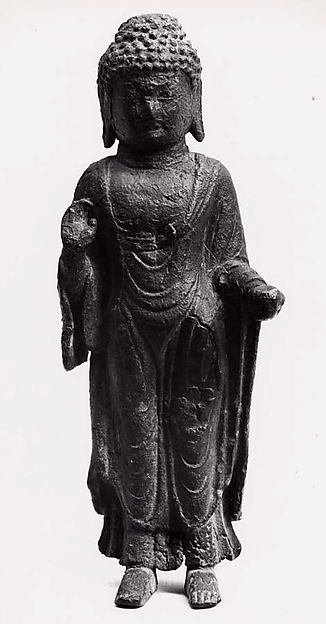
Korea, 11th to 12th century. Bronze; height 18.4 cm.
Look closer: The robe falls in long, narrow folds and the hands are held out in gestures of reassurance and giving. Compare the slim, upright figure with the heavier Jingo-ji Yakushi of the same few centuries.
The Metropolitan Museum of Art, Fletcher Fund, 1938 (38.79). Public domain, Open Access.

China, about 1319. Water-based pigment over a foundation of clay mixed with straw; 751.8 × 1511.3 cm.
Look closer: This is a wall, not a scroll: it is 15 metres wide. Look for the central Buddha and then the long rows of bodhisattvas and guardians on each side, which fill the wall as a procession fills a street.
The Metropolitan Museum of Art, Gift of Arthur M. Sackler, in honor of his parents, Isaac and Sophie Sackler, 1965 (65.29.2). Public domain, Open Access.
| Where | Form and name | What the record shows |
|---|---|---|
| India | Bhaiṣajyaguru; Bhaiṣajya-guru-vaiḍūrya-prabha-rāja | The full Sanskrit name; translated “Medicine Guru, King of Lapis Lazuli Light”. |
| China | Yaoshi Fo (藥師佛); Yaoshi Rulai (藥師如來) | The sutra was translated four times, the last in 707. His mantra is one of the Ten Small Mantras recited in Chinese monasteries. |
| Korea | Yagsa Yeorae (약사여래) | The Korean form. |
| Tibet | Sangyé Menla | The Tibetan form given in Wikipedia. |
| Vietnam | Dược Sư Phật | The Vietnamese form given in Wikipedia. |
| Japan | Yakushi Nyorai (薬師如来) | Honoured since at least the seventh century; the focus of Yakushi-ji, Shin-Yakushi-ji and Jingo-ji. |
| Korea, art | Yagsa Yeorae; Silla plaque; Goryeo bronze | The Cleveland Museum has a gilded copper plaque of the Medicine Buddha triad from the Unified Silla period (676 to 935), made by hammering from the back, and the Met a bronze “Buddha of Medicine” of the eleventh or twelfth century, 18.4 centimetres high. |
| China, wall painting | Yaoshi fo; Buddha of Medicine | The Met’s enormous mural of about 1319, 7.5 metres high and 15 metres wide, shows Bhaishajyaguru among his attendants. |
| China and Thailand, attributes | The pagoda, the amulet | Wikipedia says that in China he is sometimes shown holding a pagoda, and that in Thailand he appears on the Phra Kring amulet. |
| Central Asia | Bamiyan and Gandhāra | Birchbark fragments and a Gandhāran manuscript show the sutra circulated in Afghanistan and north-west India before the seventh century. |
The healer of the east
Among the Nyorai Yakushi is the Buddha who answers illness. The Thirteen Buddhas place him at the forty-ninth day after a death, the last of the seven-day rites that open the sequence, the same occasion that follows Jizō at thirty-five days and Miroku at forty-two. His attendants Nikkō and Gakkō stand on either side of him, and his twelve generals protect those who pray to him.
| Memorial occasion | Figure | Role |
|---|---|---|
| 35th day | Jizō Bosatsu | Fifth of the thirteen |
| 42nd day | Miroku Bosatsu | Sixth of the thirteen |
| 49th day | Yakushi Nyorai | The Healing Buddha, seventh of the thirteen |
| 100th day | Kannon Bosatsu | Eighth of the thirteen |
| 1st anniversary | Seishi Bosatsu | Ninth of the thirteen |
Where to see him
| Place | What to look for |
|---|---|
| Yakushi-ji, Nara | The bronze triad of 697 in the main hall rebuilt in 1976, and the East Pagoda of 730, the only original eighth-century building. |
| Shin-Yakushi-ji, Nara | The unpainted hinoki Yakushi and the twelve clay generals of the eighth century, eleven of them original. |
| Jingo-ji, Kyoto | The bare-wood Yakushi of the early Heian period, a National Treasure, in the Kondō. |
| Hōryū-ji, Ikaruga | The Yakushi of 607 in the Golden Hall, with the vow of Emperor Yōmei on the halo. |
| Metropolitan Museum of Art, New York | A Yakushi triad scroll, six wooden generals and a drawing of Anchira, all in the public domain. |
| Enryaku-ji, Mount Hiei | The Konpon-chūdō, the main hall of the Tendai school, rebuilt in 1642 under Tokugawa Iemitsu and dedicated to Yakushi. |
| Cleveland Museum of Art | The Kamakura scroll of Yakushi and the twelve generals, a seated Nikkō of about 800, a crystal-eyed general with a horse and a Silla gilt plaque, all in Open Access. |
| Rijksmuseum, Amsterdam | A hanging scroll of Yakushi, in the public domain. |
The triad in one picture
Japan, 17th or 18th century.
Look closer: Jar, raised hand, two attendants: the pattern of this chapter in one picture.
The Metropolitan Museum of Art, Gift of Sue Cassidy Clark, in honor of Barbara Brennan Ford, 2021 (2021.396.3). Public domain, Open Access.
In the house
The house keeps pieces that carry the Healing Buddha. The strip below reads the live shelves, so it shows what is available now.
A short dictionary of the Medicine Buddha
Terms are given in Japanese with the Sanskrit or Chinese root where the sources supply one.
- Yakushi Nyorai (薬師如来)
- The Medicine Master Buddha; the Japanese form of Bhaiṣajyaguru.
- Yakushi Rurikō Nyorai (薬師瑠璃光如来)
- The full name: the Medicine Master Buddha of Lapis Lazuli Radiance.
- Bhaiṣajyaguru
- The Sanskrit name: “Medicine Guru”, with the epithet “King of Lapis Lazuli Light”.
- Yakushikyō (薬師経)
- The Medicine Buddha Sūtra, which records the twelve vows.
- Jōruri (浄瑠璃)
- The eastern Pure Land of lapis lazuli, ruled by Yakushi.
- Nikkō (日光)
- Sun Radiance, the bodhisattva at Yakushi’s left hand.
- Gakkō (月光)
- Moon Radiance, the bodhisattva at Yakushi’s right hand.
- Yakushi sanzon (薬師三尊)
- The Yakushi triad: the Buddha with Nikkō and Gakkō.
- Jūni shinshō (十二神将)
- The Twelve Divine Generals who protect the Buddha and his devotees.
- Semui-in (施無畏印)
- The gesture of fearlessness, right hand raised, used in early Japanese Yakushi.
- Yakkō (薬壺)
- The medicine jar held in the left hand.
- Ennichi (縁日)
- A temple’s special day, when the benefit of prayer is held to be greatest; Yakushi’s is the eighth.
- Mokoshi (裳階)
- A small skirt roof between the main roofs of a pagoda.
- Shichi Yakushi (七薬師)
- The Seven Medicine Buddhas, from Yijing’s 707 translation.
- Yakushi hachibosatsu mandara
- The Shingon mandala that shows Yakushi with eight bodhisattvas.
- Shuni-e (修二会)
- The “second-month service”; at Yakushi-ji it is the Hana-e-shiki of late March.
- Hana-e-shiki (花会式)
- The flower rite of Yakushi-ji, with paper flowers offered to the principal image.
- Kokuhō (国宝)
- National Treasure, the highest designation for cultural property in Japan.
- Butsuzō-zu-i (仏像図彙)
- The 1783 compendium of Buddhist images on which common lists of the generals draw.
Answered plainly
What does Yakushi mean?
Yakushi is Japanese for “medicine master”. It renders the Sanskrit Bhaiṣajyaguru, “Medicine Guru, King of Lapis Lazuli Light”, the Buddha of healing and medicine.
How do I recognise a Yakushi statue?
Look for a plain-robed Buddha holding a small medicine jar in the left hand. In early Japanese images the right hand is raised in the fearless gesture and the figure otherwise resembles Shaka. The jar is the deciding attribute.
Who are Nikkō and Gakkō?
The bodhisattvas Solar Radiance and Lunar Radiance, who attend Yakushi on either side and form the Yakushi triad.
What are the twelve divine generals?
Armoured guardians introduced in the Yakushi Sutra who vow to protect his devotees and scriptures. Each is paired with a zodiac animal, and the names vary by tradition.
Why was Yakushi-ji founded?
Emperor Tenmu commissioned it in 680 to pray for his consort’s recovery from illness. He died in 686, and Empress Jitō consecrated the bronze triad in 697.
Which memorial service belongs to Yakushi?
In the Thirteen Buddhas sequence Yakushi presides over the forty-ninth day after a death, the seventh rite.
What are the twelve great vows of the Medicine Buddha?
They are promises he made as a bodhisattva: to shine, to be pure as crystal, to supply what beings need, to lead the lost back, to help keep precepts, to heal the sick and disabled, to relieve the poor, to help women in hardship, to free beings from evil thought, to save repentant prisoners and disaster victims, to save the starving and to save the poor tormented by insects. The full list is in the vows section of this chapter, following Wikipedia.
What is the Medicine Buddha mantra?
The long form, as Wikipedia gives it, ends “oṃ bhaiṣajye bhaiṣajye bhaiṣajya-samudgate svāhā”. It is one of the Ten Small Mantras. In Japan the esoteric seed syllable is bei.
Why does Yakushi hold a jar?
The jar is the medicine vessel. It is the attribute that identifies him in Japan.
Is Yakushi the same as Akshobhya?
No. Both are Buddhas of the east, which is why they are confused. Akṣobhya, Ashuku in Japan, makes the earth-touching gesture and belongs to the Five Wisdom Buddhas. Onmark records a wooden Ashuku at Kakuon-ji that was long taken for a Yakushi.
Which are the best temples to see him?
Yakushi-ji and Shin-Yakushi-ji in Nara, Jingo-ji in Kyoto, Hōryū-ji in Ikaruga and the main hall of Enryaku-ji on Mount Hiei. The list in the where-to-see section gives what each holds.
What day is Yakushi’s day?
The eighth of each month is his ennichi. Yakushi-ji holds a service at eleven in the morning and a talk in the afternoon, according to its published schedule, which may change.
Do people still pray to Yakushi?
Yes. Yakushi-ji keeps his monthly day, a new-year health prayer, the spring flower rite and a sutra-copying programme, which it promoted for the pandemic in 2020.
Where next
Sources and image credits
- The Metropolitan Museum of Art, object 853239
- The Metropolitan Museum of Art, object 75292
- The Metropolitan Museum of Art, object 45622
- Wikipedia, Bhaisajyaguru (names, vows, iconography, translators)
- Wikipedia, Yakushi-ji
- Wikipedia, Shin-Yakushi-ji
- Wikipedia, Twelve Heavenly Generals
- Wikipedia, Statue of Yakushi Nyorai (Jingo-ji)
- Wikipedia, Hōryū-ji
- Wikipedia, Thirteen Buddhas
- Japanese Architecture and Art Net Users System, Yakushi
- Japan Tourism Agency multilingual database, the Yakushi Triad of Yakushi-ji
- Japan Tourism Agency multilingual database, the Yakushi Nyorai of Hōryū-ji
- Yakushi-ji, the Yakushi Triad
- Wikipedia, Enryaku-ji
- Wikipedia, Kongōbu-ji
- Onmark Productions, Twelve Heavenly Generals (names, animals, lists)
- Onmark Productions, Ashuku Nyorai (Kakuon-ji statue)
- Japanese Architecture and Art Net Users System, Nikkō Gakkō
- Yakushi-ji official site, About
- Yakushi-ji official site, Annual events and rites
- New World Encyclopedia, Hōryū-ji
- Tokyo National Research Institute for Cultural Properties, Dismantling and repair of the East Pagoda of Yakushi-ji
- Nara Sightseeing, The restoration of the East Pagoda
- inkl, Nara temple celebrates completion of pagoda repairs
- Asia Research Institute, NUS, Protection without punishment: Buddhist gods during Covid-19
- Tale of Genji site, The Yakushi Pilgrimage of 49 Temples in Western Japan
- Rijksmuseum, Yakushi Nyorai (AK-RAK-1996-2)
- The Metropolitan Museum of Art, object 45618
- The Metropolitan Museum of Art, object 57372
- The Metropolitan Museum of Art, object 42716
- Cleveland Museum of Art, Medicine Master Buddha and the Twelve Divine Generals (1938.422)
- Cleveland Museum of Art, Sun Bodhisattva (Nikkō Bosatsu) (1961.48)
- Cleveland Museum of Art, A Heavenly General (One of the Jūnishinshō) (1988.53)
- Cleveland Museum of Art, Plaque with the Image of Medicine Buddha Triad (1987.59)
- Wikimedia Commons, Nara Yakushi-ji Kondo Interior Yakushi Triad 1.jpg (Zairon, CC BY 4.0)
- Wikimedia Commons, Nara Yakushi-ji Toto Exterior 05.jpg (Zairon, CC BY 4.0)
- Wikimedia Commons, Nara Yakushi-ji Saito & Toto.jpg (Zairon, CC BY 4.0)
- Wikimedia Commons, 12 Heavenly Generals ShinYakushiji.JPG (Ogawa Seiyou (1894-1960), a famous photographer in Japan, Public domain)
- Wikimedia Commons, Basara 12 Heavenly Generals ShinYakushiji.JPG (Ogawa Seiyou (1894-1960), a famous photographer in Japan, Public domain)
- Wikimedia Commons, Antera 12 Heavenly Generals ShinYakushiji.JPG (MITSUMURA ART Publishing Co., Public domain)
- Wikimedia Commons, Yakushi Nyorai Jingoji2.JPG (Annoted Photographer: Manshichi Sakamoto, Public domain)


Last reviewed 28 October 2026. Pictures are public-domain or openly licensed, each credited beneath it. Diagrams on this page are drawn by Japonista.
Looking for a Yakushi, a triad scroll, or a small altar piece for a home shrine? Tell us what you have in mind and we will look.
Private concierge
Looking for something in particular?
Describe the piece or the project you have in mind. A senior advisor in Tokyo reads every case file personally and replies within two business days, with fees set out in writing before any work begins.