
Ashuku Nyorai
Buddha of the East
Ashuku Nyorai
阿閦如来
The Buddha who is named for a vow never to be angry. In the Diamond Realm he holds the east, touches the earth with his right hand and is blue, the colour of a mirror that reflects without judging. In Japan his own images are hard to find, but he is prayed to on the sixth anniversary of a death.
Identity card
Know him at a glance
- The Buddha’s head. A Buddha wears no crown. JAANUS says Ashuku is usually shown blue, though this diagram keeps the house palette.
- The halo. A plain disc behind the head and body. The Met’s Tibetan painting of Akṣobhya shows a deep blue body against a red ground.
- The left fist. JAANUS says the left hand either lies clenched in the lap as the kongōken, the adamantine fist, or holds a corner of the robe. The diagram draws a simple closed circle.
- The right hand. The right hand reaches down to touch the ground, the shokuchi-in. It is not drawn here; look for it in the photographs below.
- The lotus throne. He sits cross-legged on a lotus. Wikipedia adds that in Indian and Tibetan art two elephants may support the throne.
The Buddha who would not be angry
Wikipedia gives the Sanskrit name Akṣobhya as the Immovable One, and says he is one of the Five Wisdom Buddhas of Mahāyāna and Vajrayāna Buddhism, lord of an eastern pure land called Abhirati, “The Joyous”. The Japanese Architecture and Art Net Users System, known as JAANUS, gives Ashuku Nyorai as the Japanese reading and places him in the east of the Kongōkai, the Diamond Realm mandala. JAANUS says that, with Amida, he is one of the earliest names to appear in Mahāyāna Buddhism, in the second century, and Wikipedia places the sutra of his vow among the oldest known Mahāyāna or Pure Land texts.
His story begins with a vow, and the vow is the name. A monk wished to practise the bodhisattva path in the eastern world of delight. He was told the path was hard, because a bodhisattva must harbour no anger or malice towards any being. He promised to hold none until his awakening, and he proved immovable, akṣobhya, in that promise. So he became the Buddha who lives in the east. Wikipedia and JAANUS agree on the terms of the oath: no anger or malice.
In Japan he is a quiet figure. JAANUS says that, owing to the early decline of his cult, there are no independent images of Ashuku made in Japan whose authenticity is certain, and that his image is to be seen in sets of the five wisdom Buddhas. This chapter therefore treats him as the eastern member of the Five Wisdom Buddhas, whose centre is Dainichi and whose western member is Amida, and it uses the Indian, Nepalese, Tibetan and Pakistani images in museums to show what he looks like. Where a claim on this page rests on a single source, the text says so.
An oath older than the mandalas

Bangladesh, probably Comilla District, 8th to early 9th century. Bronze; 20.2 × 13.4 cm.
Look closer: Look at the right hand resting down toward the earth, which is the gesture of the vow kept, and at the open scrollwork of the base beneath the lotus. This is among the oldest images in the chapter.
The Metropolitan Museum of Art, Gift of John and Evelyn Kossak, The Kronos Collections, 1984 (1984.486.5). Public domain, Open Access.
The text that tells the story is the Akṣobhyatathāgatasyavyūha Sūtra, in Chinese Achu foguo jing, in Japanese Ashuku bukkoku-kyō, the Scripture of the Buddha-land of Ashuku. It is old. Wikipedia places it among the oldest known Mahāyāna or Pure Land texts and dates its Chinese translation to the second century. JAANUS is more exact and says it was translated into Chinese in 147 and is the oldest extant Buddhist text to expound Pure Land thought. The Dictionary of Chinese Buddhist Terms, quoted by Onmark Productions, says his cult has existed in China since the Han dynasty.
The vow itself is simple and severe. A monk tells the Buddha of that world that he wishes to follow the bodhisattva path in the eastern world of delight, called Abhirati in Sanskrit and Myōki, 妙喜, in Japanese. The Buddha warns him that the practice is hard. A bodhisattva must generate no thoughts of anger or malice towards any being. The monk accordingly vows to feel none until he attains enlightenment. He keeps the vow, he becomes the Buddha Ashuku, and he now lives in the eastern world and teaches there. The oath is about a feeling, not a deed. It asks for an interior state that cannot be seen, and it names the Buddha after the state.
Newer evidence pushes the story back further still. Wikipedia reports that Gāndhārī manuscripts from the Bajaur Collection in Pakistan contain fragments of an early Mahāyāna sutra that mentions Akṣobhya, and that preliminary dating by script suggests the late first or early second century. More conclusive radiocarbon dating was described as under way, and this chapter has not seen a result, so the date should be read as provisional. Wikipedia also lists Jan Nattier’s 2000 article, “The Realm of Akṣobhya: A Missing Piece in the History of Pure Land Buddhism”, among its references; the title alone says something about how recently scholars began to treat Akṣobhya’s land as a rival to Amida’s.
He appears in other scriptures as well. The Digital Dictionary of Buddhism, quoted by Onmark, says brief descriptions occur in the Amitābha Sūtra and the Vimalakīrti Sūtra and the fullest in the Sūtra of the Land of Akṣobhya Buddha. The Soothill and Hodous dictionary, quoted at the same place, adds that he is first mentioned in the Prajñāpāramitā sutras and then in the Lotus Sūtra, where he is the first of the sixteen sons of the Buddha Mahābhijñājñānābhibhū. The Flammarion Guide, also quoted there, gives a third-century start for the Prajñāpāramitā mentions.
A hand that touches the earth

Pakistan, Swat Valley, 9th century. Bronze with silver and copper overlays; 24.1 cm.
Look closer: Look at the base: three elephant heads face the viewer in a row beneath the seat, the animal throne that JAANUS names for Ashuku. Then look at the crown and ornaments, which are those of a Buddha in tantric dress, and at the right hand reaching down.
The Metropolitan Museum of Art, Purchase, Friends of Far Eastern Art Gifts, 1985 (1985.77). Public domain, Open Access.
JAANUS gives the principal mark as the right-hand gesture of touching the ground, shokuchi-in, which it says symbolises his spiritual immovability. The left hand either lies in the lap clenched as the adamantine fist, kongōken, or holds a corner of the robe. He is usually blue; his animal throne is the elephant; his seed syllable is un (Sanskrit hūṃ); his esoteric symbol is a single five-pronged vajra or two of them arranged as an inverted T. The Shingon and Tendai mantra recorded in Wikipedia’s article on the Thirteen Buddhas is short: on akishubiya un, from the Sanskrit oṃ akṣobhya hūṃ.
Wikipedia’s article on the Five Tathāgatas describes the pose in the Indian terms. He may sit in the vajraparyaṅka posture, also called bhūmisparśa, with the right hand on the right knee, palm turned inwards and the middle finger touching the ground. The same earth-touching gesture is used by Shaka under the bodhi tree, and a viewer who reads only the right hand can mistake one for the other. The difference lies in context: Shaka sits alone as the historical teacher, while Ashuku usually sits in a set of five, and in the Diamond Realm he is blue. The Metropolitan Museum’s own title for one Tibetan gilt-copper image of the eleventh or twelfth century is “Buddha Shakyamuni or Akshobhya”, and it is an honest title: a single figure with that hand can be either.
Wikipedia’s article on Akṣobhya adds that his consort is Lochanā, that he is normally accompanied by two elephants, and that his attributes include a bell, three robes and a staff, as well as a jewel, lotus, prayer wheel and sword. Those belong largely to the Tibetan and Nepalese tradition. Japanese images are plainer, and the Japanese sources read for this chapter mention none of them.
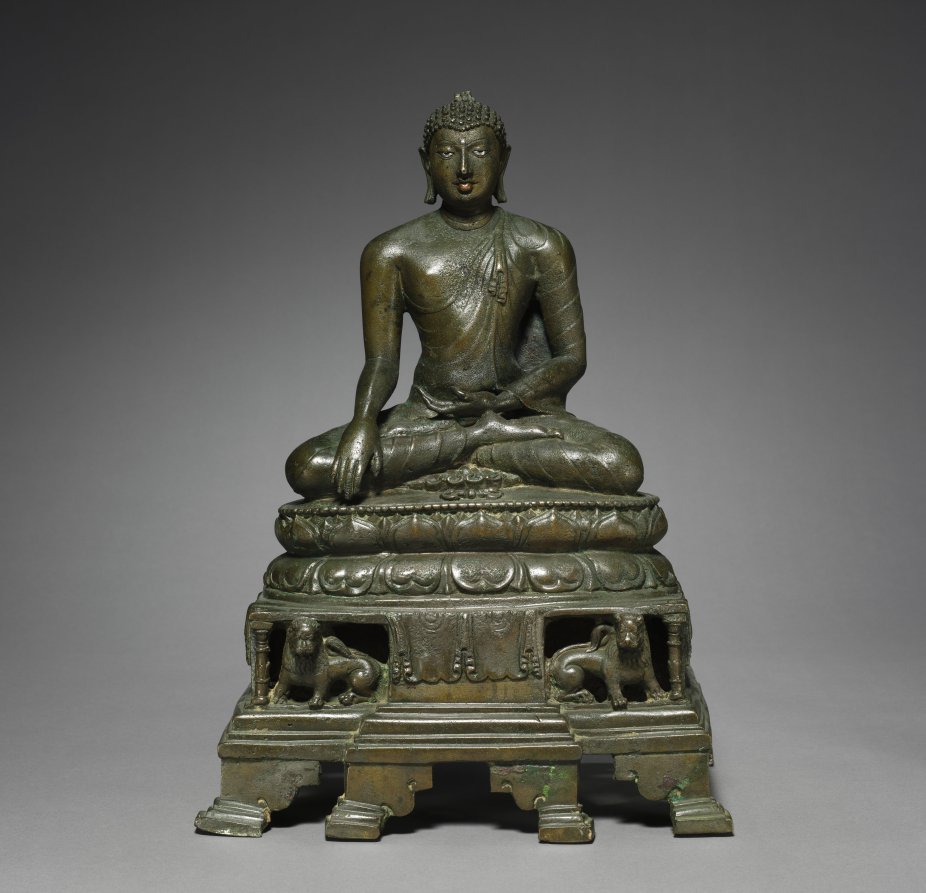
Northeast India, Bihar, Kurkihar, Pala period, late 800s. Bronze with silver and copper inlay.
Look closer: Look at the right hand reaching to the ground and at the tiered base below the lotus. The museum points to the double-headed vajra set on top of the pedestal in front of the figure, which it says shows that this is a tantric image.
Cleveland Museum of Art, Purchase from the J. H. Wade Fund (1970.10). CC0, Open Access.
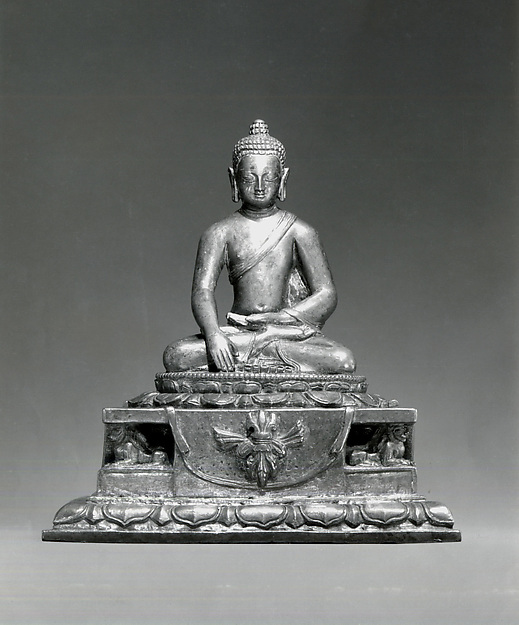
Nepal, Kathmandu Valley, 12th century. Copper with gold paint; 15.9 cm.
Look closer: Look at the front of the base, where a crossed vajra is set in the middle, the emblem JAANUS names for him, with a small seated animal at each end. The hand reaches down in the earth-touching gesture.
The Metropolitan Museum of Art, Gift of Bette-Ann and William Spielman, 1979 (1979.506). Public domain, Open Access.
| Feature | In the record | Source |
|---|---|---|
| Right hand | Touches the ground, shokuchi-in | JAANUS |
| Left hand | A fist, kongōken, or holding the robe | JAANUS |
| Colour | Usually blue; blue-black in Indian and Tibetan sources | JAANUS; Wikipedia |
| Mount or throne | Elephant; two elephants in Indian and Tibetan art | JAANUS; Wikipedia |
| Seed syllable | Un (hūṃ) | JAANUS; Onmark |
| Esoteric symbol | A five-pronged vajra, single or crossed | JAANUS |
| Direction | East of the Diamond Realm | JAANUS |
| Wisdom | The great perfect mirror wisdom | JAANUS |
The mirror that holds nothing
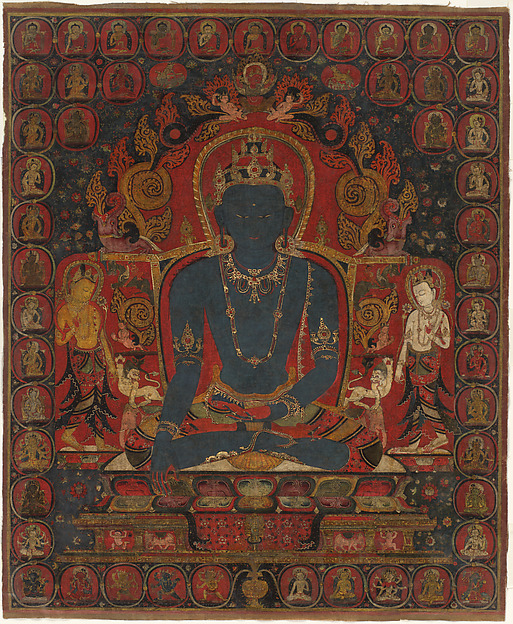
Central Tibet, 13th or early 14th century. Distemper on cloth; 76.4 × 62.8 cm.
Look closer: Look at the blue body against the red ground and at the rows of tiny Buddhas that make the border. The body is the deep blue of the ocean in Wikipedia’s image, and the border is the multitude of images that the mirror holds.
The Metropolitan Museum of Art, Purchase, Gift of Florence and Herbert Irving, by exchange, 2021 (2021.288). Public domain, Open Access.
In the scheme of the five wisdoms, Ashuku holds the great perfect mirror wisdom, daien kyōchi. JAANUS gives the Sanskrit as ādarśa-jñāna. Wikipedia’s article on Akṣobhya spells out the image. The mirror, it says, is like the mind itself: clear as the sky and empty, yet luminous. It holds all the images of space and time and is untouched by them. Its brilliance illuminates the darkness of ignorance and its sharpness cuts through confusion. The Buddha is that eternal mind, and the Vajra family is associated with it.
The same article ties the Vajra family to water, and the image is a good one for a Buddha whose virtue is not being moved. Even if the surface of the ocean is blown into crashing waves, the depths remain undisturbed. Water seems weightless but is heavy, it flows to the lowest place and settles, it carves rock without violence, and when frozen it is hard and clear like the intellect. Wikipedia adds that many wrathful, tantric beings are blue because they embody the transmuted energy of hatred and aggression, turned into wisdom. This is the other side of the vow: the Buddha who refuses anger and the fierce guardians who burn it up are, in colour at least, relatives.
In the five-family reading, Onmark Productions says each Buddha converts one of the afflictions into a wisdom, and that Ashuku turns anger and aggression into mirror-like wisdom. Wikipedia’s article on the Five Tathāgatas adds that the Guhyasamāja literature assigns the Vajra family the mantra vajradhr̥k. These are Indian and Tibetan frames, and the Japanese Shingon reading follows them closely, but the sources read do not say how a Japanese worshipper of the Heian or Kamakura period would have put it.
One of the five wisdoms
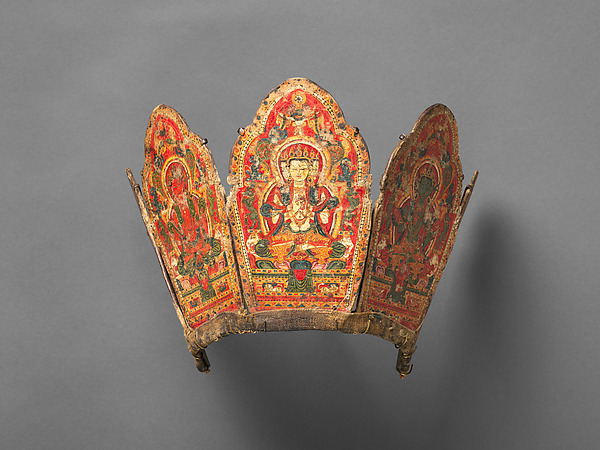
Tibet, late 14th to early 15th century. Opaque watercolor and gold on board.
Look closer: Look at the five painted panels, each with its own seated Buddha: the crown is worn by the officiant so that the five wisdoms sit on his head. JAANUS describes the Japanese counterpart, the five-wisdom crown, as the headgear of the initiate who is to attain a state equal to Vairocana.
The Metropolitan Museum of Art, Gift of Jeffrey Kossak, The Kronos Collections, 1985 (1985.391). Public domain, Open Access.
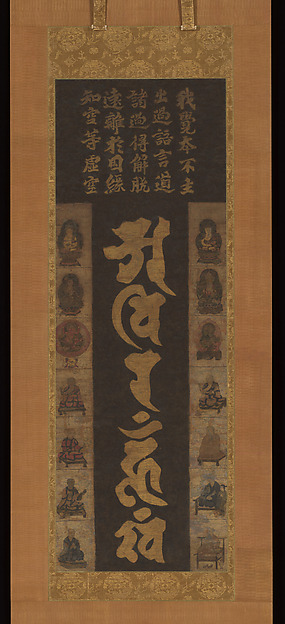
Japan, 13th to 14th century. Hanging scroll; ink, colors, and gold on silk.
Look closer: Look at the great Siddhaṃ letters in the centre and the small figures in columns on either side. The Met titles it a mandala in Sanskrit with Buddhas, bodhisattvas and the eight patriarchs of the Shingon sect. In this kind of Japanese picture the deities are present as seed syllables and as tiny figures at once.
The Metropolitan Museum of Art, Purchase, Sue Cassidy Clark Gift, in memory of Koichi Yanagi, 2024 (2024.410). Public domain, Open Access.
The Five Wisdom Buddhas, Gochi Nyorai, are the heart of the Diamond Realm. JAANUS gives the arrangement: Dainichi in the centre, Ashuku in the east with the great perfect mirror wisdom, Hōshō in the south with the wisdom of equality, Amida in the west with the wondrous observing wisdom, and Fukūjōju in the north with the wisdom of accomplishing action. In the Diamond Realm mandala he presides over the east, where he is surrounded by four attendant bodhisattvas, Vajrasattva, Vajrarāja, Vajrarāga and Vajrasādhu. The five also appear on the five-wisdom jewelled crown worn by Dainichi and by certain bodhisattvas, and, JAANUS says, on the head of the initiate at the Shingon rite that confers the rank of master.
The set was not always these five. Wikipedia’s article on the Five Tathāgatas says that the now-standard five first appear in the Sarvatathāgatatattvasaṃgraha, the Compendium of Principles, of the late seventh century, and in the Vajraśekhara Sūtra, but that directional Buddhas are older. The Sūtra of Golden Light, of about the fifth century, has a mandala with Shakyamuni in the centre and Ratnaketu, Amitāyus, Dundubhisvara and Akṣobhya round him; Indian stupas at Sanchi, Udayagiri and elsewhere carry four Buddhas facing the four directions. At Udayagiri the four are Vairocana, Amitābha, Akṣobhya and Ratnasambhava. The art historian Kimiaki Tanaka, Wikipedia says, argues that this four-direction scheme combined with the Vairocana of the Avataṃsaka Sūtra to make the later set of five.
JAANUS gives the frame. The Kongōkai mandala is described in the Diamond Peak Sutra, the Kongōchō-kyō, and is built from the five wisdom Buddhas, sixteen great bodhisattvas, four pāramitā bodhisattvas, eight offering bodhisattvas and four guardian bodhisattvas: 37 deities in all, divided into five families, the Tathāgata, Adamantine, Jewel, Lotus and Action families, which occupy the centre and the four quarters. Ashuku is the head of the Adamantine family. Kūkai brought to Japan the form of the mandala in which eight further mandalas are arranged round the great one, and that is the standard form in Shingon. JAANUS also records a 37-deity version brought by Saichō, once kept at Shōren-in in Kyoto and now at the Metropolitan Museum; the sources read do not say whether it is the Met’s handscroll of Diamond World deities of 1083, shown below.
The directions have their own variants. JAANUS says Ashuku or Yakushi is usually found in the east among the Four Buddhas of the four directions, with Amida in the west, and Miroku in the south and Shaka in the north in some arrangements; it gives the earliest such group, in the Golden Light Sutra of about the fourth century, as Ashuku in the east, Hōshō in the south, Amida in the west and Tenkuon in the north. Wikipedia’s article on the Five Tathāgatas, describing the same sutra, names the southern Buddha Ratnaketu and the northern Dundubhisvara, and dates the sutra to about the fifth century. The Hōshō chapter takes up the question of who the southern Buddha of the early set was.
JAANUS lists the Japanese sets of the five: at Anjō-ji in Kyoto of the ninth century, at present on view at the Kyoto National Museum; at Henmyō-in in Okayama, ninth century; at Kongōzanmai-in on Mount Kōya, thirteenth century; and at Tōji in Kyoto, sixteenth century. The Kyoto National Museum’s own pages spell the first temple Anshō-ji and show its seated Five Wisdom Buddhas, a National Treasure, in a special exhibition of 2019. At Tōji the Lecture Hall, Kōdō, is the great three-dimensional mandala, and the Five Great Buddhas stand at the centre of the dais.

Manuscript from Vikramashila Monastery, Bihar, with paintings made in Kathmandu, Nepal; dated Sunday, 14 September 1119 (Newar Samvat 239). Gum tempera, colours and paper on wood; cover 57 cm long.
Look closer: Look along the strip: the museum says the white Vairochana is in the centre, with blue Akshobhya next to him making the earth-touching gesture, red Amitabha with the meditation gesture, and gold Ratnasambhava and green Amoghasiddhi at the ends. The cover belongs to a copy of the Perfection of Wisdom in Eight Thousand Lines, dated 1119.
Cleveland Museum of Art, Purchase from the J. H. Wade Fund (1938.301.b). CC0, Open Access.

Japan, dated 1083. Handscroll; ink and color on paper; 29.8 cm high, 541.7 cm long.
Look closer: Look beneath each figure: lions under the large central roundel, and in the others an elephant, a horse and birds. These are the animal thrones, chōjūza, that JAANUS says mark the Buddhas of the Diamond Realm, and the elephant is Ashuku’s. The scroll is more than five metres long and shows only a short stretch here.
The Metropolitan Museum of Art, The Harry G. C. Packard Collection of Asian Art, Gift of Harry G. C. Packard, and Purchase, Fletcher, Rogers, Harris Brisbane Dick, and Louis V. Bell Funds, Joseph Pulitzer Bequest, and The Annenberg Fund Inc. Gift, 1975 (1975.268.3). Public domain, Open Access.
| Position | Buddha | Wisdom | Family (Wikipedia, Onmark) |
|---|---|---|---|
| Centre | Dainichi | The Dharma realm | Buddha |
| East | Ashuku | Great perfect mirror | Vajra |
| South | Hōshō | Equality | Ratna |
| West | Amida | Wondrous observation | Padma (Lotus) |
| North | Fukūjōju | Accomplishing action | Karma |
The Womb Realm names and the fierce forms
The five Buddhas of the Diamond Realm have a counterpart in the Womb Realm, and the two sets do not line up cleanly. JAANUS says Ashuku is identified with Tenkuraion in the Taizōkai, on the strength of a passage in the Dainichi Sutra in which Ashuku appears under the name Immovable One, Fudō, as the Buddha of the northern quarter, the position later assigned in the same text to Tenkuraion. Onmark’s page on the five Buddhas gives a different Womb Realm list: Hōtō (Ratnaketu) in the east, Kaifuke-ō in the south, Muryōju in the west and Tenkuraion in the north. Wikipedia’s article on the Five Tathāgatas says the Vairocanābhisaṃbodhi Sūtra has Saṃkusumitarāja and Ratnaketu in the places that Amoghasiddhi and Ratnasambhava hold in the later set.
The result is that a Japanese label can give the same Buddha two names. A set of five Buddhas on the Old Tōkaidō between Okabe and Fujieda in Shizuoka Prefecture, which the writer of the Temple Guy’s website found standing in a parking lot, carries name plates that read “Hōdō (Ashuku)”, “Kaifuke-ō (Hōshō)” and “Fukujoju (Shaka)”. In the writer’s account each figure has a second figure seated behind it with identical hand gestures, a puzzle that one of his professors explained as emanations, “like ripples in a pond”. The detail is worth keeping because it shows how the two mandalas were folded into one set of five when the figures were made.
Each Buddha also has a wrathful form, the Wisdom King who carries the same wisdom in a fierce body, and here the sources part company. Onmark’s table gives Ashuku’s as Gōzanze (Trailokyavijaya) and Hōshō’s as Gundari (Kuṇḍalī). The Soothill and Hodous dictionary, quoted at the same place, gives them the other way round, with Kuṇḍalī for Akṣobhya and Trailokyavijaya for Ratnasambhava, and Wikipedia’s article on Ratnasambhava says his wrathful form is Kuṇḍali. Two of the three sources therefore put Gundari with Hōshō and one puts it with Ashuku. The Wisdom Kings chapter of this almanac takes up the five fierce forms.
A cult that faded and returned

Tibet, 11th to 12th century. Gilt copper.
Look closer: Look at the right hand reaching to the earth and the empty throne. The Met’s title is “Buddha Shakyamuni or Akshobhya”, which is exactly the difficulty the sources describe: with no attribute and no inscription, the same gesture serves both.
The Metropolitan Museum of Art, Purchase, Rogers Fund and Florence and Herbert Irving Gift, 1995 (1995.106). Public domain, Open Access.
JAANUS says Ashuku, with Amida, is one of the earliest names to appear in Mahāyāna Buddhism, in the second century, as a Buddha living in a paradise. His early popularity declined, probably, JAANUS says, because of the greater popularity of Yakushi, who is also tied to the east. He remained in the texts as one of the four Buddhas of the four directions, usually the east, and in that role he regained an important place in Esoteric Buddhism around the seventh and eighth centuries, counted among the five Buddhas and thirty-seven deities of the Diamond Realm mandala. In late Esoteric Buddhism, it adds, he sometimes replaces Dainichi as the central deity.
The Flammarion Guide, quoted by Onmark, puts the Japanese story more bluntly: introduced with the two great mandalas in the early ninth century, he enjoyed little popularity and was soon eclipsed by Yakushi Nyorai, who also reigns over an eastern paradise. After the Heian period, it says, he was no longer represented except in mandalas, in the company of the other four. Wikipedia says something similar and a little differently: before Bhaiṣajyaguru arrived, Akṣobhya was the subject of a minor cult in Japan as a healing Buddha, though both are now venerated within Shingon.
The two Buddhas are tangled together in the sources, and the knot is worth recording. Onmark says that in some traditions Yakushi and Ashuku are said to inhabit the same body. Wikipedia’s article on Bhaiṣajyaguru says the principal image of Kongōbu-ji on Mount Kōya was changed from Akṣobhya to Bhaiṣajyaguru, an exceptional case; Wikipedia’s article on Kongōbu-ji lists the temple’s deity as Ashuku Nyorai without describing the image. Both statements cannot be right, and a visitor should ask the temple.
The Wikipedia article on the Five Tathāgatas adds a line on how far the five were ever worshipped as individuals. Although all five families abide in pure lands, it says, it appears that only Amitābha’s Sukhāvatī, and to a much lesser extent Akṣobhya’s Abhirati, were popularly venerated. In the Śūraṅgama Mantra, Wikipedia adds, Akṣobhya is named as host of the Vajra Division in the East, one of the five divisions that control the armies of the five directions. It is a role of command, not of comfort, and it fits a Buddha whose chief gift is steadiness.
The Buddha who was mistaken for a doctor
At Kakuon-ji, a temple in the hills of Kamakura, there is a wooden statue of Ashuku Nyorai. Onmark Productions says it was carved in 1322 by a local sculptor named Inkō, and that it is 115 centimetres tall. The deity holds a medicine jar in the left hand, and so the statue was originally thought to be Yakushi, the Medicine Buddha. At some point the temple priests found an inscription hidden inside the head that gave the name of the deity, Ashuku, and the carver, Inkō. Onmark adds, from Kondō Takahiro, that Inkō belonged to the “In” school of Kamakura sculptors, which included Inkei and In’no.
This is the only source read for the statue, and it should be weighed accordingly. The detail is specific and is credited by Onmark to a named scholar, but this chapter has not found a second source for it, and JAANUS says flatly that there are no independent images of Ashuku made in Japan whose authenticity is certain. The two statements can be reconciled if JAANUS means securely documented images of the classical period, but neither source says so. A visitor to Kamakura should treat the Kakuon-ji Ashuku as a claim to check with the temple.
The story, if true, has a fine irony. The two Buddhas who share the east are told apart by what they hold, and when the jar is in the wrong hand the distinction fails. Onmark records that Yakushi is lord of the Eastern Pure Land of Lapis Lazuli and Ashuku lord of the Eastern Land of Great Delight. Their cults were rivals once, and in this one statue they are confused for good.
A smaller tale is the Buddha’s second Japanese title. Onmark notes that among the Thirteen Buddhas Ashuku is known as Renge-ō, the Lotus King, a note credited to the site author and not to a classical source.
The sixth anniversary
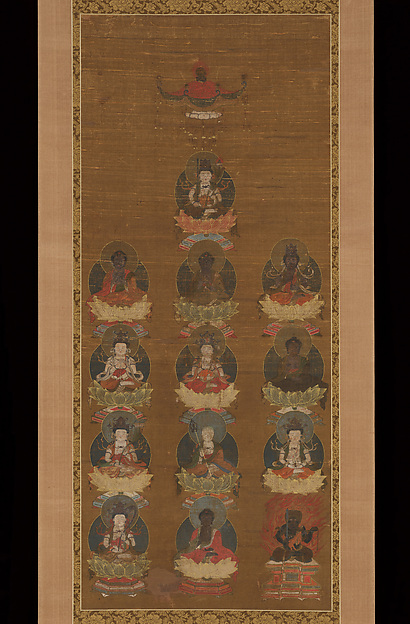
Japan, 16th or 17th century. Hanging scroll; ink, color, and gold on silk; image 94 × 39.7 cm.
Look closer: Look at the arrangement: the deities of the memorial sequence are set in rows, each on a lotus, with a fierce figure ringed in flames at the lower right in the manner of Fudō, who opens the sequence at the seventh day. Ashuku is one of the seated Buddhas among them, and a family would have used a scroll like this at the services.
The Metropolitan Museum of Art, Gift of Sue Cassidy Clark, in honor of Barbara Brennan Ford, 2021 (2021.396.1). Public domain, Open Access.
In Japan the dead are remembered at fixed intervals, and a set of thirteen Buddhas and bodhisattvas is matched to those dates. JAANUS says Ashuku presides over the memorial service held on the sixth anniversary of a person’s death, and Wikipedia’s article on the Thirteen Buddhas gives the same: Ashuku, sixth anniversary. It lists Amida at the second anniversary, Dainichi at the twelfth and Kokūzō at the thirty-second. In Shingon and Tendai services, Wikipedia says, lay followers recite a mantra to each figure in turn, and Ashuku’s is on akishubiya un.
The Thirteen Buddhas chapter of this almanac sets out the whole sequence, and the Dainichi chapter explains the twelfth-year service. A family that observes the sixth-year service, then, has Ashuku in mind without necessarily knowing his story. The vow never to be angry is a quiet one to hold over a grave: it asks the survivors, six years on, to have let their own anger go.
The sources read give the interval as the sixth anniversary. For the date of an actual service, the temple’s own notice is the authority.
Telling Ashuku from his neighbours
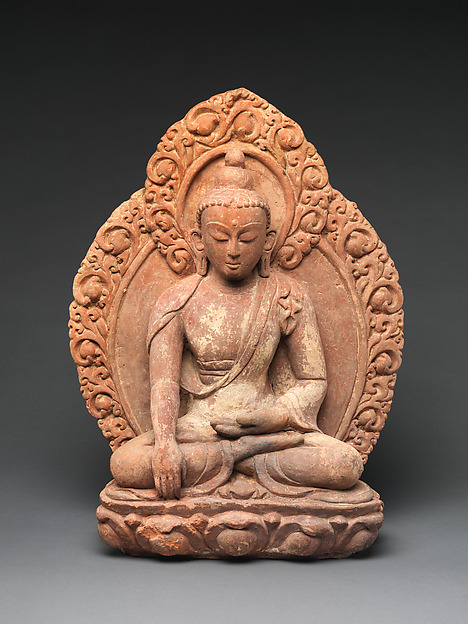
Nepal, 16th to 17th century. Terracotta; 50.8 × 37.5 cm.
Look closer: Look at the flamed halo and at the right hand reaching down. A small clay votive of this kind is how many people first meet him, and its identity rests on the hand alone unless an inscription says more.
The Metropolitan Museum of Art, Seymour Fund, 1962 (62.207). Public domain, Open Access.
A collector meets Ashuku in three settings: as one of a set of five Buddhas, as a single Himalayan or Indian bronze, and as a mandala or painted scroll in which he is one figure among many. Each needs a different eye, and the sources read give a sound starting point for all three.
First, the hand. The earth-touching gesture is common to Ashuku and Shaka. Look for the context that separates them: a set of five, a blue body, an elephant, a vajra on the throne or at the base. The Cleveland bronze has its double-headed vajra in front of the figure, which the museum reads as a sign of tantric intent, and the Met’s Swat Valley bronze has elephants. Remove those and the figure becomes the Met’s “Shakyamuni or Akshobhya”, a title that records a scholar’s hesitation.
Second, the jar. A seated Buddha with a medicine jar is usually Yakushi, but the Kakuon-ji story, if it is right, shows the opposite risk: an Ashuku with a jar in the left hand. JAANUS, for its part, says the left hand should be a fist or hold the robe. A figure whose left hand holds a jar and whose right touches the earth is therefore unusual, and any attribution to Ashuku should rest on an inscription, not on the hand alone.
Third, the set. Because JAANUS says Ashuku appears in Japan chiefly in sets of the five wisdom Buddhas, a single Japanese figure offered as Ashuku should be asked where the other four are. A figure that was made as one of five, and has lost its companions, is still worth having, but its value lies in the set it came from. Ask whether the figure has the same scale, the same wood and the same carving hand as any neighbours, and whether the hall or temple it came from can be named.
The house keeps no Ashuku at present, and a private request is the right route for anyone who wants one found. The concierge can discuss condition, boxes and provenance with anyone who writes.
Where the Immovable One stands now
The living tradition is quieter than the scholarship. In Japan he remains a figure of the Shingon and Tendai memorial service and of the mandalas used in initiation, and Tōji’s visitor pages still describe the Lecture Hall and its twenty-one statues, and the Japan Tourism Agency database carries a text written for visitors in 2019. The Kyoto National Museum showed the Anshō-ji set of five in the summer of 2019, and that exhibition page is the most recent public record of the set read for this chapter.
In scholarship the largest change of the past two decades is the dating of the earliest texts. The Bajaur manuscripts, reported by Wikipedia, push the first mentions of Akṣobhya towards the first century, and the 2000 article by Jan Nattier argued that his realm was a missing piece in the history of Pure Land Buddhism. Wikipedia’s article lists a teaching on Akṣobhya and his dhāraṇī by the seventeenth Karmapa among its external links, which suggests that the Tibetan practice is current.
The practical point for a visitor is that the best places to meet him are museums. The Cleveland Museum of Art, the Metropolitan Museum and the Kyoto National Museum hold the examples read for this chapter, and the Japanese temples that hold his images are mostly the temples of the Shingon school.
Small facts worth the detour
- His name is his vow: Akṣobhya is the Immovable One, and the vow was never to be angry (Wikipedia; JAANUS).
- JAANUS calls the Scripture of the Buddha-land of Ashuku, translated into Chinese in 147, the oldest extant Buddhist text to expound Pure Land thought.
- Gāndhārī manuscripts from the Bajaur Collection in Pakistan contain fragments of an early sutra that mentions him, provisionally dated by script to the late first or early second century (Wikipedia).
- He is the first of the sixteen sons of the Buddha Mahābhijñājñānābhibhū in the Lotus Sūtra (Soothill and Hodous, quoted by Onmark).
- Ashuku is sometimes named Fudō, the Immovable, the same word as the name of the red-faced Wisdom King (JAANUS; Wikipedia).
- In the Shingon mantra of the Thirteen Buddhas his words are on akishubiya un (Wikipedia, “Thirteen Buddhas”).
- A set of five Buddhas on the Old Tōkaidō in Shizuoka has a second set of five seated behind it, with identical hand gestures (the Temple Guy).
- The Cleveland Museum has a manuscript cover dated Sunday, 14 September 1119 with all five cosmic Buddhas painted on its inner side (Cleveland Museum of Art).
- The Met’s Tibetan figure is titled “Buddha Shakyamuni or Akshobhya”, because the earth-touching hand alone cannot settle which.
- At Kakuon-ji in Kamakura a statue taken for Yakushi is said to have been identified by an inscription inside its head (Onmark, single source).
Names across the Buddhist world
Wikipedia, JAANUS and the museum records give the following. The row on Japan is the shortest because the Japanese evidence is the thinnest.
| Where | Form and name | What the record shows |
|---|---|---|
| India | Akṣobhya, Akṣobhyatathāgata | The Sanskrit name: the Immovable One. The sutra of his vow is dated by Wikipedia to the second century CE. |
| Tibet | Blue-black; the vajra family | Wikipedia describes him as blue-black and as head of the vajra family. |
| Japan | Ashuku Nyorai (阿閦如来) | Eastern Buddha of the Kongōkai; Buddha of the sixth anniversary (JAANUS). |
| Pure land | Abhirati; Myōki (妙喜) | The world of Delight, in the eastern quarter (JAANUS). |
| Pakistan | Swat Valley bronze, 9th century | The Met’s crowned Akshobhya with a row of three elephants beneath the seat. |
| Bangladesh and Bihar | Bronzes of the 8th to 9th century and the late 800s | The Met’s Comilla bronze and the Cleveland bronze from Kurkihar, from the Pala period when tantric imagery was first emerging. |
| Nepal | Copper, terracotta and a painted cover | A 12th-century copper image, a 16th- or 17th-century terracotta and, in Cleveland, a manuscript cover dated 1119 whose paintings were made in Kathmandu. |
| Tibet | Painting and gilt copper | The Met’s blue Akshobhya of the 13th or early 14th century, and a gilt copper figure of the 11th or 12th century catalogued as Shakyamuni or Akshobhya. |
| Pure land | Abhirati; Myōki | Wikipedia says Abhirati was, to a much lesser extent than Sukhāvatī, popularly venerated. |
The Buddha of the east
Ashuku belongs to the Five Wisdom Buddhas of the Diamond Realm. The table sets him among them.
| Position | Buddha | Wisdom |
|---|---|---|
| Centre | Dainichi | The Dharma realm |
| East | Ashuku | Great perfect mirror |
| South | Hōshō | Equality |
| West | Amida | Wondrous observation |
| North | Fukūjōju | Accomplishing action |
Where to see him
| Place | What to look for |
|---|---|
| Cleveland Museum of Art | A late ninth-century bronze Akṣobhya from Bihar, Pala period, in Open Access. |
| Metropolitan Museum of Art, New York | The Bangladeshi bronze, the Nepalese terracotta and the Tibetan painting, all in Open Access. |
| Tōji, Kyoto | The Lecture Hall, Kōdō, with its 21 statues arranged as a three-dimensional mandala and the Five Great Buddhas on the central dais, according to the Japan Tourism Agency text; the present hall dates from 1491. |
| Kyoto National Museum | The seated Five Wisdom Buddhas of Anshō-ji, a National Treasure, shown in 2019; check the current display. |
| Metropolitan Museum of Art, New York | A handscroll of Diamond World deities dated 1083 and a scroll of the Thirteen Buddhas, both in Open Access. |
| Kakuon-ji, Kamakura | A wooden Ashuku of 1322 by Inkō, reported by Onmark alone; confirm with the temple before travelling. |
Akṣobhya in bronze, clay and paint
Northeast India, Bihar, Kurkihar, Pala period, late 800s. Bronze with silver and copper inlay.
Look closer: Look at the right hand reaching to the ground and at the tiered base below the lotus.
Cleveland Museum of Art, Purchase from the J. H. Wade Fund (1970.10). CC0, Open Access.
Nepal, 16th to 17th century. Terracotta; 50.8 × 37.5 cm.
Look closer: Look at the flamed halo and at the right hand reaching down.
The Metropolitan Museum of Art, Seymour Fund, 1962 (62.207). Public domain, Open Access.
Central Tibet, 13th or early 14th century. Distemper on cloth; 76.4 × 62.8 cm.
Look closer: Look at the blue body against the red ground and at the rows of tiny figures along the edge.
The Metropolitan Museum of Art, Purchase, Gift of Florence and Herbert Irving, by exchange, 2021 (2021.288). Public domain, Open Access.
In the house
Pieces of Ashuku appear on the shelves from time to time. The strip below reads the live shelves and appears only when one is in the house.
A short dictionary of the Immovable One
Terms are given in Japanese with the Sanskrit or Chinese root where the sources supply one.
- Ashuku Nyorai (阿閦如来)
- The Japanese form of Akṣobhya, the Buddha of the east among the Five Wisdom Buddhas.
- Akṣobhya
- The Sanskrit name: the Immovable One.
- Abhirati; Myōki (妙喜)
- His eastern pure land: delight, or the Joyous.
- Ashuku bukkoku-kyō (阿閦仏国経)
- The Scripture of the Buddha-land of Ashuku, which tells of the vow.
- Gochi Nyorai (五智如来)
- The Five Wisdom Buddhas of the Diamond Realm.
- Kongōkai (金剛界)
- The Diamond Realm mandala, in which Ashuku holds the east.
- Taizōkai (胎蔵界)
- The Womb Realm mandala, with its own set of five Buddhas.
- Daien kyōchi (大円鏡智)
- The great perfect mirror wisdom of Ashuku.
- Shokuchi-in (触地印)
- The earth-touching gesture: the right hand reaching to the ground.
- Kongōken (金剛拳)
- The adamantine fist, the left hand’s usual form.
- Un (吽)
- His seed syllable, from Sanskrit hūṃ.
- Sanmayagyō (三昧耶形)
- The esoteric symbol: here a five-pronged vajra, single or crossed.
- Chōjūza (鳥獣座)
- The animal throne; Ashuku’s is the elephant.
- Jūsanbutsu (十三仏)
- The Thirteen Buddhas of the memorial services; Ashuku presides over the sixth anniversary.
- Fudō (不動)
- The Immovable: a name of Ashuku in the Dainichi Sutra and of the Wisdom King Fudō Myōō.
- Gōzanze (降三世)
- The Wisdom King Trailokyavijaya, named by Onmark as Ashuku’s wrathful form.
- Gundari (軍荼利)
- The Wisdom King Kuṇḍalī, assigned to Ashuku or to Hōshō by different sources.
- Gochi hōkan (五智宝冠)
- The five-wisdom crown, worn at initiation.
- Kōdō (講堂)
- The Lecture Hall; at Tōji it holds the three-dimensional mandala of 21 statues.
Answered plainly
Who is Ashuku Nyorai?
Ashuku is the Japanese form of Akṣobhya, the Immovable One. He is the Buddha of the east among the Five Wisdom Buddhas of the Diamond Realm.
What is the story of his vow?
Wikipedia says a sutra dated to the second century CE tells of a monk who vowed never to feel anger or malice toward any being, and who became a Buddha in the east.
How can I recognise him?
JAANUS says his right hand touches the ground and his left is a fist. He is usually blue, and in a set of five he sits in the east.
What is his pure land called?
Abhirati in Sanskrit and Myōki, 妙喜, in Japanese, according to JAANUS.
Why is he linked to the sixth anniversary?
JAANUS says that in the Thirteen Buddhas, a set matched to memorial dates after a death, Ashuku is the Buddha of the sixth anniversary.
Are there famous Japanese statues of him?
JAANUS says his independent images are not securely identified. The images on this page are from museum collections, mainly Indian, Nepalese and Tibetan.
Why is Ashuku called the Immovable One?
Because of his vow. In the scripture a monk promised to feel no anger or malice towards any being until he reached awakening, and he kept the promise without wavering.
Is Ashuku the same as Yakushi?
No, though both rule an eastern land and were confused. Yakushi holds a medicine jar and is the Buddha of healing; Ashuku touches the earth with his right hand and belongs to the Five Wisdom Buddhas. Onmark records a Kamakura statue first thought to be Yakushi and later found by its inscription to be Ashuku (single source).
What is the difference between Ashuku and Shaka?
Both can make the earth-touching gesture. Shaka sits alone as the historical Buddha. Ashuku sits in a set of five, is usually blue and may have elephants under his throne or a vajra beside him.
What is the mantra of Ashuku?
In Shingon and Tendai services it is on akishubiya un, from the Sanskrit om akṣobhya hūṃ, as given by Wikipedia in its article on the Thirteen Buddhas.
What colour is Ashuku?
Usually blue in Japan (JAANUS) and blue-black in Indian and Tibetan sources (Wikipedia). One quoted dictionary says pale gold and the Tōji mandala detail reproduced by Onmark shows him green, so colour is a convention, not a rule.
Are there Japanese statues of Ashuku?
JAANUS says none of his independent Japanese images is securely authenticated and that he appears in sets of five. Sets survive at Anshō-ji (now at the Kyoto National Museum), Henmyō-in, Kongōzanmai-in and Tōji.
Where next
Sources and image credits
- The Metropolitan Museum of Art, object 38940
- The Metropolitan Museum of Art, object 38439
- The Metropolitan Museum of Art, object 854905
- Cleveland Museum of Art, Akshobhya: the Buddha of the East (1970.10)
- Wikipedia, Akshobhya
- Japanese Architecture and Art Net Users System, Ashuku
- Japanese Architecture and Art Net Users System, Gochi Nyorai
- Cleveland Museum of Art, The Five Cosmic Buddhas, top cover of a manuscript (1938.301.b)
- The Metropolitan Museum of Art, object 38990
- The Metropolitan Museum of Art, object 39358
- The Metropolitan Museum of Art, object 38646
- The Metropolitan Museum of Art, object 37789
- The Metropolitan Museum of Art, object 912998
- The Metropolitan Museum of Art, object 44845
- The Metropolitan Museum of Art, object 853237
- Japanese Architecture and Art Net Users System, Kongōkai mandara
- Japanese Architecture and Art Net Users System, Shibutsu (Four Buddhas)
- Wikipedia, Five Tathāgatas
- Wikipedia, Thirteen Buddhas
- Wikipedia, Ratnasambhava
- Wikipedia, Bhaisajyaguru
- Wikipedia, Kongōbu-ji
- Onmark Productions, Ashuku Nyorai
- Onmark Productions, Godai Nyorai (the Five Wisdom Buddhas)
- Tōji, Lecture Hall (Kōdō)
- Japan Tourism Agency multilingual database, Inside the Lecture Hall: A Three-dimensional Mandala
- Kyoto National Museum, Buddhist and Shinto Images of Kyoto (2019)
- The Temple Guy, Words-and-Pictures: The Buddhas of the Five Directions
Last reviewed 28 October 2026. Pictures are public-domain or openly licensed, each credited beneath it. Diagrams on this page are drawn by Japonista.
Looking for an Ashuku, a Five Wisdom Buddhas set or a small altar piece? Tell us what you have in mind and we will look.
Private concierge
Looking for something in particular?
Describe the piece or the project you have in mind. A senior advisor in Tokyo reads every case file personally and replies within two business days, with fees set out in writing before any work begins.