
Fukūjōju Nyorai
Buddha of the North
Fukūjōju Nyorai
不空成就如来
The Buddha whose name means that nothing he sets out to do fails. He holds the north of the Diamond Realm, raises a hand against fear, and is shown green, the colour of wind and of work completed. His family symbol is a double vajra.
Identity card
Know him at a glance
- The Buddha’s head. A Buddha without a crown. Wikipedia says Amoghasiddhi is usually coloured green, though the diagram keeps the house palette.
- The halo. A plain disc behind the head. In the Met’s Tibetan painting a green Buddha sits within a large halo, with attendants on each side.
- The left hand. The left hand rests in the lap in the usual seated manner.
- The raised hand. The right hand lifts in the mudra of fearlessness, which Wikipedia says stands for fearlessness toward the poisons and delusions.
- The lotus throne. He sits on a lotus. His mounts are garudas, and his family symbol is the double vajra (Wikipedia).
The one whose work does not fail
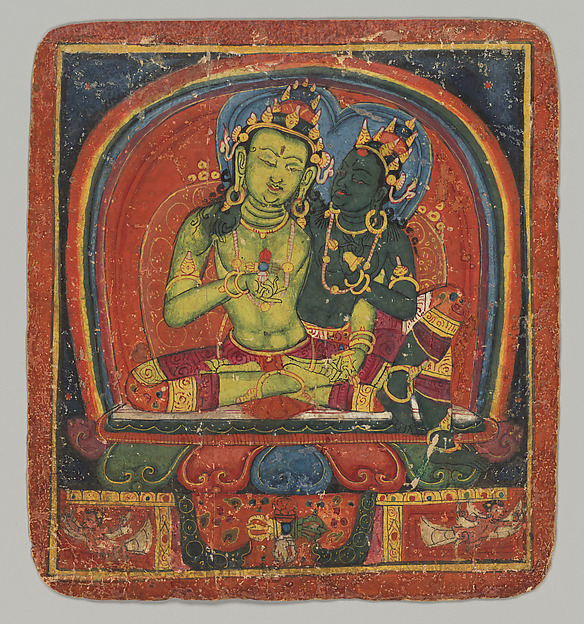
Tibet, early 15th century. Opaque watercolour on paper; 16 × 14.5 cm.
Look closer: Look at the green crowned figure and at his dark blue companion, and at the bands of the arch above them. Wikipedia gives the Buddha’s consort as Tārā and his colour as green; the card shows the pair seated close together.
The Metropolitan Museum of Art, Rogers Fund, 2000 (2000.282.5). Public domain, Open Access.
Wikipedia introduces Amoghasiddhi as one of the Five Wisdom Buddhas of the Mahayana and Vajrayana tradition. He is associated with the accomplishment of the Buddhist path and with the destruction of the poison of envy. His name means Unfailing Accomplishment. The Japanese Architecture and Art Net Users System, known as JAANUS, gives the Japanese as Fukūjōju, written 不空成就, and sets him in the north of the Diamond Realm.
Japanese Wikipedia explains the name in a sentence. The Sanskrit amogha, it says, means “not empty”, and the name shows a Tathāgata who leaves nothing undone. The wisdom it gives him, from the Yogācāra school’s list, is jōshosachi, which the article glosses as acting without being caught by anything. His esoteric symbol is the katsuma kongō, the karma vajra, a pair of three-pronged vajras crossed in a cross. His seed syllable is aḥ, and his mantra, in Japanese reading, is On abokya shitsudei aku.
Where Ashuku is defined by a vow and Hōshō by a gift, Fukūjōju is defined by action. JAANUS pairs him with the wisdom of accomplishing that which is to be done: the knowledge that is not only seen but carried out. The other three of the five are Dainichi at the centre and Amida in the west.
He is the least often met of the five. Japanese Wikipedia says that nearly all Japanese images of him were made as one of the five, and that an image or a cult of him alone is almost unknown. The most useful independent images in the museums read for this chapter come from Tibet, where he is painted green with a raised hand.
Green, with a hand raised
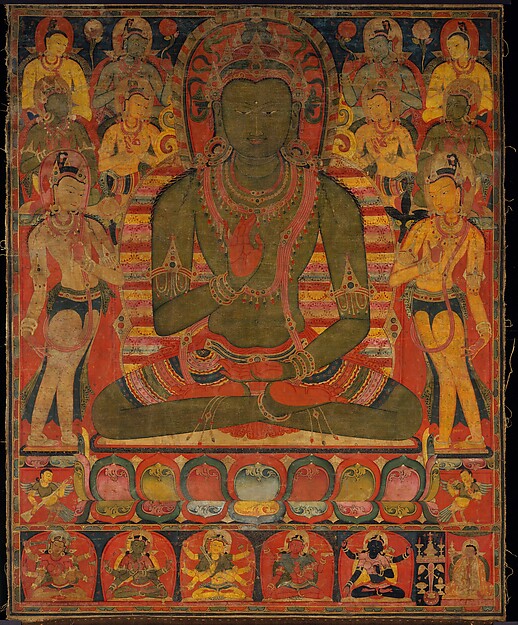
Central Tibet, about 1200 to 1250. Distemper on cloth; 68.9 × 54 cm.
Look closer: Look at the green central Buddha against the red panel, and at the small figures filling the borders. His right hand is raised and the left rests in his lap.
The Metropolitan Museum of Art, Purchase, Miriam and Ira D. Wallach Philanthropic Fund Gift, 1991 (1991.74). Public domain, Open Access.
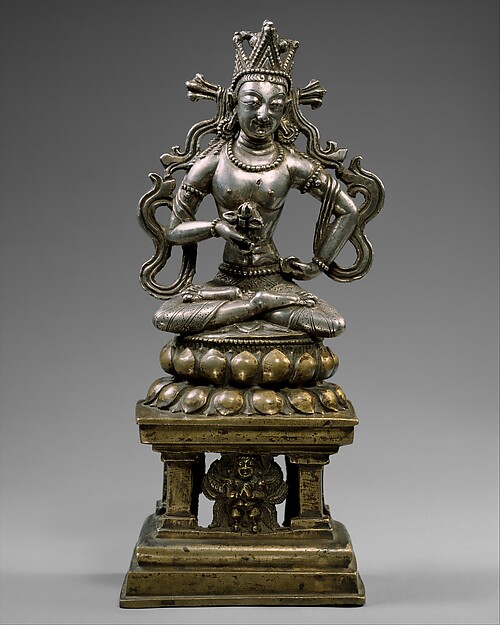
Western Tibet, late 10th to early 11th century. Silver and bronze with copper inlay and traces of gold foil; 20.3 × 8.9 cm.
Look closer: Look at the crown and the flowing scarves, and at the stepped base beneath the lotus. The figure is small, about 20 centimetres high, and from western Tibet.
The Metropolitan Museum of Art, Purchase, Lita Annenberg Hazen Charitable Trust Gift, 1984 (1984.211). Public domain, Open Access.
Wikipedia gives the signs. He is usually coloured green. He gestures in the mudra of fearlessness, and his mounts are garudas. His element is air or wind, his season is autumn, and his quarter is the northern Buddha field called Prakuta. His consort is Tārā, and he belongs to the karma family, whose symbol is the double vajra. His own symbol is the moon, and the article connects him with the conceptual skandha, the saṃskāra.
Japanese Wikipedia describes the hands. The left hand grips the robe in front of the belly, and the right hand is raised to the height of the chest with the palm turned forward, in the gesture that Japanese sources call semui-in, the fearless gesture. The Agency for Cultural Affairs, in its entry on the set of five Heian statues at Amano-san Kongō-ji in Ōsaka, describes the old iconography of the standard Diamond Realm mandala in the same way: the left fingers are curled at the abdomen, and the right hand differs for each of the four Buddhas. Ashuku touches the ground, Hōshō gives, and Fukūjōju offers the fearless gesture. A viewer who wants to tell the northern Buddha from the eastern one in a set need only look at the right hand.
The Metropolitan Museum has three images that show how the signs appear in practice. A Tibetan painting of about 1200 to 1250 shows a green Buddha at the centre of the panel with an attendant on each side, seated with small figures filling the borders. A silver and bronze figure from western Tibet, of the late tenth or early eleventh century, shows a crowned figure with flowing scarves on a lotus above a stepped base. A Tibetan initiation card of the early fifteenth century, on this page, shows a green, crowned Amoghasiddhi seated close against a dark blue consort.
A fourth image comes from the modern Himalayas and is released into the public domain by its photographer. It is a mural in a monastery at Kalimpong in the Indian state of West Bengal, and shows a green central Buddha inside a ring of four smaller green figures. It shows that the green Buddha is still painted on the walls of living monasteries as well as shown in museums.
The colour is part of a scheme: blue for Ashuku, yellow or gold for Hōshō and green for Fukūjōju. The Met’s own titles identify each of the first three images as Amoghasiddhi, and this chapter takes them at their word.

India, West Bengal. Mural painting; photograph by Prof Ranga Sai, 14 May 2013.
Look closer: Look at the four small figures set round the central Buddha in a cross, each in its own flame-coloured halo. The photographer’s caption says the mural is on the wall of Thongsa Gompa, a monastery at Kalimpong, and names the Buddha as the lord of the karma family.
Prof Ranga Sai, “Amoghasiddhi, mural at Thongsa Gompa, Kalimpong”, Wikimedia Commons, CC0. Source: commons.wikimedia.org (file page listed in the sources below).
| Sign | In the record | Source |
|---|---|---|
| Direction | North; Buddha field Prakuta | JAANUS; Wikipedia |
| Colour | Green (Wikipedia, Onmark); black or purple in one Japanese list | Wikipedia; Onmark; Japanese Wikipedia |
| Gesture | Fearlessness: right hand raised, palm out; left hand at the belly | Wikipedia; Japanese Wikipedia |
| Element and season | Air or wind; autumn | Wikipedia; Onmark |
| Mount | Garudas | Wikipedia; Onmark |
| Consort | Tārā | Wikipedia |
| Family symbol | Double vajra; the moon is his own symbol | Wikipedia |
| Esoteric symbol | Karma vajra, two crossed three-pronged vajras | Japanese Wikipedia |
| Wisdom | Accomplishing action, jōshosachi | JAANUS; Japanese Wikipedia |
Fukūjōju, Tenkuraion and Shaka
The Japanese name is Fukūjōju Nyorai, written 不空成就如来. Japanese Wikipedia gives the Tibetan as Don grub, and Wikipedia’s entry gives the Chinese as Bùkōng Chéngjiù Fó. In Japan the same Buddha has a second name in the other mandala, the Womb Realm.
JAANUS lists the four Buddhas of the Womb Realm around its central Dainichi as Hōdō in the east, Kaifukeō in the south, Muryōju in the west and Tenkuraion in the north. Japanese Wikipedia’s article on Tenkuraion, whose name means roughly the one with the thunder-like sound of the heavenly drum, says he stands north of the central Dainichi in that mandala, to the left of Dainichi in the picture, and that he is considered the same body as the Fukūjōju of the Diamond Realm. His seed syllable is the same, aḥ.
The article also says that Tenkuraion’s hand is the earth-touching gesture, which it glosses as the gesture of subduing demons, a sign that the Buddha’s will drives off whatever obstructs practice. The Fukūjōju of the Diamond Realm raises a hand against fear. Two gestures for one Buddha is not a contradiction in the sources, which say the figure is the same in meaning, but it is a trap for anyone who identifies a figure by its hand alone. The earth-touching gesture belongs, in the Diamond Realm, to Ashuku.
The earliest set of four is older still. JAANUS says the oldest group of four Buddhas of the four directions, in the Golden Light Sutra of about the fourth century, is Ashuku in the east, Hōshō in the south, Muryōju in the west and Tenkuon in the north. Wikipedia’s account of the same sutra, which it dates to about the fifth century, names the northern Buddha Dundubhisvara. The sources read do not say whether this northern Buddha is the one Japan later calls Tenkuraion, though the two names share the sense of a drum’s sound.
And then there is Shaka. Japanese Wikipedia says Fukūjōju is sometimes identified with Shaka, and in its table of the Five Wisdom Buddhas it gives him as identified with Shaka, as it gives Ashuku as identified with Yakushi. Onmark Productions says the northern Buddha is Fukūjōju “or sometimes Śākyamuni”, and the Soothill and Hodous dictionary, quoted by Onmark, says the five are not always the same: they may include Śākyamuni in place of Amoghasiddhi. On the Old Tōkaidō in Shizuoka, a set of five Buddhas photographed by the Temple Guy carries a name plate that reads “Fukujoju (Shaka)”. Wikipedia’s article on the Five Wisdom Buddhas adds that another text, the Amoghapāśakalparāja, puts Shakyamuni at the centre and replaces Amoghasiddhi with a Buddha named Lokendraraja.
The wisdom of accomplishing action
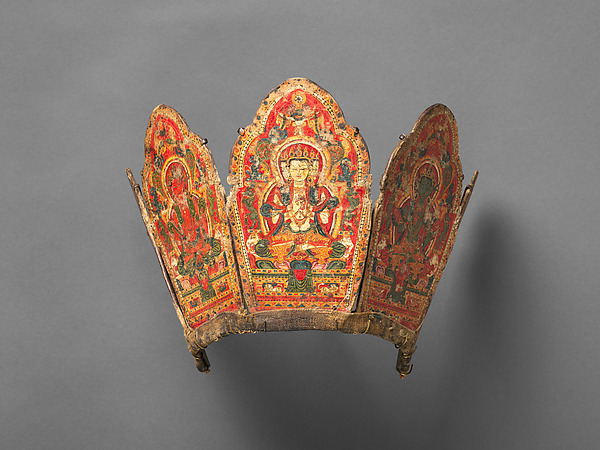
Tibet, late 14th to early 15th century. Opaque watercolour and gold on board.
Look closer: Look at the five painted panels, each with its own seated Buddha. In Tibet the officiant wears the crown so that the five wisdoms sit on his head, and one of them is the northern Buddha.
The Metropolitan Museum of Art, Gift of Jeffrey Kossak, The Kronos Collections, 1985 (1985.391). Public domain, Open Access.
JAANUS says each of the Five Wisdom Buddhas is matched with one of five wisdoms. Dainichi holds the wisdom of the Dharma realm, Ashuku the great perfect mirror, Hōshō equality, Amida wondrous observation, and Fukūjōju the wisdom of accomplishing action. It adds that the five wisdoms develop the four posited by the Yogācāra school, with the fifth, Dainichi’s, evolving within Esoteric Buddhism to embrace the other four.
Wikipedia’s article on the five wisdoms gives the doctrine behind the last of them. This wisdom, it says, is the awareness that spontaneously carries out all that has to be done for the welfare of beings, manifesting itself in every direction. Japanese Wikipedia puts it in the language of the Yogācāra school: it is the wisdom of acting without being held by anything. Onmark Productions, whose own text marks the identification unconfirmed, says Fukūjōju is the Tathāgata of unerring performance who teaches people how to benefit themselves and others, and who instils the will to work for the good of others.
In the five-family scheme this Buddha converts a poison. Wikipedia’s article on Amoghasiddhi says it is envy; Onmark’s page says jealousy and envy become all-accomplishing wisdom; and Onmark’s general account of the five wisdoms lists the five poisons as anger, envy, desire, ignorance and pride, one for each of the five Buddhas. The sources agree on the poison. None of the sources read says more about how the poison is turned.
The distribution of the five in space is the part that Japanese temples copy. JAANUS’s entry on the Diamond Realm describes the great mandala as built from the five wisdom Buddhas, sixteen great bodhisattvas, four pāramitā bodhisattvas, eight offering bodhisattvas and four guardian bodhisattvas, 37 deities in all, divided into five families. The standard form in Shingon is the nine-assembly form brought by Kūkai; a version of 81 deities was brought by Ennin and used in the Tendai school. Where the northern Buddha sits on the page is a matter on which the Japanese sources are plain: Japanese Wikipedia says that in the Diamond Realm mandala he is north of Dainichi, which on the picture is to the right of Dainichi as one looks at it.
The wisdom Buddhas appear on the five-wisdom crown. JAANUS says the crown is seen on Dainichi, Vajrasattva, Miroku and certain other bodhisattvas, that it is placed on the head of an initiate at the Shingon rite conferring the rank of master, and that the headgear worn by practitioners of Shugendō is identified with it. The Met’s Tibetan ritual crown, shown here, has five painted panels, one for each of the five Buddhas.
North in the mantra of the armies
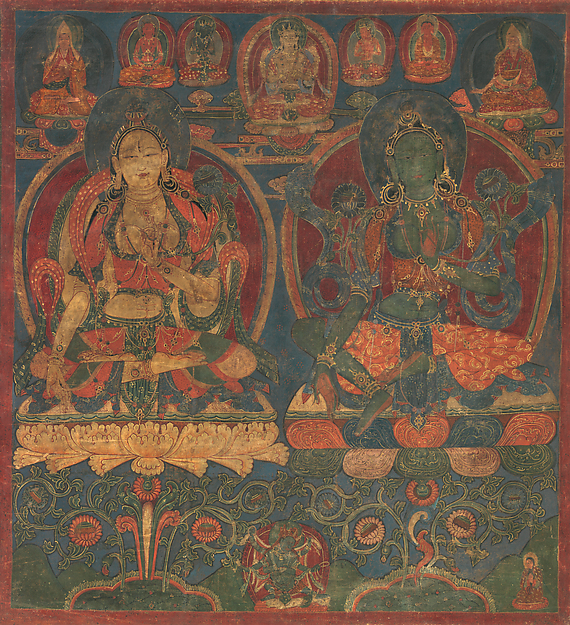
Western Tibet (Guge), 1450 to 1500. Distemper on cloth; 51.4 × 50.8 cm.
Look closer: Look at the green goddess on the right and her pale companion. Wikipedia says Tārā is the consort of Amoghasiddhi, and green is his colour. Small seated Buddhas fill a band across the top.
The Metropolitan Museum of Art, Zimmerman Family Collection, Purchase, Oscar L. Tang Gift, in honor of Agnes Hsu, 2012 (2012.460). Public domain, Open Access.
Wikipedia notes that in the Śūraṅgama mantra, a dhāraṇī widely recited in Chinese Chan Buddhism, Amoghasiddhi is named the host of the Karma Division in the north, one of the five great divisions that control the demon armies of the five directions. As with Hōshō in the south, his compass position is the same in a text from outside the Diamond Realm tradition.
Wikipedia’s article on the Five Wisdom Buddhas records the family mantras of the Guhyasamāja Tantra, in which each Buddha family has a mantra of its own; the Karma family’s is prajñādhr̥k. The same article says that the Vairocanābhisaṃbodhi Sūtra puts Saṃkusumitarāja and Ratnaketu in the places that Amoghasiddhi and Ratnasambhava hold in the later set, and that the standard five appear first in the Compendium of Principles, of the late seventh century.
The Soothill and Hodous dictionary, quoted by Onmark, adds that each of the five has three forms: a bodhisattva that represents the Buddha’s spiritual body, a vajra form that is his wisdom in gracious guise, and a fierce form, the Wisdom King, that is his power against evil. It gives Amoghasiddhi’s three as Maitreya, Karmavajra and Vajrayakṣa. In Japan that Maitreya is Miroku. Onmark’s own text says the Karma family is “sometimes associated with Tara Bosatsu”.
Tārā is, in Wikipedia’s account, the consort of the green Buddha, so a green figure in a Tibetan painting has often a green goddess nearby. The Met’s painting of White and Green Tara from western Tibet, dated 1450 to 1500, shows the two goddesses side by side; it is not a portrait of the Buddha, and the museum does not claim that. The Met also has a small silver goddess named Karmavajri, of the eleventh century in the Kashmiri style, whose name echoes his symbol; the sources read do not connect her to him. A collector who finds either figure in a group should not mistake it for him.
Kongōyasha, devourer of enemies

Japan, 12th century. Hanging scroll; ink on paper; image 72.1 × 54 cm.
Look closer: Look at the three faces and the six arms, and at the weapons held out in each hand: this is the form that Japanese Wikipedia describes. The drawing is in ink alone and is a model for painters, not a finished painting.
The Metropolitan Museum of Art, The Harry G. C. Packard Collection of Asian Art, Gift of Harry G. C. Packard, and Purchase, Fletcher, Rogers, Harris Brisbane Dick, and Louis V. Bell Funds, Joseph Pulitzer Bequest, and The Annenberg Fund Inc. Gift, 1975 (1975.268.12). Public domain, Open Access.
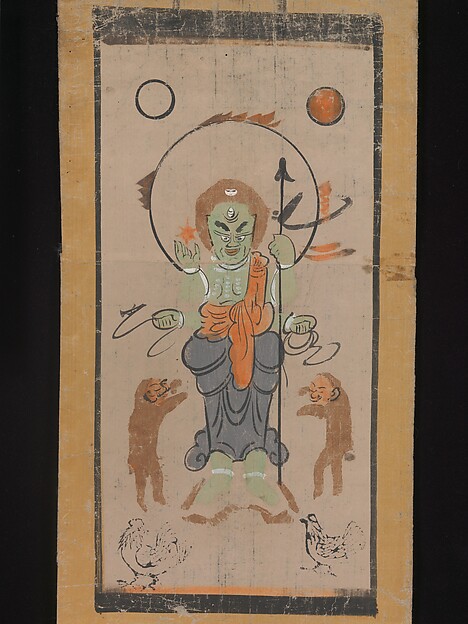
Japan, 17th century. Hanging scroll; ink, color and hand-coloured woodblock print on paper; 58.4 × 23.2 cm.
Look closer: Look at the blue-green face and the many arms, and at the two small brown creatures at his feet, which read as monkeys. This is the folk version of the Wisdom King, a popular print coloured by hand, and its sun and moon discs are above his head.
The Metropolitan Museum of Art, The Harry G. C. Packard Collection of Asian Art, Gift of Harry G. C. Packard, and Purchase, Fletcher, Rogers, Harris Brisbane Dick, and Louis V. Bell Funds, Joseph Pulitzer Bequest, and The Annenberg Fund Inc. Gift, 1975 (1975.268.142). Public domain, Open Access.
The fierce form of the northern Buddha is Kongōyasha Myōō, written 金剛夜叉明王, the Wisdom King Vajrayakṣa. Onmark Productions says he is the wrathful Shingon manifestation of Fukūjōju, and that in the Tendai school the Buddha is associated instead with Ususama Myōō. The Soothill and Hodous dictionary, quoted by Onmark, gives Vajrayakṣa as the third of Amoghasiddhi’s forms. The Tendai exception rests on Onmark alone.
Japanese Wikipedia describes the king. The name means a vajra-yakṣa, and the yakṣa in question was a terrifying demon that attacked and devoured people, who was converted by the virtue of Dainichi and became one of the protectors of Buddhism. Having turned to the faith, the article says, he devours only wrongdoers, and this is the reading that made him a deity of victory in war in Japan, one that warriors honoured. He is shown with three faces and six arms, and the front face has five eyes. The six hands hold a vajra, a bow and arrow, a long sword and a vajra bell.
His origin is older than the group of five. The article traces him to the Vajra Yakṣa Bodhisattva of the mandalas and sutras, one of the five bodhisattvas of great power described in the Ninnō-kyō, who are the forerunners of the Wisdom Kings. The article says that Amoghavajra’s later translation of the same sutra lists Vajrayakṣa Bodhisattva with Amoghasiddhi as the Buddha, the Crusher of All Demons as the bodhisattva and Kongōyasha as the king. The article quotes a passage of the Rishu-kyō in which the Crusher of All Demons forms the sign of the vajra fang and changes his whole body into the form of Vajrayakṣa, to frighten all things and draw them to the path, so that great wrath becomes great joy.
The Wisdom King has a second life outside the temple. Wikipedia’s article on the Kōshin belief says that one prominent god of that folk cult was Shōmen Kongō, the Blue-Faced Vajra-Yakṣa, a fearsome many-armed deity. The earliest scriptures to link him with Kōshin came from esoteric rituals at Onjōji, known as Miidera, and Shitennō-ji was another early centre. When the cult expected the god to sicken the Three Corpses that live inside each person and keep them from reporting to the heavenly emperor, he became Kōshin-san. The Met holds two hanging scrolls of this folk figure, titled Ōtsu-e of Shōmen Kongōyasha, and the title identifies him with the Wisdom King. The sources read for this chapter do not say whether the folk deity and the Wisdom King were always one figure.

Japan, 12th century. Handscroll; ink and color on paper; 33.7 cm high, 1,285.7 cm long.
Look closer: Look at the five kings in their flames, each with his own weapon beside him. Together the five are the fierce forms of the five Buddhas, and one of them is Kongōyasha. The scroll is more than twelve metres long and shows only a short stretch here.
The Metropolitan Museum of Art, The Harry G. C. Packard Collection of Asian Art, Gift of Harry G. C. Packard, and Purchase, Fletcher, Rogers, Harris Brisbane Dick, and Louis V. Bell Funds, Joseph Pulitzer Bequest, and The Annenberg Fund Inc. Gift, 1975 (1975.268.6). Public domain, Open Access.
Five, never one: the surviving sets
Because Fukūjōju is rarely made alone, his Japanese history is the history of the sets. JAANUS lists the oldest: the five at Anshō-ji in Kyoto, of the ninth century and at present on view at the Kyoto National Museum; those at Henmyō-in in Okayama, also of the ninth century; at Kongōzanmai-in on Mount Kōya, of the thirteenth century; and at Tōji in Kyoto, which it dates to the sixteenth. The Kyoto National Museum says of the Anshō-ji five that they were designated National Treasures in 2019 and are the oldest extant complete statuary set of the iconography. Its own exhibition list of 2007 shows them then as an Important Cultural Property, so the 2019 designation was a promotion within the register.
The Agency for Cultural Affairs database describes a set at the Gobutsu-dō of Amano-san Kongō-ji in Ōsaka Prefecture: five Heian-period statues designated Important Cultural Properties on 7 June 2005, with Dainichi at the centre and Ashuku, Hōshō, Amida and Fukūjōju at the four quarters. The four are identified by the seed syllables on the tops of their haloes. The entry says that Ashuku and Hōshō sit with the left foot outside, in front of the altar, and that Fukūjōju and Amida sit behind them with the right foot outside. It dates the work to about 1180.
The entry contains a remark that every collector of Buddhist sculpture should remember. Hōshō and Fukūjōju at Kongō-ji have heads and bodies carved of separate materials, and a recent repair found that the bodies of the two appear to have been exchanged. The statues have never been taken apart for repair, and from the state of the joins the present arrangement is judged to be the original specification. In plain words, the northern Buddha and the southern Buddha of the set have each other’s torsos, and the Agency concludes that this is how they were made. The Anshō-ji set, the entry adds, follows the old pattern, and the Kongō-ji set a newer one, with different leg positions.
Japanese Wikipedia’s article on the five Wisdom Buddhas names two well-known sets, Tōji’s and Anshō-ji’s, and illustrates the pagoda of Kongōzanmai-in on Mount Kōya, where the Buddhas stand around the central Dainichi with Fukūjōju at the right front as the viewer faces them, and the others follow clockwise. At Tōji the temple’s own text, published by the Japan Tourism Agency, says that the 21 statues in the Lecture Hall form a three-dimensional mandala, that 15 of them were made in the early ninth century and installed in 839 according to tradition, and that the other six replaced losses after the hall was rebuilt in 1491. At the centre of the dais stand the Five Great Buddhas. The text does not say which of the statues are original, so this chapter does not say whether the Tōji Fukūjōju is of the ninth century or later; JAANUS’s sixteenth-century date for the set is another figure to hold beside it.
In Miyazaki Prefecture the wandering sculptor Mokujiki, who lived from 1718 to 1810, carved a set of five Wisdom Buddhas for Hyūga Kokubun-ji after a fire there in 1791, and left the temple in 1797. Japanese Wikipedia, which describes the site, says the statues were protected by local worshippers when the temple was abandoned in 1871, are now a prefectural cultural property and are kept in a hall called the Mokujiki Gochi-kan. The year of the carving is not stated, so this chapter gives only the span the text allows. The Hōshō chapter tells the sculptor’s story at greater length.
A modern set stands in Kumamoto Prefecture. Japanese Wikipedia’s article on Renge-in Tanjō-ji in Tamana records that the temple’s pagoda, the Tahōtō, was completed on 12 May 2018, with a ceremony to open the eyes of the Gochi Nyorai that day. The article says the central Dainichi faces east, Ashuku east, Hōshō south, Muryōju west and Fukūjōju north, and that the five are shown to the public on 13 January, 29 April and 13 June each year. Both of Wikipedia’s statements come from one encyclopedia in one language, and no statement by the temple was read for this chapter, so this is a single-source report. Visitors should confirm the dates with the temple.
A whole other family of five turns up in a place-name. Japanese Wikipedia says that one theory holds the place-name Gochi in Isobe to come from the Five Wisdom Buddhas. The article offers it as a theory and the sources read for this chapter do not support or contradict it.

Japan, Miyazaki Prefecture, Saito; carved by Mokujiki between 1791 and 1797. Photograph by Saigen Jiro, 24 August 2013.
Look closer: Look at the five figures as a group: they sit in a single row, with rounded faces and plain robes, carved as a set. Mokujiki’s Buddhas are generally gentle in expression. The photograph was taken inside the Mokujiki Gochi-kan.
Saigen Jiro, “Gochi Nyorai, Hyūga Kokubun-ji (Mokujiki Gochi-kan)”, Wikimedia Commons, Public domain. Source: commons.wikimedia.org (file page listed in the sources below).
Telling Fukūjōju from his neighbours
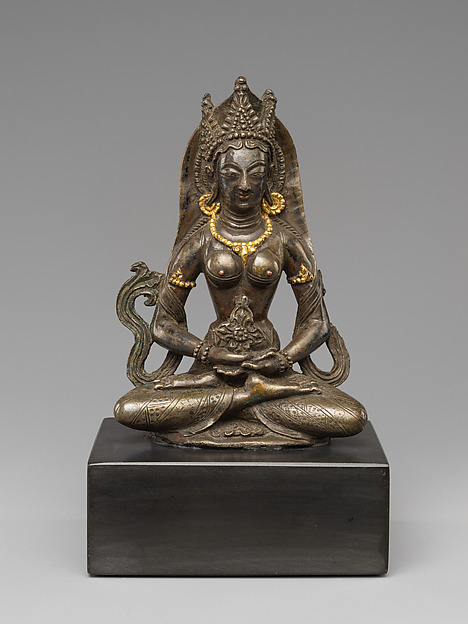
Kashmir style in western Tibet, 11th century. Silver inlaid with copper and gold; 10.8 × 7 cm.
Look closer: Look at the tall crown and the object held before the chest. Her name, Karmavajri, echoes the karma vajra that is the northern Buddha’s symbol in Japanese Wikipedia, but the sources read do not link her to him, so she is a neighbour in name only. The Met dates her to the eleventh century and calls the work Kashmiri in style, made in western Tibet.
The Metropolitan Museum of Art, Gift of Amy and Robert Poster, 2022 (2022.363). Public domain, Open Access.
A collector meets Fukūjōju in three settings: as one of a set of five, as a single Himalayan bronze or painting, and as one figure among many on a card, crown or mandala. He is the Buddha most likely to be mislabelled, because his gesture is a common one and his colour is not constant.
First, the hand. In a set of five seated Buddhas of the Diamond Realm the right hand tells the northern Buddha from his neighbours: the raised palm is Fukūjōju, the giving hand is Hōshō, the earth-touching hand is Ashuku, and Amida holds the meditation gesture in the lap. The Agency for Cultural Affairs entry on Kongō-ji describes this for the old pattern, and also shows that a later set may use a different arrangement of hands. A raised palm alone is not enough, since the sources read show the same hand elsewhere in the mandalas.
Second, the colour and the seat. Green and a garuda throne are what Wikipedia and the Tibetan paintings give, but Japanese Wikipedia’s list gives black or purple, and Japanese wooden figures rarely keep their paint. What remains is the gesture and the seed syllable on the halo. At Kongō-ji the four Buddhas are identified from the seed syllables on the top of the halo, a reminder that an inscription is worth more than a pose. Fukūjōju’s seed is aḥ, in Japanese Wikipedia’s account, which is also the seed syllable it gives for Tenkuraion.
Third, the name. A figure labelled Tenkuraion may be the Womb Realm form of the same Buddha, and the sources say they are the same body, but its hand may be earth-touching. A figure labelled Shaka in a set of five may be the northern Buddha, as the placard on the Old Tōkaidō shows. A collector or a curator who finds a seated Buddha in a Japanese set with a raised hand should ask where the other four are before settling the name.
Fourth, the set. The Agency for Cultural Affairs found that at Kongō-ji the bodies of Hōshō and Fukūjōju appear to have been exchanged and that the arrangement is original. A single figure of this kind should therefore be asked three questions: where are the other four, who made the set, and do the head and body belong together. A figure made to stand in a set and now parted from it is still worth having, but its value lies in the set it came from.
Fifth, the retinue. The goddess Tārā, who is his consort in Wikipedia’s account, and the silver Karmavajri, whose name echoes his symbol, are easily taken for him. The folk prints of Shōmen Kongō are not images of the Buddha but of a fierce deity connected with his fierce form. The house keeps no Fukūjōju at present, and a private request is the right route for anyone who wants one found. The concierge can discuss condition, boxes and provenance with anyone who writes.
Where the northern Buddha stands now
The living tradition is quiet. In Japan Fukūjōju is a figure of the Shingon and Tendai mandalas and of the sets of five in their halls; the newest fact in the public record is the elevation of the Anshō-ji five to National Treasures in 2019, the year in which the Kyoto National Museum showed them. The Tōji text on the Lecture Hall, placed in the Japan Tourism Agency’s database for 2019, is the other recent statement of how his hall is read.
The newest statues in the sources read are the five of the Renge-in pagoda in Kumamoto, consecrated in 2018 according to Japanese Wikipedia, and the Mokujiki set in Miyazaki, whose gallery was built in a purpose-made hall. Visitors should confirm opening times with the temple or the local authority before travelling.
Outside Japan he is a living icon. The monastery mural at Kalimpong was photographed in 2013, and the Tibetan painting, silver and card in the Met show that the green Buddha has been made across the Himalayas from about the tenth century. In scholarship the largest open question is the one in the fact boxes above: how the northern Buddha of the sutras, Tenkuraion of the Womb Realm and Amoghasiddhi of the tantras are related, which English Wikipedia’s account of Tanaka Kimiaki’s argument describes as the growth of a four-Buddha scheme into a set of five.
The practical point for a visitor is that Fukūjōju is best found in company. The museum images read for this chapter are in the Metropolitan Museum; the Japanese sets are in Kyoto, Mount Kōya, Okayama, Ōsaka, Miyazaki and Kumamoto, and each is more rewarding when seen as a whole.
Small facts worth the detour
- His name means Unfailing Accomplishment, and Japanese Wikipedia reads the Sanskrit as “not empty”.
- His esoteric symbol is the karma vajra, two three-pronged vajras crossed in a cross (Japanese Wikipedia).
- Japanese Wikipedia says images of Fukūjōju alone are almost unknown in Japan; nearly all were made as one of five.
- The Agency for Cultural Affairs notes that at Kongō-ji in Ōsaka the bodies of Hōshō and Fukūjōju appear to have been exchanged, and that the present arrangement is judged original.
- A set of five Buddhas on the Old Tōkaidō in Shizuoka carries a placard that reads “Fukujoju (Shaka)” (the Temple Guy).
- The Womb Realm’s Tenkuraion is said to be the same body, but takes the earth-touching hand (Japanese Wikipedia).
- The Anshō-ji five were named National Treasures in 2019 as the oldest complete set of the iconography (Kyoto National Museum).
- His fierce form, Kongōyasha, was a man-eating yakṣa in the story, and eats only wrongdoers after his conversion (Japanese Wikipedia).
- A folk print of the blue-faced Kongōyasha in the Met shows two small brown figures at his feet that look like monkeys (the Met’s image, read by eye).
- The Hyūga Kokubun-ji set was carved by the wandering sculptor Mokujiki after a fire in 1791 (Japanese Wikipedia).
Names across the Buddhist world
Wikipedia’s entry and Japanese Wikipedia give the forms of the name. The museum records add where the images have been found.
| Where | Form and name | What the record shows |
|---|---|---|
| India | Amoghasiddhi (अमोघसिद्धि) | Sanskrit, Unfailing Accomplishment. |
| China | Bùkōng Chéngjiù Fó (不空成就佛) | The Chinese name for the same Buddha. |
| Japan | Fukūjōju Nyorai (不空成就如来) | The north of the Five Wisdom Buddhas; in the Womb Realm, Tenkuraion. |
| Tibet | Don grub (དོན་གྲུབ།) | The Tibetan name, as Japanese Wikipedia gives it. |
| Western Tibet | Silver and bronze figure, 10th to 11th century | The Met’s crowned, scarved figure on a lotus above a stepped base. |
| Central Tibet | Painting, about 1200 to 1250 | The Met’s green Buddha with eight bodhisattvas. |
| Tibet | Initiation card, early 15th century | A green Amoghasiddhi seated close against a dark blue consort. |
| Kalimpong, India | Monastery mural, photographed 2013 | A green central Buddha ringed by four small green figures, on a monastery wall. |
| Western Tibet (Guge) | White and Green Tara, 1450 to 1500 | The green goddess, consort of the green Buddha in Wikipedia’s account. |
| Japan | Sets of five | Anshō-ji, Henmyō-in, Kongōzanmai-in, Tōji, Kongō-ji and the Mokujiki set at Hyūga Kokubun-ji. |
| Kumamoto, Japan | Renge-in Tanjō-ji pagoda, 2018 | Japanese Wikipedia records a new set of five here; no temple source was read, so the report stands alone. |
The Buddha of the north
Fukūjōju belongs to the five of the Diamond Realm. The table sets him among them.
| Position | Buddha | Wisdom |
|---|---|---|
| Centre | Dainichi | The Dharma realm |
| East | Ashuku | Great perfect mirror |
| South | Hōshō | Equality |
| West | Amida | Wondrous observation |
| North | Fukūjōju | Accomplishing action |
Where to see him
| Place | What to look for |
|---|---|
| Metropolitan Museum of Art, New York | The Tibetan painting, the silver figure, the initiation card, the Green Tara and the Karmavajri, and the Japanese drawings of Kongōyasha, all in Open Access. |
| Kyoto National Museum | The Five Wisdom Buddhas of Anshō-ji, a National Treasure since 2019, were shown in that year; check the current display. |
| Tōji, Kyoto | The Lecture Hall, Kōdō, with 21 statues forming a three-dimensional mandala and the Five Great Buddhas at the centre of the dais. |
| Mount Kōya | JAANUS lists the set of the thirteenth century at Kongōzanmai-in. |
| Amano-san Kongō-ji, Ōsaka | The Gobutsu-dō, with five Heian statues of about 1180 that are Important Cultural Properties; confirm access with the temple. |
| Mokujiki Gochi-kan, Saito, Miyazaki | Five statues carved by Mokujiki at Hyūga Kokubun-ji, a prefectural cultural property; confirm opening times locally. |
| Renge-in Tanjō-ji, Tamana, Kumamoto | Japanese Wikipedia records a new set of five in the pagoda, shown on three dates a year; a single-source report, so confirm with the temple. |
Unfailing Accomplishment in silver and paint
Western Tibet, late 10th to early 11th century. Silver and bronze with copper inlay and traces of gold foil; 20.3 × 8.9 cm.
Look closer: Look at the crown and the flowing scarves, and at the stepped base beneath the lotus.
The Metropolitan Museum of Art, Purchase, Lita Annenberg Hazen Charitable Trust Gift, 1984 (1984.211). Public domain, Open Access.
Tibet, early 15th century. Opaque watercolour on paper; 16 × 14.5 cm.
Look closer: Look at the green figure and his dark blue companion, and at the bands of the arch above them.
The Metropolitan Museum of Art, Rogers Fund, 2000 (2000.282.5). Public domain, Open Access.
Central Tibet, about 1200 to 1250. Distemper on cloth; 68.9 × 54 cm.
Look closer: Look at the green central Buddha against the red panel.
The Metropolitan Museum of Art, Purchase, Miriam and Ira D. Wallach Philanthropic Fund Gift, 1991 (1991.74). Public domain, Open Access.
In the house
Pieces of Fukūjōju appear on the shelves from time to time. The strip below reads the live shelves and appears only when one is in the house.
A short dictionary of the Unfailing
Terms are given in Japanese with the Sanskrit or Chinese root where the sources supply one.
- Fukūjōju Nyorai (不空成就如来)
- The Japanese form of Amoghasiddhi, the Buddha of the north among the Five Wisdom Buddhas.
- Amoghasiddhi
- The Sanskrit name: Unfailing Accomplishment.
- Gochi Nyorai (五智如来)
- The Five Wisdom Buddhas of the Diamond Realm.
- Kongōkai (金剛界)
- The Diamond Realm mandala, in which Fukūjōju holds the north.
- Taizōkai (胎蔵界)
- The Womb Realm mandala; its northern Buddha is Tenkuraion.
- Tenkuraion (天鼓雷音)
- The Womb Realm Buddha of the north, said to be the same body as Fukūjōju.
- Jōshosachi (成所作智)
- The wisdom of accomplishing action (kṛtyānuṣṭhāna-jñāna).
- Semui-in (施無畏印)
- The gesture of fearlessness: right hand raised, palm out.
- Shokuchi-in (触地印)
- The earth-touching gesture, which Ashuku and Tenkuraion make.
- Katsuma kongō (羯磨金剛)
- The karma vajra: two three-pronged vajras crossed; Fukūjōju’s esoteric symbol.
- Shuji (種子)
- The seed syllable; Japanese Wikipedia gives aḥ for Fukūjōju.
- Karma family
- The family of the northern Buddha, with the double vajra as its symbol in Wikipedia’s account.
- Kongōyasha Myōō (金剛夜叉明王)
- The Wisdom King Vajrayakṣa, the fierce form of Fukūjōju in most sources.
- Ususama Myōō (烏枢沙摩明王)
- The Wisdom King whom Onmark associates with the Buddha in Tendai.
- Shōmen Kongō (青面金剛)
- The blue-faced vajra-yakṣa of the Kōshin cult.
- Ōtsu-e (大津絵)
- Folk pictures of Ōtsu; the Met’s Shōmen Kongōyasha scrolls are examples.
- Garuda
- The mythical bird that is the mount of the northern Buddha in Wikipedia’s account.
- Tārā
- The goddess who is the consort of Amoghasiddhi in Wikipedia’s account.
- Gobutsu-dō (五仏堂)
- A hall of the five Buddhas, with Dainichi at the centre.
- Jūyō bunkazai (重要文化財)
- Important Cultural Property, the register that includes the Kongō-ji set and (until 2019) the Anshō-ji set.
Answered plainly
Who is Fukūjōju Nyorai?
Fukūjōju is the Japanese form of Amoghasiddhi, Unfailing Accomplishment. He is the Buddha of the north among the Five Wisdom Buddhas.
What wisdom does he hold?
JAANUS pairs him with the wisdom of accomplishing action, the knowledge of what is to be done.
How can I recognise him?
Wikipedia says he is usually green and makes the gesture of fearlessness. His mounts are garudas and his consort is Tārā.
What poison does he overcome?
Wikipedia says he is linked with the destruction of envy.
Is there a famous Japanese temple to him?
This chapter found none. Japanese Wikipedia says images and worship of him alone are almost unknown in Japan; JAANUS lists the Japanese sets of five, and Japanese Wikipedia records a new set at Renge-in Tanjō-ji in Kumamoto (a single-source report).
What is the double vajra?
It is the symbol of the karma family to which he belongs, according to Wikipedia.
What does the name Fukūjōju mean?
It is written 不空成就 and means unfailing accomplishment. It translates the Sanskrit Amoghasiddhi.
Is Fukūjōju the same as Shaka?
Several sources say the northern Buddha is sometimes identified with Shaka: Japanese Wikipedia, Onmark Productions and a placard on the Old Tōkaidō. English Wikipedia does not. Treat it as a habit of some temples, not a rule.
What is the Womb Realm form of Fukūjōju?
Tenkuraion, the northern Buddha of the Womb Realm, who Japanese Wikipedia says is the same body. His hand is the earth-touching gesture.
What is his fierce form?
Kongōyasha Myōō, the Wisdom King Vajrayakṣa, according to Japanese Wikipedia, Onmark and the Soothill dictionary. Onmark says Tendai associates the Buddha with Ususama instead.
How do I tell Fukūjōju from Ashuku and Hōshō in a set?
Look at the right hand: raised palm for Fukūjōju, earth-touching for Ashuku, giving for Hōshō. Colour and gesture can differ between sets and mandalas, so treat them as clues.
Where can I see a set of five in Japan?
The Kyoto National Museum showed the Anshō-ji set in 2019; Tōji has the Lecture Hall mandala; Amano-san Kongō-ji in Ōsaka has a Heian set of about 1180; Mokujiki’s five are in Miyazaki; and Japanese Wikipedia records a new set at Renge-in Tanjō-ji in Kumamoto. Confirm access before travelling.
Where next
Sources and image credits
- The Metropolitan Museum of Art, object 37966
- The Metropolitan Museum of Art, object 38258
- The Metropolitan Museum of Art, object 61709
- Wikipedia, Amoghasiddhi
- Japanese Architecture and Art Net Users System, Gochi Nyorai
- The Metropolitan Museum of Art, object 45620
- The Metropolitan Museum of Art, object 36111
- The Metropolitan Museum of Art, object 44911
- The Metropolitan Museum of Art, object 78194
- The Metropolitan Museum of Art, object 856720
- The Metropolitan Museum of Art, object 37789
- Wikimedia Commons, Amoghasiddhi-Dhyanibuddha.jpg (Prof Ranga Sai, CC0)
- Wikimedia Commons, 日向国分寺 五智如来坐像.JPG (Saigen Jiro, Public domain)
- Wikipedia, Five Wisdom Buddhas
- Wikipedia, Five wisdoms
- Wikipedia, Kōshin
- Japanese Wikipedia, 不空成就如来
- Japanese Wikipedia, 天鼓雷音如来
- Japanese Wikipedia, 五智如来
- Japanese Wikipedia, 金剛夜叉明王
- Japanese Wikipedia, 蓮華院誕生寺
- Japanese Wikipedia, 日向国分寺跡
- Agency for Cultural Affairs, Cultural Heritage Online: 木造五智如来坐像 (Kongō-ji Gobutsu-dō)
- Japanese Architecture and Art Net Users System, Shibutsu (Four Buddhas)
- Japanese Architecture and Art Net Users System, Kongōkai mandara
- Japanese Architecture and Art Net Users System, Gobutsudō
- Onmark Productions, Godai Nyorai (the Five Wisdom Buddhas)
- Tōji, Lecture Hall (Kōdō)
- Japan Tourism Agency multilingual database, Inside the Lecture Hall: A Three-dimensional Mandala
- Kyoto National Museum, Buddhist and Shinto Images of Kyoto (2019)
- National Art Center, Tokyo, Art Commons: Kyoto National Museum, Buddhist Sculpture of the Heian Period (2007)
- The Temple Guy, Words-and-Pictures: The Buddhas of the Five Directions


Last reviewed 28 October 2026. Pictures are public-domain or openly licensed, each credited beneath it. Diagrams on this page are drawn by Japonista.
Looking for a Fukūjōju, a Five Wisdom Buddhas set or a small altar piece? Tell us what you have in mind and we will look.
Private concierge
Looking for something in particular?
Describe the piece or the project you have in mind. A senior advisor in Tokyo reads every case file personally and replies within two business days, with fees set out in writing before any work begins.