
Seishi Bosatsu
Strength Obtained
Seishi Bosatsu
勢至菩薩
The attendant at Amida’s side whose name means he who has obtained great strength. He stands with hands pressed together, a water jar in his crown, the partner of Kannon in the Pure Land triad, and in the Thirteen Buddhas the guardian of the first anniversary of a death.
Identity card
Know him at a glance
- The crown. JAANUS says the crown carries a water jar. The Wikipedia entry on the Yamada-den triad calls the water jug the detail that identifies him.
- The halo. The disc of light that marks a bodhisattva of high rank.
- The clasped hands. JAANUS gives clasped hands as his usual gesture.
- The face. Butuzou describes a youthful, upright bodhisattva with a gentle expression. In Chinese art, Wikipedia says, he is sometimes depicted as a woman.
- The lotus. A lotus seat, as for every figure of the Pure Land.
He who has obtained strength
The Japanese Architecture and Art Net Users System, known as JAANUS, gives the Sanskrit as Mahāsthāmaprāpta and the meaning as “he who has obtained great strength”. It lists four Japanese names: Seishi, Daiseishi, Tokudaiseishi and Tokudaisei. Wikipedia glosses the Sanskrit as “arrival of the great strength” and calls him a bodhisattva who represents the power of wisdom, one of the Eight Great Bodhisattvas of the Mahayana.
JAANUS places him in the early Mahayana sutras but says he never won much popularity in India, and that he grew in importance only as faith in the Pure Land spread across China and Japan. Even then he stayed in the shadow of his partner. The same source says that Kannon stands for compassion and Seishi for wisdom, and that he is rarely shown outside the Amida triad.
This chapter sits inside the Buddhism and Zen Almanac, on the Bosatsu rank. Seishi is half of a pair. To meet him is to meet Amida first, and Kannon at the other shoulder.
Two hands, one jar
Telling Seishi from Kannon is the whole of the art. JAANUS gives two marks for him: the hands clasped and, in the crown, a water jar. The Wikipedia entry on the Yamada-den Amida triad, the gilt-bronze group of the seventh century now in the Tokyo National Museum, says it is that jug in the crown that names him. Butuzou, writing for collectors, adds that Kannon’s crown often carries a small figure of Amida, that Seishi is usually the more upright and composed of the two, and that some crowns carry a small lotus or jewel instead.
The Met’s Seishi of the late twelfth or thirteenth century stands on a lotus in a tall crown, hands pressed together at the chest, with a scarf falling in long folds and gold still showing in the creases of the wood. The Met catalogues a companion Kannon of the same date beside it, and also holds an Amida of about 1250.
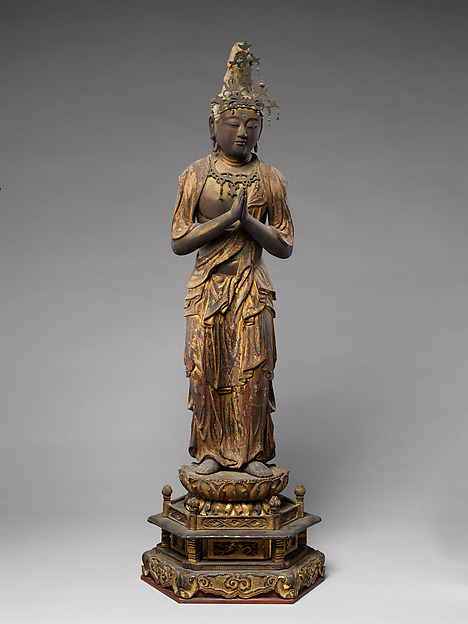
Japan, Kamakura period, late 12th–13th century. Wood with lacquer, gold paint, gold leaf and inlaid crystal; figure height 83.8 cm.
Look closer: Look at the hands pressed together and at the tall crown above the face. The Met dates the figure to the late twelfth or thirteenth century. Look at how the gold has worn to the darker wood in the folds of the robe.
The Metropolitan Museum of Art, Rogers Fund, 1912 (12.134.18). Public domain, Open Access.
| Feature | What it means | Where to look |
|---|---|---|
| Water jar | The sign that names him (JAANUS) | The crown |
| Clasped hands | His usual gesture (JAANUS) | The chest |
| Lotus | Held by some images; a bud or flask in others (Butuzou) | A hand or the seat |
| Position | Beside Amida, opposite Kannon | The triad |
| Upright bearing | Composed and steady, against Kannon’s softer stance (Butuzou) | The stance |
| Youthful face | A gentle expression, simple jewellery | The face |
Which side he stands
JAANUS says that in the Amida triad he is usually to the right of Amida. Butuzou says Seishi stands on the viewer’s right and warns that shops describe left and right from either the viewer’s side or the Buddha’s, so it should always be confirmed. The Wikipedia entry on the Yamada-den triad places him on the left, with Kannon on the right. The sources therefore use different viewpoints, and no one rule can be taken from them. The reliable test is the crown, not the side.
Twenty-five who come with him
JAANUS counts him among the twenty-five bodhisattvas who accompany Amida when he comes to welcome a dying person to the Pure Land, the subject of the raigō-zu paintings. The Met owns several. In its late fourteenth-century silk embroidery Amida stands on a cloud in a radiating halo, with Kannon and Seishi on lotus clouds at his feet and a border of lotus leaves below. A thirteenth-century embroidered panel shows the same grouping, and a thirteenth-century scroll turns the triad into three Sanskrit syllables.
The moon and the nenbutsu
Wikipedia lists the texts in which he appears. In the longer Sukhāvatīvyūha he has an important role for the Pure Land school. In the Lotus Sutra he is among the eighty thousand bodhisattvas on Vulture Peak and is addressed in chapter twenty. In the Śūraṅgama Sūtra he describes reaching samādhi through nianfo, the continuous mindfulness of Amitābha. Wikipedia adds that in Tibetan Buddhism he is equated with Vajrapāṇi, and that in Japan he is associated with the temple guardians Kongō Rikishi.
The Pure Land schools drew a personal line to him too. Wikipedia says Hōnen is theorised to be an incarnation of Daiseishi, that he was called Seishimaru as a child, and that Shinran wrote a hymn naming Daiseishi as Hōnen’s original form. It also records that Shi Yinguang, thirteenth patriarch of Chinese Pure Land Buddhism, was widely held to be a manifestation of Dashizhi.
The ninth of thirteen
JAANUS says that in the Thirteen Buddhas Seishi presides over the memorial held on the first anniversary of a death. Wikipedia’s list agrees and sets him between Kannon on the hundredth day and Amida on the second anniversary. He stands, in other words, at the point where the first year ends and the rites begin to space themselves by years. JAANUS adds that in esoteric Buddhism he appears in the Lotus section of the Taizōkai mandala.
| Memorial occasion | Figure | Role |
|---|---|---|
| 100th day | Kannon Bosatsu | Compassion, eighth of the thirteen |
| 1st anniversary | Seishi Bosatsu | Wisdom, ninth of the thirteen |
| 2nd anniversary | Amida Nyorai | The Buddha of the Pure Land, tenth |
The great strength in other tongues
The rows below record the names given in the sources I read.
| Where | Form and name | What the record shows |
|---|---|---|
| India | Mahāsthāmaprāpta | “Arrival of the great strength” (Wikipedia). |
| China | Dàshìzhì Púsa (大勢至菩薩); Dédàshì Púsà (得大勢菩薩) | Sometimes shown as a woman, resembling Guanyin (Wikipedia). |
| Japan | Seishi, Daiseishi (大勢至) | Four names in JAANUS: Seishi, Daiseishi, Tokudaiseishi, Tokudaisei. |
| Korea | Daeseji Bosal (대세지 보살) | The Korean reading. |
| Vietnam | Đại Thế Chí Bồ Tát | The Vietnamese name. |
| Tibet | mthu chen thob | Equated with Vajrapāṇi in Tibetan Buddhism. |
| Thailand | พระมหาสถามปราปต์โพธิสัตว์ | The Thai form, as Wikipedia writes it. |
The partner of compassion
Seishi stands with Kannon at Amida’s side and presides over the first anniversary of a death. In the Thirteen Buddhas he follows Kannon and precedes Amida.
Where to see him
| Place | What to look for |
|---|---|
| Tokyo National Museum | The Yamada-den Amida triad, a gilt-bronze group of the Asuka period, formerly at Hōryū-ji and described by Wikipedia as the oldest depiction of the Amida triad in Japanese art. |
| Metropolitan Museum of Art, New York | Two Seishi figures, with a Kannon and an Amida, raigō embroideries and a Sanskrit-syllable triad, in the public domain. |
Seishi in wood and silk

Japan, Edo period, 17th or 18th century. Wood with lacquer, gold leaf, cut gold (kirikane) and metal; height 81.3 cm.
Look closer: The Met dates this Seishi to the seventeenth or eighteenth century. Look at the openwork crown with its hanging jewelled pendants and at the scarf that lifts away from the arms. The Met also holds a Kannon of the same date.
The Metropolitan Museum of Art, Purchase, Friends of Asian Art Gifts; Charles Stewart Smith Collection, Gift of Mrs. Charles Stewart Smith, Charles Stewart Smith Jr., and Howard Caswell Smith, in memory of Charles Stewart Smith, Rogers Fund and Seymour Fund, by exchange, 2006 (2006.438a–e). Public domain, Open Access.
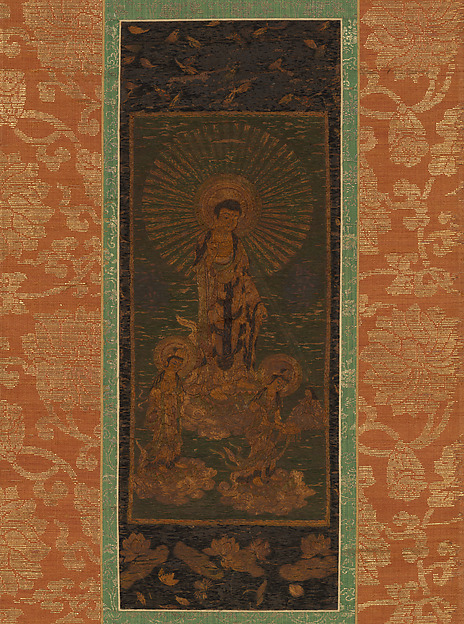
Japan, late 14th–early 15th century. Hanging scroll; silk and hair embroidery on silk ground; image 39.4 × 14.5 cm.
Look closer: The Met titles it Welcoming Descent of Amida Buddha with Bodhisattvas Kannon and Seishi and dates it to the late fourteenth or early fifteenth century. Look at the long rays around the central figure and the two small attendants on clouds below him.
The Metropolitan Museum of Art, Purchase, Bequest of Mary Stillman Harkness, by exchange, 2023 (2023.327). Public domain, Open Access.
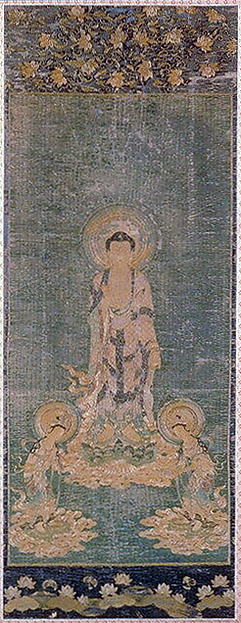
Japan, 13th century. Framed panel; embroidered silk and possibly human hair; image 100.3 × 38.7 cm.
Look closer: The Met dates the panel to the thirteenth century and says the embroidery uses silk and possibly human hair. Look at the two smaller figures on lotuses at the lower corners, one for each attendant.
The Metropolitan Museum of Art, Rogers Fund, 1912 (12.37.166). Public domain, Open Access.
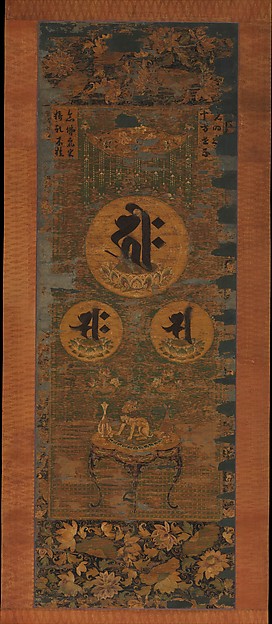
Japan, 13th century. Hanging scroll; silk embroidery, gold-wrapped thread and human hair; image 114 × 38.7 cm.
Look closer: The Met dates it to the thirteenth century and says the silk embroidery uses gold-wrapped thread and human hair. Look at the large central syllable and the two smaller ones. Each stands for one of the three figures of the Amida triad.
The Metropolitan Museum of Art, The Harry G. C. Packard Collection of Asian Art, Gift of Harry G. C. Packard, and Purchase, Fletcher, Rogers, Harris Brisbane Dick, and Louis V. Bell Funds, Joseph Pulitzer Bequest, and The Annenberg Fund Inc. Gift, 1975 (1975.268.22). Public domain, Open Access.
In the house
Pieces of Seishi, alone or with Amida and Kannon, appear on the shelves from time to time. The strip below reads the live shelves and appears when one is in the house.
Answered plainly
Who is Seishi?
The bodhisattva of wisdom beside Amida, whose name means he who has obtained great strength. The Sanskrit is Mahāsthāmaprāpta. He is Kannon’s partner in the Amida triad.
How do I tell Seishi from Kannon?
By the crown. JAANUS says Seishi’s crown holds a water jar, and Butuzou says Kannon’s often carries a small Amida. Seishi’s hands are usually clasped. Left and right vary with the viewpoint and should not be relied on alone.
Why do Kannon and Seishi appear together?
JAANUS ties them to Amida as his two main attendants, Kannon for compassion and Seishi for wisdom. Wikipedia notes the Contemplation Sutra pairs them as sun and moon.
Is Seishi ever shown on his own?
Rarely. JAANUS says he never gained Kannon’s popularity and is rarely represented outside the Amida triad.
Which day of the Thirteen Buddhas is Seishi?
The first anniversary of a death, the ninth of the thirteen, between Kannon on the hundredth day and Amida on the second anniversary.
What is a raigō?
A painting of Amida coming to welcome a dying person to the Pure Land with Kannon, Seishi and other bodhisattvas. JAANUS counts Seishi among the twenty-five attendants.
Where next
Sources and image credits
- The Metropolitan Museum of Art, object 49108
- The Metropolitan Museum of Art, object 73226
- The Metropolitan Museum of Art, object 890456
- The Metropolitan Museum of Art, object 44959
- The Metropolitan Museum of Art, object 45509
- Japanese Architecture and Art Net Users System, Seishi
- Wikipedia, Mahasthamaprapta: names, sutras, Japan
- Wikipedia, Yamada-den Amida Triad
- Butuzou, Why Seishi Bosatsu appears alongside Amida Nyorai
- Wikipedia, Thirteen Buddhas
Last reviewed 28 October 2026. Pictures are public-domain or open-access, each credited beneath it. Diagrams on this page are drawn by Japonista.
Looking for a Seishi, an Amida triad or a small altar group? Tell us what you have in mind and we will look.
Private concierge
Looking for something in particular?
Describe the piece or the project you have in mind. A senior advisor in Tokyo reads every case file personally and replies within two business days, with fees set out in writing before any work begins.