
Kokuzo Bosatsu
Wisdom Without Edges
Kokuzo Bosatsu
虚空蔵菩薩
The bodhisattva whose wisdom is said to be as boundless as space. He holds a jewel that grants wishes, wears a crown of five small Buddhas, is the one to whom a young Kūkai chanted a memory rite, and closes the Thirteen Buddhas at the thirty-second anniversary of a death.
Identity card
Know him at a glance
- The halo. The disc of light that marks a bodhisattva of high rank.
- The wish-granting hand. JAANUS says one hand makes the yogan-in, the gesture of granting wishes.
- The jewel. JAANUS says the other hand is raised to the breast and holds a jewel. In the Taizōkai mandala he instead holds a sword in one hand and a jewel on a lotus in the other.
- The crown. A five-wisdom diadem with small figures of the five Buddhas of Wisdom (JAANUS).
- The seat. Seated with both legs crossed or one pendent, JAANUS says. This diagram shows a lotus seat.
A treasury of space
The Japanese Architecture and Art Net Users System, known as JAANUS, glosses the Japanese name as space or sky repository and calls him a bodhisattva of unlimited wisdom and compassion who is believed to fulfil all wishes. It gives the Sanskrit as Akasagarbha or Khagarbha and warns that he is often confused in Japan with Kokūko, which stands for Gaganagañja. Wikipedia renders the name as “boundless space treasury” or “void store”, ties him to the great element of space, and lists him among the Eight Great Bodhisattvas. It adds that he is sometimes called the twin brother of Kṣitigarbha, the bodhisattva Japan knows as Jizō.
Wikipedia counts a dozen scriptures devoted to him, among them the Ākāśagarbha Bodhisattva Sūtra, the Meditation on Ākāśagarbha Bodhisattva Sūtra and the Five Great Ākāśagarbha Bodhisattvas Sūtra, and notes a brief appearance in the last chapter of the Kṣitigarbha sutra, where he asks the Buddha to teach the merit of praising that scripture and its bodhisattva.
This chapter sits inside the Buddhism and Zen Almanac, on the Bosatsu rank. Of all the bodhisattvas in it he is the one most closely tied to the founder of the Shingon school.
Five small Buddhas and a jewel
JAANUS describes the standard image. He sits with both legs crossed or with one leg pendent and wears a five-wisdom diadem, gochi hōkan, set with small figures of the five Buddhas of Wisdom. One hand makes the wish-granting gesture, the yogan-in, and the other is raised to the breast holding a jewel. In the central court of the Taizōkai mandala dedicated to him he wears the same diadem and holds a raised sword in one hand and a lotus topped with a jewel in the other. In the Shaka court of the same mandala he stands at the right of Shaka with a fly whisk and a lotus with a green gem.
The Met’s sixteenth- or seventeenth-century Mandala of the Thirteen Buddhas shows the figure in the setting where Japanese families meet him most: thirteen small seated deities arranged in rows on a dark gold ground, each on a lotus, with one at the lower right in a halo of flame. Kokūzō, the last of the thirteen, is among them.
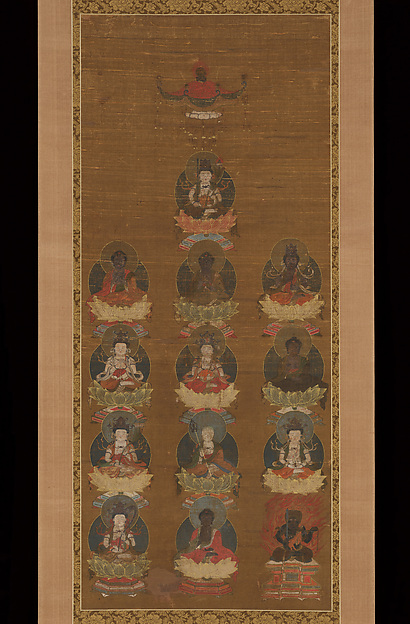
Japan, 16th or 17th century. Hanging scroll; ink, color and gold on silk; image 94 × 39.7 cm.
Look closer: The Met dates the scroll to the sixteenth or seventeenth century. Look first at the single figure in flames at the lower right, then at the neat rows of seated deities, each on his own lotus. Kokūzō is the last of the thirteen.
The Metropolitan Museum of Art, Gift of Sue Cassidy Clark, in honor of Barbara Brennan Ford, 2021 (2021.396.1). Public domain, Open Access.
| Feature | What it means | Where to look |
|---|---|---|
| Five-wisdom crown | The five Buddhas of Wisdom (JAANUS) | The head |
| Wish-granting gesture | The yogan-in (JAANUS) | One hand |
| Jewel | Fulfilment of wishes (JAANUS) | The other hand, at the breast |
| Sword and lotus-jewel | The Taizōkai central court form (JAANUS) | The two hands |
| Fly whisk and green gem | The Shaka court form (JAANUS) | The two hands |
| Pendent leg | One of two seated poses (JAANUS) | The seat |
A rite for remembering
JAANUS calls the Gumonji-hō an esoteric rite for improving memory, introduced to Japan in the Nara period, in which the bodhisattva is worshipped for the wisdom he can bestow. Wikipedia tells the story that gives it its fame. It says Kūkai, the founder of Shingon, as a young acolyte met a well-known monk who had repeatedly chanted a Kokūzō mantra, and learned the Kokūzō Gumonji method from him. During the chanting, it says, he had a vision in which Kokūzō told him to go to Tang China and study the Mahāvairocana Sūtra. In China he learned the esoteric teaching from Huiguo and went on to found the Shingon tradition in Heian Japan.
The mantra, which Wikipedia calls the morning star mantra and says is used mainly in the Gumonji rite, runs in Sanskrit namo ākāśagarbhāya oṃ ārya kāmāri mauli svāhā, which it translates as homage to Ākāśagarbha, om, crown of the noble enemy of Kāma, svāhā.
Lion, elephant, horse, peacock, garuda
JAANUS describes a group of five, the Godai Kokūzō Bosatsu, who are manifestations of the five Buddhas of the Kongōkai mandala and who are invoked in an esoteric rite for fulfilling wishes and averting misfortune. Their names come from the Yugikyō: Hokkai, Kongō, Hōkō, Renge and Gyōyō. A set at Kanchi-in, part of Tō-ji in Kyoto, was brought from Tang China in 847 by the monk Eun (798 to 869) and sits on a lion, an elephant, a horse, a peacock and a garuda. A set at Jingo-ji in Kyoto, from the middle of the ninth century, sits on lotus pedestals and is a National Treasure.
Wikipedia gives the same five with their directions and colours, each tied to a Buddha: Dharmadhātu at the centre in white with Vairocana, Vajradhātu in the east in blue with Akṣobhya, Ratnaprabha in the south in yellow with Ratnasambhava, Padma in the west in red with Amitābha and Karma in the north in black with Amoghasiddhi.
| Direction | Name | Colour | Buddha |
|---|---|---|---|
| Centre | Dharmadhātu Ākāśagarbha | White | Vairocana |
| East | Vajradhātu Ākāśagarbha | Blue | Akṣobhya |
| South | Ratnaprabha Ākāśagarbha | Yellow | Ratnasambhava |
| West | Padma Ākāśagarbha | Red | Amitābha |
| North | Karma Ākāśagarbha | Black | Amoghasiddhi |
The last of thirteen
JAANUS says Kokūzō is the last of the Thirteen Buddhas and presides over the memorial held on the thirty-second anniversary of a death. Wikipedia’s list agrees. The sequence that began with Fudō on the seventh day closes with a bodhisattva of unbounded space on the thirty-second anniversary, after Dainichi at the twelfth. It is a sequence that ends not with a final judge but with a treasury.
| Memorial occasion | Figure | Role |
|---|---|---|
| 6th anniversary | Ashuku Nyorai | The Buddha of the east, eleventh of the thirteen |
| 12th anniversary | Dainichi Nyorai | The cosmic Buddha, twelfth of the thirteen |
| 32nd anniversary | Kokūzō Bosatsu | The space treasury, last of the thirteen |
The void store in other tongues
The rows below record the names given in the sources I read.
| Where | Form and name | What the record shows |
|---|---|---|
| India | Ākāśagarbha; Gaganagañja | “Boundless space treasury”; the Kongōkai mandala name (JAANUS). |
| China | Xūkōngzàng Púsà (虛空藏菩薩) | The Chinese name. |
| Japan | Kokūzō (虚空蔵) | Sometimes confused with Kokūko (JAANUS). |
| Korea | Heogongjang Bosal (허공장보살) | The Korean reading. |
| Vietnam | Hư Không Tạng Bồ Tát | The Vietnamese name. |
| Tibet | Namkhé Nyingpo (nam mkha’i snying po) | The Tibetan name. The Met holds an early fifteenth-century initiation card of him. |
| Thailand | พระอากาศครรภโพธิสัตว์ | The Thai form, as Wikipedia writes it. |
The treasury at the end
Kokūzō closes the Thirteen Buddhas at the thirty-second anniversary of a death. In the Taizōkai mandala he has a court of his own, and in the Kongōkai he is one of the sixteen deities of the Auspicious Aeon.
Where to see him
| Place | What to look for |
|---|---|
| Tokyo National Museum | A late Heian painting of Kokūzō, especially popular (JAANUS). |
| Gakuan-ji, Nara | A dry-lacquer image on a wooden core from the Nara period, an early statue (JAANUS). |
| Kanchi-in at Tō-ji, Kyoto | The five great Kokūzō brought from Tang China in 847 (JAANUS). |
| Jingo-ji, Kyoto | A set of five from the middle of the ninth century, a National Treasure (JAANUS). |
| Hōrin-ji, Kyoto; Kongōshō-ji, Mie; Enzō-ji, Fukushima | The three famous Kokūzō, called San Kokūzō (JAANUS). |
| Tōdai-ji, Nara | A seated gilded figure whose sign reads Kokūzō Bosatsu, shown in the first photograph of the gallery (Marco Almbauer, Wikimedia Commons). |
| Metropolitan Museum of Art, New York | A Mandala of the Thirteen Buddhas, a Shingon mandala with eight patriarchs and a Tibetan initiation card of Akashagarbha, in the public domain. |
The treasury, in the hall and on paper

Photograph by Marco Almbauer, September 2019. Digital photograph.
Look closer: Look at the small white sign at the foot of the dais. It reads 虚空蔵菩薩, Kokūzō Bosatsu. The Commons file is titled as a Nyoirin Kannon, which is a mistake; this chapter names the figure from its sign. Then look up at the tall crown and the halo of fine rays behind the shoulders.
Marco Almbauer, “Kokūzō Bosatsu at Tōdai-ji, Nara”, Wikimedia Commons, CC BY 4.0. Source: commons.wikimedia.org (file page listed in the sources below).
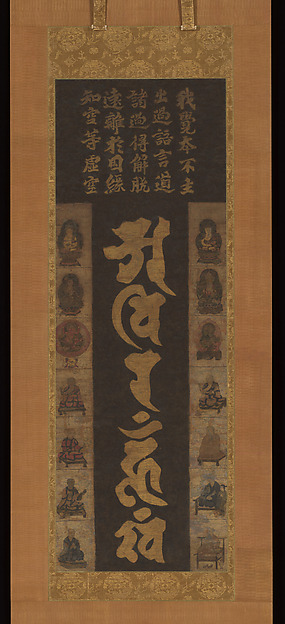
Japan, Kamakura period, 13th–14th century. Hanging scroll; ink, colors and gold on silk; image 101 × 34.9 cm.
Look closer: The Met titles it Mandala in Sanskrit with Buddhas, Bodhisattvas, and Eight Patriarchs of the Shingon Sect and dates it to the thirteenth or fourteenth century. Look at the large gold syllables in the middle, then at the small figures on the panels at either side. The title counts eight Shingon patriarchs among them. Kūkai, who features in the story above, founded the school.
The Metropolitan Museum of Art, Purchase, Sue Cassidy Clark Gift, in memory of Koichi Yanagi, 2024 (2024.410). Public domain, Open Access.
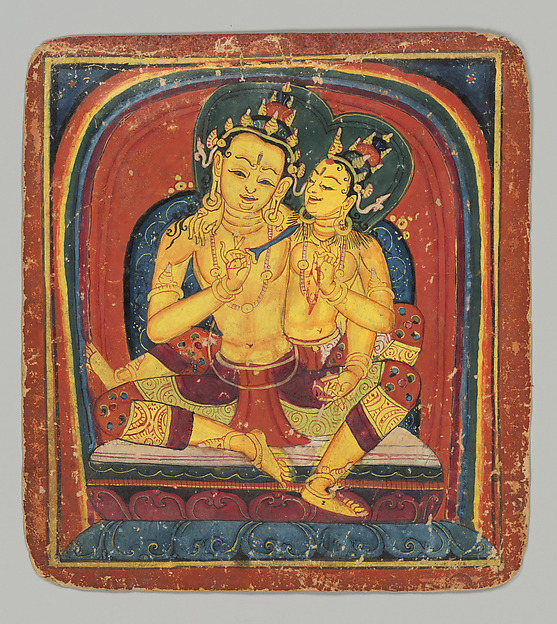
Tibet, early 15th century. Opaque watercolor on paper; 16 × 14.5 cm.
Look closer: The Met titles it Initiation Card (Tsakalis): Akashagarbha and dates it to the early fifteenth century in Tibet. This is a Tibetan form, not a Japanese one. Look at the two crowned figures with golden skin and the bands of colour around them.
The Metropolitan Museum of Art, Rogers Fund, 2000 (2000.282.7). Public domain, Open Access.
In the house
Pieces of Kokūzō are uncommon. The strip below reads the live shelves and appears when one is in the house.
Answered plainly
Who is Kokuzo?
The bodhisattva of the space treasury, Ākāśagarbha in Sanskrit, whose wisdom is said to be as boundless as space and who is believed to fulfil wishes.
What is the Gumonji rite?
An esoteric rite for improving memory, introduced to Japan in the Nara period. Wikipedia says Kūkai learned it as a young man and had a vision of Kokūzō sending him to China.
What are the five great Kokuzo?
A set of five manifestations tied to the five Buddhas of the Kongōkai, seated on a lion, elephant, horse, peacock and garuda in the set at Kanchi-in, Tō-ji.
How do I recognise him?
By the five-wisdom crown with five small Buddhas, a jewel in one hand and the wish-granting gesture in the other. In the Taizōkai central court he holds a sword and a lotus with a jewel.
Why is he confused with Kokuko?
JAANUS says Kokūzō is often confused in Japan with Kokūko, the Japanese name for Gaganagañja, a name the Kongōkai mandala uses.
Which day of the Thirteen Buddhas is Kokuzo?
The thirty-second anniversary of a death, the last of the thirteen, after Dainichi at the twelfth anniversary.
Where next
Sources and image credits
- The Metropolitan Museum of Art, object 853237
- The Metropolitan Museum of Art, object 912998
- The Metropolitan Museum of Art, object 61711
- Wikimedia Commons, Statue of Nyoirin Kannon in the Golden Hall, Todaiji.jpg (Marco Almbauer, CC BY 4.0)
- Japanese Architecture and Art Net Users System, Kokūzō
- Wikipedia, Ākāśagarbha: names, sutras, Kūkai, mantra
- Wikipedia, Thirteen Buddhas

Last reviewed 28 October 2026. Pictures are public-domain or openly licensed, each credited beneath it. Diagrams on this page are drawn by Japonista.
Looking for a Kokūzō, a Shingon altar piece or a Thirteen Buddhas scroll? Tell us what you have in mind and we will look.
Private concierge
Looking for something in particular?
Describe the piece or the project you have in mind. A senior advisor in Tokyo reads every case file personally and replies within two business days, with fees set out in writing before any work begins.