
Enma and the Ten Kings of Hell
Judges of Hell
Enma and the Ten Kings
閻魔・十王
The king who weighs the dead with a mirror, the nine other judges who sit beside him, and the esoteric guardian of the south who shares his name and his origin.
Identity card
Know the figure at a glance
- Mirror. The Jōhari no kagami lies before him and shows the life of the dead as images (yokai.jp). Wikipedia calls the Chinese version the Mirror Platform.
- Register. Records kept by the Kushōjin are read aloud by one scribe and written down by another, and the sins are finalised through them (yokai.jp).
- Scribes. Shimei and Shiroku sit at his left and right (yokai.jp).
- Official robes. He wears the robes of a Chinese official with a crown and holds a sceptre (yokai.jp).
- Buffalo. The esoteric Enmaten is usually shown seated on a buffalo with one leg hanging down (JAANUS).
- Jizō. Medieval Japan treated Jizō as Enma's original form: compassion and wrath in a single deity (yokai.jp).
From Yama to Enma
The Japan Architecture and Art Net Users System (JAANUS) explains that Enma transliterates the Sanskrit Yama, the first human to die, who became king of the underworld and judge of the dead. Buddhism absorbed him, and in Japan he is better known as Enmaō, King Enma. Wikipedia adds that the Buddhist Yama rests on the Vedic god of the same name but developed different myths. In the Pali canon, it says, the Buddha tells of people who mistreated their parents, ascetics or elders and so go to Yama at death, where he questions them about their conduct; the passages cited are the two Devaduta Suttas, Majjhima Nikāya 130 and Aṅguttara Nikāya 3.35. Buddhaghosa's commentary calls him a vimānapeta, a being in a mixed state, and judges his rule to be just.
The Chinese form added a bureaucracy. According to the same article, from the Tang dynasty onward a version influenced by Daoism made Yanluo Wang the fifth of ten kings, each named by the Jade Emperor to head a hell. The other nine have names of their own, but Yanluo remained the most famous and is the one shown most often in pictures. The belief then travelled: the article lists Korea, where he is Yeom-ra, Japan and Vietnam among the countries it reached. The Japanese Wiki Corpus article on the Jūō dates the arrival in Japan to the Heian period, when it spread together with the ideas of mappō, the last age of the Law, and of the world of the dead.
Ten kings and their reckonings
The Japanese Wiki Corpus says the belief arose in China, where Buddhism mixed with Daoism, and names an apocryphal scripture of the late Tang as its source: the Yoshu Jūō Shoshichi Kyō, a sutra without an Indian original. In the system each king pronounces judgement at a set point after death. Traditionally, the same article says, services for the dead are held seven times, once every seven days, to ask the kings to lighten the dead person's transgressions; further trials fall on the hundredth day and on the first and later anniversaries.
JAANUS gives the full roll, with each king matched to a Buddha or bodhisattva as his honji, or original nature. The table below sets out the ten as JAANUS records them. The first king, Shinkōō, is Fudō Myōō; the fifth, Enma, is Jizō; and the tenth, Godōtenrinnō, is Amida. The Japanese Wiki Corpus adds that in the Kamakura period each king was believed to correspond to one of ten Buddhas, and it links the three additional kings to the thirteen Buddhas, who have a chapter of their own in this almanac.
The sources count the days differently. JAANUS writes ordinal numbers beside the first seven kings that read as the first to seventh seven-day periods; the Japanese Wiki Corpus gives the seven trials as the 7th, 13th, 20th, 27th, 34th, 41st and 48th days, noting that the first is really the 6th by Buddhist counting, while a Kamakura guide and yokai.jp both give Enma's trial as the 35th day. The pattern is the same everywhere: seven sevens, then the hundredth day, then the anniversaries. Only the counting of the first day differs.
A mirror, a register and a river
The yokai.jp encyclopaedia describes Enma as a wrathful, imposing magistrate in the robes of a Chinese official, crowned and holding a sceptre. His face has bristling eyebrows, wide glaring eyes, an open roaring mouth and a red complexion. Before him lies the Jōhari no kagami, the Pure Crystal Mirror, which replays the dead person's life as images. Wikipedia's article on the Ten Courts of Yanluo describes a Chinese counterpart, the Mirror Platform, in which souls are shown their sins before they reach the courts.
At his left and right sit the scribes Shimei and Shiroku. The records kept by the Kushōjin are read aloud by one and written down by the other, and, according to yokai.jp, the final verdict is fixed through them. The same site calls him the fifth of the ten kings and describes his central trial as the one that settles the dead person's fate.
The river comes first. The yokai.jp account of the netherworld says that the second king, Shokō, administers the Sanzu no kawa; at the river the hag Datsue-ba strips the dead of their clothing, and Keneō hangs it on the branch of the Eryōju tree and judges the weight of sin by how far the bough sags. This is a preliminary judgement, made before the dead reach Enma.
The tongue is the part that children knew. Yokai.jp quotes the warning that if you lie, Lord Enma will pull out your tongue, and describes the image as extraction with large iron pincers.
Compassion behind the wrath
The most important fact about Enma in Japan may be that he is also Jizō. Yokai.jp reports that in medieval Japan the bodhisattva Jizō was regarded as Enma's honji, so that compassion and wrath were presented as one deity with two faces, a view it assigns to esoteric Buddhism and the Pure Land schools. JAANUS's table of the ten kings says the same of the fifth king, naming Jizō as his honji. Cleveland's Welcoming Descent of Jizō, a Kamakura hanging scroll in the gallery below, shows the bodhisattva as a monk with a wish-fulfilling jewel, descending on clouds to rescue a believer who has called to him; the museum notes that Jizō is well known for rescuing people from the many Buddhist hells.
Wikipedia makes the same pairing from the Chinese side: some see Yanluo Wang as a Buddhist deity and others as the Daoist counterpart of Kṣitigarbha, the Sanskrit Jizō, and a Joseon-period painting shows Jizō with the ten kings. The Jizō chapter of this almanac follows his story in full.
Enmaten, guardian of the south
JAANUS keeps a separate entry for the esoteric form, Enmaten 焔魔天, written with characters that differ from the judge's 閻魔. It places him among the Twelve Deities in esoteric Buddhism, where he guards the south, one of the eight directions; among the Twenty Deities of the Diamond World mandala; and in the Outer Vajra Section of the Womb World mandala. The entry also notes that the name is sometimes applied to Yamaten, the third of the six heavens of desire, and says the two should be kept apart.
The image is quite unlike the judge. JAANUS says Enmaten is usually shown seated on a buffalo, with one leg hanging down, holding in one hand a staff topped with a human head, the other arm bent at the elbow with the palm turned outward. A wooden image in this style survives at Daigoji in Kyoto. In this form he is counted among the guardians of the eight directions and was associated especially with long life and protection from illness and misfortune; the Enmaten mandara, centred on him, was used in rites for those purposes.
Courts on silk
The Metropolitan Museum holds five scrolls from a set of ten Ten Kings of Hell, by Jin Chushi, a Chinese painter active in the late twelfth century, and dated before 1195. They are Chinese, not Japanese, and the museum does not name which king is which, so the gallery shows two of them as courts rather than portraits. In each a king in official dress sits behind a draped table, clerks present documents, and demons drive the condemned across the ground below.
Cleveland's Fourth King of Hell is Korean, from the late fourteenth century in the Goryeo dynasty, and was part of a set of ten. A red label at its upper right names the king as the fourth, Wuguan, which is Gokan'ō in JAANUS's table. The museum describes a king with bulging eyes, a secretary beside him, and sinners suffering in a cauldron of boiling water, pierced by a guard's burning spears, and notes that ready-made Buddhist paintings from workshops in the Chinese port of Ningbo are believed to have been an important inspiration. The road from China through Korea to Japan is the usual one for this subject.
Ennōji and a sculpted king
The Ennōji temple in Kamakura is known for its statues of the Ten Kings of Hades. The Kamakura Today guide dates its founding to 1250 and credits the monk Dōkai Sōden, while noting that some historians doubt the date because he died around 1309. It says the temple stood near Zaimokuza beach until an earthquake and tsunami destroyed it in 1703, after which it moved to its present site, and that the main hall holds twelve statues arranged in a U shape on the altar.
Atlas Obscura reports a legend that the sculptor Unkei had a near-death experience, was revived by Enma, and then carved the laughing statue, which folk tales call Child-Eating Enma or Child-Raising Enma. The Atlas page does not state the statue's size or material, and the date and maker remain a matter of legend rather than record. Some of the kings, it says, have been lent to the Kamakura Museum of National Treasures. Brooklyn Museum owns a Muromachi-period Emma-ō, sixteenth century, in wood with gesso, traces of colour and inlaid glass eyes; its entry says families pray before such an image to ask leniency for their departed.
Sevens, anniversaries and festival days
The kings still shape Japanese memorial practice. The Japanese Wiki Corpus says that today the services are simplified: after the wake, the funeral and the first seven days, generally none are held until the forty-ninth day. Jōdo Shinshū believers do not hold them at all, since they believe that all believers go to the Pure Land after death.
Yokai.jp also records Enma Saijitsu, his festival days, on the sixteenth day of the first and seventh lunar months, when the lid of hell's cauldron is said to open and Enma rests from torture. It pairs them with Jizō Bon on 24 August.
Across Asia
The judge of the dead has changed his robes in every country he reached.
| Where | Form and name | What the record shows |
|---|---|---|
| India | Yama | The first human to die and king of the underworld (JAANUS). |
| China | Yanluo Wang 閻羅王 | Fifth of ten kings from the Tang dynasty (Wikipedia). |
| Korea | Yeom-ra | The Korean name for the same king (Wikipedia). |
| Vietnam | Diêm Vương | Governed there by Phong Đô Đại Đế (Wikipedia). |
| Tibet | Yama Dharmaraja | Also Shinje; a feared force behind death and a protector (Wikipedia). |
| Japan | Enma 閻魔; Enmaten 焔魔天 | Judge, and esoteric guardian of the south (JAANUS). |
The courts of the dead
Enma sits among the Heavenly Beings by origin and in the esoteric diagrams, as a guardian of the south, but in popular worship he is the head of a court. He is the single deity in this almanac who is at once a ruler, a judge and, in another form, a bodhisattva.
| King | Judgement | Honji (JAANUS) |
|---|---|---|
| 1 Shinkōō 泰広王 | First seven-day period | Fudō Myōō |
| 2 Shokōō 初江王 | Second | Shaka |
| 3 Sōteiō 宋帝王 | Third | Monju |
| 4 Gokan'ō 五官王 | Fourth | Fugen |
| 5 Enmaō 閻魔王 | Fifth | Jizō |
| 6 Henseiō 変成王 | Sixth | Miroku |
| 7 Taizan'ō 泰山王 | Seventh | Yakushi |
| 8 Byōdōō 平等王 | 100th day | Kannon |
| 9 Toshiō 都市王 | First anniversary | Seishi |
| 10 Godōtenrin'ō 五道転輪王 | Third anniversary | Amida |
Where to see them
| Place | What to look for |
|---|---|
| Ennōji, Kamakura | The temple of the Ten Kings, with Enma Daiō as its main figure (Kamakura Today, Atlas Obscura). |
| Daigoji, Kyoto | A wooden Enmaten seated on a buffalo, the type JAANUS describes. |
| Metropolitan Museum of Art, New York | Five of the Chinese Ten Kings of Hell scrolls, a Japanese lacquer inrō of Emmao, and Scenes of the Buddhist Hell, in open access. |
| Cleveland Museum of Art | The Korean Fourth King of Hell and the Kamakura Welcoming Descent of Jizō, in open access. |
| Brooklyn Museum | A sixteenth-century wooden Emma-ō. |
Seven images of the courts
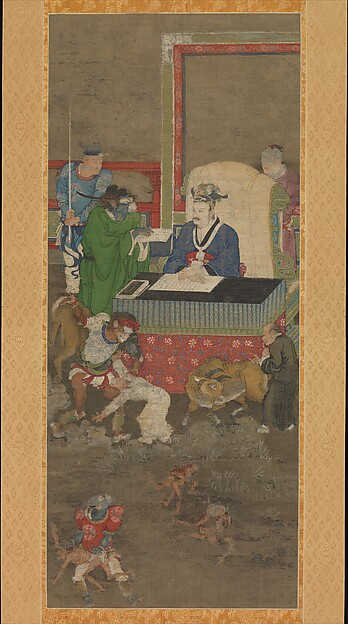
Jin Chushi, China, before 1195. One of five of a set of ten hanging scrolls; ink and color on silk; image H. 129.5 cm, W. 49.5 cm. Metropolitan Museum of Art, 30.76.290.
Look closer: Note the king raised behind his table and the clerk offering a document at the left, while the condemned are driven across the ground below.
The Metropolitan Museum of Art, Rogers Fund, 1930. Open Access.
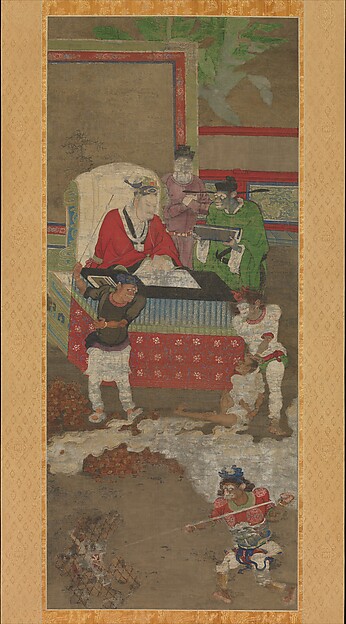
Jin Chushi, China, before 1195. One of five of a set of ten hanging scrolls; ink and color on silk; image H. 129.5 cm, W. 49.5 cm. Metropolitan Museum of Art, 30.76.292.
Look closer: Note the red-robed king at the upper left, the two clerks behind him and the spear-bearing demon in the lower right.
The Metropolitan Museum of Art, Rogers Fund, 1930. Open Access.
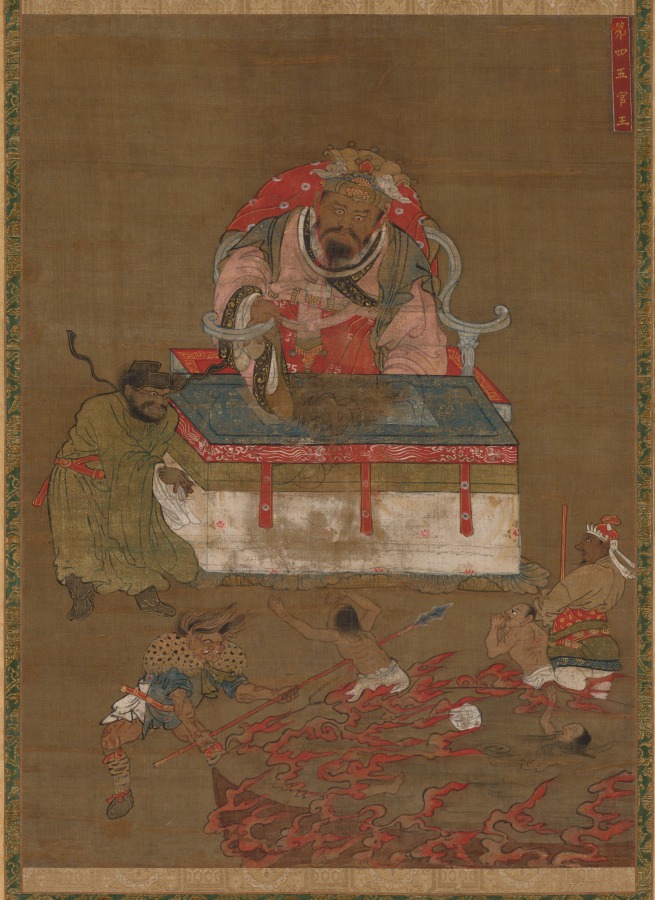
Korea, Goryeo dynasty (918-1392), late 1300s. Hanging scroll; ink, color and gold ink on silk; image H. 63 cm, W. 45.3 cm. Cleveland Museum of Art, 2019.224.
Look closer: Note the red label at the upper right naming the king as the fourth and the red-flamed cauldron where the condemned are pierced with spears.
Cleveland Museum of Art, Leonard C. Hanna Jr. Fund and museum purchase from various donors by exchange and Partial Gift of The Honorable Joseph P. Carroll and Roberta Carroll, M.D. CC0 (Cleveland Open Access).
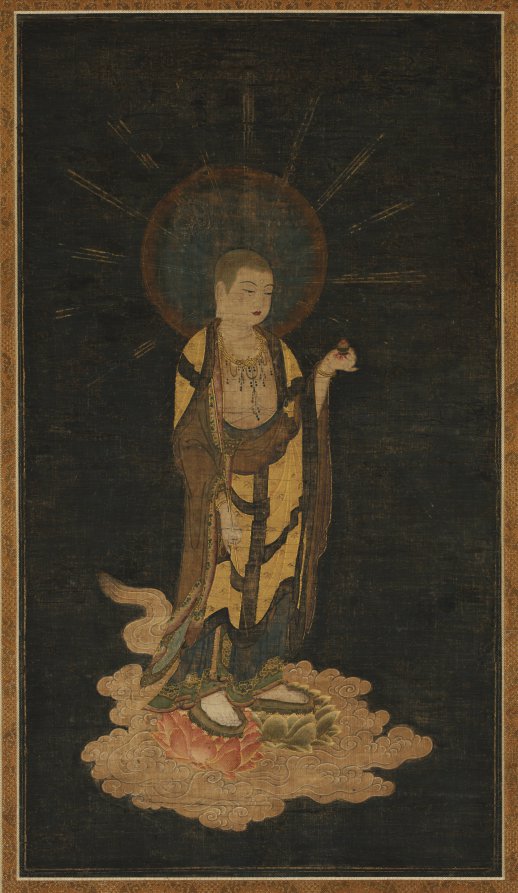
Japan, Kamakura period (1185-1333), 1200s. Hanging scroll; ink, color, gold and cut gold on silk; image H. 59 cm, W. 33.2 cm. Cleveland Museum of Art, 1983.75.
Look closer: Note the radiating gold lines around the halo and the clouds and lotuses on which the bodhisattva descends.
Cleveland Museum of Art, John L. Severance Fund. CC0 (Cleveland Open Access).

Japan, 19th century. Lacquer, kinji, gold and red hiramakie, metal inlay; interior red lacquer, nashiji and fundame; H. 7.3 cm, W. 6.9 cm. Metropolitan Museum of Art, 13.67.88.
Look closer: Note the king's dark cap and the tablet in his hands, set against the red seal and inscription on the back.
The Metropolitan Museum of Art, Rogers Fund, 1913. Open Access.
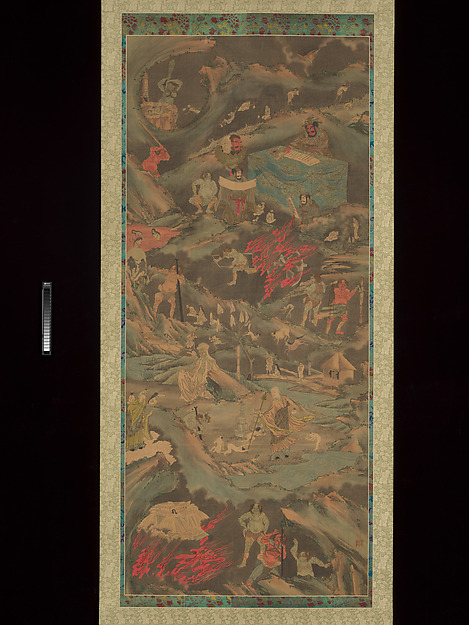
Shōsai, Japan, second half of the 19th century. Hanging scroll; ink and color on silk; image H. 195.4 cm, W. 84.4 cm. Metropolitan Museum of Art, 2020.170.
Look closer: Note the judge at his blue table in the upper right and the red flames that run down the length of the scroll.
The Metropolitan Museum of Art, Purchase, Friends of Asian Art Gifts, 2020. Open Access.

Seigan Sōi, Japan, mid-17th century. Hanging scroll; ink on paper; image H. 30.5 cm, W. 90.2 cm. Metropolitan Museum of Art, 2014.719.11.
Look closer: Note the forceful strokes of the two characters for hell, written as a single sweep of the brush.
The Metropolitan Museum of Art, Gift of Sylvan Barnet and William Burto, in honor of Setsu Isao, 2014. Open Access.
At the desk
An Enma carving, inrō or print appears below when we hold one. If none shows, the concierge desk can search for it.
Answered plainly
Who is Enma?
The Japanese form of Yama, the first human to die, who became king of the underworld and judge of the dead (JAANUS).
Who are the Ten Kings?
Ten judges of the dead, from Shinkōō to Godōtenrin'ō, of whom Enma is the fifth (JAANUS).
Is Enma also Jizō?
In medieval belief Jizō was Enma's honji, his original nature (yokai.jp, JAANUS).
What is Enmaten?
The esoteric form of Yama, a guardian of the south seated on a buffalo (JAANUS).
What does the mirror do?
The Jōhari no kagami replays the dead person's life as images (yokai.jp).
Where is the temple of the Ten Kings?
Ennōji in Kamakura (Kamakura Today).
Where next
Sources and image credits
- JAANUS, Enmaten 焔魔天 (Columbia University)
- JAANUS, Jūō 十王 (Ten Kings)
- Wikipedia, Yama (Buddhism)
- Wikipedia, Ten Kings of Hell
- Japanese Wiki Corpus, Juo (10 Kings; 10 judges of the hell)
- Yokai.jp, Enma-ō
- Yokai.jp, The Netherworld: Ten Kings and the River of Three Crossings
- Kamakura Today, Ennoji
- Atlas Obscura, Ennoji Temple
- Brooklyn Museum, Emma-ō, King and Judge of Hell (79.277)
- Metropolitan Museum of Art, Ten Kings of Hell (30.76.290)
- Metropolitan Museum of Art, Ten Kings of Hell (30.76.292)
- Metropolitan Museum of Art, Case (Inrō) with Design of Emmao (13.67.88)
- Metropolitan Museum of Art, Scenes of the Buddhist Hell (2020.170)
- Metropolitan Museum of Art, Hell (2014.719.11)
- Cleveland Museum of Art, The Fourth King of Hell, 2019.224
- Cleveland Museum of Art, Welcoming Descent of Jizō, 1983.75
Last reviewed 28 October 2026. Pictures are public-domain or open-access, each credited beneath it. Diagrams on this page are drawn by Japonista.
Looking for an Enma carving, inro or print? Tell the concierge desk what you have in mind and we will search Japan for it.
Private concierge
Looking for something in particular?
Describe the piece or the project you have in mind. A senior advisor in Tokyo reads every case file personally and replies within two business days, with fees set out in writing before any work begins.