Japonista
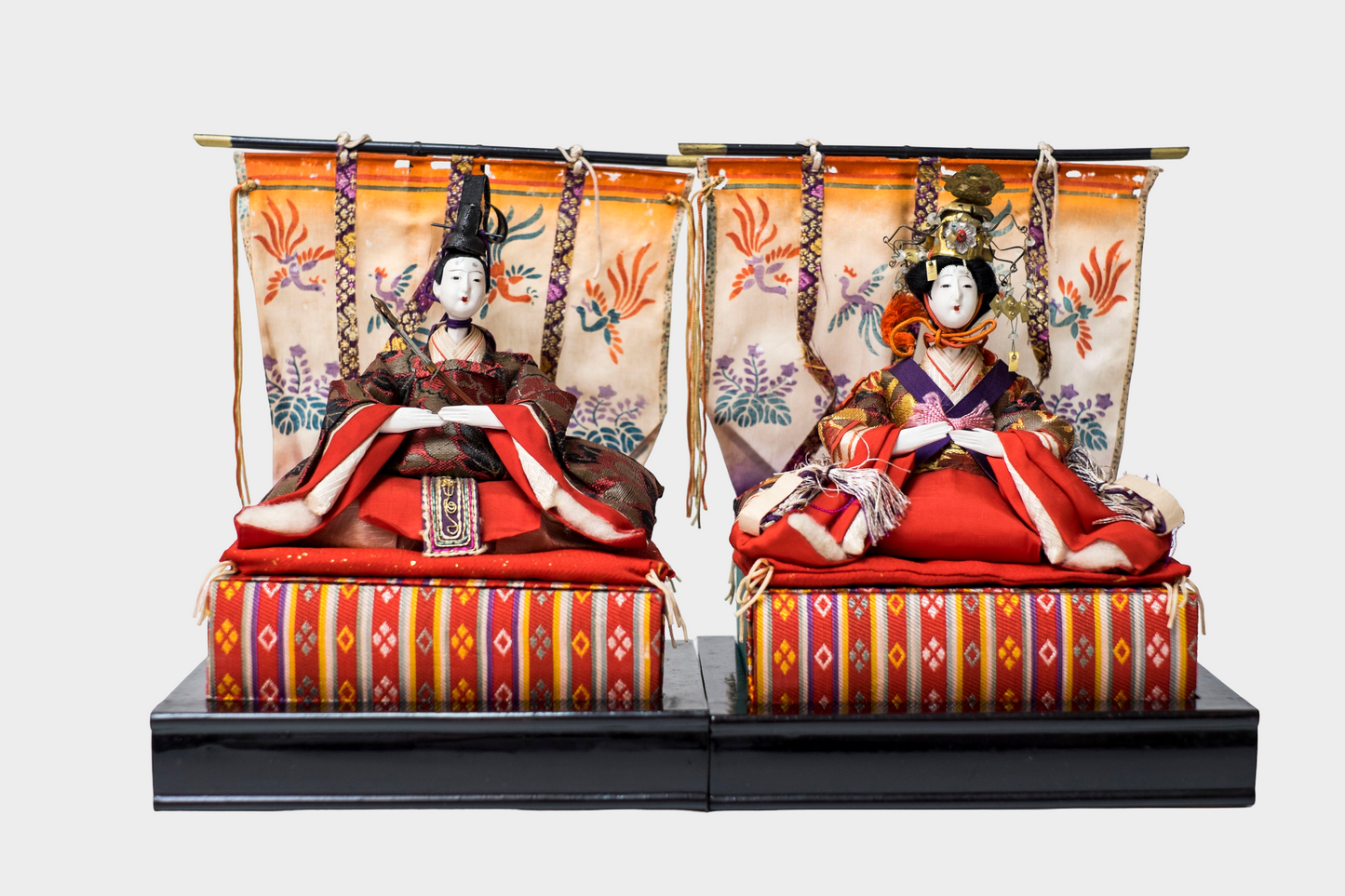
Pareja imperial de muñecas Hina, Dairi-bina, del período Taishō a principios de Shōwa, brocado de seda con biombos Byōbu con fénix
Pareja imperial de muñecas Hina, Dairi-bina, del período Taishō a principios de Shōwa, brocado de seda con biombos Byōbu con fénix
No se pudo cargar la disponibilidad de recogida
All sales are final. Please read our refund policy before purchase.
Have a reasonable price in mind? Submit your best offer and our concierge will review it personally.
The Emperor and Empress of the Hina Matsuri display, seated on red brocade platforms before textile screens patterned with phoenixes. Made in early 20th century workshop production, the pair is a complete upper-tier display rather than a fragment, the kind of household treasure set out each March, carefully stored and passed down.
The Piece
A dignified Dairi-bina imperial pair representing the Heian court ideal, executed in early 20th century workshop production. The Emperor (Odairi-sama) holds a ritual baton (shaku); the Empress (Ohina-sama) wears elaborate kanmuri-style head ornamentation with dangling metal fittings. Both are seated formally on red brocade platforms mounted on lacquered bases, and behind them textile byōbu screens carry stylized hō-ō phoenix motifs in a repeating dyed pattern. This is a complete upper-tier two-figure display, not a fragment.
Hina Matsuri, Girls' Day on March 3, originates in Heian court purification rites. The phoenix on the screens signifies imperial authority, renewal, feminine grace and auspicious power, and the layered kimono reflect the Heian jūnihitoe, stylized and simplified for the doll format.
The heads are likely gofun over a molded composition core. The hair is black silk fiber arranged in the traditional shimada style, and the Empress's headpiece includes metal floral and pendulum ornaments. The garments are silk brocade with metallic thread accents in multi-layer construction, early machine-woven brocade rather than handwoven Nishijin masterwork. The brocade risers sit over wooden cavity frames, and the lacquered bases are likely black urushi or a period-consistent synthetic lacquer. The screens are fabric-draped wooden frames with a purple gradient lower section.
The Taishō era (1912–1926) and early Shōwa saw expanded middle-class access to Hina displays. Workshop production increased while quality remained respectable, and sets like this were displayed annually, carefully stored and often passed through generations. This is not an Edo-period hina, a Meiji imperial commission, a signed master-studio work or a museum-tier carved-head specimen, but an authentic early 20th century ceremonial pair: complete, strong in textile presence, culturally meaningful and well suited to tokonoma display, seasonal exhibition or cultural photography.
Details
- Era: Late Taishō to early Shōwa (circa 1920s–1940s)
- Origin: Japan
- Material: Gofun-finished heads (likely composition base); black silk fiber hair; silk brocade garments with metallic thread; lacquered wood platforms; textile byōbu screens on wooden frames
- Color: Red brocade platforms; black lacquered bases; screens with purple gradient lower section
- Set: Dairi-bina imperial pair: Emperor (Odairi-sama) and Empress (Ohina-sama)
- Mounting: Separate black lacquered bases with integrated brocade risers
- Screens: Fabric-covered panels with hō-ō phoenix motif
Condition
- Age-consistent wear, with the heads largely intact.
- Head surfaces appear intact with minimal cracking in the images.
- Textiles show age-related wear.
- The screens show staining consistent with age.
Authenticity & Care
Period assessed visually, with no internal inspection performed, and no signature observed in the images. Classified as Taishō to early Shōwa production and not represented as Meiji without further evidence. Every piece is examined and documented in Japan before dispatch and is offered with the Japonista authenticity guarantee.
Delivery from Japan
Packed by hand in Japan and shipped insured and tracked by EMS or an equivalent express service. Import duties and taxes, where applicable, are payable on arrival. Returns follow our published policy.
Considered offers are welcome through Send an Offer, and each one is reviewed personally.
Continue browsing: Japanese Dolls
Related pieces: Meiji musha ningyo armored warrior doll · Urasaki Hakata ningyo shunga oiran figure · Darth Vader musha ningyo samurai doll
Consolidated Freight
Furniture, folk pieces and machines can be gathered, packed and shipped together from our Warehouse & Export Vault™, saving on international freight. Consolidate your pieces →
Collectors also search: dairi bina imperial pair · taisho hina dolls · vintage hina ningyo emperor empress · hina matsuri dolls antique · japanese girls day dolls · hina dolls phoenix screen