Japonista
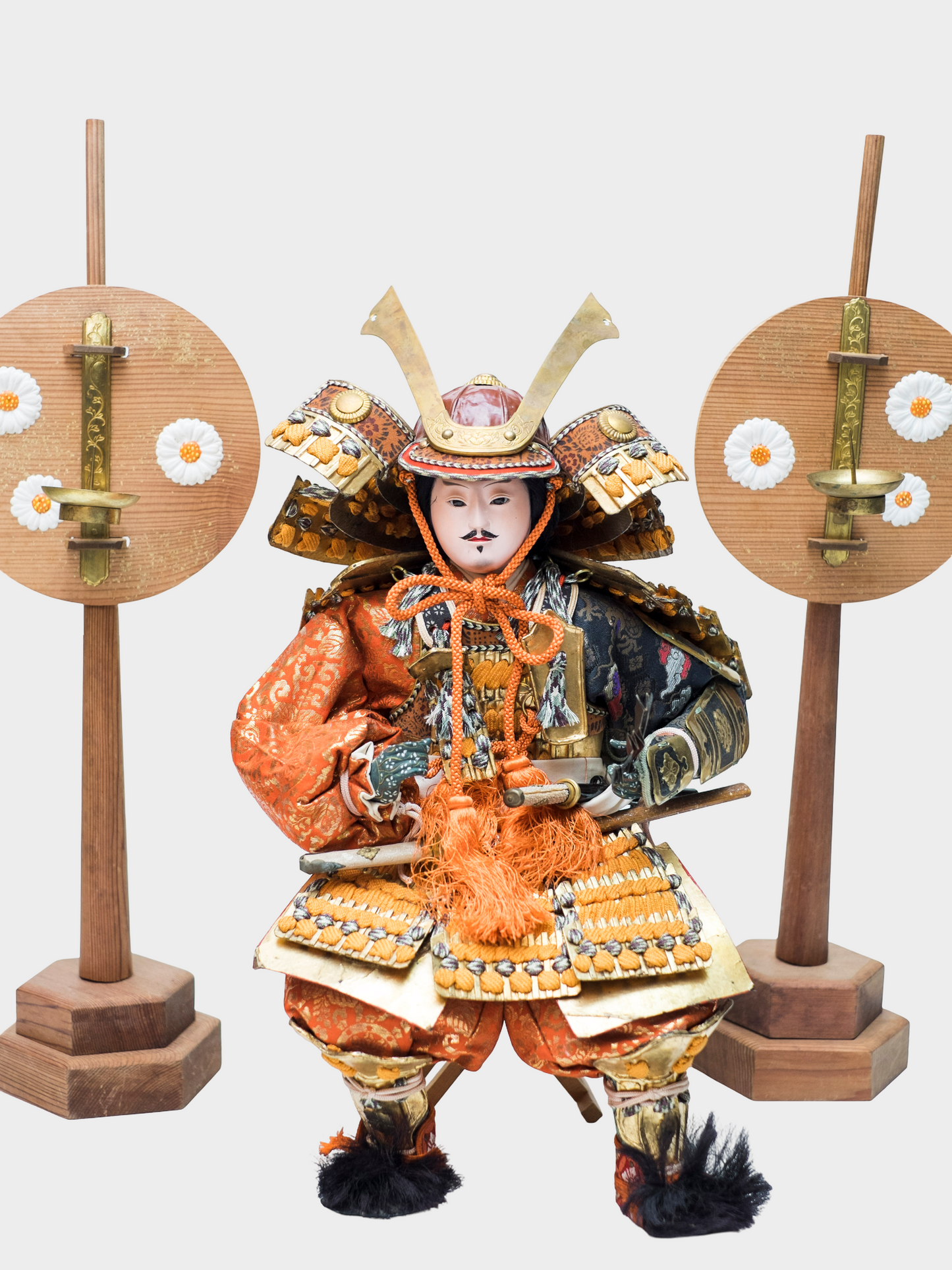
Muñeca guerrero Musha Ningyō con armadura del período Meiji, kabuto y brocado de seda, rostro de gofun, figura del festival del Día de los Niños
Muñeca guerrero Musha Ningyō con armadura del período Meiji, kabuto y brocado de seda, rostro de gofun, figura del festival del Día de los Niños
No se pudo cargar la disponibilidad de recogida
All sales are final. Please read our refund policy before purchase.
Have a reasonable price in mind? Submit your best offer and our concierge will review it personally.
A late Meiji musha ningyo that carries itself with a composure beyond seasonal ornament. Individually articulated armor plates, functional lacing and dense silk brocade preserve the dimensionality that later mass-produced festival dolls lost, and the gofun face, spare and vigilant, remains stable after more than a century.
The Piece
Made during the late Meiji period, late nineteenth century, this armored warrior figure belongs to the tradition of Tango no Sekku, the Boys' Day festival, yet it holds its space with notable restraint. The posture is compact and centered, the weight settling naturally into the stance. The armor does not flare theatrically and the cords do not erupt in decorative abundance. Unlike later Showa festival dolls, whose proportions grew exaggerated and whose surfaces flattened under mass production, it keeps its dimensionality: the plates articulate individually, the lacing is functional rather than implied, and the garments fall with the gravity of real textile.
Musha ningyo were displayed in the household during Boys' Day as embodiments of martial virtue, filial strength and moral discipline. In the Meiji era, with the samurai class dissolved into memory, they became quiet monuments to a vanishing ethos, armor no longer worn in battle preserved in miniature within the home. The kabuto crest rises in measured assertion, its metal surface softened by a subdued patina, and the odoshi lacing binds the lamellae as a true structural element.
The face is finished in traditional gofun, with a deliberate, spare brushed moustache and eyes that look forward and attentive rather than theatrical; the expression suggests vigilance. Beneath the armor, silk brocade of late nineteenth-century weight and density retains depth in its weave, its orange tones softened by time. The lacquered plates follow anatomical curvature, and twin circular shield panels frame the figure symmetrically, lifting it from isolated sculpture into ceremonial arrangement. The wood bases show honest grain and appropriate patination.
The figure sits at a transitional moment, when musha ningyo were moving from elite ritual objects toward broader merchant patronage while modernization reshaped Japan. It retains the hand assembly and layered construction of late Edo and early Meiji workshops, without the simplifications of early twentieth-century export production. It suits a focused musha ningyo archive, a broader collection of Japanese seasonal ritual art, a study of samurai iconography, or an institutional display of domestic ceremonial craft.
Details
- Era: Late Meiji period, late 19th century
- Origin: Japan
- Type: Musha ningyo (armored warrior doll) for Tango no Sekku, Boys' Day
- Material: Gofun face; silk brocade garments; lacquered armor plates with metal rivets and fittings; odoshi lacing; metal kabuto crest; wood bases
- Color: Orange silk brocade, softened with age
- Included: Twin circular shield panels; wood bases; sword elements
Condition
- Preserved rather than restored, with gentle age consistent with the period; structural alignment sound and stance stable.
- Textiles show natural softening and minor fatigue consistent with age; fading of the orange brocade consistent with exposure and age rather than artificial distress.
- Armor lacquer shows subtle surface wear at the edges.
- Minor oxidation at metal rivets and fittings, appropriate to the period.
- Gofun face surface stable, the powder layer even, without widespread cracking or flaking and no serious instability.
- Helmet crest intact; sword elements retain coherence.
Authenticity & Care
Presented as a late Meiji musha ningyo on the evidence of its hand assembly, layered textile construction, dimensional armor and gofun facial modeling; not a later Showa export simplification or modern reproduction. Every piece is examined and documented in Japan before dispatch and is offered with the Japonista authenticity guarantee.
Delivery from Japan
Packed by hand in Japan and shipped insured and tracked by EMS or an equivalent express service. Import duties and taxes, where applicable, are payable on arrival. Returns follow our published policy.
Considered offers are welcome through Send an Offer, and each one is reviewed personally. Pieces over $1,000 may be reserved over several payments with Layaway Privilege™.
Continue browsing: Samurai Arts · Japanese Dolls
Related pieces: Urasaki Hakata ningyo shunga oiran figure · Darth Vader musha ningyo samurai doll · Taishō–Shōwa Dairi-bina imperial pair
Armory & Export
Armor, sword fittings and historical militaria travel with export paperwork, custom crating and insured freight through our Museum-Grade Logistics Suite™. Plan a museum-grade shipment →
Collectors also search: meiji musha ningyo · antique samurai doll · japanese warrior doll boys day · gogatsu ningyo antique · tango no sekku doll · gofun samurai doll · antique japanese armor doll