Japonista
Sukajan Kabukimono Musubi de Senbu × Miyabi, guerrero montado Maeda Keiji, sakura y calavera, rayón negro, talla S
Sukajan Kabukimono Musubi de Senbu × Miyabi, guerrero montado Maeda Keiji, sakura y calavera, rayón negro, talla S
No se pudo cargar la disponibilidad de recogida
All sales are final. Please read our refund policy before purchase.
Have a reasonable price in mind? Submit your best offer and our concierge will review it personally.
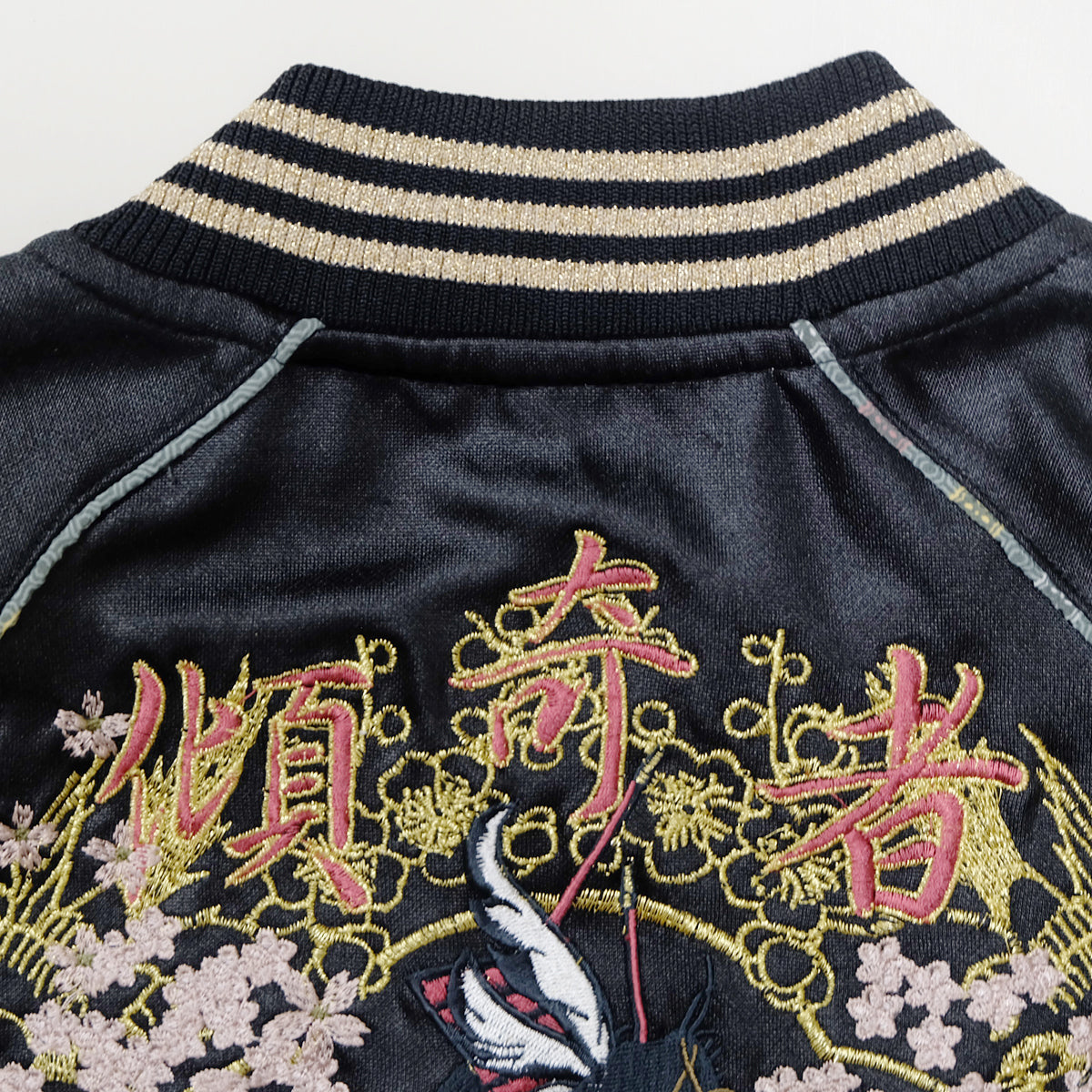
Dark, theatrical and dense with embroidery, this Senbu × Miyabi Musubi sukajan turns the legend of the flamboyant Sengoku warrior into black satin, pale cherry blossoms and antique-gold thread. A mounted warrior beneath the characters 傾奇者 commands the back, while a skull, crossed kiseru and a vermilion spear carry the story around the jacket.
The Piece
The back depicts a warrior seated on a powerful black horse, surrounded by a near-circular explosion of sakura and intricate gold-thread ornament. Above the rider are the characters 傾奇者, read kabukimono: an eccentric, flamboyant or unconventional warrior who rejected ordinary expectations through fearless conduct, extravagant dress and an unmistakable personal code. The word suits a sukajan, since the kabukimono and the souvenir jacket share an attitude of visual defiance, individuality and deliberate excess. This is not a restrained souvenir jacket but a fully composed piece of Japanese maximalist streetwear, balancing the beauty of sakura with skull symbolism, warrior imagery and the rebellious spirit of the kabukimono.
The rider, in black and crimson armor and holding a long spear, and the horse are embroidered largely in subdued black, charcoal, gray and deep red, so they emerge gradually from the satin ground rather than as a flat, brightly colored illustration. Tonal threadwork defines the horse's musculature, bridle, leg ornaments and flowing mane, lending the composition unusual gravity without disturbing its nocturnal palette. Around them, pale pink, blush and white blossoms gather like a spring storm frozen in embroidery, and behind the blossoms metallic gold thread forms flowering vines, stylized birds, decorative knots and curls, floral cartouches, fine ornamental linework and small inscription-like details: an illuminated frame that sets the warrior almost like an icon within a textile shrine.
On the right chest a white embroidered skull sits above two crossed gold-and-black objects resembling traditional kiseru smoking pipes, among drifting pink petals: mortality without the purely macabre, the blossoms bringing delicacy and renewal and the pipes the air of a fearless, pleasure-loving kabukimono. The opposite chest carries the inscription 天に愛されし 戦国一の 極傾奇, naturally rendered as “Loved by heaven, the ultimate kabukimono of the Warring States age”, divided between pale silver-white and antique-gold thread and placed asymmetrically to balance the skull like a dramatic historical proclamation. One sleeve carries a long red and black spear running from shoulder toward cuff, completed by a large silver-gray spearhead near the lower sleeve, so that the whole arm becomes part of the narrative. The other is densely embroidered with flowering branches, clusters of cherry blossom and scattered petals in pale pink, dusty rose, ivory, mauve, olive green and muted gold, heaviest at the shoulder and upper arm and breaking into drifting petals below, as if carried across the jacket by wind.
The kabukimono stands for radical individuality, confidence and a refusal to disappear into the crowd: not rebellion for spectacle, but a cultivated identity expressed through clothing, posture and personal conduct. Sakura speak of the brilliance and impermanence of life, their beauty heightened by their brief season; the skull is a reminder that beauty, fame and life are temporary; the horse, a major visual force rather than decoration, carries mobility, power, freedom and the warrior's untamed character. The spear suggests martial readiness and authority, the kiseru refinement, leisure and cultivated extravagance: together a portrait of a warrior moving between battlefield strength and unapologetic personal style. The palette is rich but controlled, with a black and charcoal ground, warrior and horse in black, gray, white and crimson, sakura in ivory, blush, pale pink and dusty rose, ornament in antique gold and olive, and weapon accents in vermilion, black and silver, so the dark ground holds the complex embroidery together while blossoms and gold supply the light.
The body is lustrous black rayon satin that shifts between charcoal and deep black as it catches the light, finished with raglan bomber construction, a full front metal zipper, two zippered welt pockets with decorative cloud-shaped metal pulls, black rib-knit collar, cuffs and waistband with metallic cream-gold stripes, and contrasting piping around the raglan seams. The exact production year is not shown. The rayon construction, extensive computer-guided embroidery, specialized hardware and collaboration label are consistent with a late twentieth or early twenty-first century Japanese fashion sukajan rather than an original postwar military-commissioned souvenir jacket, within the collectible wagara tradition that reinterprets classic sukajan construction through manga, Sengoku, tattoo and historical-warrior imagery.
Details
- Maker: Senbu × Miyabi Musubi (戦武 × 雅結), collaboration woven neck label
- Line / Series: Hana no Keiji / Maeda Keiji collaboration family; kabukimono design
- Era: Late 20th or early 21st century (production year not shown)
- Origin: Japan
- Material: Black rayon satin; multicolored machine-guided embroidery with metallic gold thread; rib-knit textile; metal zipper; antique brass-tone hardware; satin piping
- Color: Black and charcoal with ivory, pale pink, antique gold and vermilion
- Size: S (Japanese size tab); approximately Western XS–S
- Construction: Raglan bomber; full front metal zipper; two zippered welt pockets; decorative cloud-shaped metal zipper pulls; black rib-knit collar, cuffs and waistband with metallic cream-gold stripes; contrasting piping around the raglan seams
- Inscriptions: 傾奇者 (kabukimono) on the back; 天に愛されし 戦国一の 極傾奇 on the chest
Condition
- Vintage pre-owned condition with natural signs of age and previous handling.
- The satin retains a strong sheen, and the large embroidered compositions remain visually impressive.
- Minor creasing, surface variation, small thread irregularities, light hardware aging and other characteristics of a pre-loved embroidered garment may be present; the satin, embroidery, ribbing, zipper, pockets, cuffs and hem are best reviewed in the photographs.
Fit and Sizing
Japanese size S, approximately comparable to a Western XS–S depending on body shape, desired silhouette and layering. Japanese sizing may fit more compactly than contemporary Western sizing, so compare with a similar jacket you own and allow room for movement and layers.
Styling and Display
Predominantly black, pale pink and antique gold, the jacket remains surprisingly wearable despite the density of its embroidery, and it displays well as textile art within a collection of Japanese fashion, sukajan, manga-inspired clothing, Sengoku imagery or embroidered statement garments.
- Black denim or Japanese selvedge jeans
- Wide-leg trousers or military cargos
- Leather boots
- Minimal monochrome outfits
- Punk and rock styling
- Wagara streetwear and contemporary kimono-inspired fashion
Cleaning and Storage
Professional specialist cleaning is recommended. Avoid machine washing, prolonged soaking, aggressive stain treatment and direct ironing over the embroidery. Store away from continuous sunlight and excessive humidity, on a padded hanger that supports the shoulders without straining the satin or embroidered panels.
Authenticity & Care
The woven neck label presents the collaboration between Senbu (戦武), a Japanese warrior-inspired fashion line, and Miyabi Musubi (雅結), known for richly embroidered wagara garments and contemporary sukajan; the design belongs to the Hana no Keiji / Maeda Keiji collaboration family and appears in Japanese catalog records as a rayon embroidered kabukimono sukajan. Every piece is examined and documented in Japan before dispatch and is offered with the Japonista authenticity guarantee.
Delivery from Japan
Packed by hand in Japan and shipped insured and tracked by EMS or an equivalent express service. Import duties and taxes, where applicable, are payable on arrival. Returns follow our published policy.
Considered offers are welcome through Send an Offer, and each one is reviewed personally.
Continue browsing: Sukajan Souvenir Jackets · Amekaji & Wagara Fashion
Related pieces: Prince Shokai navy hawk and pine sukajan · Black velvet monochrome dragon sukajan · Ed Hardy red and gold reversible tattoo sukajan
Yokosuka Archive
A particular size, motif or decade in mind? Postwar souvenir jackets and heritage amekaji surface in Japan one at a time. Name the maker, the embroidery and the chest measurement, and the Hunting Salon™ watches for it on your behalf. Request a jacket search →
Collectors also search: miyabi musubi sukajan · senbu sukajan · kabukimono sukajan · maeda keiji jacket · hana no keiji sukajan · samurai embroidered sukajan · black rayon sukajan sakura · sengoku warrior souvenir jacket