Kutani Ware
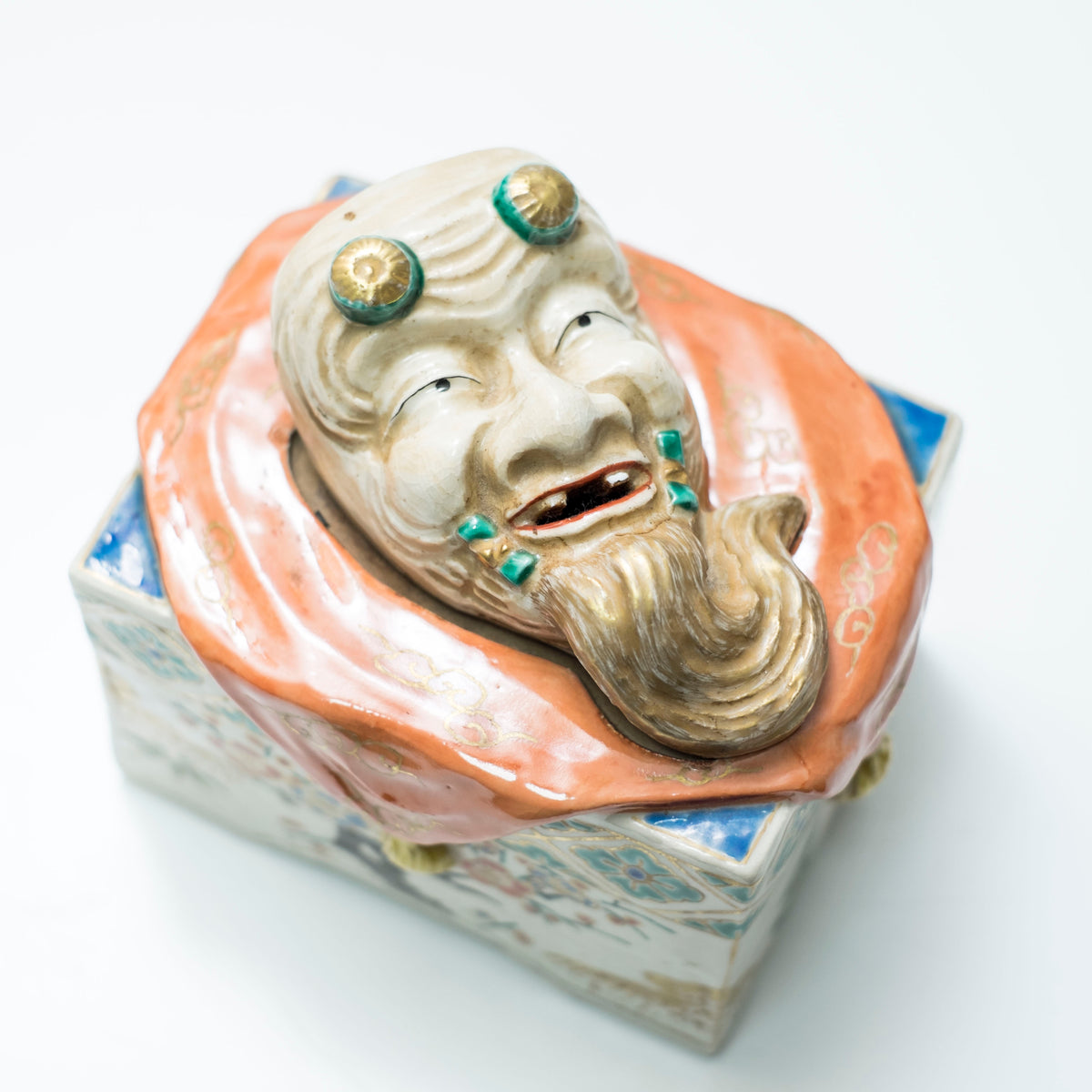
Kogo de porcelana policromada de estilo Kutani con máscara de Noh de Rojin, decoración dorada y tomobako
Kogo de porcelana policromada de estilo Kutani con máscara de Noh de Rojin, decoración dorada y tomobako
No se pudo cargar la disponibilidad de recogida
All sales are final. Please read our refund policy before purchase.
Have a reasonable price in mind? Submit your best offer and our concierge will review it personally.
An unusual meeting of Noh imagery, incense culture and richly colored ceramic art: a square porcelain kogo crowned by the sculptural face of an elderly man with a long flowing beard, emerging from a vermilion ceramic drape. The incense box becomes a miniature stage, theatrical, whimsical and refined.
The Piece
Rather than treating the incense container as a simple covered vessel, the maker has turned it into a miniature stage. The square body, slightly raised on corner feet, is decorated on all visible sides with blossoms, stylized foliage, landscape passages, geometric diaper borders and delicate gilding. Above it lies a salmon-vermilion textile-like ceramic drape with modeled yellow corner tassels and scrolling gold ornament, and from its center emerges the three-dimensional face of an elderly man, the hollow face-form conceived as part of the covered vessel.
The figure belongs visually to the old-man imagery of Noh theater, which includes several elderly male masks conveying dignity, wisdom, humor or supernatural presence; it is best described as Rojin or old-man Noh-inspired rather than tied to a specific mask type without documentation. The high forehead, modeled cheeks, projecting nose, softened eyelids, slightly open mouth and deeply carved beard, sweeping dramatically to one side, give an expression that reads as amused, contemplative, sleepy or gently smiling depending on angle and light. Modeled locks frame the cheeks, and small green-and-gold ornaments add a jewel-like note.
The palette evokes Kutani-style overglaze decoration: rich green, turquoise, blue, coral-orange, red, ivory, brown, yellow and gold in carefully separated zones. A geometric band of green floral forms in a diamond lattice runs around the upper body, with flowering branches, small bamboo-like plants, stylized earth or cloud formations and gold landscape accents on a warm ivory ground below. The face introduces creamy ivory with crackle, muted gold-brown beard tones, emerald accents and red at the mouth. Exuberant yet harmonious, it is read hierarchically: face, drape, border, landscape, then tiny botanical detail.
A kogo is a small covered container associated with incense, and in Japanese decorative arts such boxes became occasions for experiment, imitating fruit, animals, shells, masks and auspicious objects. This example takes that impulse further, conceived as a multi-level narrative composition that succeeds as okimono even without incense. It is accompanied by its wooden storage box with a traditional woven tie.
Details
- Origin: Japan
- Era: Antique or early vintage; possibly late Meiji to Taisho
- Material: Glazed porcelain or ceramic with polychrome overglaze enamels and gilding; wooden storage box with woven tie
- Color: Ivory, coral-orange and vermilion, green, turquoise, blue, red, yellow and gold
- Measurements: Ceramic piece height approx. 14 cm · Wooden box approx. 16 cm H × 17 cm W × 14 cm D; mask cover and beard project beyond the body, so maximum width and depth vary with the measuring point
- Included: Wooden storage box (tomobako) with woven tie
Condition
- Characteristics consistent with age, manufacture, storage, handling and previous display.
- Visible crazing or fine crackle, particularly around the ivory face and other glazed areas, with age-related toning to portions of the beard and lighter surfaces.
- The gilding shows the softened character of an older handled object; minor marks, glaze irregularities, firing characteristics, small surface imperfections and localized wear may be present.
- The wooden box shows natural age, surface variation, edge wear and wear to the woven fastening ribbon.
- No restoration, exact age, artist or kiln attribution, or provenance is claimed beyond what the object itself establishes.
Authenticity & Care
No artist, kiln, workshop or factory is documented and the box shows no readable inscription identifying a maker; decoration is consistent with Kutani-style traditions, and a late Meiji to Taisho date is plausible but undocumented. Every piece is examined and documented in Japan before dispatch and is offered with the Japonista authenticity guarantee.
Delivery from Japan
Packed by hand in Japan and shipped insured and tracked by EMS or an equivalent express service. Import duties and taxes, where applicable, are payable on arrival. Returns follow our published policy.
Considered offers are welcome through Send an Offer, and each one is reviewed personally.
Continue browsing: Butsudan & Altars · Okimono
Related pieces: Kutani ware Hotei with cloth sack · Kutani Hotei-sama fortune figure · Kutani ware seated Hotei figure
Temple to Home
Monumental statues, zushi shrines and altars travel crated and insured through our Museum-Grade Logistics Suite™. Seeking a particular deity or school? The Hunting Salon™ searches Japan for it. Arrange crating and freight →
Collectors also search: kutani noh mask kogo · rojin noh mask incense box · japanese porcelain incense box · kutani style kogo with box · old man noh mask ceramic · japanese kogo incense container · polychrome kutani okimono