Japonista
Conjunto de altar budista japonés Edo-Meiji, instalación de templo con múltiples figuras de madera tallada en santuario zushi
Conjunto de altar budista japonés Edo-Meiji, instalación de templo con múltiples figuras de madera tallada en santuario zushi
Freight piece: please confirm delivery before purchase
This piece travels in a crate or by freight rather than standard mail, and may need careful dismantling before it can be packed. The shipping shown at checkout is an estimate. Japonista reserves the right to determine the final handling, crating and freight cost when your order is received, according to the piece, the destination and carrier conditions at that time.
We advise requesting a delivery quote before checkout. If the final cost is higher than the amount paid, we send the difference for your approval before dispatch. Your piece is held for you until it is settled.
Request a delivery quoteAcquired by private invoice
Pieces of this calibre are reserved personally rather than through online checkout. Request the piece and the curator desk confirms availability, delivery and your invoice, payable by bank transfer or Wise. The piece is held for you while your transfer arrives.
Reserve this pieceAll sales are final. Please read our refund policy before purchase.
Have a reasonable price in mind? Submit your best offer and our concierge will review it personally.
Few Buddhist altar groupings leave the temple intact. Here a central wooden Buddha, its attendants and guardians, their bases and the curved-roof shrine that held them have stayed together, an Edo–Meiji ensemble whose damage and losses are outweighed by the rarity of a hall furnishing that survives complete.
The Piece
This ensemble is a complete Japanese Buddhist altar grouping in the zushi manner: a wooden shrine cabinet housing a central Buddha image flanked by attendant figures, preserved together as a single devotional unit. The figures are arranged in a hierarchical composition that reflects temple installation rather than portable household worship.
At the center stands the principal Buddha image, carved in wood and originally finished with pigment and gilding. Around it are subsidiary attendants and guardian figures, each carved independently and placed within the shrine to form a cohesive devotional scene. The figures vary in scale and posture, indicating their respective roles within the Buddhist cosmological hierarchy.
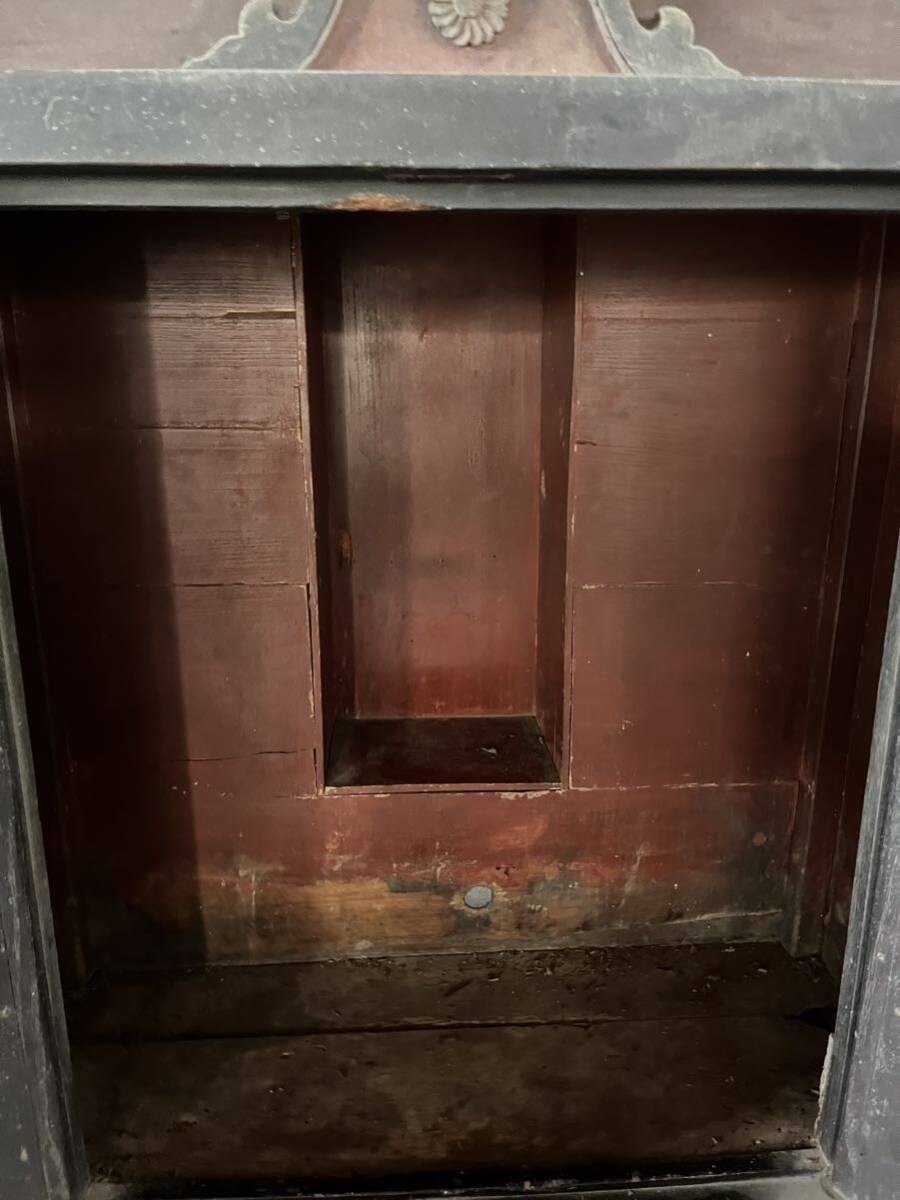
The shrine cabinet is constructed of wood with a curved roofline and hinged doors. The presence of the original components together, figures, base elements and shrine housing, adds significant historical value despite the overall condition.
Altar groupings of this kind were installed in regional temples or subsidiary halls, where they functioned as fixed devotional installations. They were not designed for frequent movement, and deterioration over time is common once they are removed from their architectural context. The ensemble is best understood as a preserved temple installation rather than an isolated sculptural object.
Details
- Era: Edo–Meiji period range
- Origin: Japan
- Material: Carved wood; figures originally finished with pigment and gilding
- Object type: Buddhist altar ensemble with shrine cabinet
- Components: Central Buddha, attendant and guardian figures, base elements, wooden shrine (zushi) with curved roofline and hinged doors
- Customs: HS Code 9706.00; country of origin Japan
- Weight: Estimated crated weight 250–350 kg (ensemble)
- Shipping: Cargo only: local pickup or freight; disassembly and professional crating required
Condition
- Overall poor, with visible damage, losses and wear to both the figures and the wooden shrine.
- The shrine cabinet shows surface wear, pigment loss and structural fatigue consistent with long-term temple use and storage.
- The ensemble retains strong documentary and ritual value as an intact group; restoration, conservation or institutional handling should be considered by the next custodian.
- Large altar ensembles require institutional-level handling, conservation planning and controlled environments.
Authenticity & Care
Dating to the Edo–Meiji range and attribution are based on visual assessment and the documentation available, and should be treated as approximate. Every piece is examined and documented in Japan before dispatch and is offered with the Japonista authenticity guarantee.
Delivery from Japan
Crated in Japan and shipped insured by air or sea freight. A freight quote is confirmed with you before dispatch through our Museum-Grade Logistics Suite™. Import duties and taxes, where applicable, are payable on arrival. Returns follow our published policy.
Considered offers are welcome through Send an Offer, and each one is reviewed personally. Pieces over $1,000 may be reserved over several payments with Layaway Privilege™.
Continue browsing: Butsudan & Altars · Buddhist Statues & Sacred Art
Related pieces: Eight-armed Benzaiten multi-figure zushi shrine · Pair of cloisonné elephant censers · Monumental three-way opening gold butsudan cabinet
Temple to Home
Monumental statues, zushi shrines and altars travel crated and insured through our Museum-Grade Logistics Suite™. Seeking a particular deity or school? The Hunting Salon™ searches Japan for it. Arrange crating and freight →
Collectors also search: antique japanese buddhist altar ensemble · zushi shrine with buddha figures · japanese temple altar installation · edo period buddhist altar · wooden buddhist shrine cabinet antique · multi figure buddhist shrine japan · japanese temple artifact for sale