Evisu
Chaqueta de tour de mezclilla índigo Evisu-Circle YAMANE Kintarō, koi y mapa de Japón bordados, talla única M-L
Chaqueta de tour de mezclilla índigo Evisu-Circle YAMANE Kintarō, koi y mapa de Japón bordados, talla única M-L
No se pudo cargar la disponibilidad de recogida
All sales are final. Please read our refund policy before purchase.
Have a reasonable price in mind? Submit your best offer and our concierge will review it personally.
An exceptional YAMANE embroidered denim jacket from the wider Evisu and Japanese Amekaji tradition, translating the narrative language of the sukajan into a substantial collared indigo tour jacket. Kintarō and the climbing carp fill both sleeves, while a dragon and an embroidered map of Japan, crowned by the YAMANE name, command the back.
The Piece
This is not a conventional satin bomber. Traditional sukajan commonly use lightweight rayon-like satin, elastic ribbed trim, raglan sleeves and reversible bomber construction; here the same storytelling impulse is carried onto a collared denim work-jacket silhouette, heavier, more architectural and more firmly connected with Japanese denim collecting. It belongs to the Amekaji lineage, Japan's highly developed interpretation of American workwear, military clothing, college sportswear, motorcycle apparel, denim and mid-century casual fashion, in which Japanese designers studied fabrics, stitching, silhouettes, hardware and aging patterns and reworked them through Japanese craftsmanship and visual storytelling. The pointed collar, indigo denim, chest pocket, sturdy cuffs and straight hem come from utilitarian Western clothing; the dragon, Kintarō, koi, embroidered map, clouds, crest and full pictorial sleeves belong to Japanese decorative and souvenir-jacket culture. The result sits between denim culture, folklore art, embroidered streetwear, souvenir mapping and wearable Japanese material culture.
The ground is dark indigo denim with a visible woven grain and subtle slub-like surface character, reading blue-black, navy, charcoal-indigo or lightly speckled blue according to the light. Unlike smooth satin, denim absorbs and breaks illumination through the weave, so the dimensional threadwork stands slightly above the surface and reads almost like appliqué or tattoo imagery transferred onto workwear. The denim also gives a firmer outline than a lightweight souvenir bomber: the collar holds its shape, the shoulder line stays defined, and cuffs and hem create a clean work-jacket finish. High-contact areas such as collar, cuffs, placket, seams, pocket openings, elbows and hem may continue to soften and lighten with wear, so the fixed narrative of the stitched motifs is joined by the evolving record of the wearer.
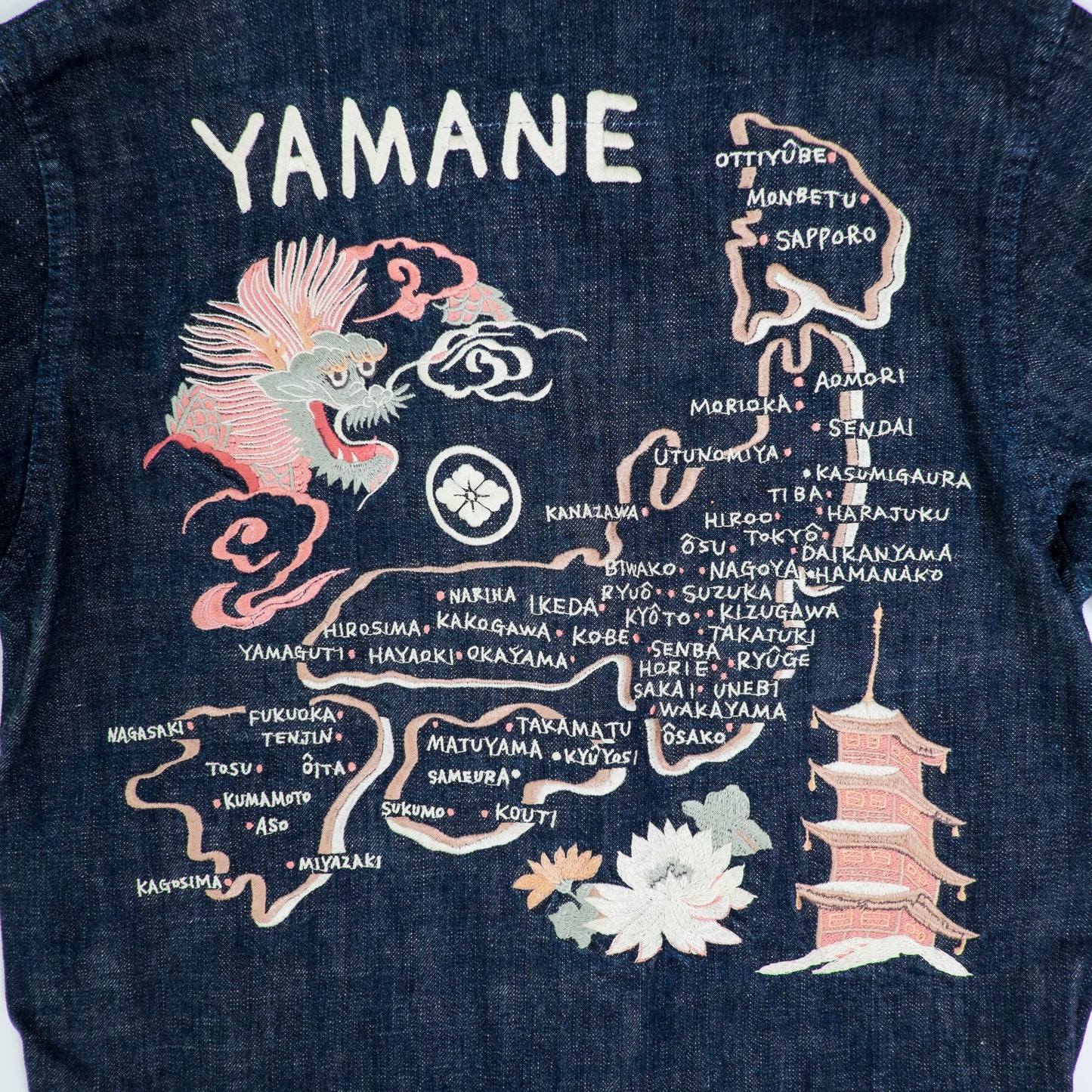
A large stylized outline of Japan occupies the central back, its islands bordered in warm pink, peach and pale coral thread while the interior remains dark indigo, letting the denim itself become sea, land, night sky and negative space. Locations are marked in hand-rendered ivory lettering with small coral dots and route-like placement, among them Sapporo, Morioka, Utsunomiya, Kanazawa, Nagoya, Kyoto, Kobe, Hiroshima, Fukuoka, Kumamoto, Miyazaki and Matsuyama, following the archipelago from Hokkaidō through Honshū into Shikoku and Kyūshū. The deliberately irregular lettering gives the back the air of an embroidered travel diary, translating the satin map-jacket concept, long a record of travel, military stations, ports and routes, into Japanese denim. Above, YAMANE is embroidered in large, slightly irregular ivory capitals across the shoulder blades, functioning as the title of the whole composition. To the left of the map a pale dragon emerges through curling clouds, its head in ivory, muted coral, pale gray and dusty pink, with long muzzle, open mouth, whiskers, horns and flowing mane, the body curling into pink and coral scrolls rather than a complete naturalistic creature; ivory and pale pink cloud forms extend from mouth and body, so the dragon reads as an apparition of cloud, water and breath. A circular ivory crest with a simplified four-petal floral device, resembling the grammar of a mon without attribution to any lineage, sits beside the dragon on both chest and back, and scattered chrysanthemum-like blossoms gather near the lower back.
Each sleeve carries a complete vertical composition, mirrored left and right. At the upper arm a Kintarō-inspired figure crouches powerfully on a rocky ledge: rounded body, dark windswept hair, coral-red skin, determined eyes, a pale yellow chest garment with green neck detail and a purple, black, ivory and pink checkered lower garment, the pair turned inward toward the body. The ledge, in layered gray, taupe, brown, white and mustard thread, descends into a rushing waterfall of bright turquoise and pale-blue bands, where a large carp in taupe, gray, ivory, pale blue, turquoise, sage and muted gold surges upward through foaming white and aqua waves, each scale outlined and the fins and tail spread through the current. Read from cuff to shoulder, the carp begins its struggle, Kintarō embodies strength, and the dragon on the body represents transformation achieved, a narrative that animates as the elbows bend.
The front continues the program with a smaller dragon and the circular crest on the left chest, balanced by a rectangular patch pocket on the opposite side, an asymmetry characteristic of Japanese designer workwear. A broad denim placket conceals most of the fastening, with a round metal snap or button visible near the lower hem; a diagonal lower pocket, structured denim cuffs and a straight denim waistband rather than elastic ribbing complete a clean vertical body line that layers easily over shirts, knitwear, T-shirts or light sweatshirts. The softened, never neon palette runs through ivory, cream, coral, salmon pink, dusty rose, turquoise, pale blue, sage green, mustard, taupe, brown, gray, black and muted gold. Kintarō's face and body are built from several coral, salmon, pink and cream tones with thread direction following the rounded anatomy; the sleeves are densely filled while the map uses open linework, keeping the garment balanced, and the denim may show gentle puckering around the larger embroidered fields, characteristic of extensive machine embroidery on woven fabric. Kintarō is a less common jacket subject than tigers, eagles or dragons, which gives the piece distinctive folklore value for collectors of Evisu and YAMANE clothing, Japanese denim, Osaka denim, embroidered tour jackets and Y2K Japanese streetwear; it suits classic Amekaji styling with raw or faded jeans and engineer or moc-toe boots, wide-leg streetwear, heritage workwear, rockabilly and biker dress, gender-neutral wardrobes, and editorial or stage use, where the turquoise water and coral figures read clearly under lighting.
Details
- Maker: YAMANE, closely associated with the Evisu-centered Japanese denim and heritage-fashion tradition
- Style: Amekaji denim tour jacket with sukajan-inspired pictorial embroidery
- Era: Consistent with Japanese YAMANE and Amekaji production of the 2000s to early 2010s (Heisei-era designer streetwear)
- Origin: Japan
- Material: Dark indigo denim with visible woven grain and subtle slub-like character; multicolor embroidery thread; metal hardware; woven label
- Color: Deep indigo (blue-black to charcoal-indigo); embroidery in ivory, cream, coral, salmon pink, dusty rose, turquoise, pale blue, sage green, mustard, taupe, brown, gray, black and muted gold
- Size: Free Size, indicated approx. M-L (tag); generally closest to a contemporary Western S-M or a trim M-L, depending on proportions and layering
- Principal Motifs: Kintarō child hero, climbing carp, waterfall, dragon, clouds, Japan map with city and regional names, circular floral crest, chrysanthemums, rocky landscape, tour-jacket typography
- Construction: Pointed denim collar; set-in sleeves; covered center-front placket with visible lower metal snap; patch chest pocket; diagonal lower hand pocket; button or snap denim cuffs; straight denim hem; interior woven YAMANE label; embroidery across chest, back and both sleeves
Condition
- Vintage pre-owned condition with natural denim creasing, mild seam wear, subtle indigo variation, softened high-contact edges and age-appropriate textile character; the jacket retains a strong dark indigo appearance and the principal embroidered compositions remain visually complete and highly legible.
- Denim body: gentle surface movement and natural variation through the weave, with subtle softening and lighter tonal development around seams, collar edges, cuffs, placket, pockets and hem, consistent with normal wear.
- Back embroidery: the YAMANE lettering, Japan map, dragon, crest, city names, route lines and floral details remain clearly readable, the ivory and coral threads still contrasting strongly against the indigo.
- Sleeve embroidery: the mirrored Kintarō figures, rocks, waterfalls, koi, fins, scales and foaming currents remain vibrant and well articulated, with strong color separation; minor thread fuzzing, isolated raised fibers, subtle edge wear or small embroidery irregularities may be present within the extensive stitched fields.
- Collar and cuffs remain present and cohesive, with gentle softening and light edge wear consistent with previous use; the chest pocket, lower pocket opening, covered placket and lower metal fastening remain integrated.
- Shoulder seams, sleeves, side panels, back yoke, collar, cuffs, hem, pockets and principal embroidery fields appear structurally sound; no major missing panel, catastrophic tear or extensive embroidery loss is evident.
- Not presented as factory-new: natural fading, seam rubbing, creasing, thread movement, denim softening and small signs of prior wear form part of its visual history. Indigo may appear dark navy, blue-black, charcoal-indigo or slightly lighter blue depending on lighting and screen.
Iconography Glossary
- Kintarō, the "Golden Boy": one of Japan's most enduring child heroes, raised in the mountains and celebrated for extraordinary strength, later associated with Sakata no Kintoki, a famed warrior retainer of Minamoto no Yorimitsu; often shown wrestling or riding a giant carp in ukiyo-e, festival imagery, tattoo designs and boys' decorative culture.
- Koi no takinobori, the carp climbing a waterfall: perseverance against difficulty, advancement through effort, courage and ambition; the fish moves against the current. In the Dragon Gate legend the carp that clears the falls becomes a dragon.
- Ryū, the Japanese dragon: linked with water, rainfall, rivers and seas, wisdom, protection, authority, transformation and elemental force.
- Circular crest: a mon-like emblem suggesting continuity, unity, inheritance and belonging, its floral center echoing the blossoms near the lower back.
- Japan map: the souvenir-jacket tradition of recording travel and place, here turning the whole country into a brand and cultural landscape.
Preservation Guidance
- Professional cleaning by a specialist experienced with indigo denim, dense embroidery, vintage Japanese clothing and metal hardware is recommended; avoid ordinary machine washing unless a textile specialist confirms it is safe.
- Indigo may transfer through friction or moisture; keep away from pale upholstery, light bags and pale clothing, particularly when damp.
- Do not scrub, brush aggressively or iron directly over the embroidery; avoid bleach, alcohol, concentrated detergent and household stain removers.
- Do not tumble dry; press only on low heat from the reverse with a pressing cloth, away from embroidered areas and hardware.
- Store on a broad, supportive hanger in a breathable cover, away from direct sunlight, humidity, smoke, perfume, dust and compression; support shoulders and body evenly rather than lifting by collar, pocket or sleeves.
Authenticity & Care
The interior woven label and the large embroidered back name identify the garment with YAMANE. The 2000s to early 2010s dating is a stylistic assessment based on denim, embroidery program and silhouette. Every piece is examined and documented in Japan before dispatch and is offered with the Japonista authenticity guarantee.
Delivery from Japan
Packed by hand in Japan and shipped insured and tracked by EMS or an equivalent express service. Import duties and taxes, where applicable, are payable on arrival. Returns follow our published policy.
Considered offers are welcome through Send an Offer, and each one is reviewed personally.
Continue browsing: Sukajan Souvenir Jackets · Amekaji & Wagara Fashion
Related pieces: Yamane EVISU Evisuchou tiger and dragon denim jacket · Evisu Yamane Nêsan Kirei embroidered denim jacket · EVISU Yamane Ebisu kamon track jacket
Yokosuka Archive
A particular size, motif or decade in mind? Postwar souvenir jackets and heritage amekaji surface in Japan one at a time. Name the maker, the embroidery and the chest measurement, and the Hunting Salon™ watches for it on your behalf. Request a jacket search →
Collectors also search: yamane denim jacket · yamane evisu jacket · kintaro embroidered jacket · japan map embroidered jacket · koi embroidered denim jacket · japanese denim tour jacket · amekaji embroidered jacket · evisu kintaro jacket