A complete Pure Land image rather than a single statue: Amida Nyorai at the center, flanked by two attendant bodhisattvas, each on a lotus pedestal and unified by consistent carving, wood tone and patina. Rising to about 68 cm, this late Edo–early Meiji triad is a rare survival as an original set.
The Piece
The composition follows orthodox Pure Land iconography. Amida occupies the central axis as the Buddha of Infinite Light, with standing attendants positioned symmetrically to embody compassion and guidance toward rebirth in the Western Paradise. The sculptural language is restrained, solemn and internally disciplined; the faces avoid dramatic exaggeration in favor of inward calm and meditative gravity, and the surfaces show accumulated patina rather than polish, signaling age, handling and long ritual presence. This is the vocabulary of temple-use sculpture rather than later decorative reinterpretation.
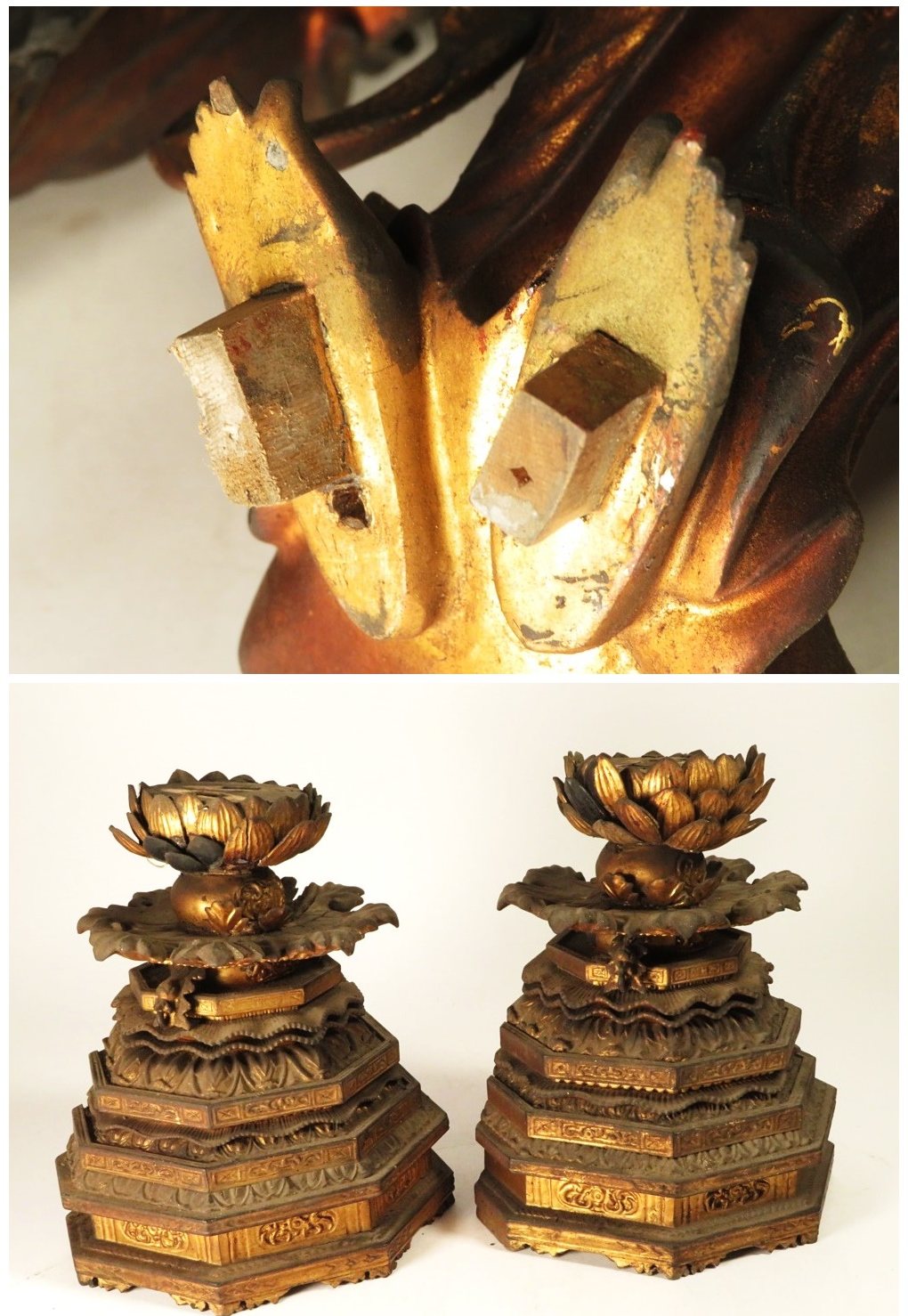
Each figure is carved in wood and mounted on an architectural lotus pedestal. Behind the central Amida rises a mandorla-backed halo structure, carved and assembled to frame the figure as a metaphysical axis rather than a mere statue; in temple sculpture this halo is not decoration but the visual grammar of radiance and vow. The attendants mirror this logic at reduced scale, reinforcing hierarchy without diminishing devotional unity.
The proportions are substantial: the full triad assembly reaches approximately 68 cm in height, and the central figure alone stands approximately 36 cm. This places the work in a liminal zone between household altar and small temple installation, a scale commonly commissioned for subsidiary halls, private chapels or temple-affiliated residences during the late Edo to early Meiji period, large enough to anchor a space as a spiritual center yet compatible with private chapels and refined household altars.
What elevates the triad is coherence. All three figures share consistent carving language, wood tone, aging patterns and proportional logic, which strongly suggests original set integrity rather than later assemblage. Triads are frequently separated over time, and when the attendants disappear the theology collapses into a single object; such completeness is increasingly rare, particularly at this scale. A triad of this kind becomes the organizing heart of a collection, a spiritual architecture around which smaller ritual objects, hanging scrolls, incense implements and sutra texts can meaningfully gather, and a strong candidate for an institutional, gallery or serious private collection.
Details
-
Era: Late Edo to early Meiji period (estimated)
-
Origin: Japan
-
Material: Carved wood
-
Configuration: Central Amida Nyorai with mandorla-backed halo; two standing attendant bodhisattvas; each figure on an architectural lotus pedestal
-
Measurements: Full triad assembly approx. 68 cm high; central figure approx. 36 cm
Condition
- Age-related wear, patina and surface variation are present and expected.
- No invasive restoration is evident in the photographs.
- Please review the photographs closely for structural joins, join stability, halo elements and base integrity.
Pure Land Triad
Amida Nyorai is the central Buddha of Pure Land Buddhism, venerated as the embodiment of infinite light and life; devotion to Amida emphasizes salvation through faith and recitation, which makes Amida triads among the most spiritually significant forms in Japanese Buddhist sculpture. Across Japanese temple sculpture, a triad is the canonical format in which a principal deity is visually and ritually supported by two attendants. It is not three separate statues but one coherent statement, a central axis of salvation with two flanking forces that translate it into lived experience, an altar's complete sentence.
The triad represents salvation as a lived encounter. In Pure Land thought Amida and his retinue descend to welcome the dying believer, the welcoming descent; the central Buddha is the promise and the attendants are the presence. The three figures are meant to be experienced frontally, at eye level, as reassurance rather than spectacle.
- Amida Buddha (Amitabha): central Buddha of the Pure Land, revered for the vow to receive beings into the Western Paradise
- Kannon (Avalokiteshvara): bodhisattva of compassion, who as attendant comforts, protects and guides the believer
- Seishi (Mahasthamaprapta): bodhisattva associated with wisdom and right mindfulness, supporting the believer's orientation toward Amida's vow
Authenticity & Care
Stylistic cues, construction and patina are consistent with late Edo to early Meiji temple or altar sculpture and clearly predate modern tourist or revival production. Without inscription or temple documentation the attribution remains a conservative, best-effort estimate based on visual assessment. Every piece is examined and documented in Japan before dispatch and is offered with the Japonista authenticity guarantee.
Delivery from Japan
Packed by hand in Japan and shipped insured and tracked by EMS or an equivalent express service. Import duties and taxes, where applicable, are payable on arrival. Returns follow our published policy.
Temple to Home
Monumental statues, zushi shrines and altars travel crated and insured through our Museum-Grade Logistics Suite™. Seeking a particular deity or school? The Hunting Salon™ searches Japan for it. Arrange crating and freight →
Collectors also search: amida triad wooden statue · amida sanzon sculpture · antique amida nyorai statue · edo period buddhist triad · pure land buddhist sculpture japan · amida kannon seishi triad · japanese wooden buddha set