Japonista
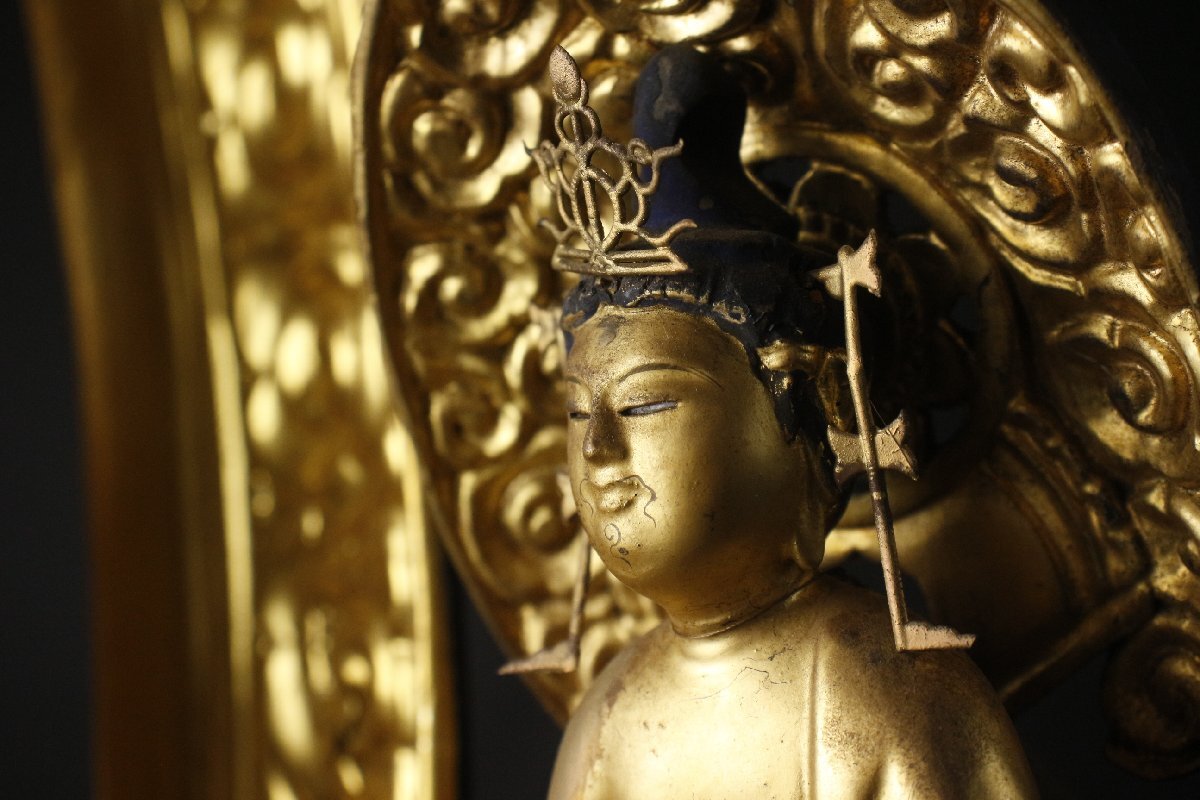
Tríada extra grande de Amida Sanzon en madera dorada con ojos gyokugan en santuario zushi de laca negra, finales del Edo-Meiji
Tríada extra grande de Amida Sanzon en madera dorada con ojos gyokugan en santuario zushi de laca negra, finales del Edo-Meiji
This piece has found its collector.
The Hunting Salon™ can search Japan's private collections for another like it. Ask us to find one or browse similar pieces.
Freight piece: please confirm delivery before purchase
This piece travels in a crate or by freight rather than standard mail, and may need careful dismantling before it can be packed. The shipping shown at checkout is an estimate. Japonista reserves the right to determine the final handling, crating and freight cost when your order is received, according to the piece, the destination and carrier conditions at that time.
We advise requesting a delivery quote before checkout. If the final cost is higher than the amount paid, we send the difference for your approval before dispatch. Your piece is held for you until it is settled.
Request a delivery quoteAcquired by private invoice
Pieces of this calibre are reserved personally rather than through online checkout. Request the piece and the curator desk confirms availability, delivery and your invoice, payable by bank transfer or Wise. The piece is held for you while your transfer arrives.
Reserve this pieceAll sales are final. Please read our refund policy before purchase.
Have a reasonable price in mind? Submit your best offer and our concierge will review it personally.
A deep black lacquered zushi opens into a gold-lit interior to reveal a complete Amida Sanzon, the triad of Amida with his two attendant bodhisattvas. Gyokugan inlaid eyes give the central Buddha a living depth of gaze, and the scale turns the shrine from shelf object into the spiritual center of a room.
The Piece
This is a shrine that behaves like architecture: a deep black lacquered zushi whose doors open into a gold-lit interior, framing a complete Amida Sanzon (Amitabha triad). The ensemble reads at once as temple language rather than casual decor, a devotional sculpture designed to be approached, opened, contemplated and closed again as a small rite of attention.
At the center stands Amida Nyorai, the Buddha of Infinite Light, revered across Japanese Pure Land traditions as the compassionate guide who welcomes beings toward the Western Paradise. The triad is a doctrinally complete iconographic set rather than one statue with additions: the two attendant bodhisattvas translate the central vow into lived qualities, compassion on one side and protective wisdom on the other, forming a symmetrical, stabilizing geometry around Amida. The three figures share consistent modeling, proportional hierarchy and a unified sense of line, signals that the group was conceived together rather than assembled later, and the principal is framed by an architectural halo or mandorla on a lotus pedestal, the visual grammar of radiance and vow.
The zushi is the second artwork. A shrine cabinet protects sacred images from dust, touch and light, but it also stages revelation: black lacquer functions as visual silence, and when the doors open the interior gold becomes a sudden sunrise, turning the moment of viewing into ceremony. Gyokugan inlaid eyes deepen that effect. Unlike painted eyes, which can read flat at a distance, inlaid eyes catch ambient light differently as one moves, giving the gaze a living depth; the figure becomes a calm witness, a higher tier of craftsmanship and a strong marker of presence.
Extra-large in scale, the work shifts category from shelf object to threshold piece, suited to a tokonoma, meditation room, a space beside a tea room or a collector's cabinet, where it can anchor smaller figures, hanging scrolls, incense implements and sutra texts. The gilded surfaces and dense platform architecture give a temple-grade impression, and the surfaces read as accumulated presence rather than new lacquer gloss.
Details
- Era: Late Edo to early Meiji period (conservatively dated, in Edo-period style)
- Origin: Japan
- Material: Giltwood figures with gyokugan inlaid eyes; black lacquer zushi with gold interior
- Measurements: Approx. 70 cm class · Assembled triad approx. 68 cm · Central figure approx. 36 cm
- Iconography: Amida Sanzon: Amida Nyorai (Amitabha) with Kannon (Avalokiteshvara) and Seishi (Mahasthamaprapta)
- Structure: Lotus pedestals; architectural halo/mandorla on the principal figure; dense platform architecture
Condition
- Light wear, age-related marks, patina and surface variation, consistent with shrine-format works of this scale.
- Softening is most likely at lacquer corners, door edges and gilded high points, where contact occurs first.
- Please review the photographs closely for join stability, halo integrity and base condition; if any pigment is unstable, a conservator can stabilize it.
The Amida Triad
Across Japanese temple sculpture, the triad is the canonical format in which a principal deity is visually and ritually supported by two attendants: one coherent statement, with a central axis of salvation and two flanking forces that translate it into lived experience. Triads are frequently separated over time, so a complete group that retains its original visual logic is inherently rarer.
In Pure Land thought, Amida and his retinue descend to welcome the dying believer, the welcoming descent. The central Buddha is the promise and the attendants are the presence, an icon meant to be experienced frontally, at eye level, as reassurance rather than spectacle.
- Amida Buddha (Amitabha): central Buddha of the Pure Land, revered for the vow to receive beings into the Western Paradise
- Kannon (Avalokiteshvara): bodhisattva of compassion, who comforts, protects and guides the believer
- Seishi (Mahasthamaprapta): bodhisattva of wisdom and the power of right mindfulness, supporting the believer's orientation toward Amida's vow
Conservation Guidance
Keep the shrine away from direct sun, high humidity and heater airflow. Avoid wiping gilded areas with wet cloths; use a soft dry brush or microfiber. The zushi format makes controlled treatment practical, since the figures are protected when the doors are closed.
Authenticity & Care
Dating to late Edo to early Meiji is a conservative estimate based on construction, proportion and surface aging; there are no inscriptions or temple documentation, and exact period, workshop and original context cannot be fully verified without in-hand examination. Every piece is examined and documented in Japan before dispatch and is offered with the Japonista authenticity guarantee.
Delivery from Japan
Packed by hand in Japan and shipped insured and tracked by EMS or an equivalent express service. Import duties and taxes, where applicable, are payable on arrival. Returns follow our published policy.
Considered offers are welcome through Send an Offer, and each one is reviewed personally. Pieces over $1,000 may be reserved over several payments with Layaway Privilege™.
Continue browsing: Butsudan & Altars · Buddhist Statues & Sacred Art
Related pieces: Natural jadeite shishi guardian lion pair · Momoyama–Edo gilt wood Amida triad · Tibetan gilt bronze Vajrakilaya with wings
Temple to Home
Monumental statues, zushi shrines and altars travel crated and insured through our Museum-Grade Logistics Suite™. Seeking a particular deity or school? The Hunting Salon™ searches Japan for it. Arrange crating and freight →
Collectors also search: amida sanzon zushi · amida triad with gyokugan eyes · large antique buddhist shrine · black lacquer zushi shrine · giltwood amida buddha · pure land triad statue japan · kannon seishi amida triad