Tailor Toyo
Tailor Toyo M18333 Okushiri-Shima 613th AC&W Reversible Sukajan, Midnight Tiger Embroidery, Early M-Number Era
Tailor Toyo M18333 Okushiri-Shima 613th AC&W Reversible Sukajan, Midnight Tiger Embroidery, Early M-Number Era
Couldn't load pickup availability
Have a reasonable price in mind? Submit your best offer and our concierge will review it personally.
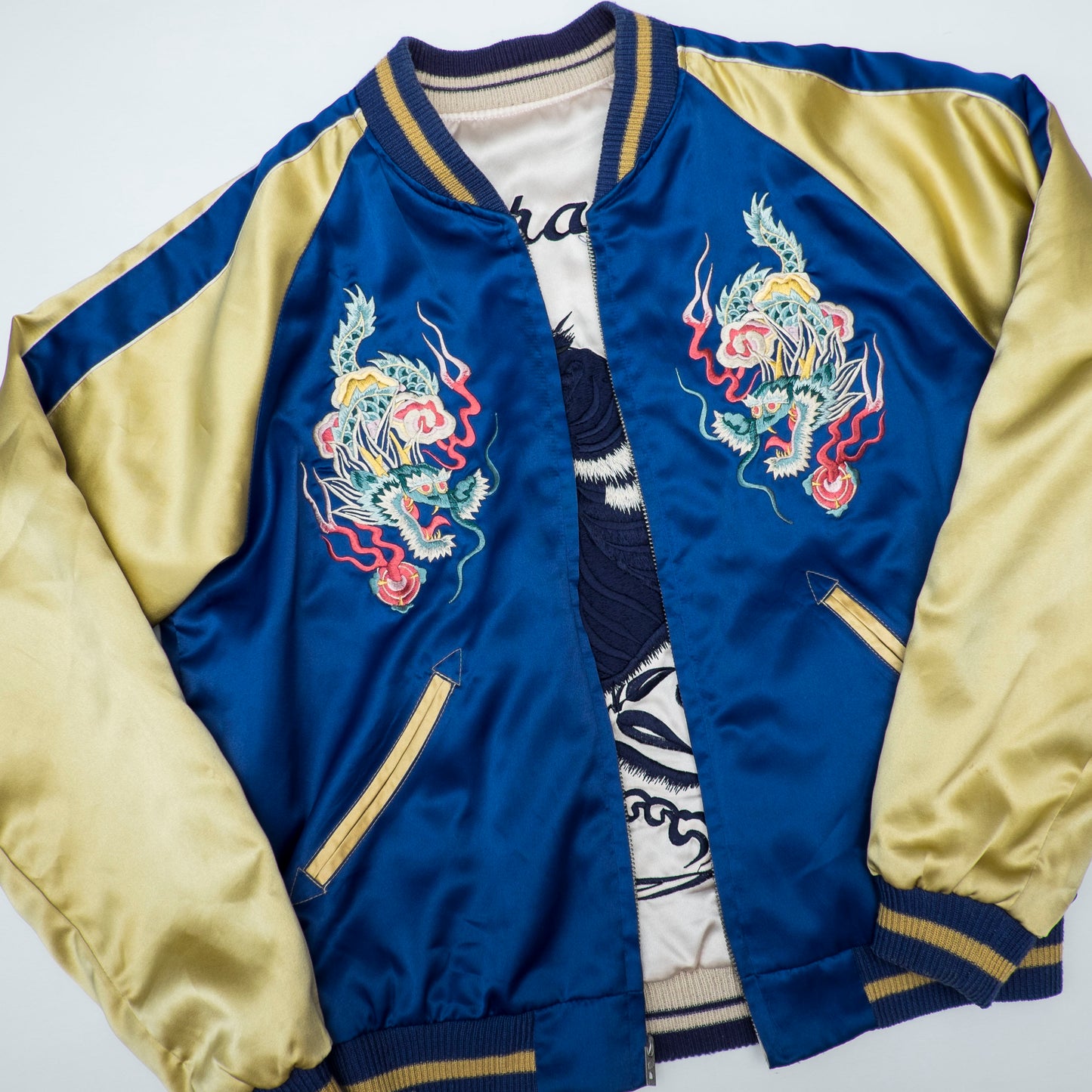
An early Tailor Toyo reversible sukajan of the M18333 family, joining two chapters of postwar souvenir culture. A midnight-blue tiger roars across ivory satin; reversed, royal blue and antique gold commemorate the 613th Aircraft Control & Warning Squadron, Detachment 29, on the remote island of Okushiri-Shima.
The Piece
Documented examples of this pattern identify it as the Okushiri-Shima / blue-tiger reversible model within Tailor Toyo’s earlier “M-number” generation, now increasingly difficult to find with both embroidered faces visually complete. It is more than a tiger jacket and more than a military reproduction: a textile collision between Japanese animal symbolism, American radar-unit history and the eccentric imagination that made the sukajan one of Japan’s most original contributions to global streetwear.
The tiger face is built on a warm ivory or champagne satin body with saturated electric-blue raglan sleeves, narrow ivory sleeve stripes with fine red piping, deep navy embroidery and cream-and-navy striped ribbing. A large tiger sits upright on rocky terrain, worked almost entirely in navy and ivory rather than the usual gold and orange: curved lines define its musculature, layered navy stitching forms the stripes, white sections articulate chest, jaw and face, dark claws extend over the foreground, the open mouth shows individually embroidered teeth, long whiskers project from the muzzle and a sharply raised eye gives an alert, confrontational look. Bamboo leaves rise around its paws, a dark mountain silhouette, likely intended to evoke Mount Fuji, stands in the distance, and curving lines below suggest water, mist or rolling terrain, an almost aizome-like effect recalling indigo textiles and monochrome printmaking. In East Asian tradition the tiger signifies courage, command, protective power, strength, fearlessness, the repelling of harmful forces and authority over the earthly realm; stripped of its natural colors, this one becomes shadow, guardian and emblem.
Two mirrored birds in flight cross the tiger-side chest, with hooked beaks, extended wings, layered tail feathers, dark navy bodies, gray-blue feather accents and pale clouds behind them. Read as eagles or hawks, they sit between American military heraldry and the hawks of Japanese warrior culture, and their symmetry forms a ceremonial entrance balancing the massive tiger.
The reverse turns to lustrous royal blue with antique-gold raglan sleeves, navy sleeve stripes and matching ribbing. Across the back the embroidery reads “613th AC&W Sqdn Det 29 Okushiri-Shima Japan” around an oversized gold numeral 5 set in a dark navy circular field with white diagonal rays, small stars and a winged or radiating lower star, a composition that visually references the Fifth Air Force context under which the 613th operated in Japan, translated into part unit insignia, part celestial symbol, part pop-art medallion. A circular procession of dragons in white and red, lavender and pink, blue and gold, red-brown, and pale green and silver weaves among stylized clouds, radiating feathers, flame shapes and jewels, fusing American military identity with Japanese decorative tradition, the very core of the sukajan.
Two mirrored dragons curl vertically across the reverse chest amid pale clouds, red flame-like tendrils, green and blue scales, white whiskers, gold highlights and small red jewels or pearls, leaving the zipper line clean. In Japanese and East Asian art the dragon commands water and weather and stands for wisdom, transformation, spiritual authority, protection, dynamic energy and imperial power; here the dragons also seem to move through the very sky the squadron was tasked with watching. The two faces share blue but use it differently: on the tiger side it is shadow and ink, on the squadron side sky, insignia and ceremony.
Details
- Maker: Tailor Toyo (Toyo Enterprise)
- Model: M18333 (model association)
- Era: Earlier Tailor Toyo M-number reproduction, likely late 1990s to early 2000s; inspired by mid-1950s American military souvenir-jacket culture in Japan
- Material: Satin-finish polyester shell, consistent with documented M18333 examples; multicolor rayon-like embroidery thread; striped rib-knit trim
- Color: Tiger face: ivory, electric blue and navy with fine red piping. Squadron face: royal blue, antique gold and navy
- Construction: Fully reversible raglan-sleeve bomber; reversible metal zipper; angled welt pockets on both faces; contrasting sleeve insets with fine piping; striped rib-knit collar, cuffs and waistband; chain-style “Japan” script lettering
- Tiger Face: Back: midnight-blue roaring tiger with bamboo, mountain and water. Front: paired stylized eagles or hawks
- Squadron Face: Back: 613th Aircraft Control & Warning Squadron, Detachment 29, Okushiri-Shima, Japan, with central “5” emblem and dragons. Front: paired dragons with clouds and flaming jewels
Condition
- Pre-owned with clear signs of previous wear and age, yet strong visual impact across both embroidered faces; this is not an unused or flawless garment.
- General satin wrinkling and creasing, with storage creasing across both faces.
- Mild surface marks and scattered spotting; age-related toning to the ivory satin panels; areas of discoloration around the pale front body; light staining near the lower front and pocket areas.
- Some darkening and wear to the cream rib-knit trim, minor pilling or fuzzing on the ribbing, and possible light discoloration along the cuffs and waistband.
- Natural puckering around dense embroidery, minor thread irregularities, subtle rubbing or dulling to high-contact satin areas, and mild fading or color variation.
- The tiger retains its face, claws, stripes and landscape; the chest birds remain distinct; the 613th AC&W lettering is legible; the central “5” emblem is bold; the surrounding and chest dragons keep their colors and definition.
- No major structural tear is apparent in the available photographs; the zipper, cuffs, collar, pocket edges, underarms and embroidery merit close inspection, as with any vintage satin garment. Colors shift with lighting and the reflective direction of the satin.
Squadron History
Aircraft Control and Warning units formed part of the radar and air-defense network that identified, tracked and plotted aircraft moving through strategically important airspace. Historical unit records place Detachment JR29 on Okushiri Island, southwest of Hokkaido, in 1955, equipped with AN/FPS-3 and AN/FPS-4 radar systems and AN/UPX-6 identification equipment; the wider squadron’s mission covered continuous radar surveillance, aircraft identification, interception control and navigational assistance in the northern defense of Japan. The lettering on this jacket therefore names a real Cold War-era radar detachment on a remote island.
Personnel posted to Okushiri were far removed from the urban centers of occupied and post-occupation Japan, and souvenir jackets let them record squadron, detachment number, base or island, years of service, personal names, unit emblems and local imagery. Tailor Toyo’s vintage archive documents an original mid-1950s jacket commissioned for a member of the 613th AC&W Squadron on Okushiri Island, showing how unit names, remote locations and custom embroidery became symbols of status and personal history.
M-Number Production
Tailor Toyo, the souvenir-jacket division of Toyo Enterprise, built its reputation by studying surviving garments and reproducing their proportions, reversible construction, embroidery, color combinations and period irregularities. Collectors use “M-number” for older Tailor Toyo models whose codes begin with M, as distinct from the later and current TT numbering. Production-year documentation for every M-number model is incomplete, but these pieces are generally associated with the brand’s earlier reproduction period around the late 1990s and the turn of the millennium.
The jacket thus carries two layers of age: the 1950s military culture that inspired it, and the early Tailor Toyo revival in which it was made. A cautious dating is late 1990s to early 2000s; the design itself references a mid-1950s Okushiri-Shima jacket recorded in Toyo Enterprise’s vintage archive.
Fit & Display
The intended silhouette is waist-length with rounded raglan shoulders and a relaxed upper body; Japanese sukajan often fit shorter and more compactly than Western bombers, so actual measurements (chest width, back length, raglan sleeve length, hem width), available on request, are a better guide than a letter size.
For display, use a broad padded hanger and avoid prolonged direct sunlight. Because of the pale satin panels, store the jacket away from dark garments that may transfer dye, and avoid crushing the embroidery beneath heavier coats.
Authenticity & Care
The Okushiri-Shima / blue-tiger pattern is documented under Tailor Toyo’s M18333 model association, and its polyester satin construction matches documented examples. It is a later Tailor Toyo reproduction of a mid-1950s design, not an original serviceman-owned souvenir jacket. Every piece is examined and documented in Japan before dispatch and is offered with the Japonista authenticity guarantee.
Delivery from Japan
Packed by hand in Japan and shipped insured and tracked by EMS or an equivalent express service. Import duties and taxes, where applicable, are payable on arrival. Returns follow our published policy.
Considered offers are welcome through Send an Offer, and each one is reviewed personally.
Continue browsing: Sukajan Souvenir Jackets · Amekaji & Wagara Fashion
Related pieces: Tailor Toyo USS Lexington Far East Cruise sukajan · Tailor Toyo pink tiger hot rod sukajan · Tailor Toyo Misawa Japan–USA friendship sukajan
Yokosuka Archive
A particular size, motif or decade in mind? Postwar souvenir jackets and heritage amekaji surface in Japan one at a time. Name the maker, the embroidery and the chest measurement, and the Hunting Salon™ watches for it on your behalf. Request a jacket search →
Collectors also search: tailor toyo m18333 · okushiri shima sukajan · 613th ac&w jacket · blue tiger sukajan · tailor toyo m number jacket · reversible military sukajan · fifth air force souvenir jacket · hokkaido souvenir jacket