Japonista
Mounted Samurai on Black Horse, Tosa-Style Musha-e Hanging Scroll Inscribed Fujiwara Mitsuaki, Edo–Meiji
Mounted Samurai on Black Horse, Tosa-Style Musha-e Hanging Scroll Inscribed Fujiwara Mitsuaki, Edo–Meiji
Couldn't load pickup availability
An armored warrior sits upright on a black horse caparisoned in vermilion, one hand gathering the reins, the other near his sword. Painted in the courtly Tosa and yamato-e manner and inscribed to Fujiwara Mitsuaki, this musha-e scroll shows not the chaos of battle but the moment before it: strength held under control.
The Piece
Rather than the turmoil of combat, the painter concentrates on presence: the warrior's alert expression, the carefully arranged armor, the powerful curve of the horse and the disciplined bond between rider and mount. Vermilion flashes against deep black, olive green, muted gold and warm earth tones, and nothing in the composition is hurried, yet the whole scene feels poised on the threshold of action. The rider is presented in an intentionally archaic, heroic manner as an embodiment of courage, loyalty, composure and inherited authority.
The warrior is shown in three-quarter view, seated securely on a compact black horse, his body turning slightly as his gaze moves outward as if he has noticed something beyond the scene. He has rounded features, sharply observed eyes, tied-back hair and the composed bearing of a military retainer or legendary hero. His armor combines broad shoulder guards, layered lamellar sections, protective sleeves, a chest plate, cords and textile components in green and black, with vivid red garments at the neck, waist and lower body. A sword is secured at his side, and further equipment around the body and saddle is partly obscured by armor, reins and horse furniture.
The horse, almost entirely black, turns its head slightly toward the viewer, with white eyes, a red brow covering, decorative tassels and carefully painted tack. The front legs lift in a measured step while the rear remain grounded, and the red saddle cloth and body covering stand out against the coat; fine line describes mane, tail, hooves, bridle, reins and fittings. Rider and mount form a single sculptural silhouette against a warm golden ground that holds little scenery beyond a few faint grasses, so that the open space turns the rider into an emblem. The eye travels from the face down across armor, reins, sword and red cloth to the black legs of the horse.
Musha-e, warrior painting, celebrates heroes from military chronicles, legends, clan histories, temple narratives and the theater. The work shares the qualities of yamato-e and Tosa-style figure painting: clear controlled outlines, separated areas of color, decorative treatment of armor and textiles, restrained depth, emphasis on costume and status, and a formal rather than naturalistic composition, quite unlike the explosive brushwork of some Kano, Nanga or later popular prints. The archaizing armor suggests a hero of the classical military past, perhaps of the late Heian period, the Genpei War or the Kamakura era, but no title, crest or matching composition identifies him, and he stands as the distilled image of the mounted Japanese warrior.
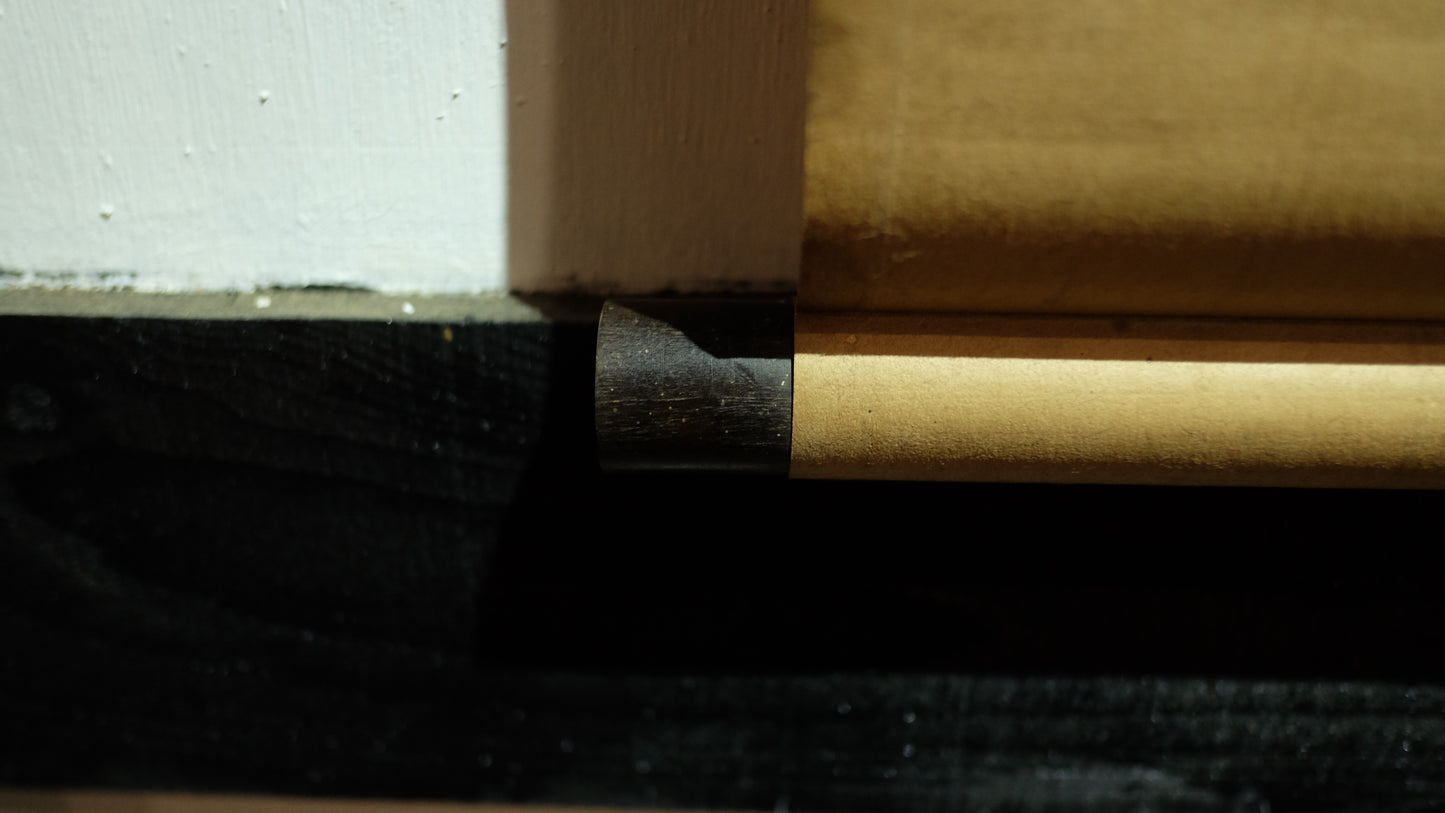
The painting appears to be executed in opaque and translucent pigments on a finely woven support, likely silk, with delicate line drawing, flat mineral-style color, controlled black outlining, layered washes and fine decorative patterning; brush variation and line quality indicate hand execution rather than printing. The restrained mounting has a narrow gold-patterned strip above and below the painted field, warm gray-brown textile around the image, a broader brown upper and side field, a pale lower section, a cylindrical wooden roller with dark end fittings, an upper suspension cord and hand-finished stitching along portions of the outer edge, all aged to tobacco brown, warm beige, gray and faded gold.
Details
- Artist: Inscribed; the inscription appears to read 土佐中納言 藤原光秋画 (provisionally Fujiwara Mitsuaki, styled Tosa Chūnagon; possibly Kōshū)
- Era: Late Edo to Meiji period style; approximately 19th to early 20th century
- Origin: Japan
- Medium: Pigments on silk or finely woven textile (support identified visually, untested)
- Color: Black, vermilion red, olive green, muted gold, brown, ivory and gray
- Subject: Armored warrior mounted on a black horse with red ceremonial or military furnishings
- Genre: 武者絵 musha-e, warrior painting; Tosa-style and yamato-e historical figure painting
- Format: 掛軸 kakejiku or kakemono hanging scroll
- Mounting: Traditional textile mounting with gold-patterned strips, gray-brown and brown fields, wooden roller with dark end fittings, suspension cord
- Seal: A faint red mark may be present beneath the inscription, not legible enough for identification
- Quantity: One scroll
Condition
- An antique or vintage textile-mounted painting with substantial signs of age, storage, rolling, handling and display; the main subject remains remarkably strong and legible.
- Overall toning and age-darkening, uneven coloration across the mounting, horizontal creases and rolling lines, surface waviness, and creasing across the lower section.
- Scattered spots and foxing, areas of discoloration, small marks and abrasions, minor stains and old moisture-like tidelines, small scattered dark marks, and darkening around portions of the painted field.
- A large irregular discolored area in the upper mounting; wear along the outer textile edges, with visible stitching along the perimeter; possible old repairs or reinforced areas.
- Gentle rubbing or pigment loss in isolated areas and natural variation within the golden ground; the warrior's face, armor, sword, garments, reins, horse, red furnishings, inscription and principal colors remain clearly visible.
- Softening and wear to the suspension cord, and age-related wear to the lower roller and fittings.
- To our knowledge the work has not been professionally conserved, scientifically dated, pigment- or fiber-tested, or formally authenticated. Additional detail photographs are available on request.
Dating Notes
A date of approximately 1850 to 1880 has been proposed, though a precise decade cannot be fixed without physical inspection. The traditional mounting, aged silk-like support, historical subject, muted pigments, overall toning, older stitching, rolling wear, archaizing signature formula and absence of printed texture support a nineteenth- to early twentieth-century date. Physical inspection of the backing paper, fibers, adhesives, roller, pigments, seals and construction could narrow it.
Scroll Care
Japanese scrolls are sensitive to light, moisture, heat, pressure and prolonged display. The wrinkles and undulation are part of the present state; any flattening, cleaning, remounting or repair should be left to a qualified specialist.
- Avoid direct sunlight, strong ultraviolet light, damp walls, kitchens, fireplaces and smoke; keep a stable indoor environment.
- Handle with clean, dry hands, support the scroll while unrolling, never pull it open by one edge, and avoid touching the painted surface.
- Do not flatten aggressively, iron, steam, or apply water or household cleaners.
- Display for limited periods, rest the scroll rolled around an appropriate inner support between displays, wrap in acid-free material if professionally advised, and consult a Japanese-scroll conservator before any treatment.
Authenticity & Care
The lower-right inscription 土佐中納言 藤原光秋画 is read provisionally and has not been professionally authenticated or matched to a documented painter; it may be an original signature, an attribution, a workshop designation or a later reference to an earlier model, and no certificate, box inscription, lineage paper or provenance document accompanies the scroll. It should not be regarded as a verified work by a catalogued Tosa master without specialist examination. Every piece is examined and documented in Japan before dispatch and is offered with the Japonista authenticity guarantee.
Delivery from Japan
Packed by hand in Japan and shipped insured and tracked by EMS or an equivalent express service. Import duties and taxes, where applicable, are payable on arrival. Returns follow our published policy.
Considered offers are welcome through Send an Offer, and each one is reviewed personally. Pieces over $1,000 may be reserved over several payments with Layaway Privilege™.
Continue browsing: Scrolls & Paintings
Related pieces: Shaka Triad Sixteen Benevolent Deities scroll · Jizō Bosatsu silk hanging scroll · Black-ground Amida Raigō triad scroll
Paper & Silk
Scrolls, screens and prints can be examined, documented and conserved before shipping through the Restoration & Documentation Lab™. Request a condition report →
Collectors also search: samurai horse scroll · musha-e hanging scroll · tosa school warrior painting · mounted samurai kakejiku · antique japanese warrior scroll · yamato-e samurai painting silk · fujiwara mitsuaki scroll · samurai on black horse painting