Japonista
Jizō Bosatsu Hanging Scroll, Kṣitigarbha in a Waterfall Mountain Landscape, Silk Kakejiku, Edo–Meiji
Jizō Bosatsu Hanging Scroll, Kṣitigarbha in a Waterfall Mountain Landscape, Silk Kakejiku, Edo–Meiji
Couldn't load pickup availability
Jizō Bosatsu, guardian of children, travelers and the departed, sits upon a coral lotus within a vast circular aureole, holding the wish-fulfilling jewel as waterfalls fall through misted mountains behind him. Rather than isolating the bodhisattva on plain silk, the painter set him inside a complete sacred landscape, turning a devotional image into a visual pilgrimage.
The Piece
The scroll portrays Jizō Bosatsu (地蔵菩薩), known in Sanskrit as Kṣitigarbha, in the form of a compassionate monk: head shaven, expression quiet, youthful and deeply composed. One hand cradles the radiant wish-fulfilling jewel, or hōju, and the finial of the ringed monk's staff, the shakujō, rises beside him and intersects the broad halo, linking the seated figure with the landscape and the heavens above. His elaborately patterned robes stand out against the subdued setting, and deep green, blue, muted gold, coral red, ivory and earthy brown pigments emerge softly from the aged silk with a meditative rather than theatrical luminosity.
Jizō is traditionally shown as a monk rather than a crowned celestial deity, a simplified human appearance that expresses his willingness to walk among ordinary beings and enter even the darkest realms. Buddhist tradition holds that he vowed to help sentient beings through the long age between the passing of Shakyamuni and the arrival of Maitreya, and in Japan he became especially cherished as protector of children, travelers and pilgrims, the deceased, souls in suffering and families remembering lost children. The jewel, with its deep green body and red center, forms a small intense point of color that draws the eye to his hands, a light within darkness and wisdom that dispels ignorance; the staff, whose rings once sounded as a monk walked, signifies spiritual travel, protection and his passage through the realms of existence.
Behind him rises a secluded world of mountains, ancient trees, waterfalls, mist, rocks and shadowed valleys. Waterfalls descend from high cliffs, mist moves through distant peaks, gnarled trees cling to rock, and pools, plants and stones surround the lotus throne. Mountains carry long associations with practice, pilgrimage and contact with sacred realms in Japanese religious culture; the falling water suggests purification and compassion moving into the human world; the veiled distance suggests a realm between the earthly and the transcendent. Many Jizō paintings isolate the figure on plain silk or show him descending on clouds, which makes this fully developed landscape setting particularly evocative.
The composition is both formal and atmospheric. Jizō occupies the center within an immense circular aureole, the coral-red lotus petals forming a warm foundation beneath the darker robes, while fine controlled linework in the face, jewelry, robes and staff meets repeated textile patterns, soft washes in the mountains and sky, darker masses of rock and vegetation and broad negative spaces. The calm, symmetrical figure against the irregular, living landscape creates a productive tension between spiritual permanence and the changing natural world.
The painting is mounted as a traditional kakejiku with a pale green silk field, blue-and-white botanical patterned borders, vermilion brocade bands above and below the image, narrow upper hanging strips, a lower roller with red lacquered ends and a suspension cord. The cool blue borders echo the painting's greens and blues, while the vermilion bands answer the red jewel, the lotus petals and the bodhisattva's lips.
Details
- Artist: Unidentified; no clearly readable signature is visible
- Era: Late Edo to early Meiji period, broadly 19th century (visual assessment)
- Origin: Japan
- Medium: Appears to be ink, mineral color and decorative pigment on silk
- Color: Muted gold, olive green, blue, coral red, ivory, brown, grey and black
- Subject: Jizō Bosatsu (地蔵菩薩), Kṣitigarbha Bodhisattva
- Format: Kakejiku or kakemono hanging scroll; Buddhist devotional painting
- Mounting: Pale green silk field, blue-and-white botanical borders, vermilion brocade bands, upper hanging strips, wooden roller with red lacquered ends, suspension cord
- Principal Symbols: Shakujō staff, wish-fulfilling jewel, lotus throne, halo, mountains, waterfalls, rocks, trees
- Quantity: One hanging scroll
Condition
- An antique or vintage hanging scroll with visible age-related character; the central figure, halo, jewel, staff, robes, lotus, waterfalls, rocks, trees and landscape remain clearly visible and compelling.
- General toning, surface wear, horizontal creases, textile waviness, light discoloration, small marks and areas of rubbing consistent with age, storage, rolling and traditional use.
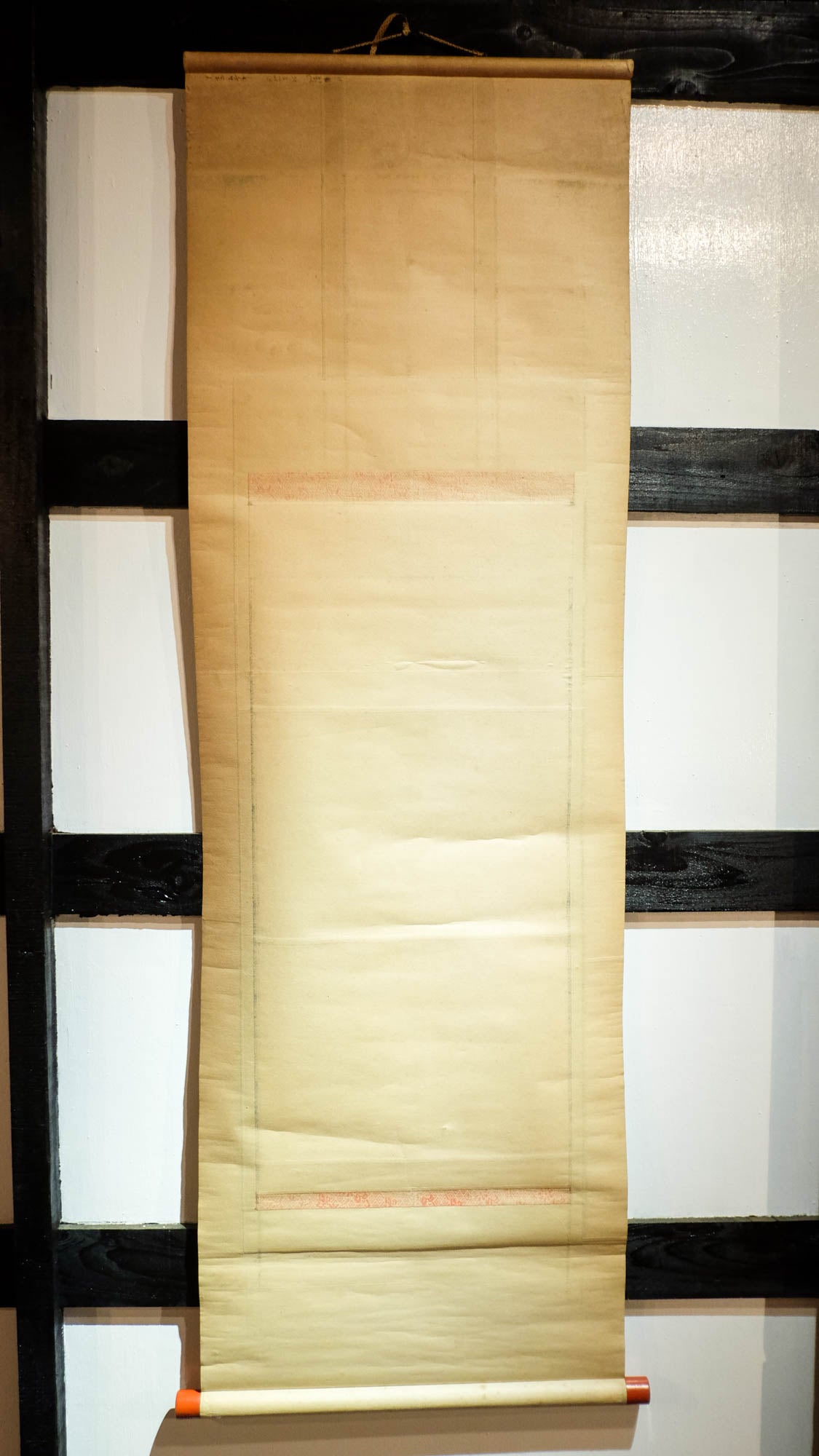
- The pale exterior mounting shows handling wear, scuffs, faint scratches, creasing and tonal variation; the painted silk shows age-softening and horizontal lines from repeated rolling.
- The roller ends, suspension cord and mounting appear present.
- No claim is made that the scroll has undergone professional conservation; a qualified specialist should be consulted for a conservation-grade assessment. Additional close-up photographs are available on request.
Display Suggestions
Because of its elongated proportions and detailed landscape, the scroll is best hung where it can be seen whole from a distance yet still examined closely: a meditation room, Buddhist altar space, memorial area, tokonoma or tea room, a quiet study, or a gallery wall devoted to Asian art. Its tall form, subdued palette and mounting suit traditional, minimalist, wabi-sabi and Japandi interiors.
Authenticity & Care
Hand-painted on silk; no securely readable signature, workshop inscription or dated colophon is visible, and the precise date has not been independently authenticated. The late Edo to early Meiji dating is a considered visual assessment of style, pigments, mounting and aged surface rather than documented provenance. Every piece is examined and documented in Japan before dispatch and is offered with the Japonista authenticity guarantee.
Delivery from Japan
Packed by hand in Japan and shipped insured and tracked by EMS or an equivalent express service. Import duties and taxes, where applicable, are payable on arrival. Returns follow our published policy.
Considered offers are welcome through Send an Offer, and each one is reviewed personally. Pieces over $1,000 may be reserved over several payments with Layaway Privilege™.
Continue browsing: Scrolls & Paintings · Butsudan & Altars
Related pieces: Black-ground Amida Raigō triad scroll · Tosa-style mounted samurai scroll · Shakyamuni Sixteen Protective Deities scroll
Paper & Silk
Scrolls, screens and prints can be examined, documented and conserved before shipping through the Restoration & Documentation Lab™. Request a condition report →
Collectors also search: jizo bosatsu scroll · ksitigarbha hanging scroll · antique jizo kakejiku · japanese buddhist scroll edo meiji · jizo painting on silk · jizo with shakujo and jewel · buddhist landscape scroll waterfall · japanese bodhisattva scroll