
Juichimen Kannon
Faces That Look Everywhere
Juichimen Kannon
十一面観音
Kannon with a crown of small faces. Three gentle, three angry, three fanged, one laughing and a Buddha above, so that nothing in the world goes unseen. Japan has prayed to him for the recovery of the sick since the seventh century.
Identity card
Know him at a glance
- The crown of faces. Small faces rise from the crown. JAANUS describes a Buddha face at the top and bodhisattva faces in one or two tiers below. This diagram draws only some of them.
- The staff. At Hase-dera in Nara the main image holds a staff in its right hand (JAANUS). Most two-armed images instead make the wish-granting gesture.
- The water jar. In the left hand, a water jar with a lotus, JAANUS says, joined with the semui-in gesture of fearlessness.
- The halo. The disc of light behind the head that marks a bodhisattva of high rank.
- The lotus. Standing images are more common in sculpture than seated ones (JAANUS). The Hase-dera image stands on a rock rather than a lotus.
Eleven faces of one compassion
The Japanese Architecture and Art Net Users System, known as JAANUS, gives the Sanskrit as Ekādaśamukha and counts the faces as eleven, or twelve if the main face is included. Butuzou, a Japanese Buddhist-art workshop, puts the same idea simply: the many faces express compassion that looks in every direction at once and responds. Wikipedia lists him as one of the six forms of Avalokiteśvara matched to the six realms, and in this chapter the sources part ways on which realm he governs. JAANUS says the human realm; Wikipedia says the asura realm. Both agree he is one of the six.
Wikipedia also says the name Avalokiteśvara of the Universally Shining Great Light, Daikō Fushō Kanzeon in Japanese, belongs to this form. It adds that the exact origin is unclear, that the scholar Lokesh Chandra linked it to the eleven Rudras of Hindu myth, and that it is among the earliest iconographic types of Avalokiteśvara, predating Vajrayāna. JAANUS notes that multi-headed, multi-armed figures were used in India by the seventh century to express complex Buddhist teaching.
This chapter sits inside the Buddhism and Zen Almanac, under Kannon on the Bosatsu rank. Wikipedia says he has been historically very popular in Japan, with many temples installing an image as the main object of worship.
Gentle, angry, fanged, laughing, and a Buddha
JAANUS gives the arrangement. A Buddha face sits at the top. Below it the bodhisattva faces stand in one or two tiers: three benign faces, three angry faces, three fanged faces with teeth pushing up from the mouth, and one laughing face at the back. A small standing Amida may be set in front of the crown. Wikipedia describes the same set of faces, and adds that the topmost head carries an uṣṇīṣa, the head knob of a Buddha.
The Met’s Jūichimen Kannon of the mid to late fourteenth century stands on a lotus on a round base within a ring of gold halo, with small faces clustered on the crown above his head. The gold leaf has worn from the face and from the folds of the scarf, and the dark lacquer shows through along the edges of the robe.
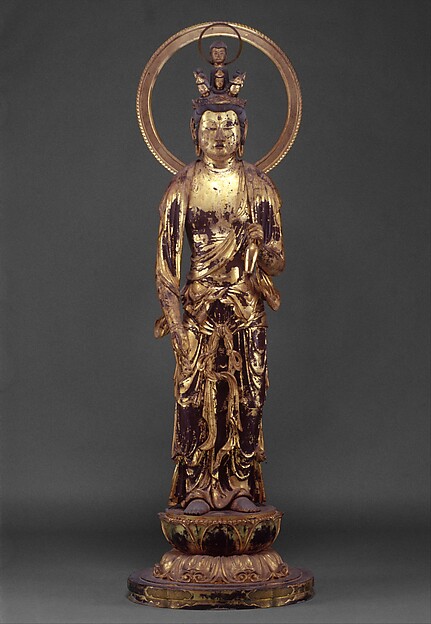
Japan, Nanbokuchō period, mid- to late 14th century. Wood with lacquer, gold leaf and metal decoration; height 199.1 cm.
Look closer: Look at the small faces clustered above the crown and at the ring of gold behind. The Met dates the figure to the mid to late fourteenth century. Notice how much of the gold has worn from the robe.
The Metropolitan Museum of Art, The Harry G. C. Packard Collection of Asian Art, Gift of Harry G. C. Packard, and Purchase, Fletcher, Rogers, Harris Brisbane Dick, and Louis V. Bell Funds, Joseph Pulitzer Bequest, and The Annenberg Fund Inc. Gift, 1975 (1975.268.167). Public domain, Open Access.
| Feature | What it means | Where to look |
|---|---|---|
| Buddha face | The final attainment, at the top (JAANUS) | Apex of the crown |
| Three gentle faces | Benign compassion (JAANUS) | Crown tier |
| Three angry faces | Compassion that corrects (JAANUS) | Crown tier |
| Three fanged faces | Teeth pushing up from the mouth (JAANUS) | Crown tier |
| One laughing face | At the back, seldom visible (JAANUS) | Behind the head |
| Water jar and lotus | Held in the left hand (JAANUS) | The left hand |
| Staff | At Hase-dera, in the right hand (JAANUS) | The right hand |
A body that split with grief
JAANUS records a folk story and a doctrine. The story is that the head split into many from the deity’s worry over living beings. The doctrine is that the deity removes the eleven impediments of living beings, and the rising heads suggest the ten stages of a bodhisattva with the Buddha head as the last attainment. Wikipedia gives two readings of the number. One takes the heads as the ten bhūmi plus buddhahood; the other as eleven kinds of ignorance that the bodhisattva removes. A twelve-headed version, it says, stands for the twelve links of dependent origination.
Wikipedia also gives two stories. In one, Avalokiteśvara’s head and arms split from grief at the world’s suffering, and Amitābha restored him with eleven heads and a thousand arms. In the other, the bodhisattva takes this form to subdue and convert a proud ten-headed demon king. The bīja, or seed syllable, is ka, which Japanese reads as kya.
A rock under his feet
JAANUS says belief in Jūichimen Kannon is recorded in Japan from the middle of the seventh century and was invoked above all for recovery from illness. Images were common in the Nara period and very popular in the Heian period. It names the painted wall image in the Kondō of Hōryū-ji, which burned in 1949, and a nine-faced sandalwood image of the eighth century at Hōryū-ji, called a Kumen Kannon.
Its most vivid detail is at Hase-dera in Nara. The main image there, very large, stands not on a lotus pedestal but on a flat stone said in the temple’s illustrated history to have been uncovered in a landslide. The figure holds a staff in the right hand and a lotus in a vase in the left. JAANUS also names Nigatsudō at Tōdai-ji, where the shuni-e ceremony, commonly called omizutori, began in 752 and is still held, with a group confession before the image.
| Site | What it holds | Source |
|---|---|---|
| Hase-dera, Nara | A very large image on a flat stone, staff and lotus vase | JAANUS |
| Nigatsudō, Tōdai-ji, Nara | The shuni-e or omizutori, begun in 752, with group confession | JAANUS |
| Hōryū-ji, Nara | A lost wall painting and an eighth-century nine-faced sandalwood image | JAANUS |
| Shidō-ji, Kagawa | A large Kamakura painting | JAANUS |
| Kaijūsen-ji, Kyoto | A painting of the descent across the sea with twenty-five bodhisattvas | JAANUS |
| Kanheri Cave 41, India | The earliest surviving image, four-armed | Wikipedia and JAANUS, dated differently |
Fudaraku and the descent
JAANUS places his paradise on Fudaraku, a rocky island in the ocean, often shown with the boy pilgrim Zenzai Dōji, and notes the descent painting at Kaijūsen-ji, in which he comes across the sea for the raigō. The Met owns three paintings that follow this tradition. In its thirteenth-century scroll Eleven-Headed Kannon on Mount Fudaraku, he sits on a lotus under a halo of fine rays, above a dark rocky landscape with a few small figures below. In its fourteenth-century Descent of Eleven-Headed Kannon he stands on a cloud in a long yellow and blue robe, a bright crown on his head, against a dark blue sky with rays spreading from him. In the sixteenth-century version, he stands on a small cloud over dark waves with long rays fanning behind him.
A kami’s Buddha
JAANUS adds two threads that run beyond the temple. In esoteric Buddhism he appears in the Taizōkai mandala. In Shintō art he serves as the honji-butsu, the Buddhist original, for female kami, and is one of the two main honji-butsu for Amaterasu Ōmikami, the other being Dainichi.
The faces in other tongues
The rows below record the names given in the sources I read.
| Where | Form and name | What the record shows |
|---|---|---|
| India | Ekādaśamukha | The Kanheri Cave 41 relief, late fifth to early sixth century (Wikipedia) or seventh to eighth century (JAANUS), is the earliest surviving image. |
| China | Shíyīmiàn Guānyīn (十一面觀音) | Common from the early Tang. Wikipedia places him second only to the thousand-armed form among Dunhuang paintings. |
| Japan | Jūichimen Kannon (十一面観音); Daikō Fushō Kanzeon | The alternate name is “of the Universally Shining Great Light”. |
| Korea | Sibilmyeon Gwaneum | The Korean reading. |
| Vietnam | Thập Nhất Diện Quan Âm | The Vietnamese name. |
| Tibet | Chuchik Zhel | The Tibetan name. |
The oldest of the changing forms
Jūichimen is one of the transformation forms of Kannon, with Senju, Nyoirin, Batō and Juntei. He appears in the Taizōkai mandala and, in Shintō art, as the original of female kami.
Where to see him
| Place | What to look for |
|---|---|
| Hase-dera, Nara | The great standing image on a rock, with staff and lotus vase (JAANUS). |
| Nigatsudō, Tōdai-ji, Nara | The setting of the omizutori, held since 752 (JAANUS). |
| Shidō-ji, Kagawa and Kaijūsen-ji, Kyoto | A Kamakura painting and a descent painting (JAANUS). |
| Tokyo National Museum | A relief of the form dated 703 from Baoqing Temple in Xi’an (Wikipedia). |
| Metropolitan Museum of Art, New York | A fourteenth-century statue, three paintings of Fudaraku and the descent, and a gilt-bronze votive mirror, in the public domain. |
The eleven faces in silk and bronze
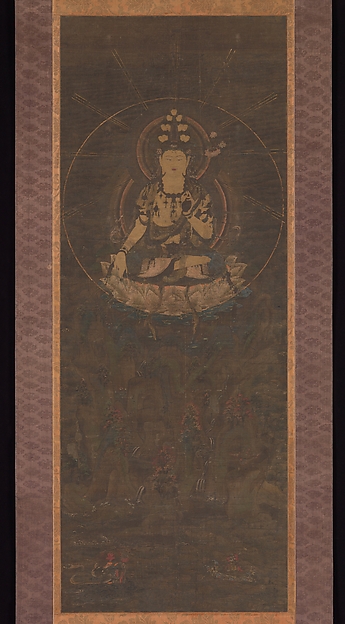
Japan, 13th century. Hanging scroll; ink, color and gold on silk; image 108 × 41 cm.
Look closer: The Met titles it Eleven-Headed Kannon on Mount Fudaraku and dates it to the thirteenth century. Look at the seated figure on his lotus and, far below him, the rocky landscape and the small figures at its foot. JAANUS describes Fudaraku as a rocky island in the sea.
The Metropolitan Museum of Art, The Harry G. C. Packard Collection of Asian Art, Gift of Harry G. C. Packard, and Purchase, Fletcher, Rogers, Harris Brisbane Dick, and Louis V. Bell Funds, Joseph Pulitzer Bequest, and The Annenberg Fund Inc. Gift, 1975 (1975.268.20). Public domain, Open Access.

Japan, 14th century. Hanging scroll; ink, color, gold and cut-out gold on silk; image 86.2 × 38.7 cm.
Look closer: The Met titles it Descent of Eleven-Headed Kannon and dates it to the fourteenth century, noting the use of cut-out gold. Look at the bright crown, the robe patterned in gold and the rays spreading against the dark blue.
The Metropolitan Museum of Art, Purchase, Charles Wrightsman Gift, Joseph Pulitzer Bequest, Dodge, Pfeiffer and Rogers Funds, and funds from various donors, 1972 (1972.181). Public domain, Open Access.
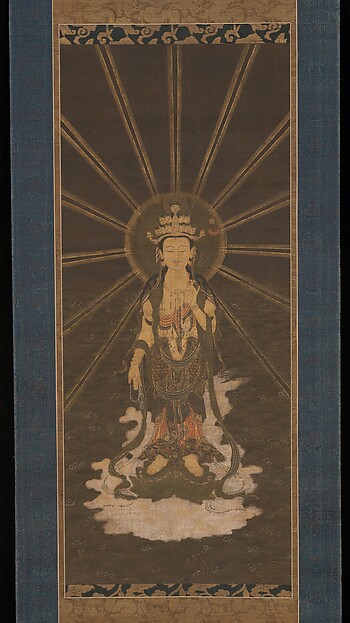
Japan, mid–late 16th century. Hanging scroll; ink, color and gold on silk; image 92.7 × 39.4 cm.
Look closer: The Met titles it Descent of Eleven-Headed Kannon and dates it to the mid to late sixteenth century. Look at the long, evenly spaced rays and the small white cloud on the dark water.
The Metropolitan Museum of Art, H. O. Havemeyer Collection, Gift of Mrs. J. Watson Webb, 1930 (30.72.3). Public domain, Open Access.
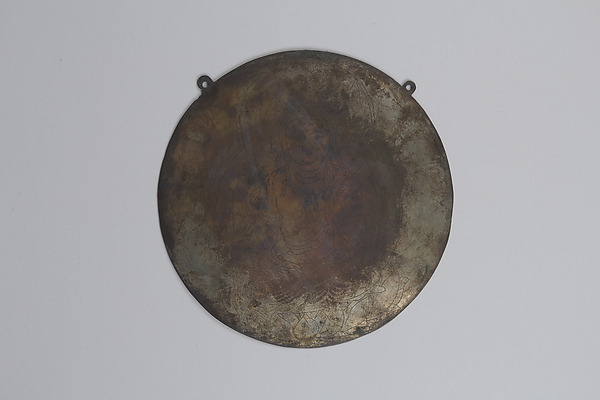
Japan, 12th century. Gilt bronze; diameter 18.1 cm.
Look closer: The Met titles it Votive Mirror with Eleven-Headed Kannon and dates it to the twelfth century. The engraving is faint after nine centuries; look for the outline of a standing figure on the disc.
The Metropolitan Museum of Art, The Harry G. C. Packard Collection of Asian Art, Gift of Harry G. C. Packard, and Purchase, Fletcher, Rogers, Harris Brisbane Dick, and Louis V. Bell Funds, Joseph Pulitzer Bequest, and The Annenberg Fund Inc. Gift, 1975 (1975.268.157). Public domain, Open Access.
In the house
Pieces of Jūichimen Kannon appear on the shelves from time to time. The strip below reads the live shelves and appears when one is in the house.
Answered plainly
What does Juichimen Kannon mean?
The eleven-faced Kannon. The Sanskrit is Ekādaśamukha. The many faces express compassion that looks in every direction.
What are the eleven faces?
JAANUS lists a Buddha face at the top, then three benign faces, three angry faces, three fanged faces and one laughing face at the back.
Why is Hase-dera famous?
JAANUS says the main image there stands on a flat stone, said in the temple’s illustrated history to have been uncovered in a landslide, and holds a staff and a lotus in a vase.
Which realm does he govern?
The sources differ. JAANUS says the human realm. Wikipedia says the asura realm. Both place him among the six Kannon.
What is the omizutori?
The shuni-e ceremony at Nigatsudō in Tōdai-ji, Nara, begun in 752 and still held. JAANUS says it centres on a group confession before the eleven-headed image.
What is Fudaraku?
The paradise of Kannon, a rocky island in the sea, often shown with the boy pilgrim Zenzai Dōji.
Where next
Sources and image credits
- The Metropolitan Museum of Art, object 44893
- The Metropolitan Museum of Art, object 44843
- The Metropolitan Museum of Art, object 44984
- The Metropolitan Museum of Art, object 45595
- The Metropolitan Museum of Art, object 45522
- Japanese Architecture and Art Net Users System, Jūichimen Kannon
- Wikipedia (mirror copy), Ekādaśamukha: names, symbolism, works
- Butuzou, Why Juichimen Kannon has eleven heads
Last reviewed 28 October 2026. Pictures are public-domain or open-access, each credited beneath it. Diagrams on this page are drawn by Japonista.
Looking for an eleven-headed Kannon, a Hase-dera type or a small altar figure? Tell us what you have in mind and we will look.
Private concierge
Looking for something in particular?
Describe the piece or the project you have in mind. A senior advisor in Tokyo reads every case file personally and replies within two business days, with fees set out in writing before any work begins.