
Nyoirin Kannon
Jewel and Wheel
Nyoirin Kannon
如意輪観音
The Kannon who rests his cheek on one hand and keeps one knee raised. Six arms hold a wish-granting jewel, a wheel of the teaching and a rosary. One Osaka temple kept its Heian image hidden for generations and now shows it on two days each April.
Identity card
Know him at a glance
- The crown with its small Buddha. The crown carries a tiny Amida, the sign of Kannon’s lineage (JAANUS).
- The jewel. The wish-fulfilling jewel, held in the second right hand in the six-armed form (Wikipedia). JAANUS reads it as wealth, wisdom and the aspiration to awaken.
- The wheel. The wheel of the teaching, held in the third left hand (Wikipedia). JAANUS reads its eight spokes as the eightfold path.
- The extra arms. Six arms in all: JAANUS says they may stand for saving power in all six realms. This diagram draws only four of them behind the body.
- The rock. He sits on a lotus on a rock rising from the sea, JAANUS says, the pose that becomes characteristic from the Heian period.
The bodhisattva who leans on his hand
The Japanese Architecture and Art Net Users System, known as JAANUS, gives the Sanskrit as Cintāmaṇicakra and the name as Nyoirin Kannon, from nyoi, wish-fulfilling, and rin, wheel. The most common form has six arms and holds a wish-fulfilling jewel and a wheel. He sits on a lotus on a rock that rises from the sea, in a pose JAANUS says is characteristic from the Heian period on, with the left leg folded in and the right knee raised. Above, in the crown, sits a small figure of Amida.
He is one of the six forms of Kannon. JAANUS places him among the divinities, the ten, of the six realms; the Wikipedia article on Cintāmaṇicakra says he saves beings in the deva realm. JAANUS calls him an esoteric version of Shō Kannon, the Holy Kannon, and says he gives what one wants, whether in worldly life or in the monastic life. It adds that he was worshipped as a protector of the emperor’s life.
This chapter sits inside the Buddhism and Zen Almanac, under Kannon on the Bosatsu rank, alongside Jūichimen, Senju, Batō and Juntei. Wikipedia adds that the Tendai monk Ryōgen is popularly believed to have been an incarnation of Cintāmaṇicakra.
Six arms and a raised knee
JAANUS describes the six-armed form hand by hand. On the left side are a full-blown lotus, a wheel, and a hand resting on the dais. On the right are the jewel, a rosary, and a third arm with its elbow on the raised knee. If the wheel is missing, JAANUS adds, one left hand appears to point upward. Arm counts vary: the deity may have anywhere from two to twelve. The two-armed form carries no jewel and sits in the half-lotus pensive pose, with the right leg crossed over the left.
Wikipedia sets out the same six arms in order. The first right hand touches the face in a pensive gesture, the second holds the jewel and the third holds prayer beads. The first left hand touches the rock, the second holds a crimson lotus and the third the wheel. The nippon.com description of the Heian image at Kanshin-ji agrees: one hand rests pensively against the cheek, one dangles beads, one palm supports the jewel, one holds a lotus, one rests against the pedestal and one raises the wheel.
The Met owns a gilded wood Nyoirin Kannon dated 1693. In the photograph the bodhisattva sits with one hand at his cheek and his right knee drawn up under his robe. The openwork crown carries hanging strands, and the gilding is darker at the knee. The Met says the figure holds the wish-fulfilling jewel and the wheel of the teaching, the two esoteric attributes.
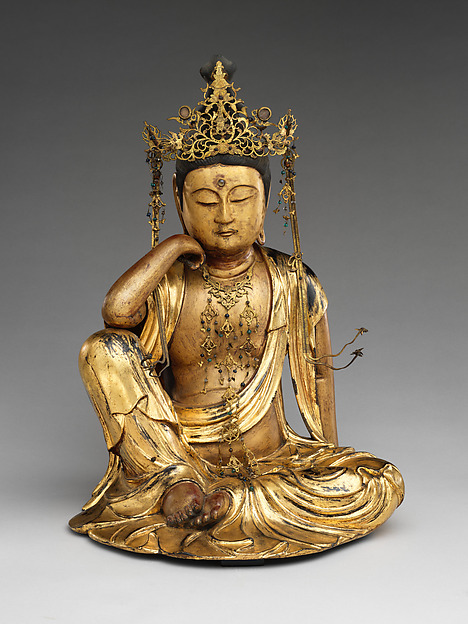
Japan, Edo period, dated 1693. Wood with gold, gold leaf, lacquer and crystal inlay; height 42.1 cm.
Look closer: Look at the hand resting on the cheek and the raised knee, the two signs that set this form apart from other seated Kannon. The Met dates the figure to 1693 and describes the jewel and wheel as its Esoteric Buddhist attributes.
The Metropolitan Museum of Art, Rogers Fund, 1956 (56.39). Public domain, Open Access.
| Hand | What it does or holds | Source |
|---|---|---|
| First right | Touches the cheek in a pensive gesture | Wikipedia; nippon.com |
| Second right | Holds the wish-fulfilling jewel | Wikipedia; JAANUS |
| Third right | Holds prayer beads | Wikipedia; JAANUS |
| First left | Rests on the rock or pedestal | Wikipedia; nippon.com |
| Second left | Holds a lotus | Wikipedia; JAANUS |
| Third left | Holds the wheel | Wikipedia; JAANUS |
A granting jewel and a turning wheel
JAANUS lists what the jewel can stand for: wealth, wisdom, the wish to awaken, Buddha-nature, the transmission of the teaching and relics. The wheel stands for dominion, for the way things are, and for the teaching itself; its eight spokes recall the eightfold path, elaborated in the precepts. The six arms, JAANUS says, may represent saving power in all six realms or the six Kannon themselves.
The figure can also appear in the mandalas. JAANUS says he is shown in the Kannon section of the Taizōkai mandala, painted gold, and that in paintings he may be the main image of a mandala, on a rock rising from the sea to stand for Kannon’s paradise.
A hidden image that opens in April
Three Nyoirin images are known in Japan as the San Nyoirin, the three Nyoirin: the ninth-century wooden statue at Kanshin-ji in Osaka, one at Murōji in Nara, and one at Kannōji in Hyōgo Prefecture. JAANUS names them without dates for the second and third, and calls the Kanshin-ji statue well known.
Nippon.com describes it. The seated Heian-period statue is 109.4 centimetres tall and a National Treasure. It is carved from a single piece of kaya wood, with the arms and some other parts in different materials, and a surface of dry lacquer. Bright colour survives in places, the lips carry a vermilion tint, and the half-closed eyes give the plump face a faintly wistful air. The hands are carved with notable realism, and the six arms are said to express the bodhisattva’s superhuman saving power.
It was historically a hidden image, shown only once every thirty-three years. Today, nippon.com says, it is open to the public on 17 and 18 April each year, and visitors should check in advance. Tradition holds that En no Gyōja founded the temple in 701 and that Kūkai carved the statue as a charm against misfortune. Work on the precincts is believed to have begun in 827 under Jichie, Kūkai’s great disciple. The image may have been made to fulfil a vow of the empress Tachibana no Kachiko (786 to 842), consort of the emperor Saga. Art historians have noticed resemblances to details in the mandalas Kūkai brought from Tang China.
A rock above the waves
Why the rock? JAANUS says the rocky seat represents Kannon’s paradise, and the Vassar exhibition entry on a fourteenth-century Nyoirin scroll in the Nara National Museum names the mountain as Fudarakusan. In that scroll, the entry says, the six-armed figure sits in a luminous halo and balances the wheel on the raised left index finger, with three wish-fulfilling jewels cupped before his heart. The figure has a moustache, the entry notes, marking him as male, as in the Met sculpture. The same entry adds that he is often the principal image in esoteric temples, citing Nachi, and records a tradition that he appeared to Kūkai when the monk was in danger of drowning.
The photograph below shows an image of a different kind. In the Great Buddha Hall of Tōdai-ji in Nara, a large gilded seated figure sits on its drapery-covered platform before a flaming halo, a small Buddha in its crown, one hand raised. The sign at its base reads Nyoirin Kannon. It sits upright, with no raised knee and no cheek hand: the same name in a very different grammar.

Photograph by KimonBerlin, 26 October 2013.
Look closer: Look at the small Buddha in the crown, the raised hand and the name board at the lower right that reads Nyoirin Kannon. Compare this upright figure with the leaning figure of 1693 above.
KimonBerlin, “Nyoirin Kannon in the Great Buddha Hall of Tōdai-ji, Nara”, Wikimedia Commons, CC BY-SA 2.0. Source: commons.wikimedia.org (file page listed in the sources below).
Mantras counted in the thousands
Wikipedia describes the sutra behind the figure. The Cintāmaṇicakra Dhāraṇī Sutra was translated into Chinese by Bodhiruci (Taishō 1080) and Yijing (Taishō 1081). It says the dhāraṇī has great power and majesty, like the celestial wish-fulfilling tree. The instructions ask the practitioner to recite it 1,080 times in each of six daily periods, and promise that three hundred thousand recitations will clear severe past karma.
In Chinese Buddhism, the same article says, it is one of the Ten Small Mantras recited at morning services in temples. His seed syllable is hrīḥ. Two shorter mantras are used in Japan: Oṃ padme cintāmaṇi jvala hūṃ and Oṃ varada padme hūṃ. He can also be represented abstractly by the jewel and the lotus, his symbols.
Names cut into a base
The Met’s 1693 figure carries a small human trace. Carved into its base, the museum says, are the names of women donors. The Met suggests it may have been a votive offering to a temple, possibly tied to the monthly jūkuya-kō rite for the health and safe delivery of children. The museum gives no further detail on the donors, so none is guessed here.
A second Met object shows how the Kannon were taught in families. A Meiji-period silk embroidery, a fragment of a banner of Kannon’s manifestations, shows Senju Kannon and Nyoirin Kannon with the sun and moon above them and mountains of paradise behind. The Met says each of the six forms is tied to a realm of existence, and that such banners were used in family rites for a dead relative. Embroidered inscriptions name both figures, and the Nyoirin holds the jewel and the wheel.
Names across the Buddhist world
Wikipedia’s infobox on Cintāmaṇicakra gives the names below.
| Where | Form and name | What the record shows |
|---|---|---|
| India | Cintāmaṇicakra (चिन्तामणिचक्र) | The Sanskrit name: wish-fulfilling jewel wheel. |
| China | Rúyìlún Guānyīn (如意輪觀音) | The dhāraṇī is among the Ten Small Mantras of the morning service. |
| Japan | Nyoirin Kannon (如意輪観音) | One of the six Kannon; shown in the Taizōkai mandala. |
| Korea | Yeouiryun Gwaneum (여의륜관음) | The Korean reading. |
| Tibet | Yid bzhin ’khor lo (ཡིད་བཞིན་འཁོར་ལོ་) | The Tibetan name. |
| Vietnam | Như Ý Luân Quán Âm Bồ Tát | The Vietnamese name. |
The jewel among the six
Nyoirin is the sixth form in the esoteric list of the Shingon monk Ningai, the form tied to the deva realm. The table gathers the three Nyoirin images JAANUS names as the best known.
| The three Nyoirin | Place | What the sources say |
|---|---|---|
| Kanshin-ji | Osaka | Ninth-century wooden statue; a National Treasure shown on 17 and 18 April (JAANUS; nippon.com) |
| Murōji | Nara | Named as one of the three (JAANUS) |
| Kannōji | Hyōgo Prefecture | Named as one of the three (JAANUS) |
Where to see him
| Place | What to look for |
|---|---|
| Kanshin-ji, Kawachinagano, Osaka | The Heian-period National Treasure, open on 17 and 18 April; check before travelling (nippon.com). |
| Murōji, Nara, and Kannōji, Hyōgo | The other two of the three Nyoirin (JAANUS). |
| Great Buddha Hall, Tōdai-ji, Nara | A large gilded seated Nyoirin Kannon beside the great Buddha, named on a sign at its base. |
| Tokyo National Museum | A Kamakura statue dated 1275 (Wikipedia). |
| Metropolitan Museum of Art, New York | The 1693 figure and a Meiji embroidery of two Kannon, in the public domain. |
The jewel in gold and silk

Japan, Meiji period (1868–1912). Silk embroidery; 95.3 × 67.9 cm.
Look closer: The Met titles it Two Bodhisattvas and gives the period as Meiji. Embroidered inscriptions name the figures Senju Kannon and Nyoirin Kannon. Look at the sun and moon above and the mountains of paradise behind.
The Metropolitan Museum of Art, H. O. Havemeyer Collection, Bequest of Mrs. H. O. Havemeyer, 1929 (29.100.510). Public domain, Open Access.
In the house
Pieces of Nyoirin Kannon appear on the shelves from time to time. The strip below reads the live shelves and appears when one is in the house.
Answered plainly
What does Nyoirin Kannon mean?
The wish-wheel Kannon. Nyoi means wish-fulfilling and rin means wheel. The Sanskrit is Cintāmaṇicakra.
What does he hold?
In the usual six-armed form, a wish-fulfilling jewel and a wheel of the teaching, with a lotus and prayer beads. JAANUS reads the jewel as wealth and wisdom and the wheel as dominion and the teaching.
Why does he lean on his hand with one knee raised?
JAANUS says the six-armed form sits on a lotus on a rock with the right knee raised, and Wikipedia says one right hand touches the face in a pensive gesture.
Which realm does he govern?
The deva realm, among the six Kannon. JAANUS places him among the divinities.
When can I see the Kanshin-ji statue?
Nippon.com says it is open on 17 and 18 April each year. It was historically a hidden image shown once every thirty-three years, so check with the temple before travelling.
Is the Chūgūji statue a Nyoirin?
No. JAANUS and Wikipedia both say it was long venerated as one by mistake. Wikipedia identifies it as a Maitreya.
Where next
Sources and image credits
- The Metropolitan Museum of Art, object 49109
- The Metropolitan Museum of Art, object 54946
- Wikimedia Commons, Nyoirin-kannon (11140621175).jpg (KimonBerlin, CC BY-SA 2.0)
- Japanese Architecture and Art Net Users System, Nyoirin Kannon
- nippon.com, Encounters with Buddhist Art: Nyoirin Kannon at Kanshin-ji
- Wikipedia (mirror copy), Cintāmaṇicakra
- Vassar College, Embodying Compassion, entry 12: Nyoirin Kannon
- Wikipedia (mirror copy), Six Guanyin

Last reviewed 28 October 2026. Pictures are public-domain or openly licensed, each credited beneath it. Diagrams on this page are drawn by Japonista.
Looking for a Nyoirin Kannon, a small altar figure or a shrine? Tell us what you have in mind and we will look.
Private concierge
Looking for something in particular?
Describe the piece or the project you have in mind. A senior advisor in Tokyo reads every case file personally and replies within two business days, with fees set out in writing before any work begins.