
Juntei Kannon
Mother of Buddhas
Juntei Kannon
准胝観音
The Kannon who is also called a mother. Eighteen arms in the Chinese texts, three eyes, a yellow body, and a place in the Six Kannon that Japan’s two great schools could not agree on. At Daigo-ji, her image is secret all year but three days in May.
Identity card
Know her at a glance
- The crown and the third eye. The Chinese texts, JAANUS says, describe a yellow figure with three eyes and eighteen arms.
- The many arms. Eighteen is the usual East Asian number, which Wikipedia links to the eighteen merits of Buddhahood. Surviving images range from two to 84 arms (JAANUS). This diagram draws four.
- The hands that give. The common gestures are the teaching wheel, wish-granting and fearlessness (Wikipedia). The right hand here gives.
- The lotus in hand. The lotus stands for purity; the other attributes include a book, a rosary, a wheel, a banner, a sword and a begging bowl (Wikipedia).
- The lotus throne. Some images show two dragon kings rising from the sea below the throne (JAANUS).
The mother of seventy million Buddhas
The Japanese Architecture and Art Net Users System, known as JAANUS, gives the Sanskrit as Cundī and several Japanese names: Juntei Butsumo, Shichigutei Butsumo and Butsumo Juntei. Butsumo means mother of the buddhas. Wikipedia’s entry adds that she is a Mahayana and Vajrayana deity still popular in East Asian Buddhism, known in Chinese as Zhǔntí Fómǔ and as Qījùzhī Fómǔ, which it translates as the Buddha Mother of Seventy Million.
She belongs to the Kannon family only by degrees. In Chinese she is also called Zhǔntí Guānyīn, Wikipedia says, and the Kāraṇḍavyūha Sūtra, centred on Avalokiteśvara, helped lead to her identification with Guanyin. In Japan, JAANUS says, how to classify her depended on the school.
This chapter sits inside the Buddhism and Zen Almanac, under Kannon on the Bosatsu rank, with Jūichimen, Senju, Nyoirin and Batō.
A name nobody can settle
JAANUS says Juntei means pure. Wikipedia is less sure. It says the name has several variants and no settled meaning, and that scholars disagree on whether the original Sanskrit form was Cundī or Cundā. The name has also been linked to a low-status woman and to a word meaning small well. For the Japanese form it lists proposed sources: Śundhi, meaning purity, Sunda, Cuṇṭi, a well, and Cuṇḍī, and records that Oda Tokunō read the name as praise of purity of mind and nature, tied to the Dharmakāya.
The Wikipedia article also notes a Hindu thread. In Hindu texts a figure called Cundā is a fierce form of Durgā or Pārvatī. Robert Gimello doubts that the Buddhist Cundī is simply a borrowing of the Shaiva Durgā, the article says.
Eighteen arms and three eyes
JAANUS describes the Chinese translated texts as giving a yellow figure with three eyes and eighteen arms. Surviving images vary from two arms to 84. Eight-armed forms appear in Japanese compilations such as the Kakuzenshō of the thirteenth century, and some images show two dragon kings rising from the sea below the lotus throne. Early four- and six-armed images survive at Ellora, of the seventh and eighth centuries, and at Borobudur, of the eighth and ninth.
Wikipedia lists the implements. They include the lotus for purity, a book for the dhāraṇī, a rosary for counting recitations, a wheel for completeness, a banner for victory, a sword for emptiness and a begging bowl for renunciation. The Sādhanamālā, it says, describes a four-armed figure the colour of the autumn moon, with a gift-giving gesture, a book on a lotus and a bowl. The Niṣpannayogāvalī describes a moon-white twenty-six-armed figure holding many implements, among them a book of the Perfection of Wisdom.
The oldest Japanese picture on this page is a Heian hanging scroll of the twelfth century in the Tokyo National Museum, colour on silk. Time has dimmed it, but the design survives: a pale many-armed figure sits on a lotus above a tiered octagonal base, with darker figures crowding either side. Commons records it as an Important Cultural Property. A far later and plainer image comes from the Butsuzō zui of 1783, a printed compendium of Buddhist figures. The print shows her with hands joined at the chest and arms spread round the body; among the implements drawn are a sword, a banner, a lotus, a vase and a wheel.
The Met owns a small Chinese-Tibetan ivory labelled Seated Deity: Juntei Guanyin, early eighteenth century, 17.1 centimetres tall. In the photograph in the gallery below, a crowned figure sits cross-legged on a double lotus with both hands joined before the chest. Arms fan out on either side, each carrying an implement, in front of an openwork panel. The Met’s page gives no description beyond the title and measurements, so what the implements are is not claimed here.

Japan, Heian period, 12th century. Colour on silk; Tokyo National Museum.
Look closer: Look at the fan of arms on both sides of the central body and the tiered base beneath the lotus.
Anonymous (Heian period painter), “Juntei Kannon (Cundī)”, Wikimedia Commons, Public domain. Source: commons.wikimedia.org (file page listed in the sources below).
| Arms | Where recorded | Source |
|---|---|---|
| Two to 84 | Surviving images, as a range | JAANUS |
| Four and six | Early images at Ellora and Borobudur | JAANUS |
| Eight | Japanese compilations such as the Kakuzenshō | JAANUS |
| Eighteen | Chinese translated texts; the usual East Asian form | JAANUS; Wikipedia |
| Twenty-six | Niṣpannayogāvalī | Wikipedia |
The dhāraṇī and the mirror
The Cundī Dhāraṇī Sūtra, Wikipedia says, was translated into Chinese three times in the late seventh and early eighth centuries, by Divākara, Vajrabodhi and Amoghavajra. The dhāraṇī itself is oṃ cale cule cunde svāhā, preceded by a homage to seven koṭis of buddhas. The sutra promises that reciting it 800,000 times purifies deadly karma and leads toward Buddhahood.
The practice combined three things. Practitioners recited the dhāraṇī while gazing into a mirror, often a bronze disc inscribed with the deity’s image and mantra, and formed the Cundī mudra. Together these make up the three mysteries, sanmi. Daoshen, of the Liao dynasty, linked Cundī esotericism with Huayan philosophy in the eleventh century, and Shoudeng (1607–1675) wrote a popular practice guide. Late Ming Buddhists such as Yunqi Zhuhong, Hanshan Deqing and Ouyi Zhixu engaged with her practice.
Her image reached Europe early. Chen Hongshou painted her in the late Ming, and Athanasius Kircher included an illustration in China Illustrata in 1667. In Southeast Asia, Wikipedia adds, her statues are enshrined in vegetarian halls.
A secret hall at Daigo-ji
The Japanese centre of the cult is Daigo-ji in Kyoto. JAANUS says that Shōbō (832–909), the founder of Daigo-ji, is famous for successfully propitiating Juntei for the birth of two emperors. The temple’s own history says that a monk named Shōbō founded a hermitage on Mount Kamidaigo in 874, and that statues of Juntei and Nyoirin Kannon were dedicated on top of the mountain where he built it. The Juntei Hall is well known as the eleventh place of the Saigoku pilgrimage in western Japan.
The temple’s precinct guide gives details of the hall. It is dedicated to Juntei Kannon, the guide says, and was originally built in 866; the present building was reconstructed in 1968. The statue is usually kept secret. During the Gokaihi ceremony on 18 May it is opened to the public for three days. The temple’s two pages give 874 for the hermitage and 866 for the hall, and this chapter reports both without reconciling them.
The fifth place that schools disputed
The six Kannon were first set out in the Mohe Zhiguan of Zhiyi, which lists one saviour for each realm. Wikipedia’s article on the Six Guanyin gives them as Great Mercy for hell, Great Compassion for hungry ghosts, Fearless Lion-like for animals, Universally Shining Great Light for asuras, Divine Hero for humans and Mahābrahmā the Profound for devas. The Shingon monk Ningai (951–1046) matched them to six esoteric forms, and in his list Cundī replaces the Divine Hero. The Tendai school later dropped Cundī and put Amoghaāpāśa, Fukūkenjaku, in the fifth place.
JAANUS explains the split. In the Ono line of Shingon, associated with Daigo-ji, Juntei is a bodhisattva and a form of Kannon, one of the six. In the Hirosawa line of Shingon and in Tendai she is considered a Buddha. In the Taizōkai mandala she appears not in the Kannon section but in the Henchi-in, linked to wisdom, beside Butsugen Butsumo. Wikipedia sums up the disagreement: some see her as a form of Avalokiteśvara, some as a distinct bodhisattva, some as a Buddhamātṛ, a mother of buddhas.
Names across the Buddhist world
Wikipedia’s entry on Cundī and JAANUS give the following.
| Where | Form and name | What the record shows |
|---|---|---|
| India | Cundī, Cundā, Cundavajrī; Saptakoṭibuddhamātṛ | The Sanskrit names; the last means mother of seven koṭis of buddhas. |
| China | Zhǔntí Fómǔ (準提佛母); Zhǔntí Púsà (準提莩薩); Qījùzhī Fómǔ (七俱胝佛母) | Also Zhǔntí Guānyīn, a form of Guanyin. |
| Japan | Juntei Butsumo (准胝仏母); Shichigutei Butsumo (七倶胝仏母) | Juntei Kannon among the six Kannon in Ono-line Shingon. |
| Tibet | Lhamo Cunda; Chunde | The Tibetan forms of the name. |
| Southeast Asia | Statues in vegetarian halls | Wikipedia lists Thai, Khmer, Vietnamese and Tagalog forms of the name. |
The disputed fifth
Juntei sits where the schools of Japan disagreed. The table compares the three lists of the Six Kannon.
| The list | Fifth place | Note |
|---|---|---|
| Mohe Zhiguan (Zhiyi) | Divine Hero | Saviour of humans (Wikipedia) |
| Ningai, Shingon | Cundī | Replaces the Divine Hero (Wikipedia) |
| Tendai, later | Amoghaāpāśa (Fukūkenjaku) | Tendai dropped Cundī (Wikipedia) |
Where to see her
| Place | What to look for |
|---|---|
| Juntei Hall, Kami-Daigo, Daigo-ji, Kyoto | The eleventh Saigoku stop; the statue is secret, opened for three days at the Gokaihi ceremony on 18 May. Check with the temple before travelling. |
| Metropolitan Museum of Art, New York | The early eighteenth-century ivory, with a public-domain photograph. |
| Tokyo National Museum | A twelfth-century Heian hanging scroll of Juntei Kannon (Commons). |
| Ellora and Borobudur | Early four- and six-armed images of the seventh to ninth centuries (JAANUS). |
The Mother in print and ivory
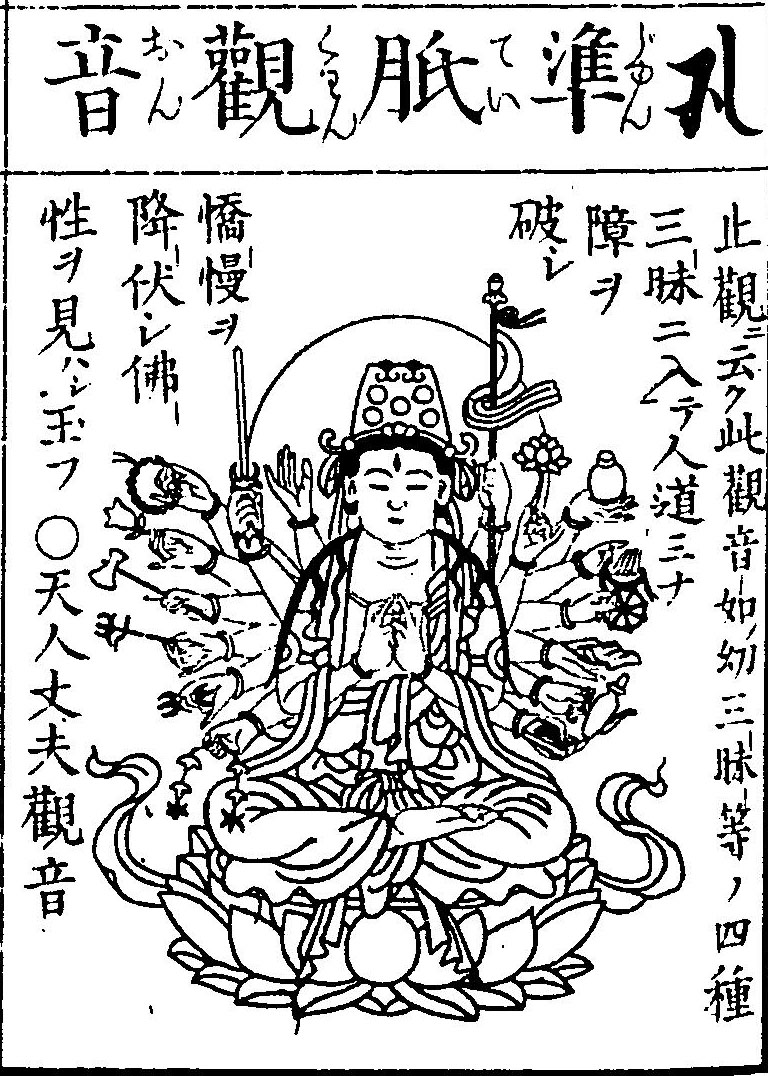
Japan, 1783. Woodblock print; illustration by Tosa Hidenobu.
Look closer: Look at the arms radiating from the shoulders, each with its object, and at the columns of characters that name them. The title strip reads Juntei Kannon.
Tosa Hidenobu (土佐秀信), “Juntei Kannon, from the Butsuzō zui”, Wikimedia Commons, Public domain. Source: commons.wikimedia.org (file page listed in the sources below).
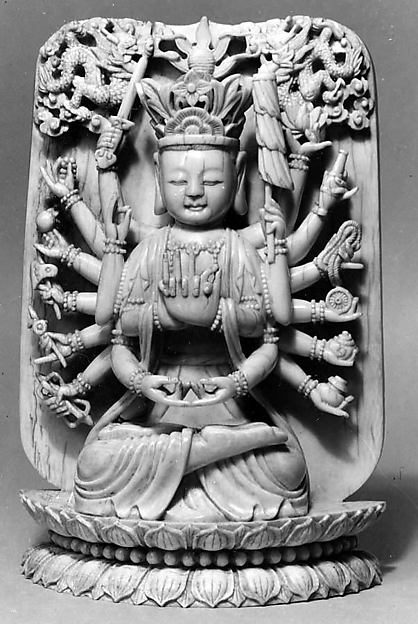
Sino-Tibetan, early 18th century. Ivory; 17.1 × 10.8 cm.
Look closer: Look at the fan of arms on either side of the central hands. The Met titles it Juntei Guanyin and dates it to the early eighteenth century.
The Metropolitan Museum of Art, Purchase, Gifts, Bequests, and Funds from various donors, by exchange, 1953 (53.114). Public domain, Open Access.
In the house
Pieces of Juntei Kannon appear on the shelves from time to time. The strip below reads the live shelves and appears when one is in the house.
Answered plainly
Who is Juntei Kannon?
Juntei is the Japanese form of the Indian Buddhist deity Cundī, the Mother of Seventy Million Buddhas. In Ono-line Shingon she is a bodhisattva and one of the Six Kannon.
How many arms does she have?
Chinese translated texts describe eighteen arms, JAANUS says, but surviving images range from two to 84 arms.
Is she a Kannon or a Buddha?
It depends on the school. JAANUS says Ono-line Shingon counts her a bodhisattva, while Hirosawa Shingon and Tendai consider her a Buddha.
Why do Tendai lists leave her out?
Wikipedia says Tendai later dropped Cundī from the Six Guanyin and substituted Amoghaāpāśa, Fukūkenjaku.
Can I see the Juntei Hall image at Daigo-ji?
The temple says the statue is usually kept secret and is opened to the public for three days during the Gokaihi ceremony on 18 May. Check with the temple before travelling.
What is her dhāraṇī?
Oṃ cale cule cunde svāhā, preceded by a homage to seven koṭis of buddhas, according to Wikipedia. The sutra promises purification of deadly karma after 800,000 recitations.
Where next
Sources and image credits
- The Metropolitan Museum of Art, object 38923
- Wikimedia Commons, Juntei Kannon (Cundi), 12th century, Tokyo National Museum.JPG (Anonymous (Heian period painter), Public domain)
- Wikimedia Commons, Juntei Kannon Butsuzo Zui.jpg (Tosa Hidenobu (土佐秀信), Public domain)
- Japanese Architecture and Art Net Users System, Juntei
- Wikipedia, Cundi (Buddhism)
- Wikipedia (mirror copy), Six Guanyin
- Daigo-ji, history of the temple
- Daigo-ji, Upper Daigo precinct


Last reviewed 28 October 2026. Pictures are public-domain or openly licensed, each credited beneath it. Diagrams on this page are drawn by Japonista.
Looking for a Juntei Kannon, a Cundī figure or a small shrine? Tell us what you have in mind and we will look.
Private concierge
Looking for something in particular?
Describe the piece or the project you have in mind. A senior advisor in Tokyo reads every case file personally and replies within two business days, with fees set out in writing before any work begins.