Popy
Figura de robot gigante Getter Dragon Popy Jumbo Machinder con caja original, mecha de la era Showa
Figura de robot gigante Getter Dragon Popy Jumbo Machinder con caja original, mecha de la era Showa
No se pudo cargar la disponibilidad de recogida
All sales are final. Please read our refund policy before purchase.
Have a reasonable price in mind? Submit your best offer and our concierge will review it personally.
A jumbo Getter Dragon is Showa broadcast mythology made physical, a giant-format emblem of the years when Japanese pop culture learned to manufacture icons with industrial efficiency and emotional force. Boxed and openly worn, this example sits in the authentic-survivor tradition, where presence, scale and silhouette are the true measure.
The Piece
This is a Popy-era jumbo-scale character figure from the Showa period, the kind of large, room-dominating object that sits between toy, icon and cultural furniture. In Japan’s character economy of the 1970s and early 1980s, giant figures were more than playthings; they were totems of broadcast culture, translating television heroics into physical presence, a sentinel at a child’s height and a shrine piece at an adult’s.
The subject is Getter Robo G’s Getter Dragon, a later-evolution silhouette in the Getter lineage that remains rooted in the bold, poster-graphic language of the era: high-contrast color blocking, simplified heroic geometry and emblematic chest details that read from across a room. Getter Robo and its G continuation sit in a uniquely Showa zone where science fiction is both future-worship and anxiety-management; if the world is chaotic, at least the hero can be assembled, literally. Getter’s visual language is one of transformative power, modularity, evolution and upgrade, and Getter Dragon reads as an escalation, more weaponized and more mythic machine than prototype.
Color here is signage rather than decoration. Saturated primaries and hard separations act like safety paint on industrial equipment, implying function, readiness and strength, while the horned, crested, antenna-like head silhouette echoes the era’s broader mecha grammar of divinity through engineering, the robot as both tool and idol. Jumbo pieces were built to be seen at a distance, not studied at macro range, and that loudness is the point: industrial optimism packaged as character design, and a physical compression of the period’s media ecosystem, its manga-to-television pipelines and toyetic design, in which characters were engineered to become objects and objects reinforced the characters’ myth.
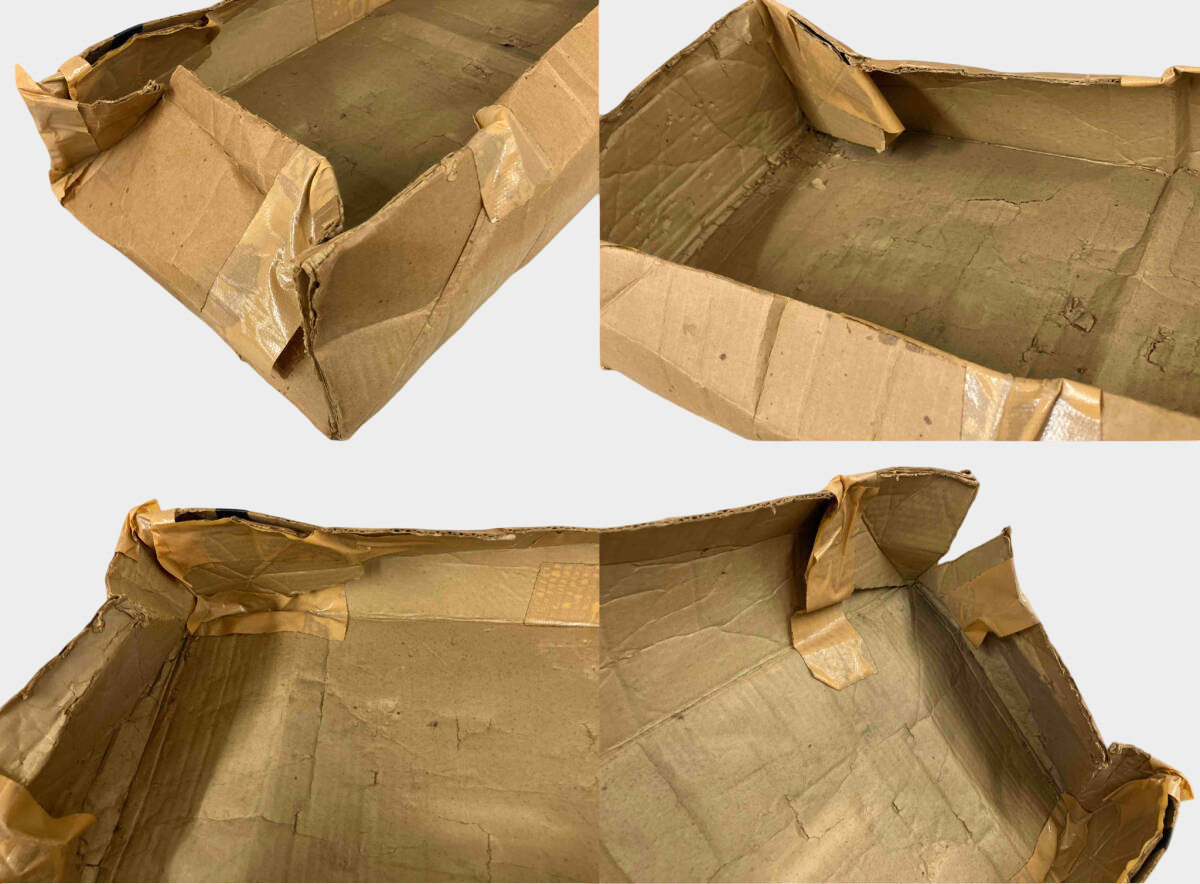
The set includes the original box, which even when imperfect functions as a second artifact, carrying period typography, product photography and distribution context; for collectors, box and figure together are documentation as much as completeness. Jumbo-scale Showa figures prioritize impact resistance over fine detail, simple panel surfaces designed for mass color application and large-format joints that tolerate movement but show wear at the edges.
Large-format character figures were costly in space, fragile across a life cycle of house moves and discards, and sensitive to sunlight, humidity and handling, so survival is selective: many were played hard and thrown out, others stored in closets where humidity left its signature. Boxed survivors, even with box damage, preserve the commercial archaeology of the period, and these jumbo robots have become room anchors for serious collections that explain themselves from across a room. The piece suits Showa mecha collectors seeking one giant to define a wall, design-focused collectors who treat vintage character objects as pop-industrial sculpture, and interiors where nostalgia is curated as cultural history rather than clutter.
Details
- Maker: Popy
- Model: Jumbo class vintage character figure, Getter Robo G / Getter Dragon
- Series: Getter Robo G
- Era: Showa-period vintage (broadcast-era item)
- Origin: Japan
- Material: Mixed materials typical of the era (hard plastics; some examples in this category include soft vinyl components depending on release and parts)
- Size: Jumbo class (roughly ~55–65 cm is typical for this family)
- Included: Figure, original box and the inserts and parts pictured only
Condition
- Box damage, sticker deterioration, scratches, surface wear and grime, including mold-like soiling (kabi yogore).
- Sticker wear is often the first sign of age in authentic survivors, since adhesives and print layers degrade faster than the underlying body; at this size micro-flaws become clearly visible, and the right expectation is honest surface history rather than mint perfection.
- Accessories are only those that appear in the photographs; completeness is defined by the photographs.
Popy Jumbo Heritage
Jumbo Machinder refers to a large-scale Japanese robot toy format, typically produced in soft vinyl at approximately 60 cm in height. Developed during the 1970s super-robot era, these figures were designed as monumental display pieces with missile-launching features and bold mechanical presence, and many of the most iconic examples were produced by Popy, the Bandai subsidiary that defined the standards of Japanese robot toys.
Founded in 1971 and later integrated into Bandai, Popy occupies a foundational position in the history of Japanese character toys. During the explosive growth of anime and tokusatsu in the 1970s it established the manufacturing and design standards by which robots and heroes were translated from screen to physical form, formalizing scale, weight and material language through lines such as Chogokin and Jumbo Machinder: die-cast heft, oversized proportions and bold mechanical silhouettes that made toys feel monumental rather than disposable, at once playthings and display icons within the home.
Even after the brand was absorbed into Bandai in the early 1980s, the term “Popy era” continues to signal a peak period of experimentation, quality and cultural impact. For collectors, Popy represents origin rather than revival: items bearing the name are recognized not merely as licensed merchandise but as historical benchmarks in the evolution of modern toy culture.
Authenticity & Care
Period-correct large-format Popy figure accompanied by its original box. Every piece is examined and documented in Japan before dispatch and is offered with the Japonista authenticity guarantee.
Delivery from Japan
Packed by hand in Japan and shipped insured and tracked by EMS or an equivalent express service. Import duties and taxes, where applicable, are payable on arrival. Returns follow our published policy.
Considered offers are welcome through Send an Offer, and each one is reviewed personally. Pieces over $1,000 may be reserved over several payments with Layaway Privilege™.
Continue browsing: Vintage Toys
Related pieces: Popy Jumbo Machinder Mazinger Z XX Plan, boxed · Popy Brave Raideen jumbo robot with box and parts · Popy Jumbo Machinder Brave Raideen with box
Toy Box Requests
Hunting a particular robot, kaiju, figure or model? The Hunting Salon™ searches Japan’s collector shops and private collections, and the Deputy Vault™ secures a piece you have already found. Begin a Hunting Salon™ request →
Collectors also search: popy getter dragon jumbo machinder · getter robo g jumbo machinder · getter dragon vintage figure box · jumbo machinder getter robo · showa getter robo toy · large vintage japanese robot figure