Japonista
Sukajan reversible Pin-Ball Originals, bordado de águila monumental, satén oliva y champán, década de 1990, talla M
Sukajan reversible Pin-Ball Originals, bordado de águila monumental, satén oliva y champán, década de 1990, talla M
No se pudo cargar la disponibilidad de recogida
All sales are final. Please read our refund policy before purchase.
Have a reasonable price in mind? Submit your best offer and our concierge will review it personally.
A rare Pin-Ball reversible sukajan in which a single monumental eagle spreads across chest, shoulders and back, turning the whole jacket into its canvas. Olive satin, champagne sleeves and cream-striped ribbing give the bird an earthy, military-adjacent setting, with a calmer olive-and-cream face on the reverse.
The Piece
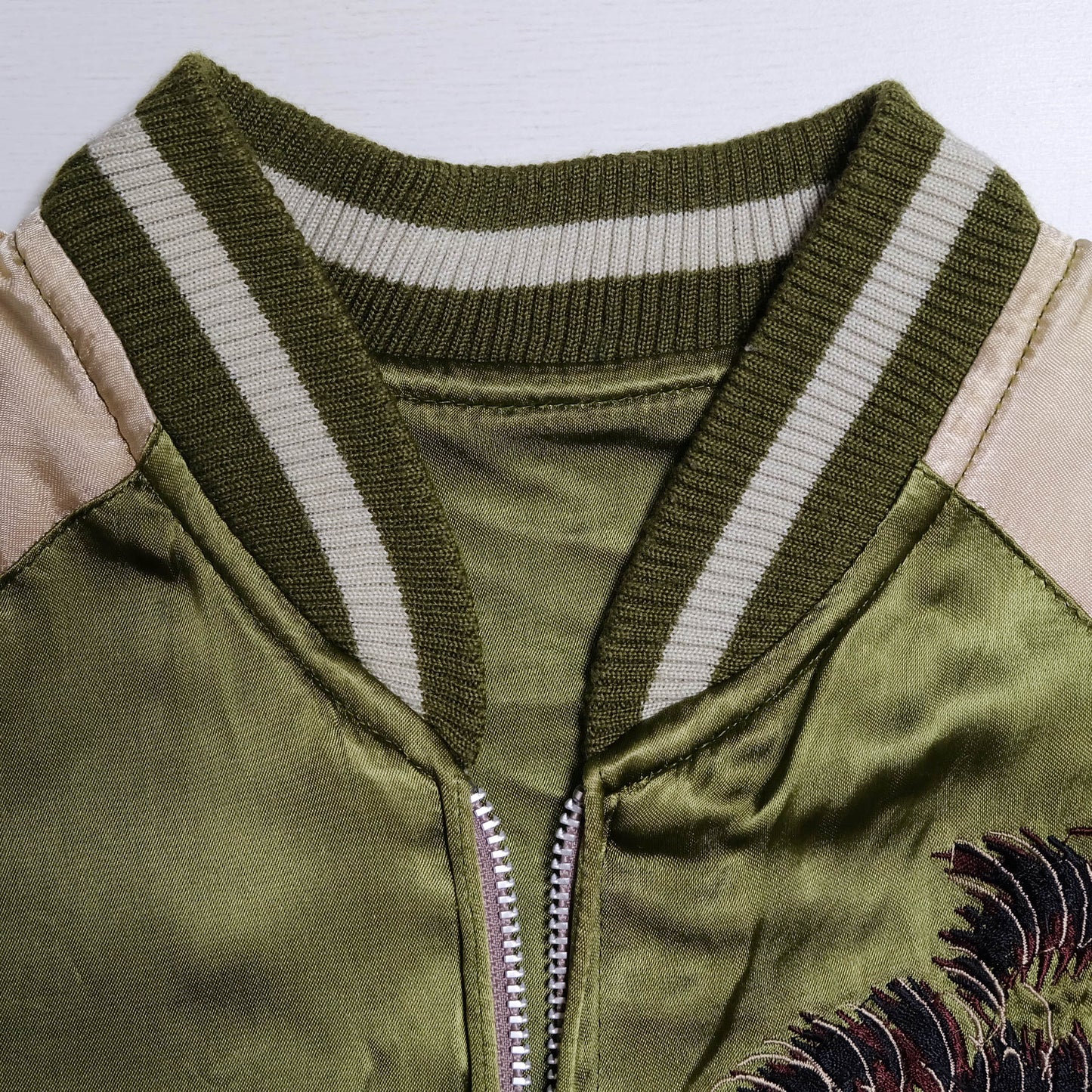
The principal face pairs a muted olive-green satin body with champagne-ivory raglan sleeves and coordinated olive-and-cream striped ribbing. A monumental eagle dominates the garment: pale head, sharply curved beak, extended talons and dense black, olive, burgundy, cream and brown plumage are embroidered directly across the body panels. The bird is not confined to a conventional rectangular back graphic; its form spreads over chest, shoulders and back, so that it seems to close around the wearer. Even lying flat, the jacket feels almost predatory.
On the front, the eagle's head, sweeping wing and clawed talon are divided across the zipper line. The broad feathered wing spreads over one side of the chest and torso, the pale head descends through the center with its curved beak approaching the lower zipper line, a large talon opens on the opposite side, and dark layered plumage extends toward the shoulder and upper sleeve. Closed, the divided image reconnects into one composition; worn open, each panel becomes an independent fragment of feather, claw and beak. Split-front embroidery of this kind is considerably more complex than a pair of small chest motifs, since the design must stay coherent across two moving panels while accommodating the zipper and pockets.
The back presents another enormous eagle rather than a reduced repetition of the front. The head occupies the center-right of the jacket, its eye rendered in pale green with dark outlining; a cream and champagne crown of feathers rises before giving way to black, olive, burgundy and brown plumage. The wing spreads diagonally across the opposite side from shoulder toward hem, built from hundreds of curved feather strokes whose clusters change direction to suggest turbulence and depth, while the talon near the shoulder, its curled claws outlined in cream, burgundy, olive and black, makes the bird appear to twist through the air rather than sit as a flat heraldic emblem.
The plumage is the jacket's greatest technical feature. Instead of one continuous block of thread, the wing is constructed from repeated crescent-shaped feather strokes, black for the deepest shadow and burgundy, brown, olive and pale cream for layered highlights. The olive satin remains visible between sections, so the ground fabric becomes part of the bird's coloring and the eagle reads as integrated into the garment. Under changing light some feathers disappear into the satin while others flash into view. The olive itself shifts between moss, khaki, bronze-green and muted chartreuse; the warm champagne sleeves soften the darker embroidery, and cream pocket welts repeat the sleeve color in clean diagonals across the lower body.
The eagle has long stood for vision, freedom, authority, courage and mastery of the sky, and in souvenir-jacket imagery birds of prey carry command and independence with a harder energy than cranes or songbirds. Here the bird is shown in motion, wing extended, head lowered, claw open, and the muted palette brings it closer to a weathered military emblem or painted aircraft insignia than a bright fashion graphic. Turned inside out, the jacket becomes calm and restrained: an olive-and-cream satin face with a cleaner front, the same raglan construction, striped knit trims, diagonal welt pockets and reversible zipper, a practical second option when the eagle feels too commanding. Hung open, the embroidered face recalls two panels of a folding screen; zipped closed, it becomes one unified bird of prey.
Details
- Maker: Pin-Ball
- Label: Woven label reading “Top Fashion · Pin-Ball · The Great Price Maker · Originals · Medium” in period-style typography with a red-and-blue crest
- Era: Assessed 1990s, possibly extending into the very early 2000s; the label carries no production year
- Origin: Japanese fashion sukajan of the late-20th-century revival period
- Material: Satin or satin-finish shell with the fluid drape of rayon-type sukajan satin; dense machine embroidery; rib-knit trims; metal reversible zipper
- Color: Embroidered face: olive green, champagne ivory, black, burgundy, brown, cream and muted gold. Reverse: olive-green and champagne satin
- Size: Medium (tag); older Japanese Medium may fit smaller and shorter than a contemporary Western Medium
- Construction: Fully reversible satin bomber with raglan sleeves (no separate shoulder seams); full metal reversible zipper; angled welt hand pockets on both faces; olive-and-cream striped rib-knit collar, cuffs and waistband; contrasting sleeve and pocket trim; unpadded or lightly structured, lightweight drape
- Embroidered face: Monumental eagle with extended wing and talon across front and back; curved feather embroidery in black, olive, burgundy, brown and cream; large eagle head and hooked beak
- Reverse face: Olive-green body with champagne sleeves, cleaner front, diagonal welt pockets and striped knit trims
Condition
- Good vintage pre-owned condition with natural characteristics of age, storage and previous wear; the eagle embroidery remains dense, dramatic and substantially complete, with feather, beak, eye and talon details retaining strong definition.
- General wrinkling and storage creasing throughout, with natural directional sheen, tonal variation and light age-related surface variation across the olive satin.
- Mild wear and possible faint toning on the champagne sleeves; light handling wear around the cuffs, hem, pockets and zipper area.
- The woven brand label shows minor age-related wear; the rib-knit trims appear substantially intact and the front zipper is present.
- No obvious large holes or severe structural tears and no major areas of missing embroidery are apparent in the photographs; minor marks, pulls, thread irregularities and further signs of age may be present on close inspection.
- Satin reflects light according to direction and folds, so some darker and lighter areas are created by the fabric itself. The photographs form an important part of the condition record.
Maker and Period
Pin-Ball is encountered in Japanese vintage fashion through embroidered sukajan, reversible satin jackets and other heavily decorated pieces. Comparable examples are commonly attributed to the 1990s, though the brand appears to have produced multiple designs and constructions rather than one fixed sukajan series. The label design, fluid satin, oversized guided-machine-style embroidery, reversible construction and muted palette align with other documented 1990s Pin-Ball souvenir jackets.
The jacket belongs to the later Japanese revival, when sukajan imagery became deeply integrated into amekaji, biker fashion, rock styling and streetwear. That era has its own collector following, valued less as postwar artifact than as an archive of the exuberant embroidery culture of late-20th-century Japanese fashion.
Sizing Guidance
Depending on build and preferred silhouette, the marked Medium may suit a regular Japanese men's Medium, a fitted Western men's Small to Medium, a relaxed women's or unisex Medium, or an oversized fit on a smaller frame. The raglan sleeves give flexibility through the shoulders, while the ribbed waistband creates the compact sukajan profile. Compare flat measurements with a similar jacket that fits well.
Styling & Display
The eagle face pairs naturally with black or washed denim, olive military trousers, wide-leg fatigues, workwear-inspired pants, vintage boots, minimal black knitwear, Japanese Americana layering and biker or rock-inspired styling. The calmer reverse suits indigo denim, chinos, cargo pants, cream trousers and understated vintage sportswear. The earthy palette lets the jacket read almost like an olive military bomber until the eagle comes fully into view, and the embroidered face also displays well as textile art.
Authenticity & Care
Woven Pin-Ball “The Great Price Maker Originals” label marked Medium; assessed as a 1990s Japanese revival-period sukajan, not an original 1940s or 1950s military-tour souvenir jacket. Every piece is examined and documented in Japan before dispatch and is offered with the Japonista authenticity guarantee.
Delivery from Japan
Packed by hand in Japan and shipped insured and tracked by EMS or an equivalent express service. Import duties and taxes, where applicable, are payable on arrival. Returns follow our published policy.
Considered offers are welcome through Send an Offer, and each one is reviewed personally.
Continue browsing: Sukajan Souvenir Jackets · Amekaji & Wagara Fashion
Related pieces: TEDMAN Peak'd Yellow geisha tattoo sukajan · TFOA Crows × Worst × Zero sukajan · JUNGLE STORM pink dragon sukajan
Yokosuka Archive
A particular size, motif or decade in mind? Postwar souvenir jackets and heritage amekaji surface in Japan one at a time. Name the maker, the embroidery and the chest measurement, and the Hunting Salon™ watches for it on your behalf. Request a jacket search →
Collectors also search: pin-ball sukajan · pin ball eagle jacket · olive eagle sukajan · reversible eagle souvenir jacket · 1990s japanese sukajan · champagne sleeve sukajan · eagle embroidered bomber medium · vintage japanese satin bomber