Japonista
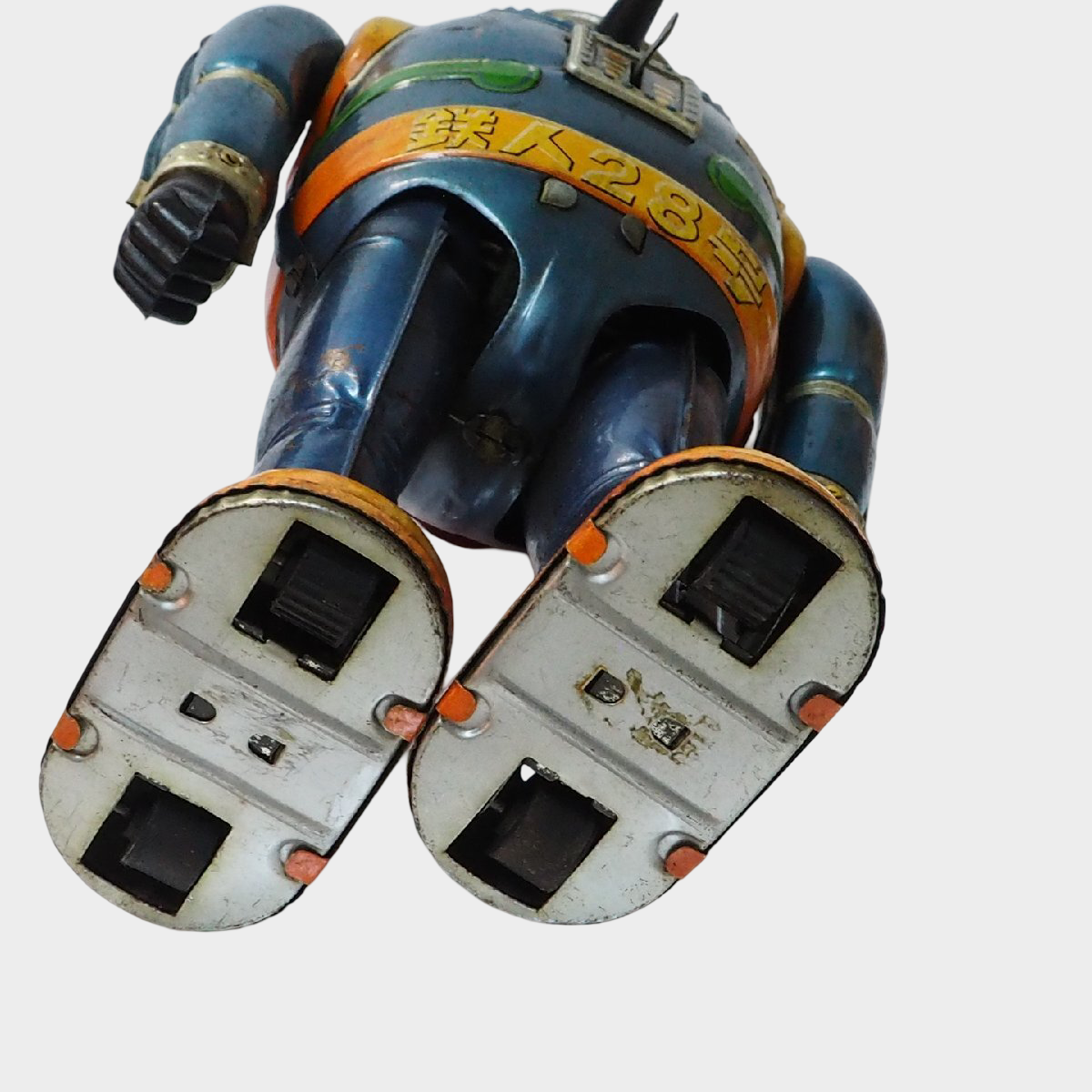
Robot andante de hojalata litografiada Nomura Tetsujin 28 n.º 3, a pilas y con caja original, era Shōwa
Robot andante de hojalata litografiada Nomura Tetsujin 28 n.º 3, a pilas y con caja original, era Shōwa
No se pudo cargar la disponibilidad de recogida
All sales are final. Please read our refund policy before purchase.
Have a reasonable price in mind? Submit your best offer and our concierge will review it personally.
The origin point of Japanese giant robot culture, rendered by one of the core houses of tin toy production. Nomura's Tetsujin 28 No.3, with rounded helmet head, broad cylindrical torso and thick limbs built for a forward walk, is the version most people picture at the name, and this example keeps its original illustrated box.
The Piece
This battery-operated Tetsujin 28 No.3 was manufactured by Nomura during the peak Showa years of robot production. The form is immediately recognizable: rounded helmet head, broad cylindrical torso, simplified mechanical chest panel and thick articulated limbs designed for forward walking. The paint is consistent with mid-period Nomura output, a matte blue body with contrasting yellow accents and bold chest insignia.
The original illustrated box lifts the piece into a higher archival tier. Even with age wear, it preserves the visual language that defined early Japanese robot culture: urban nightscapes, looming scale and the sense that technology itself had become a character.
Created by Mitsuteru Yokoyama in 1956, Tetsujin 28 predates piloted robots, super robots and mecha teams. He is a remote-controlled giant machine, built originally as a wartime weapon and later operated by a child controller, a concept that shaped the emotional core of robot storytelling: power without maturity, responsibility without consent. He stands as the first giant robot protagonist, the foundation for later works such as Mazinger Z, Getter Robo and Gundam, and a symbolic bridge between postwar trauma and technological optimism. Unlike later heroic robots he is morally neutral; he does not choose, he obeys.
The robot belongs to the pre-super-robot era, when tin toys were parallel cultural objects rather than merchandise extensions, and toy and manga evolved together. Where Mazinger Z is piloted and heroic, Tetsujin is remote, dangerous, child-controlled and morally complex, which is why early Tetsujin toys feel heavier, simpler and more imposing. Nomura, known for bold silhouettes, reliable battery and wind-up engineering and conservative, durable paint schemes, expressed this in the No.3 configuration through thick proportions, minimal decoration and an emphasis on mass and movement.
Details
- Maker: Nomura
- Model: Tetsujin 28 No.3
- Era: Showa period, peak years of Japanese robot production
- Origin: Japan
- Material: Tinplate
- Color: Matte blue body with contrasting yellow accents and bold chest insignia
- Mechanism: Battery-operated walking mechanism
- Included: Original illustrated box
Condition
- Honest, unrestored survivor with strong visual integrity; the structural form remains intact and display-worthy.
- Paint wear, scuffs and patina consistent with age and use.
- Box present with visible age wear consistent with Showa paper stock.
- Period-correct construction and scale; not restored or modernized.
No.1, No.2, No.3 Lineage
Within the early Nomura tin Tetsujin series, which captures the moment before the genre split into super robot and real robot, No.1, No.2 and No.3 are not revisions but philosophical and industrial stages.
- No.1, the prototype icon: the earliest mass-market physical interpretation, closest to the manga-era conception, with the simplest body geometry, a heavy rounded torso, minimal decoration and often darker or muted finishes. Postwar anxiety made metal, rarest and most historically charged, prized even in rough condition.
- No.2, the industrial standard of the silver era: a transitional, machine-forward form with cleaner symmetry, refined proportions, expanded chest-panel detailing, silver or muted metallic finishes and an emphasized walking mechanism. The robot as infrastructure, recognizable but not yet friendly.
- No.3, the iconic hero form: the most widely recognized and most popular version, a bridge between weapon and hero, with a more expressive silhouette, brighter accents, bolder chest graphics and a slightly more animated posture. It marks Tetsujin's entry into collective memory and the softening of postwar fear into adventure and nostalgia, with the broadest appeal across casual and advanced collectors.
Authenticity & Care
Nomura production with period-correct construction and scale, unrestored, accompanied by its original illustrated box. Every piece is examined and documented in Japan before dispatch and is offered with the Japonista authenticity guarantee.
Delivery from Japan
Packed by hand in Japan and shipped insured and tracked by EMS or an equivalent express service. Import duties and taxes, where applicable, are payable on arrival. Returns follow our published policy.
Considered offers are welcome through Send an Offer, and each one is reviewed personally. Pieces over $1,000 may be reserved over several payments with Layaway Privilege™.
Continue browsing: Vintage Toys · Anime Collectibles
Related pieces: Bullmark Baragon electric walking tin kaiju · Bullmark Ultra Seven tinplate toy with box · Bullmark Godzilla remote-control tinplate toy
Toy Box Requests
Hunting a particular robot, kaiju, figure or model? The Hunting Salon™ searches Japan’s collector shops and private collections, and the Deputy Vault™ secures a piece you have already found. Begin a Hunting Salon™ request →
Collectors also search: nomura tetsujin 28 tin robot · tetsujin 28 no.3 · gigantor tin robot · battery operated tin robot boxed · showa tin robot nomura · vintage japanese robot toy · tetsujin 28 go toy