Satori
Sukajan reversible Satori Batō Kannon × Benzaiten, bordado budista Wagara, aproximadamente de 2009, talla M
Sukajan reversible Satori Batō Kannon × Benzaiten, bordado budista Wagara, aproximadamente de 2009, talla M
No se pudo cargar la disponibilidad de recogida
All sales are final. Please read our refund policy before purchase.
Have a reasonable price in mind? Submit your best offer and our concierge will review it personally.
One of Satori’s most ambitious Buddhist embroidery programs: a wrathful, many-armed Batō Kannon wreathed in fire on one face and a serene Benzaiten with her biwa amid waves on the other. The exact motif pairing is recorded in a Japanese retail archive of December 2009.
The Piece
An early Satori (さとり) reversible sukajan, tagged size M, carrying two complete devotional compositions: 馬頭観音 Batō Kannon on one face and 弁財天 Benzaiten on the reverse. A surviving Japanese retail advertisement dated December 2, 2009 lists the design as 和柄総刺繍リバーシブルスカジャン『馬頭観音/弁財天』, a fully embroidered Japanese-pattern reversible sukajan featuring Batō Kannon and Benzaiten, which places this jacket firmly as a circa-2009 release rather than a later modern sukajan.
The Kannon face is fierce, almost volcanic. Against a blue-black satin ground, a red-bodied, crowned and many-armed Batō Kannon rises from an elaborate throne, multiple wrathful faces emerging from the composition, ritual implements raised in the hands and a small horse head above the crown, the attribute that identifies the Horse-Head Kannon and distinguishes the figure from Fudō Myōō, Aizen Myōō, Ashura or Gundari Myōō. Vermilion flames form a full mandorla around the shoulders and continue down the black inserts of the crimson sleeves, so the imagery stays alive when the wearer is seen from the side. On the chest, a gray sacred emblem in the manner of bonji (Siddham seed-syllable) calligraphy is ringed by red flames like a spiritual crest.
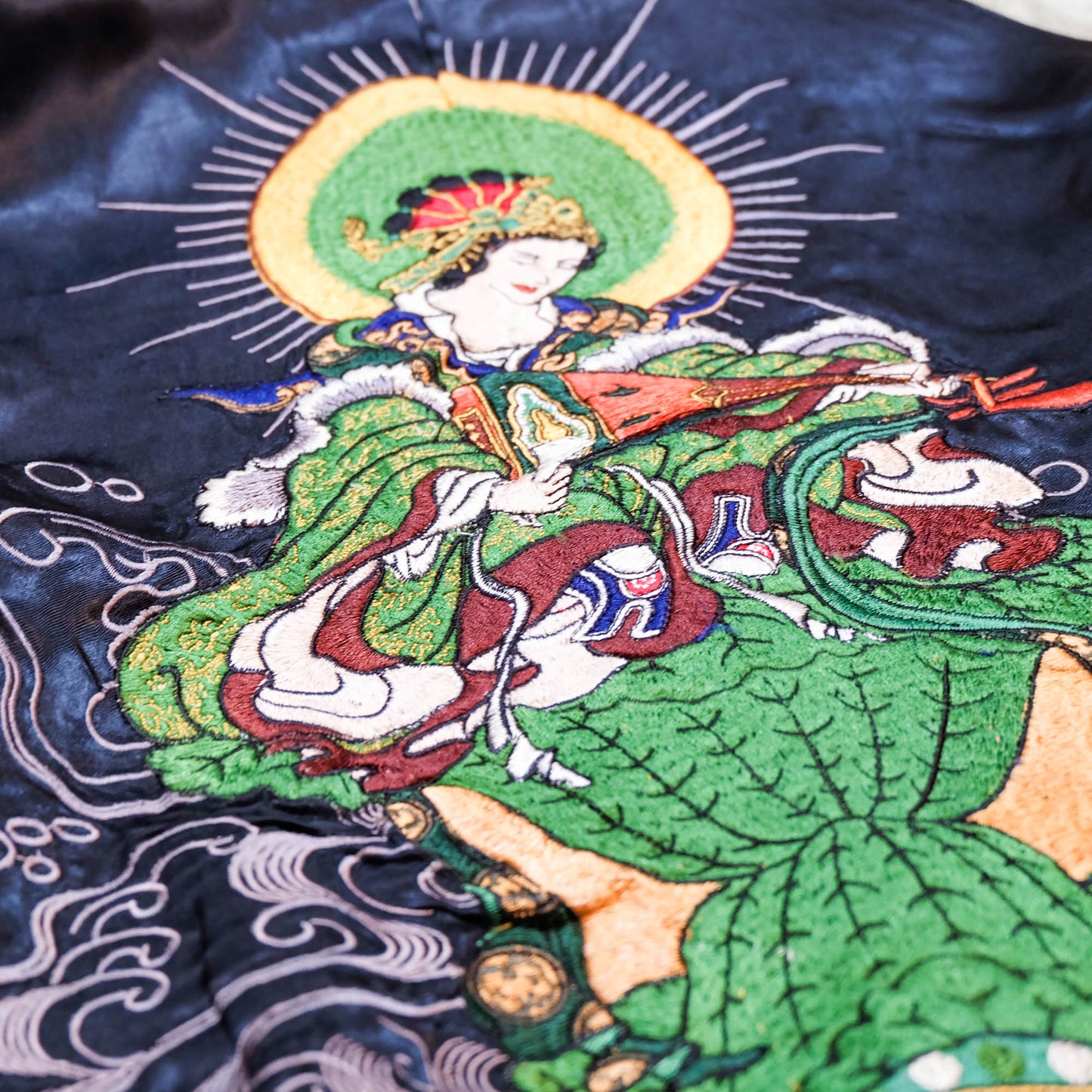
Reverse the jacket and fire gives way to water. Beneath a radiant halo, green within and gold without, with fine pale rays extending across the dark ground, Benzaiten sits in brilliant emerald and jade robes accented with orange, red, gold, white, turquoise, blue and cream, her biwa resting across her body. Monochrome waves in gray, white and lavender-gray thread curl beneath her, recalling woodblock-print linework more than conventional embroidery. Champagne-gold sleeves and black-and-ivory ribbing frame the scene, and pale lotus blossoms in cream, blush pink and white float across the front, one chest motif showing a pale sacred symbol emerging from a lotus.
The two faces are not color inversions but opposing emotional states: wrath and grace, protection and art, fire and water. Satori, a pillar of Japanese wagara fashion, has long used the postwar souvenir-jacket silhouette as a canvas for Buddhist, folkloric and tattoo imagery, and its catalogues continue to feature Fudō Myōō, Ashura, dragons, Kannon figures, oiran, tigers and koi. This older pairing belongs to an earlier generation of that work, a design now discontinued and difficult to replace, with double-sided Buddhist examples uncommon even within the brand.
Either face displays as textile art, the Kannon side like an embroidered Buddhist painting and the Benzaiten side like a devotional scroll translated into satin and thread. The flame sleeves make the Kannon face especially powerful when worn with black denim and boots, while the champagne sleeves give the reverse an unexpectedly elegant character with indigo or cream.
Details
- Maker: Satori (さとり)
- Design: 馬頭観音 / 弁財天 (Batō Kannon / Benzaiten), fully embroidered Japanese-pattern reversible sukajan
- Era: Circa 2009; design recorded in a Japanese retail advertisement dated December 2, 2009
- Origin: Japanese-market release
- Material: Lustrous satin body with contrasting satin raglan sleeves (catalogued as rayon satin); dense multicolor machine embroidery; rib-knit collar, cuffs and waistband; woven pocketing
- Color: Kannon face: deep blue-black body, crimson sleeves with black inserts, red and black ribbing. Benzaiten face: dark body, champagne-gold sleeves, black-and-ivory ribbing
- Size: M (tag)
- Measurements: Flat measurements available on request
- Construction: Fully reversible; reversible center metal zipper; angled hand pockets; full back and chest embroidery on both faces; sleeve flame embroidery on the Kannon face; lightweight traditional sukajan structure
Condition
- Genuine pre-owned archive garment with visible age, wear and material evolution consistent with an older satin sukajan, offered as a circa-2009 collector piece rather than new clothing.
- Dark satin body: pronounced tonal movement, with blue-black areas, charcoal shading, cloud-like lighter patches, warm brown-black undertones, sheen variation, creasing and storage impressions; partly the reflective direction of the satin, partly age, wear and storage, giving a smoky, naturally aged surface.
- Crimson sleeves: natural wrinkling, light tonal variation, subtle fading or softening, age-related surface movement and handling wear around cuffs and seams; the flame embroidery remains strongly visible.
- Champagne sleeves: warm tonal variation, localized darker shading, light surface discoloration, wrinkling, storage impressions and variation in sheen.
- Embroidery remains the strongest aspect: the Kannon’s faces, horse-head crown, hands, ritual objects, flames, jewelry and throne, and Benzaiten’s face, halo, biwa, robes, waves and base all read clearly; isolated thread movement, pulls or small irregularities may be present.
- Rib-knit collar, cuffs and hem show age-appropriate wear and relaxation.
- No major structural damage is apparent in the full-garment photographs, which form an essential part of the condition record.
Iconography Notes
Batō Kannon is one of the distinctive forms of Kannon (Avalokiteśvara). Unlike the serene Kannon, it takes a wrathful appearance, understood as compassionate power able to confront obstacles gentler forms cannot. Important surviving Japanese examples are three-faced and eight-armed (三面八臂), and in Japan the deity became associated with horses and animals; Sensō-ji links Batō Kannon with animal protection, good health, calamity prevention and travel safety, and Matsumoto’s heritage records a roadside Batō Kannon monument raised for travelers’ safety, a fitting image for a garment born as a travel souvenir.
Benzaiten developed in Japan from the Indian goddess Sarasvati and became one of the Seven Gods of Good Fortune. She is associated with things that flow: water, music, poetry, speech, knowledge, wisdom and fortune. Ishiyama-dera describes her two-armed form holding a biwa, and the waves on this jacket reinforce her bond with water. The lotus, foundational in Buddhist art, stands for purity and awakening.
- Kannon face motifs: multiple wrathful faces, many arms, crown with horse head, wheel-like and staff-like implements, hooked or ringed ritual objects, mudra-like hands, vajra-inspired forms, jewelry, lotus throne in pale pink, turquoise, cream, gold and black, flame mandorla in crimson, scarlet, coral red and rust with black contouring and pale highlights
- Benzaiten face motifs: haloed goddess with elaborate hair ornaments, biwa, green robes, monochrome waves, lotus blossoms, pale sacred symbol rising from a lotus
Fit Guidance
A Japanese-market Medium, cut shorter through the body than many Western bombers; depending on build it may feel closer to a Western Small to Medium, a fitted contemporary Medium or a relaxed Small. Satori’s modern M sukajan commonly fall in the low-50 cm chest-width range, though vintage measurements vary by model and period, so flat measurements (chest pit to pit, back length from collar base, center-back collar to cuff, hem width) should take priority over the letter size.
Authenticity & Care
The Batō Kannon / Benzaiten motif pairing matches a Satori design recorded by name in a Japanese retail advertisement of December 2, 2009 (和柄総刺繍リバーシブルスカジャン『馬頭観音/弁財天』). The rayon content is inferred from Satori’s characteristic materials rather than read from a label. Every piece is examined and documented in Japan before dispatch and is offered with the Japonista authenticity guarantee.
Delivery from Japan
Packed by hand in Japan and shipped insured and tracked by EMS or an equivalent express service. Import duties and taxes, where applicable, are payable on arrival. Returns follow our published policy.
Considered offers are welcome through Send an Offer, and each one is reviewed personally.
Continue browsing: Sukajan Souvenir Jackets · Amekaji & Wagara Fashion
Related pieces: Satori GSJR-005 skull oiran and Hannya reversible sukajan · Satori skeleton samurai and shishi lion sukajan · Satori samurai warrior and Hannya mask sukajan
Yokosuka Archive
A particular size, motif or decade in mind? Postwar souvenir jackets and heritage amekaji surface in Japan one at a time. Name the maker, the embroidery and the chest measurement, and the Hunting Salon™ watches for it on your behalf. Request a jacket search →
Collectors also search: satori bato kannon sukajan · benzaiten sukajan · satori reversible buddhist jacket · batou kannon jacket · vintage satori sukajan size m · buddhist embroidered souvenir jacket · wagara reversible sukajan