Japonista
Sukajan reversible San Maruichi, ranas danzantes bajo una luna creciente con cerezos y momiji, talla L-XL
Sukajan reversible San Maruichi, ranas danzantes bajo una luna creciente con cerezos y momiji, talla L-XL
No se pudo cargar la disponibilidad de recogida
All sales are final. Please read our refund policy before purchase.
Have a reasonable price in mind? Submit your best offer and our concierge will review it personally.
A reversible San Maruichi sukajan that stages a nocturnal gathering of frogs beneath a crescent moon, with red cherry blossoms and pale-gold maple leaves falling around them. Turned inside out, it becomes a black-and-silver Japanese garden: playful embroidered folklore on one face, understated nocturnal elegance on the other.
The Piece
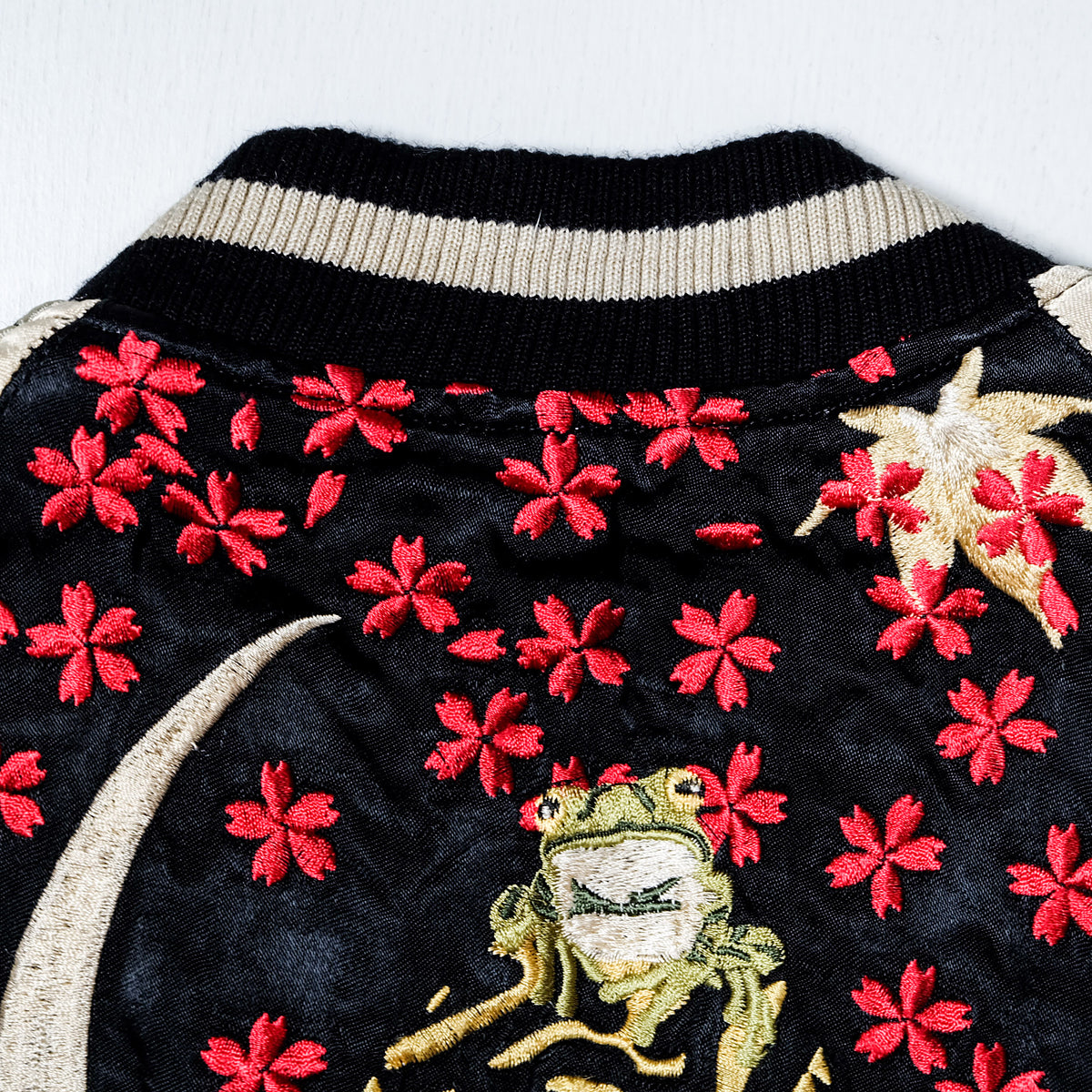
The principal face combines a smoky black satin body with softly luminous champagne sleeves, and its back is arranged vertically like a theatrical stage. At the top, a small frog sits confidently above a flowing gold brand emblem or calligraphic crest, cheerful and self-assured, a master of ceremonies presiding over the scene; a long silver crescent curves around the upper composition as both celestial symbol and graphic frame. Below, two larger frogs stand on layered green lily pads, bodies turned inward as a balanced pair, both raising their hands with elongated fingers, as if dancing, greeting the falling leaves, catching petals or taking part in a moonlit ritual understood only by frogs. Their cream bellies contrast with green-striped limbs and backs, and fine threadwork outlines mouths, eyes and toes without losing their cartoon-like personality. Beneath the lily pads, a bold black-and-ivory spiral resembles a ripple spreading across water, anchoring the softer embroidery and giving the scene movement.
Dozens of brilliant red blossoms scatter from the upper back toward the hem, some as complete five-petaled flowers, others as single petals in flight, while larger pale-gold maple leaves move diagonally across the opposite side, linking with the crescent, the emblem and the champagne sleeves. The dense green lily pads, with shaded veins, give the frogs a convincing platform. Spring and autumn coexist beneath the same moon, an embroidered calendar that gathers several seasons into one timeless fantasy garden, joyful rather than mournful. On the front, one chest shows a frog leaping within the curve of a silver crescent as red sakura and petals rise around it (frog, moon and falling blossoms condensed into one emblem); the other shows a second frog before a textured golden disc, a full moon, halo or celestial form, with pale-gold maple leaves drifting around it. The two scenes are deliberately different rather than mirrored. Two angled pockets are finished with long pale arrow-shaped borders, a familiar sukajan accent.
The reverse is an intricate black textile filled with silver-gray Japanese scenery: traditional pavilions, curving bridges, trees and branches, foliage, garden structures, layered terrain, water-like passages and architectural rooflines, with the effect of woven brocade or monochrome toile. From a distance it reads almost black; closer, a whole garden emerges across body and sleeves. A single pale frog leaps across a textured golden crescent on the upper back, alone and suspended in flight above the garden, the gold moon linking the two sides without repeating either. The reverse front is understated, the pattern flowing across both chest panels into the sleeves and fine pale piping following the shoulder and sleeve lines, so this side can be worn as a richly patterned black bomber without revealing the scene inside.
San Maruichi (参丸一, also written Sanmaruichi) is a Japanese wagara label known for making frogs the central characters of its visual world, placing expressive kaeru inside traditional landscapes, seasonal scenes and folklore adventures as samurai, travelers, fishermen, gamblers, warriors or supernatural adventurers. Japanese retailer and brand documentation describes the label as combining its signature frog with traditional wagara elements in a lighter, more playful spirit, and associates it with designer WATAKATU and the Atelier Lin family of Japanese casualwear labels. The scene carries the lively spirit of Chōjū-giga, the celebrated tradition of animals behaving like people, while remaining modern in its satin bomber construction and dense embroidery.
The exact production year and model number are not visible in the photographs. The jacket appears consistent with San Maruichi's modern wagara production, likely from the 2000s to 2010s rather than the postwar era of military souvenir jackets, as its dense computerized embroidery, brand-specific frog mythology, smooth satin construction and decorative all-over reverse indicate. Exact frog-and-moon examples have become relatively uncommon on the international secondary market.
Details
- Maker: San Maruichi (参丸一 / Sanmaruichi)
- Era: Likely 2000s to 2010s (assessed)
- Material: Smooth satin-finish textile on the embroidered face; black-and-silver brocade-style jacquard on the reverse; embroidery thread; rib-knit trim; metal zipper; woven pocketing
- Color: Embroidered face: black body, champagne or pale-gold sleeves, ivory-and-black striped ribbing, red, green, gold and silver embroidery. Reverse: black with silver-gray garden pattern and fine pale piping
- Size: L-XL range
- Construction: Fully reversible with two complete exterior faces; reversible metal zipper; angled welt pockets; striped rib-knit collar, cuffs and waistband; fine shoulder and sleeve piping; raglan sleeves; lightweight, unpadded or lightly structured
Condition
- Genuine pre-owned garment that appears visually well preserved; the principal embroidery remains colorful, detailed and strongly defined.
- Natural creasing and rippling throughout the satin, light tonal variation from the reflective fabric and gentle surface impressions from folding or storage.
- Minor thread irregularities expected in dense embroidery, subtle relaxation of the rib-knit trim and normal age and handling character.
- Possible small marks or pulls not immediately visible in full-garment photographs.
- The frogs, moons, blossoms, maple leaves, lily pads and water ripple remain clearly readable, and the silver garden reverse keeps good contrast against the black ground.
- No large holes, severe tears or obvious structural failures are visible; smaller signs of wear may be present and should be evaluated in all photographs, which form an essential part of the description. Color may vary slightly with lighting, screen calibration and the direction of the satin.
Kaeru Symbolism
The Japanese word for frog, kaeru, shares its sound with a word meaning "to return," which has made the frog a familiar symbol of good luck and safe return; the Japan Tourism Agency notes the association in its description of Kaeru Shrine. On a garment descended from the souvenir-jacket tradition of travel, departure, memory and return, the frogs carry a subtle blessing for the wearer's journey. Moving between water and land, and from tadpole to adult, the frog also suggests change, adaptability and renewal, while the rounded bellies, wide mouths, staring eyes and exaggerated fingers keep the figures funny, an auspicious motif that can make strangers smile.
The crescent moon recurs across both faces, introducing time, rhythm and change and guiding the eye around the figures. Sakura announces spring with renewal, beauty and impermanence; momiji defines autumn with transition, maturity and the beauty of change; together they make an impossible but poetic landscape.
Fit Guidance
Japanese-market sukajan often have a shorter body, broad chest, raglan shoulders, full sleeves, a fitted ribbed hem and more compact proportions than Western bombers. Compare against a similar raglan-sleeve jacket using chest width pit to pit, back length from the base of the collar, hem width across the ribbed waistband and sleeve length from the center back collar to the cuff.
Styling Notes
- Frog face: black denim, raw indigo jeans, wide-leg trousers, military chinos, engineer boots, leather footwear, minimal black shirts, Japanese graphic T-shirts, amekaji layers, rockabilly clothing, contemporary streetwear, wagara accessories
- Garden face: monochrome outfits, black trousers, charcoal denim, cream knitwear, minimal sneakers, Japanese designer clothing, evening streetwear, relaxed tailoring, silver jewelry, dark layered outfits
Authenticity & Care
Presented as a San Maruichi jacket; production year and model number are not visible, and fiber content should be confirmed from the care label (comparable San Maruichi sukajan use rayon satin for the principal face and polyester for the reverse). Every piece is examined and documented in Japan before dispatch and is offered with the Japonista authenticity guarantee.
Delivery from Japan
Packed by hand in Japan and shipped insured and tracked by EMS or an equivalent express service. Import duties and taxes, where applicable, are payable on arrival. Returns follow our published policy.
Considered offers are welcome through Send an Offer, and each one is reviewed personally.
Continue browsing: Sukajan Souvenir Jackets · Amekaji & Wagara Fashion
Related pieces: BEAMS skull and dragon reversible sukajan · Cherry blossom and butterfly vintage sukajan · Tedman ukiyo-e style Raijin and oiran sukajan
Yokosuka Archive
A particular size, motif or decade in mind? Postwar souvenir jackets and heritage amekaji surface in Japan one at a time. Name the maker, the embroidery and the chest measurement, and the Hunting Salon™ watches for it on your behalf. Request a jacket search →
Collectors also search: san maruichi sukajan · frog sukajan · kaeru jacket · frog moon souvenir jacket · reversible wagara jacket · sakura momiji embroidered jacket · sukajan l xl