Japonista
Sukajan reversible, bordado de arce momiji y calaveras emparejadas, reverso Hō-ō wagara, satén negro y marfil, década de 2000
Sukajan reversible, bordado de arce momiji y calaveras emparejadas, reverso Hō-ō wagara, satén negro y marfil, década de 2000
No se pudo cargar la disponibilidad de recogida
All sales are final. Please read our refund policy before purchase.
Have a reasonable price in mind? Submit your best offer and our concierge will review it personally.
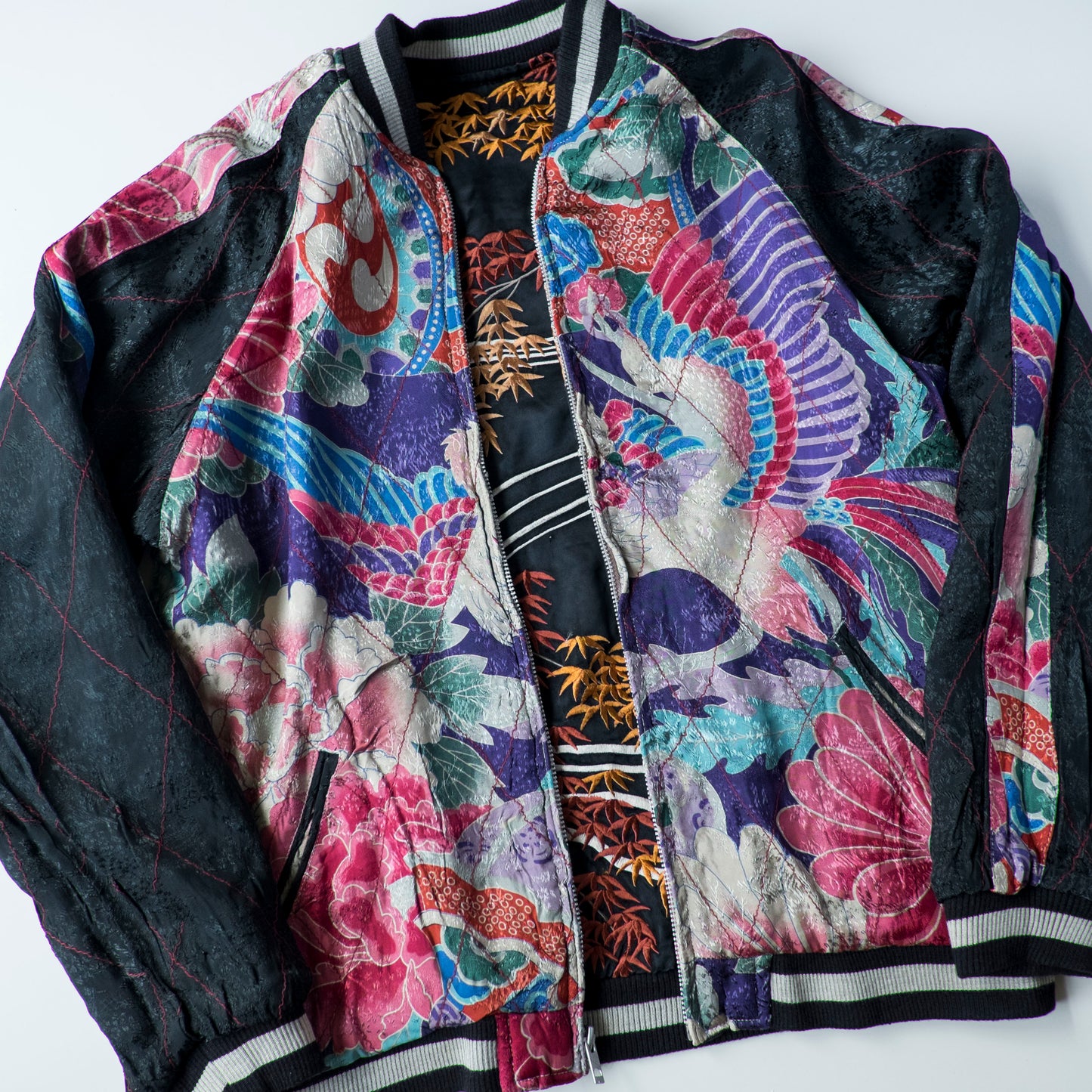
Autumn maples drift over pale river currents across black satin, and near the hem two embroidered skulls turn a seasonal landscape into a quiet memento mori. Reversed, the jacket becomes a violet wagara textile of paired hō-ō birds and opulent blossoms: two complete wearable identities in a single sukajan.
The Piece
The principal face sets an atmospheric autumn landscape across black and warm ivory satin. Layered momiji branches sweep over the shoulders, sleeves, chest and back in golden ochre, amber, burnt orange, copper, terracotta, rust red, muted burgundy, warm beige and soft brown, as though the leaves were caught at different stages of seasonal change. Rather than repeating mirrored clusters, the branches spread irregularly, dense in some places and reduced to a few suspended stems in others, while smaller detached leaves seem to drift through air or water. Long ivory and silver-gray lines loop beneath the foliage like river currents or wind, recalling the classical Tatsutagawa motif of red maple leaves carried on the Tatsuta River, a familiar image of seasonal beauty and impermanence in Japanese poetry, painting, lacquer and textile design.
Near the lower right of the back, two embroidered human skulls emerge from the dark landscape, set close together and turned in slightly different directions. Worked in layered ivory, gray, taupe and dark reddish-brown thread, with dark cavities for the eyes, nasal openings and teeth, lighter stitching shaping forehead, cheekbones and jaw, and fine crack-like contour lines, they are small enough to reveal themselves only gradually among the branches. Beside leaves at their most brilliant moment before falling, they read as a memento mori; their pairing may also suggest companionship, duality, ancestors or two lives carried in the same flow of time, and the jacket leaves that narrative open.
The landscape is continuous. On the front, branches cross both chest panels and the pale currents travel toward the zipper and resume on the opposite side, so the composition reads as a panorama even when closed, and the foliage reconnects across the sleeves as the wearer moves. Black inserts and narrow dark bands cross the ivory sleeves, organizing the leaves and linking the arms to the black body. Angled welt pockets edged in pale satin follow the color of the river lines, and the silver-toned teeth of the metal zipper on black tape form the only vertical interruption. The cream, black and copper palette is deliberately more refined than the bright primary colors of many traditional sukajan.
Reversed, the jacket changes completely. A richly patterned multicolored textile unfolds across a deep violet ground that may read as purple, indigo-violet, plum or blue-lavender: large peony-like, chrysanthemum-like and camellia-like blossoms in rose, crimson, ivory, lavender, turquoise and muted green; layered foliage; red, blue and ivory circular medallions with dotted or ring-like patterning; and, at the center, two pale fantastical birds with ornamental crests and long decorative feathers in ivory, soft silver, blush and pale pink, their wings worked in blue, turquoise, violet, red and rose, consistent with hō-ō imagery. The textile strongly recalls wagara and ceremonial kimono design, though it is not confirmed as a repurposed kimono and is best appreciated as a kimono-inspired panel. Black jacquard-like sleeves with a subtle woven floral texture are crossed with red diamond quilting, sections of the bird-and-floral textile extend over the shoulders and forearms, and black welt-pocket trim sharpens the front, where the zipper divides the scene so that its halves meet when closed.
The sukajan grew out of embroidered postwar souvenir jackets associated with Yokosuka and other port communities, and the most ambitious later examples, this one among them, treat the whole garment as a pictorial field. Read together, its two faces form complementary chapters, one nocturnal and contemplative, the other exuberant and ceremonial, moving from mortality toward the renewal and harmony traditionally associated with the hō-ō. The piece sits across several collecting fields at once, from souvenir-jacket culture and wagara-inspired fashion to early-2000s Japanese streetwear and gothic, punk, visual-kei and tattoo-inspired wardrobes. The maple face suits black trousers, faded denim, cream knitwear and boots; the reverse is best set against a single supporting color such as black, violet, burgundy, teal or deep green. On a broad padded hanger, either back functions as a substantial textile panel, and alternating the visible face spreads light exposure evenly.
Details
- Maker: No maker label or branded embroidery visible; manufacturer not confirmed
- Era: Consistent with Japanese streetwear and decorative sukajan production of the 2000s to early 2010s; exact year not visible
- Origin: Japan
- Material: Satin-finish shell with extensive machine embroidery; multicolored patterned textile with quilting on the reverse (exact technique not confirmed); jacquard-like sleeve fabric; ribbed knit trim; metal zipper
- Color: Primary face: black body, warm ivory sleeves with black panels, ochre-to-burgundy maple embroidery, ivory and silver-gray river lines. Reverse: deep violet ground with white, turquoise, cobalt, crimson, rose, lavender, green, orange and silver-gray; black sleeves with red quilting. Shared black ribbing with ivory or silver-gray stripes
- Size: No readable size designation; judge fit from flat measurements rather than assumed Japanese or Western sizing; unisex
- Construction: Fully reversible bomber; raglan-style sleeves; ribbed collar, cuffs and waistband shared by both faces; reversible central metal zipper; welt pockets accessible from either side
- Motifs: Momiji maple leaves, stylized flowing water, paired skulls, paired hō-ō-inspired birds, peony-, chrysanthemum- and camellia-like flowers, foliate scrolls, circular medallions, wagara-inspired pattern fields
- Type: Sukajan (Yokosuka jumper), reversible embroidered souvenir bomber; unisex
Condition
- Vintage pre-owned condition with visible creasing, satin rippling, textile variation, embroidery-related puckering and age-appropriate handling or storage character; both faces remain visually powerful, and the principal embroidery and patterned reverse retain substantial color and detail.
- Black satin body: natural folds, pressure lines and directional changes in sheen, with localized rippling around the dense maple embroidery and curving river lines, common where substantial threadwork meets lightweight satin.
- Ivory sleeves: natural creasing, uneven reflective sheen and gentle age-related tonal variation; no catastrophic tear or major missing sleeve section is visible.
- Maple embroidery strongly articulated, with clear separation between the ochre, copper, rust, beige and burgundy threads; minor loose fibers, raised thread ends, subtle edge wear or isolated irregularities may be present. The river lines remain substantially intact, with light distortion or puckering along the longer stitched sections.
- Both skulls complete and readable, with eye sockets, teeth, cranial contours and shading well defined; no major loss of the skull motifs.
- Multicolored reverse: visible creasing, surface wear, reflective variation and areas of softened or uneven color, most noticeable where pale areas meet darker fields; the birds, flowers, circular motifs, foliage and violet ground remain strongly legible.
- Black reverse sleeves retain their subtle woven surface and red quilting, with wrinkling, quilting-related rippling and gentle surface variation.
- Striped collar, cuffs and waistband present and cohesive; the pale stripes are gently age-toned and the knit shows normal waviness, softening and relaxation, with no extensive unraveling or major missing section.
- Central metal zipper and visible slider components present; align the reversible hardware patiently and do not force it if resistance is encountered.
- Principal panels, raglan seams, sleeves, pocket openings, cuffs, waistband and reverse panels appear structurally present, with no large hole, catastrophic seam failure or major missing panel visible in the photographs. Not presented as factory-new; additional photographs are available on request.
Motif Glossary
- Momiji (Japanese maple): autumn beauty, maturity, transition and the acceptance of change; its leaves are most brilliant just before they fall.
- Tatsutagawa: the classical pairing of maple leaves and flowing water, named for the Tatsuta River and its celebrated autumn foliage.
- Paired skulls: a memento mori of mortality, impermanence, time and memory, set beside the passing beauty of the leaves.
- Hō-ō: the auspicious mythical bird of peace, virtue, renewal and favorable eras; paired birds suggest balance and harmonious union.
- Peony and chrysanthemum: beauty, prosperity and honor; longevity, refinement and enduring vitality.
Fit Guidance
Japanese vintage sizing does not correspond consistently with modern Western sizing; fit varies with production period, bomber silhouette, body length, sleeve fullness, reversible construction and ribbing tension. Compare flat measurements with a similar jacket that already fits comfortably. Because the sleeves are raglan-cut with no conventional shoulder seam, sleeve length is taken from the collar rather than an assumed shoulder point.
- A: chest width, pit to pit, with the jacket laid flat and relaxed
- B: back length, from the base of the collar to the lower edge of the waistband
- C: sleeve length, from the base of the collar along the upper sleeve to the end of the cuff
- D: waistband width, measured relaxed without stretching the knit
- E: cuff width, measured relaxed
Authenticity & Care
No maker label or branded embroidery is visible, and the manufacturer is not confirmed; the 2000s to early 2010s dating is an assessment from construction, embroidery and style, as the production year is not visible. Every piece is examined and documented in Japan before dispatch and is offered with the Japonista authenticity guarantee.
Delivery from Japan
Packed by hand in Japan and shipped insured and tracked by EMS or an equivalent express service. Import duties and taxes, where applicable, are payable on arrival. Returns follow our published policy.
Considered offers are welcome through Send an Offer, and each one is reviewed personally.
Continue browsing: Sukajan Souvenir Jackets · Amekaji & Wagara Fashion
Related pieces: Royal blue dragon sukajan · Cropped Heads Yoshiwara oiran sukajan · Onigashima rising koi Hokusai wave sukajan
Yokosuka Archive
A particular size, motif or decade in mind? Postwar souvenir jackets and heritage amekaji surface in Japan one at a time. Name the maker, the embroidery and the chest measurement, and the Hunting Salon™ watches for it on your behalf. Request a jacket search →
Collectors also search: reversible sukajan jacket · maple leaf sukajan · skull sukajan jacket · momiji embroidered jacket · phoenix wagara jacket · memento mori japanese jacket · vintage japanese souvenir jacket · y2k japanese streetwear jacket