Tailor Toyo
Sukajan reversible Tailor Toyo TT11283 “Eddie”, piloto con calavera de la Fuerza Aérea de Yokota, geisha y monte Fuji, 2007
Sukajan reversible Tailor Toyo TT11283 “Eddie”, piloto con calavera de la Fuerza Aérea de Yokota, geisha y monte Fuji, 2007
No se pudo cargar la disponibilidad de recogida
All sales are final. Please read our refund policy before purchase.
Have a reasonable price in mind? Submit your best offer and our concierge will review it personally.
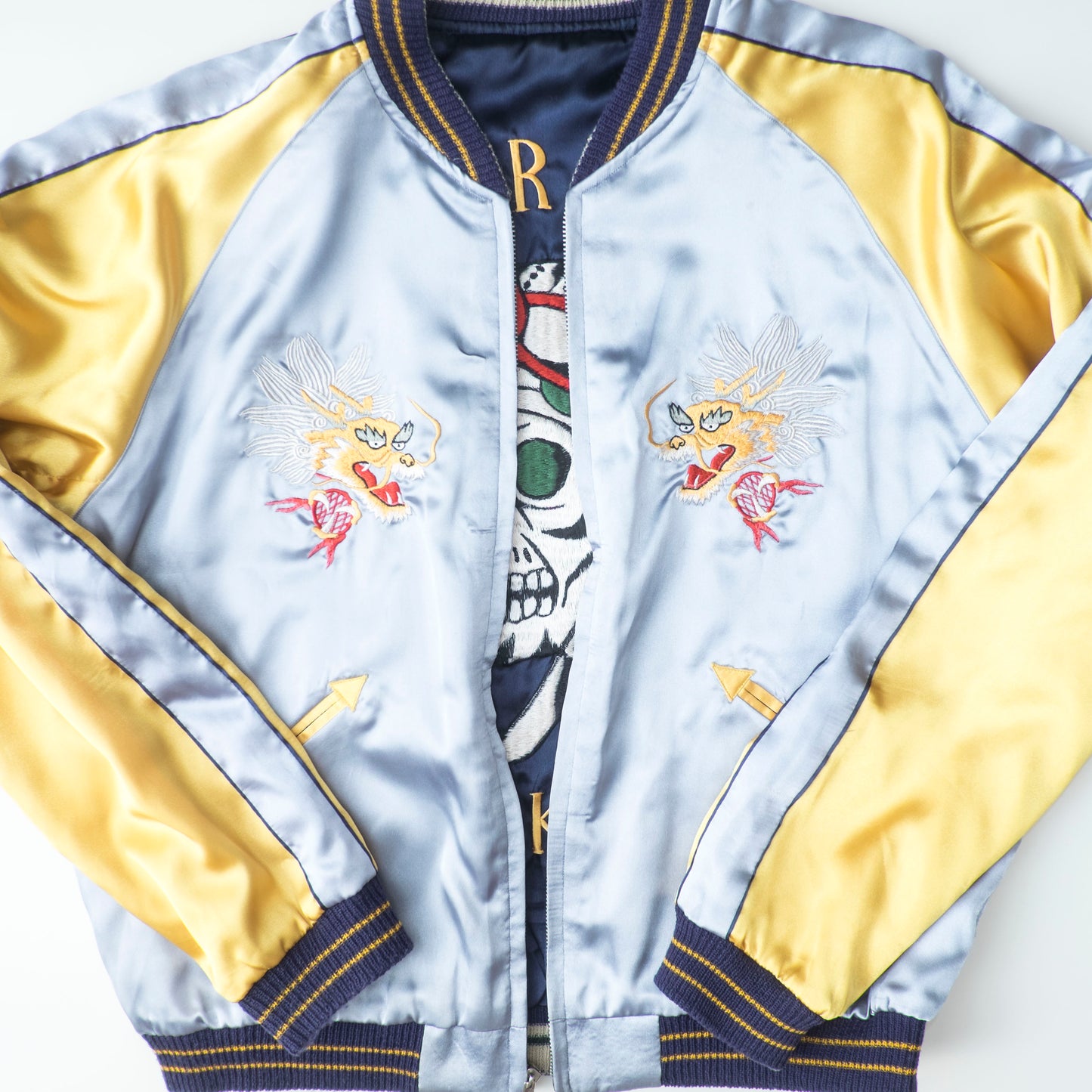
A fully reversible Tailor Toyo TT11283, cataloged as a 2007 release, built around an exceptionally personal 1950s military souvenir jacket. The midnight-navy face recreates a named “Eddie” Yokota Air Base jacket with a grinning aviator skull and the dates 1958–1959; reversed, silver-blue satin and golden-yellow sleeves open onto a geisha, dragons, a pagoda and Mount Fuji.
The Piece
This jacket does more than place Japanese imagery on a bomber silhouette; it recreates the cultural collision from which the sukajan emerged. One side speaks the language of the American serviceman, with U.S. Air Force lettering, Yokota base identification, the personalized name “Eddie,” 1958 and 1959 dates, a helmeted aviator skull and an eagle-and-snake emblem on restrained navy and dusty-pink satin. The other becomes an embroidered dream of Japan. It reads like a veteran’s memory album compressed into satin and thread: military service on one face, the country beyond the base gates on the other.
The darker face uses a deep midnight-navy body with muted blush-pink raglan sleeves, navy racing stripes edged with fine contrasting piping, and cream rib-knit trim striped in navy and green. Rather than bright red, black or olive, the design balances severe military lettering with soft pink satin for a faded postcard atmosphere. The right chest is embroidered “Eddie エディ”: the English name records the identity behind the original design, while the katakana anchors it in Japan, giving the jacket the intimate character of a personalized tour garment. The opposite chest carries a compact eagle with dark brown plumage, spread wings and open beak, entangled with a green, red and white striped snake that curls vertically around the bird, a motif of struggle, danger, conquest or survival with the intensity of traditional tattoo imagery.
Arched across the shoulders in gold is “U.S. Air Force.” Below sits an oversized white skull in a white flight helmet with green padding and ear protection, red-framed flight goggles, red buckle and hardware details, a flowing chin strap and deep green eye sockets. White numerals 58 and 59 flank the skull, and “Yokota” is embroidered beneath in gold. The skull is not a horror motif alone: its helmet makes it a phantom airman, a grinning emblem of danger, speed, mortality and camaraderie, and a playful memorial to life around an air base. The numerals commemorate the period of the original personalized jacket rather than the manufacture of this reproduction, the late 1950s being the formative postwar years when personnel stationed in Japan commissioned embroidered jackets as records of their assignments, travels and identities.
Reversed, the body turns to pale silver-blue satin that shifts between icy blue, pearl gray and lavender, with rich golden-yellow sleeves edged in narrow navy piping. Two small dragons face inward across the chest, worked in pale gold, silver, pink and red with open mouths, curled whiskers, flowing manes, clawed limbs, a small jewel or flaming-pearl motif and soft cloud-like forms; whimsical rather than fearsome, they float across the satin as a symmetrical guardian pair, and golden-yellow arrow-shaped pocket trims point up toward them. The back is a densely layered panorama beneath the embroidered word “Japan,” described in the iconography notes below. Where the Yokota side is bold, personal and slightly macabre, this face is romantic, theatrical and full of travel imagery, like an embroidered dream sequence from a vintage Japan travel poster.
The embroidery deliberately changes between the faces. The navy side uses thicker lines and bold blocks of white, red, gold and green so the skull and large inscription read at a distance; the silver side uses pale pink, lavender, light blue, ivory, gold, soft red and muted purple for a faded, ethereal quality. Areas around the skull, pagoda, dragons and kimono figure show the slight puckering typical of heavily embroidered lightweight cloth. Worn open, fragments of the skull can appear beneath the landscape, or flashes of pagoda and sakura beneath the Yokota side.
Details
- Maker: Tailor Toyo (Toyo Enterprise)
- Model: TT11283 (model number used across several color and motif combinations)
- Era: Approximate release 2007; early 21st-century heritage reproduction representing late-1950s Yokota Air Base souvenir-jacket culture
- Material: Glossy synthetic satin, likely polyester, as commonly documented for TT11283 examples; dense multicolor machine embroidery
- Color: Navy body with pale pink sleeves; reverse in silver-blue with golden-yellow sleeves
- Construction: Fully reversible satin bomber; raglan sleeves; reversible metal zipper; angled welt pockets on both faces; arrowhead pocket decorations; contrasting sleeve panels; narrow piping; striped rib-knit collar, cuffs and waistband; short traditional silhouette
- Navy Face: Front: “Eddie / エディ” and eagle-and-snake emblem. Back: U.S. Air Force Yokota aviator skull, 1958–1959
- Silver-Blue Face: Front: paired dragons. Back: geisha, five-story pagoda, Mount Fuji, dragons and cherry blossoms with “Japan” script
Condition
- Pre-owned, dating from the 2000s, with the natural characteristics of a worn satin souvenir jacket; the principal embroidery remains vivid and legible.
- General satin creasing and storage wrinkles, light surface rippling and natural puckering around the embroidery.
- Minor thread irregularities and slight tonal variation under direct light.
- Gentle wear to the rib-knit trim, with possible mild discoloration or age toning to the pale ribbing.
- Light handling wear around the cuffs, hem, zipper and pocket openings, and minor surface rubbing consistent with previous use.
- The Yokota skull, Eddie lettering, eagle, snake, dragons, pagoda, geisha and Mount Fuji compositions retain strong definition; no major tear, fabric loss or missing embroidered panel is visible in the photographs.
- Satin reflects light dramatically: the body may read as navy, dark indigo or blue-purple, and the reverse as silver, pale blue or lavender-gray, under different light and screens.
Reverse Iconography
The silver-blue back is a stylized collection of recognizable Japanese motifs, an idealized image of Japan rather than one literal view, in the manner of a mid-century travel postcard.
- Mount Fuji: a pale blue peak with snow rendered in cool blue and white thread, setting the horizon line.
- Five-story pagoda: red, white and gold, its stacked roofs rising through the center as a counterpoint to the triangular mountain.
- Kimono-clad woman: holding an open folding fan, her garment in red, pink, purple and black with floral and geometric patterning, reflecting the geisha or maiko imagery of postwar souvenir art.
- Dragons: two move through the upper scene among stylized flowers and clouds, spirits of the air above Fuji and the pagoda.
- Cherry blossoms: pink and red sakura frame the upper and lower sections, bringing spring, impermanence and warm color to the cool ground.
Yokota & Tailor Toyo
Yokota Air Base lies west of central Tokyo. The site began as a Japanese military airfield before the postwar period and later became closely associated with U.S. air operations in Japan; the official base history records major periods of activity spanning the Occupation, the Korean War, the Cold War and later Pacific operations. That history gives the embroidered word real geographic weight.
Tailor Toyo, the souvenir-jacket division of Toyo Enterprise, catalogues sukajan by period, material, construction and original-style subject matter, and its historical materials describe sukajan as garments developed from embroidered souvenirs commissioned during the postwar occupation, documenting traditional embroidery patterns and Yokoburi-style techniques. Because the TT11283 number covers several configurations, this one is identified by its full design: Yokota skull pilot, Eddie / エディ inscription, 1958–1959 dates, eagle and snake, silver-blue and yellow reverse, geisha or maiko figure, pagoda, Mount Fuji, paired dragons and cherry blossoms. It is now an approximately two-decade-old collector garment rather than a current seasonal jacket.
Fit & Display
Tailor Toyo sukajan of this period usually have a compact Japanese body length, raglan shoulders, a moderately relaxed chest, a tapered rib-knit hem and shorter proportions than many Western bombers. Useful comparison measurements are chest width pit to pit, back length from the collar seam, raglan sleeve length from center back, underarm sleeve length, hem width and cuff width, checked against a well-fitting jacket rather than a nominal Japanese size.
For display as reversible textile art, use a broad padded hanger or mannequin and avoid wire hangers, direct sunlight, damp environments and prolonged pressure against the embroidery.
Authenticity & Care
Japanese collector records identify this exact combination as TT11283, describing the Yokota skull side together with the geisha and five-story-pagoda reverse, and place the model in Tailor Toyo’s 2007 production. It is a heritage revival, not an original jacket made in 1958 or 1959. Every piece is examined and documented in Japan before dispatch and is offered with the Japonista authenticity guarantee.
Delivery from Japan
Packed by hand in Japan and shipped insured and tracked by EMS or an equivalent express service. Import duties and taxes, where applicable, are payable on arrival. Returns follow our published policy.
Considered offers are welcome through Send an Offer, and each one is reviewed personally.
Continue browsing: Sukajan Souvenir Jackets · Amekaji & Wagara Fashion
Related pieces: Tailor Toyo Guam map padded reversible sukajan · Tailor Toyo TT11283 USMC Okinawa reversible sukajan · Tailor Toyo M18280 USS Lexington reversible sukajan
Yokosuka Archive
A particular size, motif or decade in mind? Postwar souvenir jackets and heritage amekaji surface in Japan one at a time. Name the maker, the embroidery and the chest measurement, and the Hunting Salon™ watches for it on your behalf. Request a jacket search →
Collectors also search: tailor toyo tt11283 yokota · yokota air base sukajan · skull pilot souvenir jacket · eddie yokota jacket · geisha pagoda sukajan · reversible sukajan mount fuji · us air force souvenir jacket japan · tailor toyo skull jacket