Japonista
Pareja de jarras de sake chōshi japonesas antiguas de laca maki-e, con pino y ciruelo dorados, en caja de madera a medida
Pareja de jarras de sake chōshi japonesas antiguas de laca maki-e, con pino y ciruelo dorados, en caja de madera a medida
No se pudo cargar la disponibilidad de recogida
All sales are final. Please read our refund policy before purchase.
Have a reasonable price in mind? Submit your best offer and our concierge will review it personally.
A matched pair of Japanese lacquer choshi, the handled ewers of ceremonial sake service, with arched handles, removable lids and restrained gold maki-e pine and plum on a deep brown-black ground. Kept together in their fitted, divided wooden box, they survive as the complete pair so many such vessels lose.
The Piece
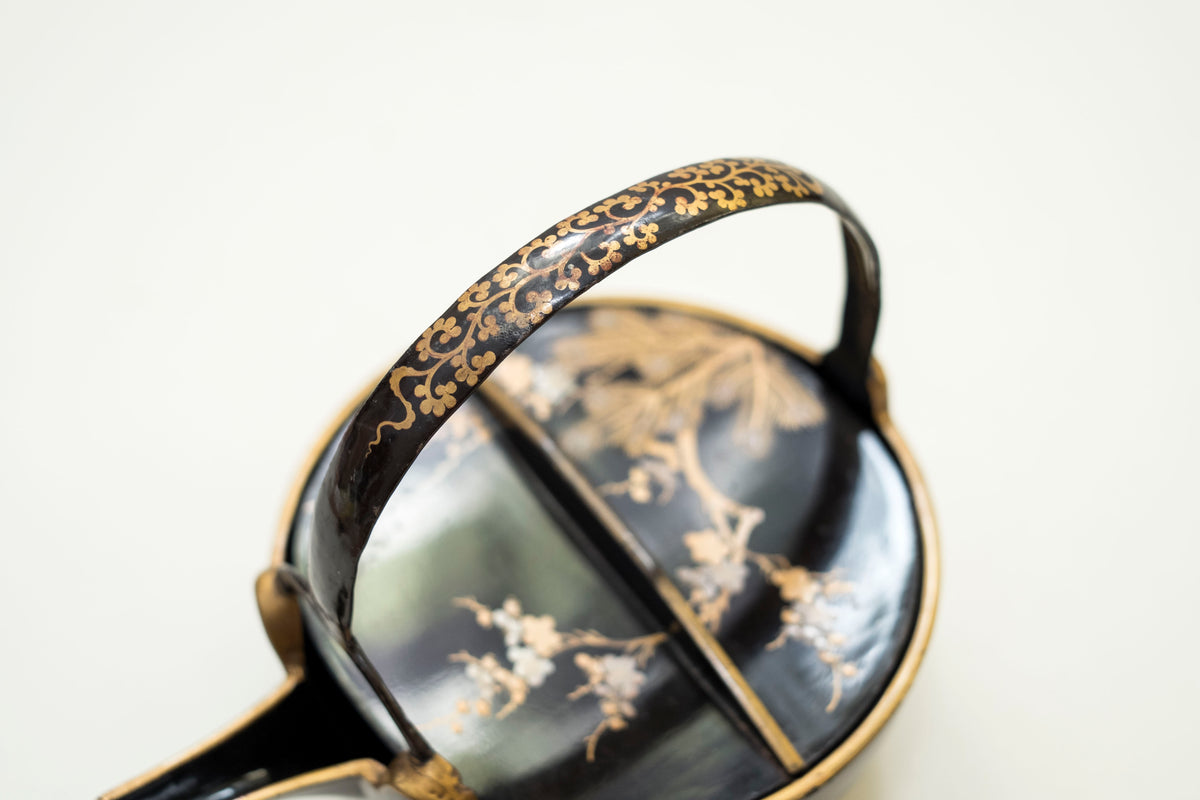
These two choshi belong to a world in which practical dining vessels were treated as decorative art. Each has a low, rounded body in deep brown-black lacquer, a short pouring spout, a sweeping overhead handle and a fitted circular lid. Across the glossy dark surfaces, fine gold decoration introduces branches of pine and flowering plum, motifs long associated in Japan with endurance, renewal, longevity and auspicious celebration. Correctly identified, they are not lacquer bowls but choshi: handled pouring vessels for sake. A broad, shallow body; a spout projecting from one side; a tall arch bridging front to back; and a lid that protects the contents while leaving the ewer easy to carry and pour. The low center of gravity keeps them stable, the handle gives height, the narrow spout controls the pour and the cover keeps warmth and presentation.
Matching scale, ground, decoration, lid construction and handle treatment show a deliberate set rather than two pieces assembled later, yet the maki-e is individually composed on each, so the pair reads as related rather than mechanically duplicated, a harmony through shared visual language valued in Japanese decorative arts. The lacquer is a rich dark brown-black, almost black in shadow, revealing warm chestnut undertones along curves and edges; like all fine urushi it seems to hold light rather than reflect it, and the gold emerges from that darkness as if suspended above it.
The ornament is in the tradition of maki-e, in which metallic powder creates decoration over lacquer, and it is restrained rather than dense. Pine needles are drawn in delicate, feather-like strokes radiating from the branches; on one ewer the pine sweeps around the side wall beneath the handle and continues onto the lid. Clusters of tiny gold plum blossoms travel across body and lid at a deliberately modest scale, animating the dark spaces between the larger motifs. Gold scrolling and floral ornament continues across the upper surface of each handle, so the vessels are decorated from every viewpoint. Each lid has a raised linear grip and carries pine and blossom framed by fine gold edging, and fine gilded lines trace the rims, spouts and boundaries. The spouts are broad at the base and taper to the opening, and their interiors appear lacquered as well.
Pine stays green through winter and stands for longevity and steadfastness; plum, among the first blossoms after the cold, for resilience and the arrival of spring. On sake vessels the pairing is especially apt: handled ewers of this kind are associated with formal Japanese occasions, including celebratory and matrimonial settings, where pouring becomes an exchange of hospitality, respect and celebration, and paired vessels evoke harmony and companionship.
The pair is accompanied by a substantial wooden storage box divided internally into two compartments, a partition that strongly suggests the vessels were meant to remain together. Old Japanese objects are so often found with lids lost, boxes gone and companions separated that this survival gives the group an unusual completeness. Their age and lacquer surfaces now make them better suited to collecting and display than to food or beverage service; on a sideboard, console, cabinet shelf or in a tokonoma-inspired arrangement, with the box nearby, they still tell the story of their original purpose.
Details
- Era: Antique; stylistically late Edo through Meiji or early modern period (no datable mark)
- Origin: Japan
- Material: Urushi lacquer over wood; gold maki-e (metallic powder) decoration; gilt edging
- Color: Deep brown-black lacquer with gold decoration
- Object: Choshi (handled ceremonial sake ewers), matched pair
- Decoration: Gold maki-e pine (matsu) and plum (ume) on bodies and lids; scrolling and floral ornament on handles; gilded rims and spouts
- Included: Two choshi with removable lids; fitted wooden storage box divided into two compartments
- Packing: Both vessels, lids and box individually protected for transit
Condition
- The pair presents attractively, with strong dark lacquer surfaces and clearly visible gold decoration; expected signs of age and previous use are present.
- Rubbing and loss to sections of the gilded edging, which has softened in places; small surface scratches, localized marks, minor lacquer wear and general handling traces.
- The undersides show wear consistent with placement and use, including marks around the small supporting feet.
- Both removable lids are present, and the arched handles remain intact in the photographs.
- The fitted wooden storage box shows substantial age-related coloration and darkening, scratches, marks and wear consistent with long-term storage and handling.
- No major structural breakage is immediately apparent from the views provided; please review all photographs carefully, as they form an important part of the condition description.
- Historic lacquer should be protected from prolonged moisture, heat, aggressive cleaning and rapid environmental change.
Authenticity & Care
Form, lacquer treatment, maki-e and wear are consistent with antique Japanese ceremonial lacquerware; no maker inscription or securely datable mark is visible, and the box is not signed (no inscription visible), so no exact date, school or workshop is presented as fact. Every piece is examined and documented in Japan before dispatch and is offered with the Japonista authenticity guarantee.
Delivery from Japan
Packed by hand in Japan and shipped insured and tracked by EMS or an equivalent express service. Import duties and taxes, where applicable, are payable on arrival. Returns follow our published policy.
Considered offers are welcome through Send an Offer, and each one is reviewed personally.
Related pieces: Meiji tanto-form red lacquer yatate
Kiln & Crate
Large chargers, vases and paired pieces travel in custom crates with insured freight through our Museum-Grade Logistics Suite™. For a piece not shown here, the Deputy Vault™ acquires, inspects and exports it for you. Open a case file →
Collectors also search: antique japanese choshi sake ewer · maki-e lacquer sake ewer pair · pine and plum maki-e · japanese lacquer choshi with box · gold makie sake pourer · antique urushi sake ewer · japanese wedding sake ewer