Japonista
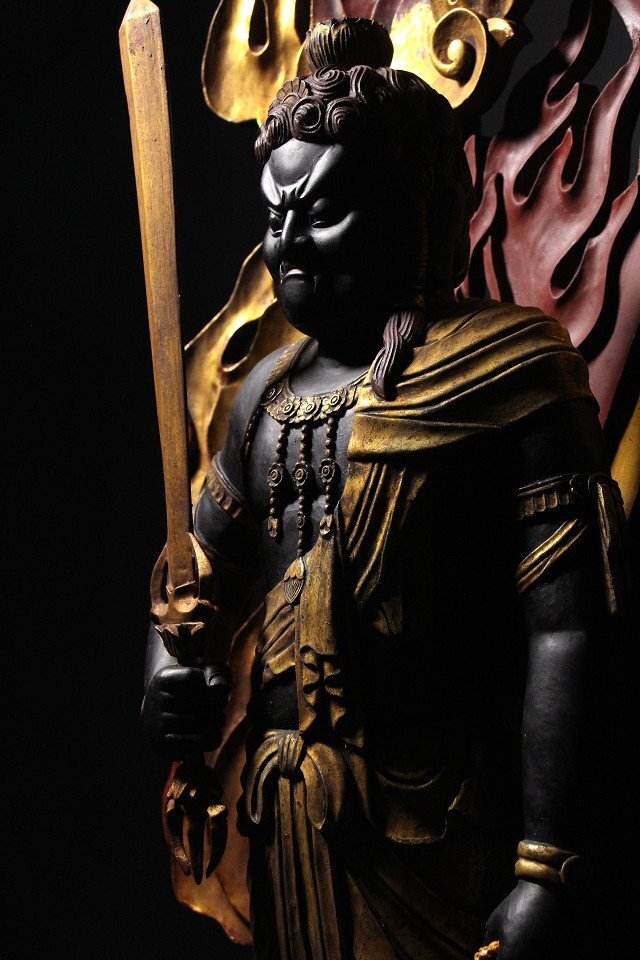
Fudo Myoo (Acala) monumental de madera tallada y policromada, rey de la sabiduría de pie con mandorla de llamas, 127 cm
Fudo Myoo (Acala) monumental de madera tallada y policromada, rey de la sabiduría de pie con mandorla de llamas, 127 cm
Freight piece: please confirm delivery before purchase
This piece travels in a crate or by freight rather than standard mail, and may need careful dismantling before it can be packed. The shipping shown at checkout is an estimate. Japonista reserves the right to determine the final handling, crating and freight cost when your order is received, according to the piece, the destination and carrier conditions at that time.
We advise requesting a delivery quote before checkout. If the final cost is higher than the amount paid, we send the difference for your approval before dispatch. Your piece is held for you until it is settled.
Request a delivery quoteNo se pudo cargar la disponibilidad de recogida
All sales are final. Please read our refund policy before purchase.
Have a reasonable price in mind? Submit your best offer and our concierge will review it personally.
Some Buddhist sculptures decorate a room; a standing Fudo Myoo at roughly 127 cm changes its gravity. Carved in wood and finished in layered polychrome, this Wisdom King stands with sword, rope and full flame aura, a hall-scale icon of practice built to anchor attention, discipline and protection.
The Piece
Fudo Myoo (Sanskrit: Acala, the Immovable One) is a Wisdom King, a protector manifestation of Esoteric Buddhism. A Wisdom King is not shown as gentle because compassion here takes the form of force: the force needed to stop what harms beings, to break attachment to delusion and to keep vows intact when the mind drifts. In temple settings such images often stand where people pass, bow, petition or recommit, because the figure does not bargain; it stabilizes.
In Japanese esoteric lineages, above all Shingon and the esoteric streams of Tendai, Fudo is the archetype of unwavering clarity. The face is wrathful, yet the doctrine is precise: the wrath is not personal anger but the intensity of awakened compassion that refuses to permit self-destruction, the compassion that intervenes. When collectors call a Fudo powerful, they mean the iconography is doing its work: it makes complacency uncomfortable.
At about 127 cm the sculpture moves from shelf object to architectural participant, meeting most viewers at torso level, the threshold at which a figure reads as a presence rather than a figurine. Larger Fudo images were historically more likely to be commissioned for temple halls, sub-altars or prominent devotional placements, where they had to read at distance, hold ritual space and remain authoritative under changing light. A standing Fudo with a full flame aura is structurally complex, neither the easiest format to produce nor to preserve, and a survival at this size with its principal elements intact becomes a centerpiece candidate by default. Museum grade here does not mean perfect condition; it means scale, iconographic completeness, credible age character and sculptural command.
In Buddhist art a triad is a three-figure arrangement in which the central figure expresses the primary principle and the flanking figures complete the doctrinal sentence, encoding cosmology and hierarchy: who stands at the center, who attends, who protects, who guides. Fudo is often understood within a wider protective family of icons, sometimes as the central stabilizer among attendants, sometimes alongside other protectors. Even as a single sculpture, esoteric presentation is ensemble-minded: sword, rope, flame aura, stance and base work together as a triad in components, a three-dimensional theology in which each element completes the whole.
A 127 cm esoteric guardian is not interchangeable. It can define an entire room, collection or exhibition narrative, from Esoteric Japan and Temple Protectors to Wrathful Compassion and Ritual Presence, and it bridges private and institutional sensibilities, communicating at distance, photographing with authority and offering interpretive density before a label is written. It suits a high-ceilinged interior, a dedicated alcove, a gallery wall with controlled lighting or a private study hall where the piece is allowed to command space, and it will make immediate sense to the collector who curates a room the way a temple curates a hall, with intention, distance and silence.
Details
- Subject: Fudo Myoo (Acala), Wisdom King of Esoteric Buddhism, standing
- Material: Carved wood with layered ground and polychrome pigments, possibly with lacquered or sealed surface elements
- Measurements: Width approx. 51 cm · Depth approx. 35 cm · Overall height approx. 127 cm
- Form: Standing figure with sword, rope and full flame aura (flame mandorla) on a carved base
- Restoration: Some minor fixes and restoration
Condition
- Age-related wear consistent with an older polychrome wooden sculpture, with signs of prior stabilization and repair.
- Visible wear includes surface fading, abrasions, dirt and soiling, losses and peeling, and small dents.
- These do not automatically reduce the sculpture's cultural value but call for responsible stewardship; the figure should be assessed in person for structural stability, join integrity and the condition of the flame aura elements.
- Areas for close attention: wood joins, internal cracking, flame aura stability, base stability and any active flaking. Where institutional acquisition is intended, a conservator condition review is recommended.
Reading the Iconography
Each attribute carries a precise meaning; at this scale the whole program reads clearly across a room.
- The sword: cutting through ignorance, obsession and destructive mental loops.
- The rope: saving by force, pulling beings back from danger and restraining what must be restrained.
- The flame aura: transformation by burning away delusion; it is not decorative.
- The standing stance: active guardianship, at this scale a statement of presence.
- The polychrome surface: historically used for legibility in temple interiors; age wear is part of the figure's life history while the structure remains coherent.
Authenticity & Care
Period attribution is offered as a plausible estimate, not a guaranteed fact. Polychrome wood condition varies widely, and restoration and stabilization may be present beyond the minor fixes noted. Every piece is examined and documented in Japan before dispatch and is offered with the Japonista authenticity guarantee.
Delivery from Japan
Packed by hand in Japan and shipped insured and tracked by EMS or an equivalent express service. Import duties and taxes, where applicable, are payable on arrival. Returns follow our published policy.
Considered offers are welcome through Send an Offer, and each one is reviewed personally. Pieces over $1,000 may be reserved over several payments with Layaway Privilege™.
Continue browsing: Buddhist Statues & Sacred Art
Related pieces: Edo wooden standing Fudo Myoo · Gandhara schist Buddha relief with attendants · Edo wooden Amida Nyorai with mandorla
Temple to Home
Monumental statues, zushi shrines and altars travel crated and insured through our Museum-Grade Logistics Suite™. Seeking a particular deity or school? The Hunting Salon™ searches Japan for it. Arrange crating and freight →
Collectors also search: fudo myoo wooden statue · acala standing statue · large japanese buddhist sculpture · wisdom king statue for sale · polychrome wood buddhist statue · esoteric buddhist guardian statue · fudo myoo flame mandorla · antique japanese temple sculpture