Miyabi Musubi
Sukajan reversible Miyabi Musubi, mapa de Japón, monte Fuji, dragón y bellezas en kimono, transformadas en bijin-ga de glicinias, talla L
Sukajan reversible Miyabi Musubi, mapa de Japón, monte Fuji, dragón y bellezas en kimono, transformadas en bijin-ga de glicinias, talla L
No se pudo cargar la disponibilidad de recogida
All sales are final. Please read our refund policy before purchase.
Have a reasonable price in mind? Submit your best offer and our concierge will review it personally.
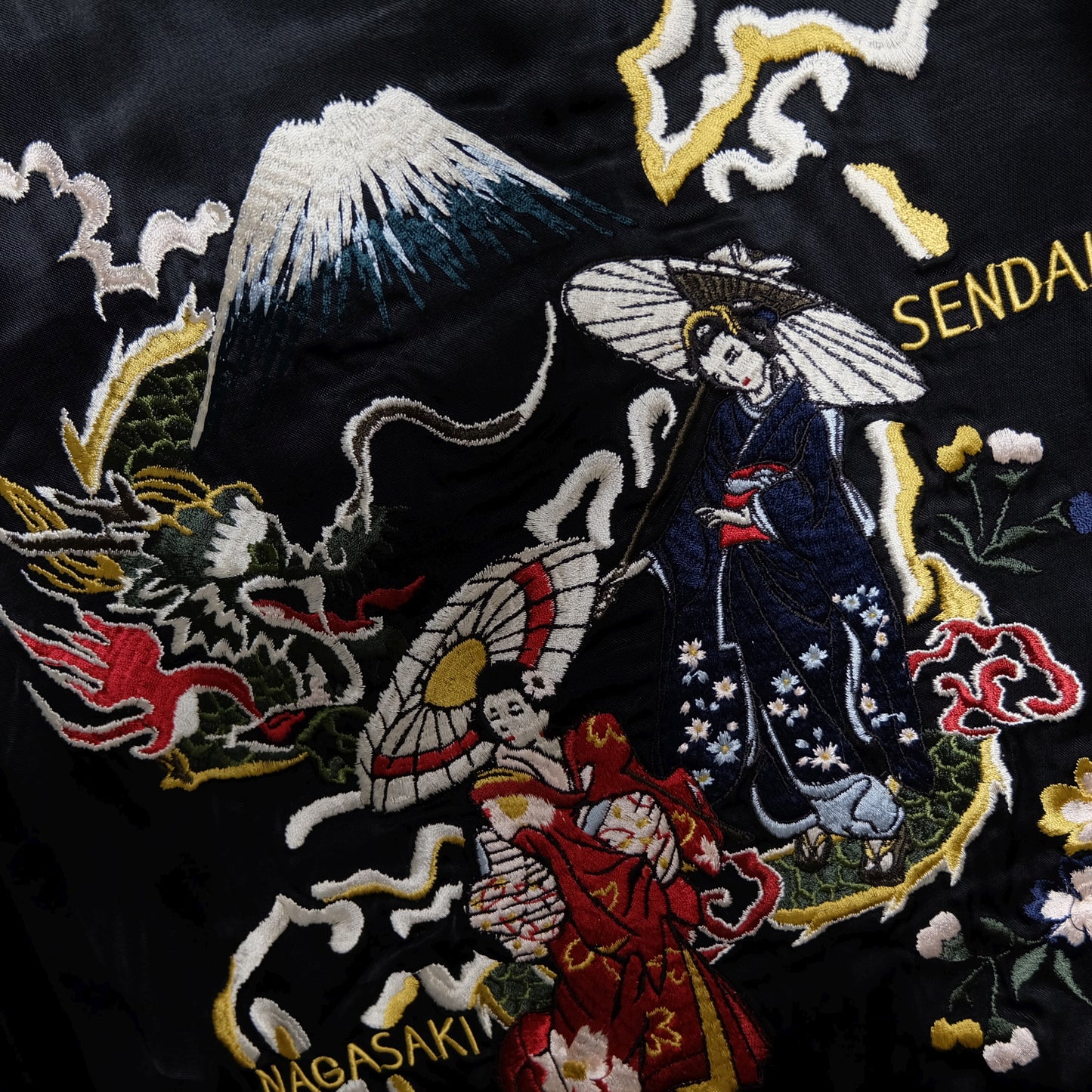
Two visions of Japan in one reversible jacket. The black face is a souvenir map in gold thread, Mount Fuji above a coiling dragon, kimono beauties with wagasa parasols and the names Sapporo, Sendai and Nagasaki; the wine-burgundy face is quieter, a bijin-ga figure framed by curtains of violet wisteria.
The Piece
A richly narrative reversible sukajan by Miyabi Musubi, an original Japanese-pattern fashion label developed by Ryugi Assaku and known for approachable wagara clothing that balances traditional motifs with everyday wearability. The black face presents an expansive souvenir-style map beneath the gold script “Japan”: Mount Fuji rises above a coiling dragon, and two elegantly dressed women carrying wagasa parasols appear among flowers and stylized regional outlines. The embroidered names Sapporo, Sendai and Nagasaki, for Hokkaido, the Tohoku region and western Kyushu, turn the design into a textile itinerary from north to south. One side recalls a classic postwar souvenir-map jacket; the other feels like a Japanese beauty print brought to life in satin. Both are complete enough to stand as separate jackets.
On the black face, the sweeping gold “Japan” crowns the upper back, its script recalling mid-century souvenir garments made to commemorate postings, travel routes and time overseas; the same warm gold carries through the map outlines, dragon horns and place names. The archipelago is loosely rendered, a decorative image stretching vertically rather than a precise diagram. Mount Fuji rises near the top center, its white summit shaded through gray, blue and charcoal to suggest snow on the volcanic slopes, set off by pale clouds. A green, gray, white and red dragon emerges from the left beneath the mountain, its horned head turned toward the women and map, red flames or cloud-like forms trailing behind, pale thread outlining face, beard and whiskers and darker green scale work giving depth. Of the two women, one wears a dark navy kimono patterned with pale blossoms under a light-colored paper parasol, the other a brilliant red kimono with floral ornament and a second wagasa; they are best read as bijin-ga-inspired kimono beauties, without assigning them a more specific role than the embroidery confirms. Small pale pink, yellow, white and blue blossoms around them and along the lower map link this face to the flower-filled reverse.
The black front is deliberately restrained: a large dragon head on the upper chest amid stylized clouds in cream, gold, navy and white, its green scales and pale mane echoing the back, while the opposite chest stays largely plain. Champagne sleeves frame the dark body, black shoulder stripes run from neck to cuff, champagne pocket welts continue the two-tone scheme, and the collar, cuffs and waistband combine black, cream and burgundy stripes that connect both colorways.
The reverse uses a deep wine-burgundy satin body with champagne sleeves and centers on a single kimono-clad woman beneath flowering wisteria. Her dress is worked with unusually varied embroidery: a deep black outer kimono, brilliant red sleeves, gold vine and leaf details, a richly decorated obi in pale pink, yellow and floral tones, a long red front panel with small white geometric marks, and orange and gold botanical embroidery across the lower garment. Her face is simplified in the traditional manner, pale skin, dark hair, red lips and a calm, formal expression, posed as the still center of a seasonal scene in the bijin-ga tradition of depicting elegant women. Long racemes of wisteria, fuji in Japanese, descend from green leaves in violet, lavender, pale lilac, white and blue-gray, forming a curtain or floral pavilion around her; a ring of pointed, maple-like flowers in yellow, pink, white, blue and red gathers at her feet, and the gold “Japan” reappears above. The burgundy front is left plain, with champagne sleeves bordered by burgundy shoulder and arm stripes and matching champagne pocket welts; worn open, glimpses of the black map side show through.
The iconography runs deep. A map turns a jacket into a record of place, and in souvenir-jacket culture marked where someone had lived, traveled or served. Mount Fuji stands for permanence, beauty, spiritual elevation and national identity; the dragon for energy, authority and protection, moving between landscape and myth through its link with clouds, rain and water. Wisteria, admired for its cascading clusters and vines that return over many seasons, suggests endurance, continuity, devotion, elegance and springtime beauty; the kimono figures embody refinement within a world shaped by woodblock prints, postcards, theater imagery and decorative textiles; and the seasonal flowers on both sides reflect the Japanese appreciation of beauty that blooms, changes, falls and returns. The jacket appears to be a later vintage or early 21st century Miyabi Musubi fashion sukajan rather than a 1940s or 1950s military-tour piece: its fluid satin, detailed computerized embroidery, reversible program and polished wagara composition reinterpret classic subjects rather than reproduce them literally.
Details
- Maker: Miyabi Musubi
- Era: Later vintage or early 21st century; no dated production label
- Material: Smooth satin or satin-like body with the sheen of rayon-based fashion sukajan; machine embroidery; rib knit; metal zipper
- Color: Black face: black body, champagne sleeves. Reverse: wine-burgundy body, champagne sleeves. Stripes in black, cream and burgundy
- Size: L (Japanese tag)
- Construction: Fully reversible; raglan sleeves; reversible metal zipper; angled hand pockets on both faces; contrasting shoulder and sleeve stripes; lightweight, non-padded
- Black Face: Japan map, gold Japan script, Sapporo, Sendai and Nagasaki, Mount Fuji, dragon, two kimono women with wagasa, seasonal flowers; dragon head on the chest
- Burgundy Face: Bijin-ga-inspired woman beneath wisteria, seasonal flowers, gold Japan script; plain front
- Thread Palette: Gold, cream, white, red, navy, green, violet, lavender, pink and blue
Condition
- Good pre-owned condition overall, judged from the photographs.
- General wrinkling and storage creasing across both satin faces, natural changes in sheen from the reflective fabric, and light handling and age-related surface wear.
- The embroidery is colorful, legible and substantially intact; wisteria, kimono, dragon, map and lettering details keep strong definition.
- Rib-knit collar, cuffs and waistband appear complete and the zipper present; no obvious large holes, severe tears, extensive embroidery loss or major conspicuous staining are visible.
- The reflective weave creates highlights, shadows and darker pressure areas depending on position, which may look more pronounced under studio lighting. The photographs form an important part of the condition record.
Fit Notes
Japanese size L may correspond more closely to a fitted Western medium or regular large, depending on the wearer, preferred silhouette and actual garment measurements. The raglan construction gives flexibility through the shoulders, while the rib-knit hem creates the classic shorter sukajan profile; compare flat measurements with a similar garment that fits well.
Authenticity & Care
Identifiable Miyabi Musubi branding; without a dated production label or catalog reference the jacket is presented as a pre-owned Miyabi Musubi archive-style sukajan rather than assigned an exact year. Every piece is examined and documented in Japan before dispatch and is offered with the Japonista authenticity guarantee.
Delivery from Japan
Packed by hand in Japan and shipped insured and tracked by EMS or an equivalent express service. Import duties and taxes, where applicable, are payable on arrival. Returns follow our published policy.
Considered offers are welcome through Send an Offer, and each one is reviewed personally.
Continue browsing: Sukajan Souvenir Jackets · Amekaji & Wagara Fashion
Related pieces: Miyabi Musubi × Hana no Keiji Maeda Keiji reversible sukajan · Miyabi Musubi Zenbu samurai rider sukajan · Miyabi Musubi reversible tiger, koi and dragon sukajan
Yokosuka Archive
A particular size, motif or decade in mind? Postwar souvenir jackets and heritage amekaji surface in Japan one at a time. Name the maker, the embroidery and the chest measurement, and the Hunting Salon™ watches for it on your behalf. Request a jacket search →
Collectors also search: miyabi musubi japan map sukajan · wisteria sukajan · geisha souvenir jacket · bijinga embroidered jacket · japan map reversible jacket · mount fuji dragon sukajan · burgundy sukajan size l