Japonista
Figura de exhibición a tamaño real Tiger Mask en FRP, estatua de exposición de la era Shōwa de 183 cm, pintada a mano, circa años 1980–1990
Figura de exhibición a tamaño real Tiger Mask en FRP, estatua de exposición de la era Shōwa de 183 cm, pintada a mano, circa años 1980–1990
Freight piece: please confirm delivery before purchase
This piece travels in a crate or by freight rather than standard mail, and may need careful dismantling before it can be packed. The shipping shown at checkout is an estimate. Japonista reserves the right to determine the final handling, crating and freight cost when your order is received, according to the piece, the destination and carrier conditions at that time.
We advise requesting a delivery quote before checkout. If the final cost is higher than the amount paid, we send the difference for your approval before dispatch. Your piece is held for you until it is settled.
Request a delivery quoteNo se pudo cargar la disponibilidad de recogida
All sales are final. Please read our refund policy before purchase.
Have a reasonable price in mind? Submit your best offer and our concierge will review it personally.
A 183 cm Tiger Mask in hand-painted FRP, made for department store windows, cinema lobbies and regional exhibitions at the height of the character's fame. Figures of this theatrical scale were never meant for private ownership, and most were discarded; this one survived from regional Japan.
The Piece
This is neither a commercial toy nor a modern licensed collectible. It belongs to a vanishing category of Japanese cultural artifact, the theatrical-scale display figure, produced for department store windows, cinema lobbies, regional exhibitions and promotional installations during Tiger Mask's cultural dominance. At 183 cm it crosses from collector item into environmental object, designed to command space and emotional recognition from across a room. Such figures were never intended for private ownership; their survival typically reflects store closures, the dismantling of regional exhibits or the dispersal of legacy assets.
Its scale, FRP construction and hand-finished paint align with Showa-era display sculpture practice, especially for anime and wrestling crossover icons. FRP was the material of choice for Japanese display sculpture because it offered structural strength at large scale, resistance to humidity and temperature variation, and light weight relative to solid resin or concrete. The figure was never intended to be perfect: it was made to be seen at a distance, under lighting, in public space, which explains both its construction and its finish. Its hand-applied paint, surface wear and aging are evidence of survival; modern replicas rarely age this way because they are cast, sealed and stored differently.
The figure's posture, upright, grounded and frontal, reinforces the character's mythology. It is not aggressive but watchful, which alone distinguishes it from kaiju or villain statuary. Tiger Mask was meant to be seen physically, not only consumed narratively: beyond manga and television he became a live wrestling persona, a department store display icon and a regional exhibition figure, visually legible even without context through the upright stance, animal ferocity held in check and masked anonymity.
The disappearance of such objects accelerated with the decline of large regional department store displays, the shift from physical exhibitions to digital promotion and licensing consolidation in the 2000s. Most were discarded, broken down or destroyed because of storage cost and size. Survivors tend to cluster in regional Japan, particularly outside Tokyo, in keeping with this piece's provenance. Placed in a room, a figure of this scale changes its emotional temperature: physical proof of an era when pop culture occupied real space and carried moral storytelling at architectural scale. It speaks to Showa-era cultural archivists, wrestling and anime historians, private museums, themed retail flagships, exhibition designers and collectors seeking a presence that cannot be replicated.
Details
- Attribution: Attributed to ATS / theatrical display lineage (shopfront and exhibition class)
- Era: Late Shōwa to early Heisei production window, circa 1980s–1990s
- Origin: Japan; regional provenance outside Tokyo
- Material: FRP (fiber-reinforced plastic) with reinforced internal structure; hand-applied painted finish
- Measurements: Height approx. 183 cm · Width approx. 117 cm · Depth approx. 76 cm
- Weight: Estimated net 70–85 kg; crated 110–130 kg
- Format: Oversized display-grade Tiger Mask figure (approx. life-size torso / near full-body scale)
- Freight: Cargo or freight shipping only (EMS, DHL, FedEx and UPS are not applicable). Custom wooden crate with internal foam blocking and strap restraint, single piece or partial disassembly (mask possibly removable); estimated crate 210 × 130 × 100 cm, volume 2.73 CBM, air volumetric weight approx. 455 kg. Delivery typically 6–10 weeks; freight to the USA estimated at around $6,000, with an exact door-to-door quotation prepared on request before purchase.
Condition
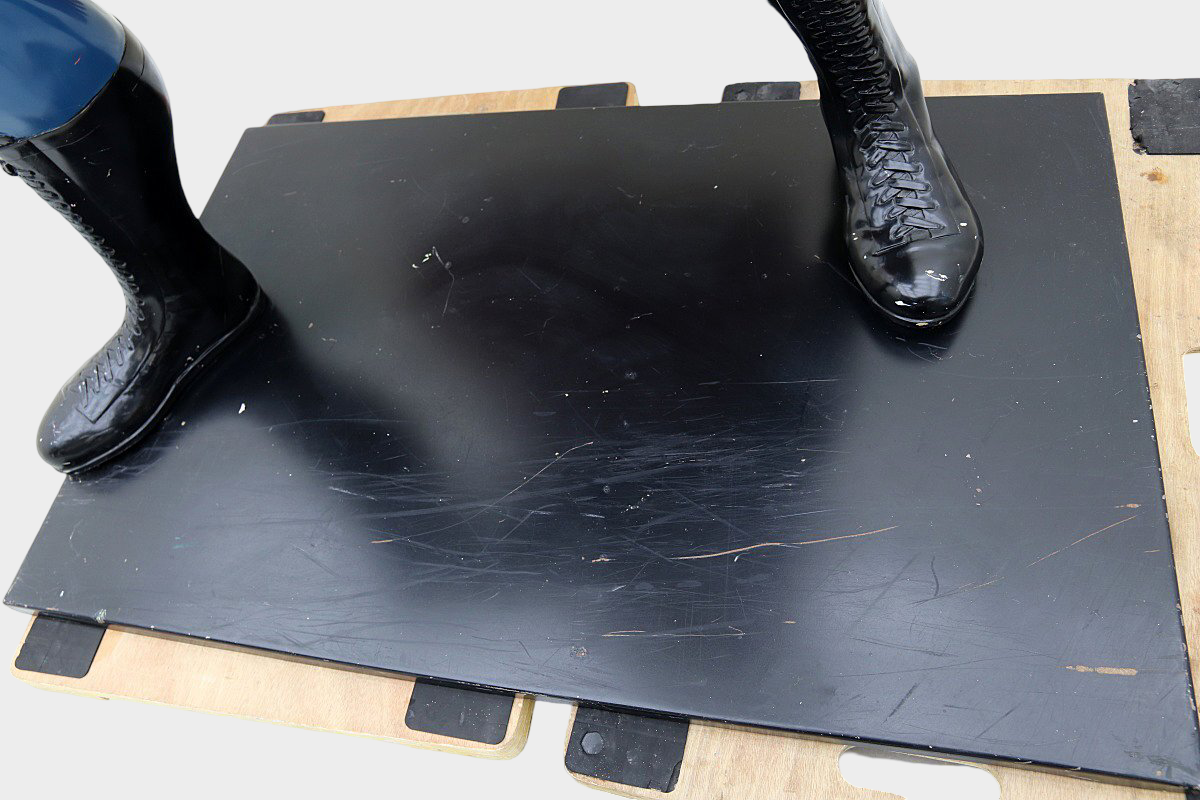
- Vintage display figure showing hand-applied paint, surface wear and aging consistent with public exhibition use.
- Made to be viewed at a distance under lighting rather than to a flawless finish; the photographs show the exact surface.
Tiger Mask as Moral Archetype
Tiger Mask emerged in the late 1960s, when Japan was rapidly modernizing, economically rebounding and still processing wartime defeat. The country sought heroic archetypes that did not rely on imperial power, divine right or militarism, and Tiger Mask answered with self-restraint, internalized ethics and strength used only when morally justified. He is remembered not because he wins but because he chooses not to, at great personal cost.
Where Western masks often signify freedom or escape, Tiger Mask's mask is a sentence: it erases personal identity, demands constant discipline and separates the hero from normal life and recognition, in line with 義理 (giri, moral duty) and 我慢 (gaman, endurance through suffering). Fighting in underground circuits run by corrupt promoters, he refuses dirty victories, the humiliation of opponents and harm to the innocent, even when it costs him. The ring becomes moral theater, each match a trial of restraint, which is why the story taught children and adults how to be strong without becoming cruel.
Unrewarded, often misunderstood, protective of orphans and willing to endure loneliness, he offered a counterweight to militaristic, corporate and dominance-based ideals of masculinity, an early template for the suffering guardian later echoed in Kamen Rider, Gundam pilots and Gamera. As late Heisei and Reiwa media turned to ambiguity, antiheroes and screens, Tiger Mask became almost too sincere for modern cycles, and that unembarrassed earnestness is exactly why he endures in memory.
- Sacrifice over fame
- Justice without reward
- Violence restrained by conscience
- The mask as burden, not disguise: animal ferocity restrained by human ethics, strength in service rather than dominance
Authenticity & Care
Attributed to the ATS theatrical display lineage on the basis of scale, FRP construction and hand-finished paint consistent with Showa-era exhibition sculpture; the aging of the paint and surface reflects decades of survival rather than modern casting. Every piece is examined and documented in Japan before dispatch and is offered with the Japonista authenticity guarantee.
Delivery from Japan
Crated in Japan and shipped insured by air or sea freight. A freight quote is confirmed with you before dispatch through our Museum-Grade Logistics Suite™. Import duties and taxes, where applicable, are payable on arrival. Returns follow our published policy.
Considered offers are welcome through Send an Offer, and each one is reviewed personally. Pieces over $1,000 may be reserved over several payments with Layaway Privilege™.
Continue browsing: Exhibition Showpieces · Anime Collectibles
Related pieces: Large-format Gamera FRP display figure · life-size Ultraman display figure · Oversized Gamera kaiju display figure
Cabinet of Curiosities
Okimono, netsuke and precious-metal miniatures surface rarely. Tell us the subject, material or carver you collect, and the Hunting Salon™ will search Japan for it. Begin a Hunting Salon™ request →
Collectors also search: tiger mask life size statue · tiger mask display figure · showa anime store display statue · life size wrestling figure japan · tiger mask frp statue · vintage japanese shop display figure · tiger mask 1980s exhibition figure