Kutani Ware
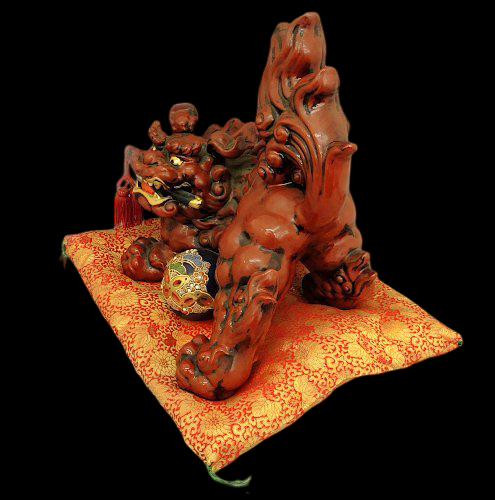
Shishi koma inu de cerámica Kutani, león guardián sujetando una joya sagrada, esmalte rojo hierro, sobre cojín de brocado, 37 cm
Shishi koma inu de cerámica Kutani, león guardián sujetando una joya sagrada, esmalte rojo hierro, sobre cojín de brocado, 37 cm
Freight piece: please confirm delivery before purchase
This piece travels in a crate or by freight rather than standard mail, and may need careful dismantling before it can be packed. The shipping shown at checkout is an estimate. Japonista reserves the right to determine the final handling, crating and freight cost when your order is received, according to the piece, the destination and carrier conditions at that time.
We advise requesting a delivery quote before checkout. If the final cost is higher than the amount paid, we send the difference for your approval before dispatch. Your piece is held for you until it is settled.
Request a delivery quoteNo se pudo cargar la disponibilidad de recogida
All sales are final. Please read our refund policy before purchase.
Have a reasonable price in mind? Submit your best offer and our concierge will review it personally.
Crouched and gripping the sacred jewel, its flame-like mane and animated face alive with vigilance, this Kutani shishi belongs to the lineage of komainu that guard thresholds, households and sacred spaces. At approximately 37 cm, presented on its own brocade cushion, it is a guardian with true physical and cultural weight.
The Piece
The lion is modeled in a dynamic crouching stance, gripping a sacred jewel (tama), with exaggerated musculature, an animated facial expression and a flame-like mane that radiate vitality, vigilance and spiritual authority. The surface is finished in a deep iron-red glaze whose subtle tonal variations emphasize the sculptural modeling, with traces of age, wear and patina throughout. The dynamic pose and detailed mane demand confident hand-modeling and controlled enamel application, indicating experienced workshop production.
The accompanying brocade cushion recalls traditional display practice, in which guardian figures were elevated and honored rather than merely placed; together, sculpture and textile bridge ritual heritage and sculptural presence.
Shishi occupy a central role in East Asian visual culture as protectors against misfortune. Their symbolism developed across Asia with the spread of Buddhism and court culture, and in Japan the shishi became a liminal protector of thresholds and transitional spaces. Such figures became especially prominent during the Edo and Meiji periods, when ceramic workshops such as those of Kutani translated temple and shrine iconography into domestic forms. Kutani is admired for fearless modeling and saturated color, and this example privileges expressive form over refinement, so that the sculpture feels alive rather than ornamental.
Shishi are traditionally associated with entrances, corridors and transitional areas, where threshold symbolism is strongest; placed near a doorway or at the edge of a room, the figure takes up its role as a protective presence. Its sculptural strength suits floor or low-table display, and it serves interior designers and folk-art collectors as a dramatic anchor object.
Details
- Maker: Kutani ware
- Origin: Japan
- Material: High-fired ceramic with enamels and gilt accents
- Color: Deep iron-red glaze
- Measurements: Height approx. 37 cm · Width approx. 38 cm · Depth approx. 29 cm
- Weight: Approx. 5.4 kg
- Included: Brocade display cushion (approx. 44 × 36 cm)
Condition
- Age-related surface wear, minor abrasions and patina consistent with time and handling.
- No major structural cracks observed; condition should be evaluated with consideration of age.
Kutani Among Shishi
Compared with other guardian lions, Kutani shishi offer near-bronze impact with the expressive surface richness of ceramic art; large-format ceramic examples are uncommon because firing, warping, glaze behavior and transport all become harder to control at scale.
- Kutani: dense enamels, strong reds and gold accents, an emphasis on power and spectacle.
- Arita and Imari porcelain: whiter bodies and finer surfaces, usually more refined and cabinet-scale.
- Seto and Tokoname: subdued palettes and folk-adjacent character, quieter in presence.
- Bronze: extremely durable, frequently positioned as architectural or formal display objects.
Authenticity & Care
Attribution to Kutani ware rests on decorative style, glaze characteristics and sculptural form, from the available documentation and close visual inspection; exact kiln documentation is not available and no exact dating is claimed. Every piece is examined and documented in Japan before dispatch and is offered with the Japonista authenticity guarantee.
Delivery from Japan
Packed by hand in Japan and shipped insured and tracked by EMS or an equivalent express service. Import duties and taxes, where applicable, are payable on arrival. Returns follow our published policy.
Considered offers are welcome through Send an Offer, and each one is reviewed personally. Pieces over $1,000 may be reserved over several payments with Layaway Privilege™.
Continue browsing: Buddhist Statues & Sacred Art · Okimono
Related pieces: Large Kutani red shishi koma-inu · Kutani ware Daruma Daishi figure · Kutani gilt sleeping maneki-neko
Temple to Home
Monumental statues, zushi shrines and altars travel crated and insured through our Museum-Grade Logistics Suite™. Seeking a particular deity or school? The Hunting Salon™ searches Japan for it. Arrange crating and freight →
Collectors also search: kutani shishi figure · kutani komainu · japanese guardian lion with jewel · red kutani lion statue · ceramic foo dog with cushion · kutani okimono lion 37 cm