Horikawa
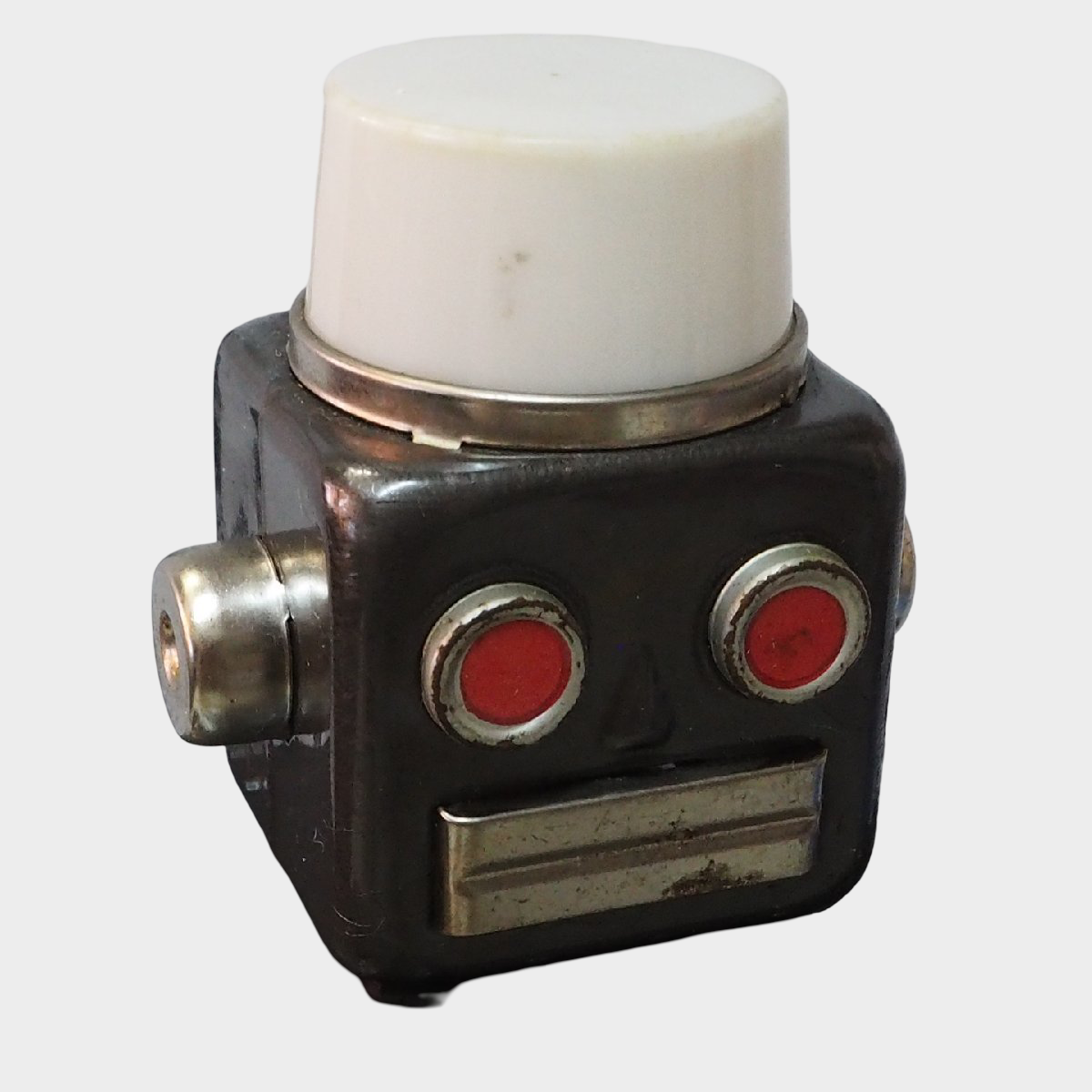
Robot Machine de hojalata Horikawa, figura andante a pilas con pecho transparente con engranajes, Japón, década de 1960
Robot Machine de hojalata Horikawa, figura andante a pilas con pecho transparente con engranajes, Japón, década de 1960
No se pudo cargar la disponibilidad de recogida
All sales are final. Please read our refund policy before purchase.
Have a reasonable price in mind? Submit your best offer and our concierge will review it personally.
Horikawa's Machine Robot sets its gear train behind a clear chest window, turning a battery walker into a moving diagram of postwar Japanese ingenuity. This mid-to-late 1960s example stands about 26–27 cm; it still walks, if unsteadily, and carries honest, unrestored wear.
The Piece
The Machine Robot exemplifies one of the most collectible design philosophies of the Showa robot era: the exposed mechanism as spectacle, mechanical transparency as toy theatre. Rather than concealing its motion, the model places its gear train front and center behind a clear chest window. The result is less a character robot than a mechanical exhibit, a moving diagram aimed squarely at children who wanted to see how machines worked.
The squared torso, cylindrical arms and oversized red feet give the robot a grounded, industrial stance. Its battery-powered, gear-driven walking mechanism is unstable, which reflects the reality of early battery robotics: motion was experimental, imperfect and thrilling precisely because of its unpredictability. This is not a toy failure but an authentic mechanical survivor that retains its most important element, visible internal life.
In a collection it belongs with the 1960s Horikawa engineering robots, bridging play object and educational machine and emphasizing motion mechanics over character branding at the peak of tin robot engineering, before plastic simplification. It sits between the boxed Horikawa Radar Robots and the later 1970s display giants, more mechanically interesting than static figures and a purer design object than character-driven television tie-in robots. It anchors a collection by showing the inside, not just the silhouette.
It is for the collector who values mechanics over mythology. It needs no character name or television show; its appeal lies in motion, exposure and honesty, from a time when toys were allowed to be strange, imperfect and educational all at once. On a shelf it does what few robots can and explains itself, serving as the mechanical heart of a Horikawa-focused collection or a broader Showa robot lineup, a reminder that these were once marvels of engineering, not just nostalgia.
Details
- Maker: Horikawa Toys (Japan)
- Model: “Machine Robot” (period trade name; generic branding)
- Era: Mid–late 1960s, peak of the Showa-era tin robot
- Origin: Japan
- Material: Tinplate body; transparent chest window with exposed gear mechanism; plastic head cap; metal limbs
- Color: Oversized red feet
- Measurements: Height approx. 26–27 cm (based on the scale ruler shown)
- Included: Robot only; no box or accessories
- Mechanism: Battery-powered, gear-driven walking; operation irregular (functional but unreliable)
Condition
- Display-grade with mechanical interest; the walking action is present but unstable and unreliable.
- Surface wear, scratches and age patina consistent with use; the robot has not been cosmetically restored or overly cleaned.
- Transparent chest intact, with the internal gears visible.
- No box or accessories.
Why Collect Horikawa
Horikawa occupies a quieter and rarer lane than the makers remembered for rockets firing, legs marching and gears turning. Its robots are about concept rather than power: box-shaped torsos, screen-like chest panels, minimal limb articulation and simplified, almost architectural forms. They read less as characters than as machines built to observe, process or communicate, resembling proto-television objects, early cybernetic thought experiments and physical metaphors for information systems, and they sit closer to industrial design artifacts than to conventional toys.
The maker's most iconic contribution is the screen-chest robot, a torso shaped like a television or monitor. In the 1950s and 1960s television was new and transformative, and robots stood for both modernity and anxiety; joining the two produced a cultural object rather than a plaything, a robot that watches or transmits instead of fighting. Collectors now describe these machines as eerily modern, proto-digital and strangely artistic, and read them as early media theory in tin, precursors of cyberpunk aesthetics and artifacts of postwar futurism. Once overlooked in Japan as simple or odd beside flashier makers, Horikawa is today sought by museum and design-focused collectors internationally, occupying the quiet middle chapter between early humanoid optimism such as Astro Boy, the later action-driven super robots and modern screen-centric culture, when robots stopped being fairy tales and began to become interfaces.
Condition is read differently for Horikawa. Surface wear often adds authenticity, oxidation reinforces industrial character, non-working status is commonly accepted, and original paint and structure matter more than motion. Collectors value untouched Showa presence over restoration, which is why display-grade, original-surface, as-found examples continue to draw strong international interest. The maker suits collectors who favor design over play, collect with an art-historical eye, value originality and surface integrity, and understand robots as cultural symbols rather than simply toys.
Showa Makers Compared
Where Masudaya excites the eye and Yonezawa satisfies the hand, Horikawa engages the mind: Masudaya for the thrill-seeker, Yonezawa for the completist, Horikawa for the thinker.
- Horikawa: conceptual, experimental robot maker; abstract, modular, idea-first designs; signature screen-chest TV robots and box torsos; industrial minimalism and bold geometry; the thinking machine or media robot; simple walking, blinking and screen effects; domestic sale with limited export in the 1960s; often worn, oxidized and display-grade today; high conceptual rarity; low restoration tolerance, as value favors originality.
- Masudaya: spectacle and motion-driven innovator; dramatic silhouettes and space fantasy; domes, rockets and astronauts; colorful futurism and cinematic flair; the space explorer or hero vehicle; complex actions, sparks and motion; strong US export during the space craze; mixed survival with many play-worn examples; high nostalgia and visual impact; medium restoration tolerance.
- Yonezawa: engineering-led mass exporter; functional mechanical realism; gear panels, vents and military cues; utilitarian, export-friendly science fiction; the robot soldier or machine assistant; reliable walking, spinning and actions; heavy US and EU export focus; higher survival with more intact units; high availability and recognizability; medium to high restoration tolerance.
Authenticity & Care
Every piece is examined and documented in Japan before dispatch and is offered with the Japonista authenticity guarantee.
Delivery from Japan
Packed by hand in Japan and shipped insured and tracked by EMS or an equivalent express service. Import duties and taxes, where applicable, are payable on arrival. Returns follow our published policy.
Considered offers are welcome through Send an Offer, and each one is reviewed personally.
Continue browsing: Vintage Toys
Related pieces: Horikawa Rotate-O-Matic Super Giant tin robot · Horikawa Star Strider AIJI-01 tin robot · Horikawa Monster Robot with original box
Toy Box Requests
Hunting a particular robot, kaiju, figure or model? The Hunting Salon™ searches Japan’s collector shops and private collections, and the Deputy Vault™ secures a piece you have already found. Begin a Hunting Salon™ request →
Collectors also search: horikawa machine robot · 1960s horikawa tin robot · tin walking robot gear chest · battery operated tin robot 1960s · transparent chest robot toy · japanese tin robot visible gears · showa tin robot