
The Six Ancient Kilns: A Map of Japanese Clay
Pottery Almanac · Regions
The Six Ancient Kilns: A Map of Japanese Clay
In everyday Japanese a ceramic dish can be called a thing of Seto. That is the measure of what one kiln town achieved, and it is only the first of six. Together they carried Japan's clay through the long centuries before porcelain, and they are still firing.
Fact sheet
At a glance
- A scholar's frame. The list is a twentieth-century classification, made in emulation of the Five Great Kilns of Song China, not a medieval ranking.
- Styles, not single sites. Each name stands for a regional style produced at many kiln sites, and each continues to the present day.
- Jars first. Their medieval work was heavy daily stoneware, the storage jar above all, for a largely agrarian country.
- A common ancestor. Sue ware, the grey stoneware brought from Korea, is the ancestor of a number of regional ceramics, Bizen among them.
- One went to glaze. Seto alone among the six is celebrated for glazes, and its name became the Japanese word for ceramics in general.
A Category With an Author
No medieval potter ever called himself a master of the Six Ancient Kilns. The phrase, Rokkoyo in Japanese, was devised in the post-war period by Koyama Fujio (1900 to 1975), a scholar of ceramics, who shaped it deliberately in emulation of the Five Great Kilns of Song China.
Original map. Towns are placed to the nearest tenth of a degree; base geometry from Natural Earth (public domain).
Look closer: Seto (1) and Tokoname (2) lie close together in Aichi Prefecture, yet one is known for its glazes and the other for its redware and bonsai pots. Kiln regions are a matter of clay and custom, not of distance.
Diagram by Japonista
The borrowing hides a difference that matters to anyone who collects. A Chinese great kiln is a single famous site that no longer fires. A Japanese ancient kiln, in Koyama's usage, is a regional style of pottery produced at numerous actual kiln sites, and it continues to be produced to the present day. The Okayama Prefectural Bizen Ceramic Museum mounted an exhibition on the six kilns in 2001, which shows how firmly the idea had settled by the start of this century.
The six are Seto and Tokoname in Aichi Prefecture, Echizen in Fukui, Shigaraki in Shiga, Tamba in Hyogo and Bizen in Okayama. On the map above they form a belt across central Honshu, with Bizen at its western end, so that the stoneware heartland of the country can be read at a glance.
Beneath All Six Lies a Grey Stoneware
The story starts earlier than the six. Sue pottery, sueki, was a blue-grey stoneware fired at high temperature in Japan and southern Korea during the Kofun, Nara and Heian periods. Wikipedia reports that it is believed to have originated in the fifth or sixth century in the Gaya region of southern Korea and to have been brought to Japan by immigrant craftsmen. Its direct precursor, according to the Metropolitan Museum and the same article, is the grayware of the Three Kingdoms period in Korea.

Long-Necked Jar (Chōkeiko), 7th century, Stoneware with natural ash glaze (Sue ware). The Metropolitan Museum of Art, The Harry G. C. Packard Collection of Asian Art, Gift of Harry G. C. Packard, and Purchase, Fletcher, Rogers, Harris Brisbane Dick, and Louis V. Bell Funds, Joseph Pulitzer Bequest, and The Annenberg Fund Inc. Gift, 1975, accession 1975.268.419.
Look closer: the green and brown streaks running down the grey shoulder are not paint. They are what the museum calls natural ash glaze: wood ash that fell on the jar in the kiln and melted, the accident that later potters learned to use.
Image: The Metropolitan Museum of Art, Open Access (CC0)
The technology matters. Sue was built from coils of clay, beaten and smoothed or carved into shape, and fired in an oxygen-reduced atmosphere above 1,000 degrees Celsius in a tunnel kiln on a hillside, the anagama, which reached Kyushu from the Korean peninsula together with the potter's wheel. The ware was generally unglazed, but the ash drifting through the kiln sometimes settled and melted on the shoulder of a jar in accidental drips. That accident, in time, became a style.
Sue began as funerary and ritual ware and, by the Heian period, had become a utilitarian pottery. The article states that it became the ancestor of a number of regional ceramics, and names Bizen ware. The tradition did not die. It changed names and moved to better clay.
Jars for an Agrarian Country
Until the seventeenth century, Wikipedia's survey of Japanese pottery records, unglazed stoneware was the popular choice for the heavy-duty daily requirements of a largely agrarian society: funerary jars, storage jars and a variety of kitchen pots. Some kilns improved their technology, and these are the ones now called the Six Ancient Kilns.
JAANUS, the Japanese Architecture and Art Net Users System, adds a useful reminder of proportion. Bizen was one of more than thirty kiln complexes in Japan that fired utilitarian stoneware, the jars called tsubo, the wide-mouthed jars called kame and the grinding bowls called suribachi. Six is a selection by a later scholar from a crowded field, and the selection favoured age, continuity and character.
The tea room later rescued such wares from the farm. In the Azuchi-Momoyama period, the same survey says, unglazed stoneware, yakishime, was modified for use in tea rooms because of its simple taste. A storage jar for seed or oil became a freshwater jar, and a jar that had held grain became a tea-leaf jar. The chapter on Tea Ceremony Almanac returns to this change of fortune.
| Ware | Where | Known for | Chapter |
|---|---|---|---|
| Seto | Seto, Aichi | Glazes; the word setomono for ceramics | Seto and Mino: Japan's Great Kiln Belt |
| Tokoname | Tokoname, Aichi | Red teapots, bonsai pots, sutra jars | Tokoname |
| Echizen | Echizen, Odacho and Miyazaki, Fukui | Medieval storage jars | this page |
| Shigaraki | Koka, Shiga, east of Lake Biwa | Tea jars; the tanuki figure | Shigaraki |
| Tamba (Tanba) | Sasayama and Tachikui, Hyogo | Daily wares; coil-and-throw jars | Tamba |
| Bizen | Imbe, Okayama | Unglazed, fire-marked stoneware | Bizen Ware: The Unglazed Kiln |
The Glaze and the Red Teapot
Seto is the exception. Wikipedia credits Kato Shirozaemon, also called Toshiro, with bringing high-fired glazed ceramics to the town after studying pottery in China in the 1220s, a founding story the survey calls a legend. Whatever the truth of the man, the Kamakura-period wares of Seto imitated the pottery of Song China, and the town developed ash brown, iron black, feldspar white and copper green glazes. The clay is a high-quality kaolin and porcelain stone that fires white and helps to carry colour.

Jar in Meiping Shape with Incised Floral Design, 14th century, Stoneware with brown iron glaze (Ko-Seto ware). The Metropolitan Museum of Art, Dr. and Mrs. Roger G. Gerry Collection, Bequest of Dr. and Mrs. Roger G. Gerry, 2000, accession 2002.447.13.
Look closer: the shape, a narrow neck over broad shoulders, is the meiping form, the Chinese model the museum names in the title. The floral scrolls were incised into the clay before glazing.
Image: The Metropolitan Museum of Art, Open Access (CC0)
The success was so complete that Seto-mono, a product of Seto, became the generic Japanese word for ceramics. When, in the late sixteenth century, Seto potters fled civil war and moved to Mino in present Gifu, they carried the habit of glaze with them and produced Yellow Seto, Shino, Black Seto and Oribe. These are the wares of the Momoyama tea world, treated in Seto and Mino: Japan's Great Kiln Belt.
Tokoname, its neighbour, took another road. Its pottery dates from the twelfth century, and by the Heian period was already part of daily life. In the late nineteenth century Koie Hokyu completed a chambered climbing kiln, and his son Koie Hoju laid the foundation for the earthenware pipes and the redware for which the town became known. Its red teapots, wind chimes and shochu servers are still made, and so, Wikipedia adds, are antique-style bonsai pots, a bridge to the Dictionary of Bonsai and Suiseki.
Bizen: No Glaze at All
At Imbe in Okayama the potters went the opposite way and glazed nothing. Wikipedia describes Bizen as characterised by great hardness from high-temperature firing, an earthy reddish-brown colour, no applied glaze, and markings left by the wood fire. The clay is sticky and fine, high in iron, and so shrinks and resists rapid temperature change that the firing must be slow, one or two firings a year lasting ten to fourteen days.
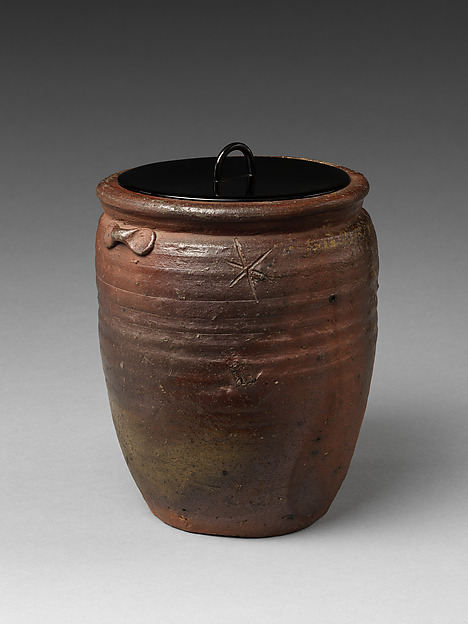
Freshwater Jar (Mizusashi) in the Shape of a Seed Jar (Tane-tsubo), late 16th century, Stoneware with natural ash glaze (Bizen ware, Ko-Bizen type); black-lacquered wooden lid. The Metropolitan Museum of Art, Mary Livingston Griggs and Mary Griggs Burke Foundation Fund, 2023, accession 2023.326a–c.
Look closer: there is no painted decoration. The rippled wheel rings, a small impressed mark beside the handle of the lid, and the shift from deep red to brown are all the potter has added; the rest is the fire.
Image: The Metropolitan Museum of Art, Open Access (CC0)
JAANUS places Bizen's growth in the tea century. From the middle of the sixteenth century the potters made tea-related vessels, freshwater jars, flower vases and sake flasks, and the ware was among the first Japanese ceramics thought suitable for the tea ceremony. The pictured freshwater jar, in the Ko-Bizen type of the late sixteenth century, has the shape of a seed jar and a black-lacquered lid, which is exactly that conversion at work.
Bizen has its own chapter, Bizen Ware: The Unglazed Kiln, and a long-standing collectors' guide on this site, Bizen Ware: Reading Fire on Unglazed Stoneware.
Echizen, Shigaraki and Tamba
Three of the six are less documented in English, and an honest map says so. Echizen, in Fukui Prefecture, is given only the barest entry in Wikipedia, which records that it is produced in Echizen, Odacho and Miyazaki and is one of the six. The Metropolitan Museum holds a twelfth-century Echizen storage jar and a sixteenth-century wide-mouthed jar with an incised kiln mark, both in stoneware with natural ash glaze, and they show a medieval jar tradition of the same kind as its neighbours.
Shigaraki, east of Lake Biwa in Koka, Shiga Prefecture, is described in the survey as one of the oldest styles in Japan. The tanuki figures for which it is now famous are a modern phenomenon: Wikipedia states that tanuki statues have flourished in Shigaraki only since the 1930s. Its older work in storage jars and tea jars is treated in Shigaraki.
Tamba, also spelled Tanba and known as Tamba-Tachikui, is produced in Sasayama and Tachikui in Hyogo Prefecture. The survey notes that the kilns continued to make the daily wares of the Tokugawa period while adding modern shapes, and that large bowls and jars at Tamba are made by the coil-and-throw method, a Korean technique brought to Japan after Hideyoshi's invasion of Korea. See Tamba.
What the Six Leave Out
A frame that selects also omits. Koyama's six are stoneware kilns chosen for age. They do not include the porcelain of Arita, which began only in the early Edo period with techniques brought from Korea, nor the tea bowls that later tea masters preferred: Raku, Hagi and Karatsu, the three named in the old proverb that ranks Raku first, Hagi second and Karatsu third. They omit, too, the Kyoto overglaze wares and the coloured Kutani and Satsuma that dominated export in the nineteenth century.
That is why this almanac has a hub rather than a list. Read the six first, as the stoneware floor of Japanese ceramics. Then climb to Arita and Imari, Karatsu, Hagi and Raku, and cross the water to Okinawa for Tsuboya, which stands outside the mainland map altogether.
A last caution for collectors. The six names describe style and region, and many later potters, studio and factory, work in the manner of an ancient kiln far from its town. The guide on Made in Japan, Collected in Japan explains how to read the difference.
Jars from Six Regions
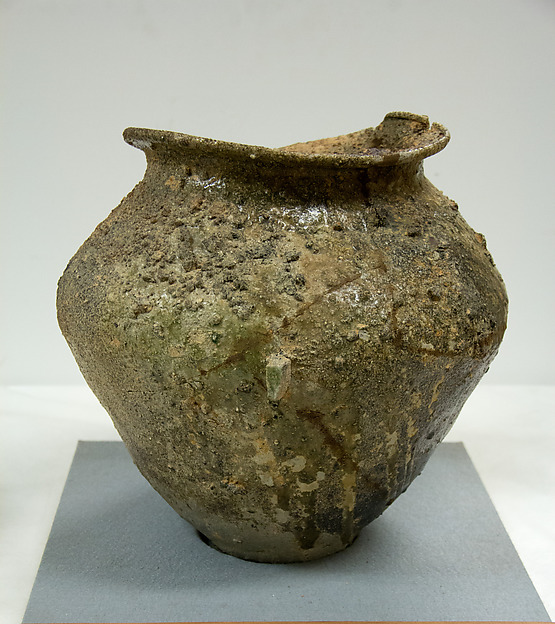
Storage Jar (Tsubo, 12th century, Stoneware with natural ash glaze (Echizen ware). The Metropolitan Museum of Art, Gift of Mary Griggs Burke, 1977, accession 1977.261.
Look closer: the rim leans and the surface is pitted where ash fused to the clay. The wide-shouldered storage jar is a form shared by all six kilns.
Image: The Metropolitan Museum of Art, Open Access (CC0)
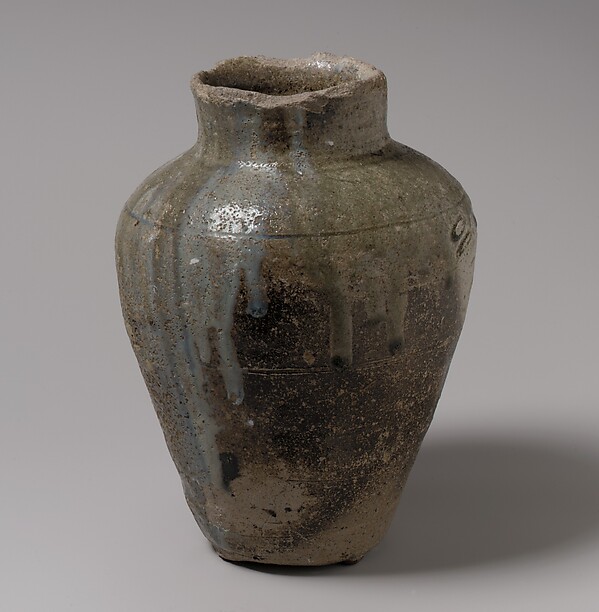
Jar for Sutra Burial (Sankinko), early 12th century, Stoneware with natural ash glaze (Tokoname ware). The Metropolitan Museum of Art, Dr. and Mrs. Roger G. Gerry Collection, Bequest of Dr. and Mrs. Roger G. Gerry, 2000, accession 2002.447.12.
Look closer: the museum describes this jar as made for sutra burial, and the grey-blue ash glaze has run in long drips from the shoulder.
Image: The Metropolitan Museum of Art, Open Access (CC0)
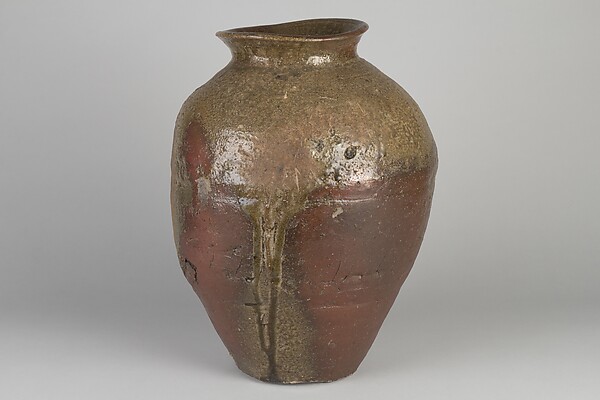
Large Storage Jar (Ōtsubo), second half 14th century, Stoneware with natural ash glaze (Tanba ware). The Metropolitan Museum of Art, The Harry G. C. Packard Collection of Asian Art, Gift of Harry G. C. Packard, and Purchase, Fletcher, Rogers, Harris Brisbane Dick, and Louis V. Bell Funds, Joseph Pulitzer Bequest, and The Annenberg Fund Inc. Gift, 1975, accession 1975.268.427.
Look closer: below the glossy green-brown glaze the body is a rusty red, so the ash fell on the shoulder and ran down like a cloak.
Image: The Metropolitan Museum of Art, Open Access (CC0)
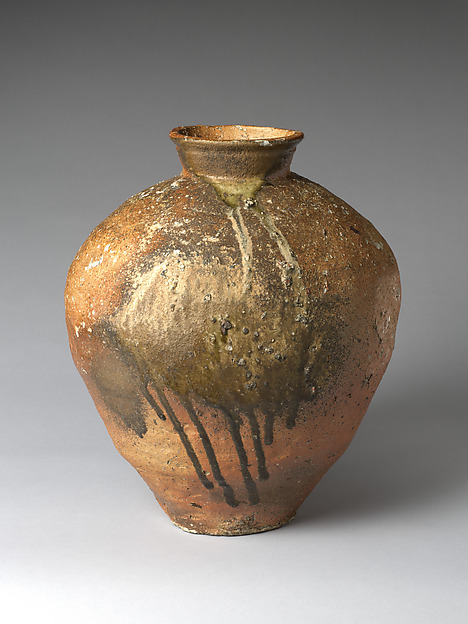
Large Storage Jar (Ōtsubo), late 15th century, Stoneware with natural ash glaze (Shigaraki ware). The Metropolitan Museum of Art, The Harry G. C. Packard Collection of Asian Art, Gift of Harry G. C. Packard, and Purchase, Fletcher, Rogers, Harris Brisbane Dick, and Louis V. Bell Funds, Joseph Pulitzer Bequest, and The Annenberg Fund Inc. Gift, 1975, accession 1975.268.428.
Look closer: orange clay shows under pale ash, and black glossy runs fall from the shoulder. Compare the deeper red-brown of the Bizen jar above.
Image: The Metropolitan Museum of Art, Open Access (CC0)
Japanese Porcelain and Ceramics
The house keeps a shelf of Japanese porcelain and ceramics. It is a shelf of the whole subject and does not promise a piece from each of the six kilns. The concierge desk can say whether a particular ware is available.
Answered plainly
What are the Six Ancient Kilns of Japan?
Seto and Tokoname in Aichi, Echizen in Fukui, Shigaraki in Shiga, Tamba in Hyogo and Bizen in Okayama. Each stands for a regional style of pottery, produced at many kiln sites, that continues today.
Who invented the category?
Koyama Fujio (1900 to 1975), in the post-war period, in emulation of the Five Great Kilns of Song China.
Are the Six Ancient Kilns the finest Japanese ceramics?
Not necessarily. They were chosen for age and continuity. The most prized tea bowls, the porcelain of Arita and the export wares of Kutani and Satsuma all lie outside the six.
Why is Seto special?
It is the one of the six celebrated for its glazes, and its name, in the form setomono, became a general Japanese word for ceramics.
Where next
Sources and image credits
- Six Ancient Kilns, Wikipedia
- Japanese pottery and porcelain, Wikipedia
- Sue pottery, Wikipedia
- Seto ware, Wikipedia
- Tokoname ware, Wikipedia
- Bizen ware, Wikipedia
- Echizen ware, Wikipedia
- Tamba ware, Wikipedia
- Bizen'yaki, JAANUS (Japanese Architecture and Art Net Users System)
- Base map geometry: Natural Earth (public domain)
- Object record, Long-Necked Jar (Chōkeiko), The Metropolitan Museum of Art
- Object record, Jar in Meiping Shape with Incised Floral Design, The Metropolitan Museum of Art
- Object record, Freshwater Jar (Mizusashi) in the Shape of a Seed Jar (Tane-tsubo), The Metropolitan Museum of Art
- Object record, Storage Jar (Tsubo, The Metropolitan Museum of Art
- Object record, Jar for Sutra Burial (Sankinko), The Metropolitan Museum of Art
- Object record, Large Storage Jar (Ōtsubo), The Metropolitan Museum of Art
- Object record, Large Storage Jar (Ōtsubo), The Metropolitan Museum of Art
Last reviewed 28 October 2026. Pictures, where shown, are public-domain or open-access and credited beneath each one.
Looking for a particular kiln, maker or form? The concierge desk replies within one to three business days.
Browse Japanese porcelain and ceramics · Make a private request
Private concierge
Looking for something in particular?
Describe the piece or the project you have in mind. A senior advisor in Tokyo reads every case file personally and replies within two business days, with fees set out in writing before any work begins.