
Tamba: Pine Ash, Climbing Kiln
Pottery Almanac · Hyōgo
Tamba: Pine Ash, Climbing Kiln
Tamba, also spelled Tanba, is the quietest of the Six Ancient Kilns. Its jars were made for the farm and the kitchen, left plain or dressed in the ash of pine firewood, and it was the arrival of the tea room that gave a few of its vessels a second life.
Fact sheet
At a glance
- Old and plain. The kiln is thought to date from the end of the Heian period, making large pots, jugs and mortars, built from coils and left unglazed.
- Ash that decorates. Pine ash melts onto the pot in the kiln, and the marks, called hai-kaburi, make each piece different.
- A wheel that turns the other way. Two sources say the lathes used for this ware turn counter-clockwise.
- Ko-Tamba. Tamba ware made through the Momoyama period is called ko-tanba, old Tanba, and artificial glazes were introduced then for tea vessels.
- Naming. The ware has been called Onohara ware, Tamba ware and Tachikui ware, according to a craft-promotion page.
Tachikui in the Hills of Hyōgo
Tamba ware, also spelled Tanba and known as Tamba-Tachikui ware, is a pottery made in Sasayama and Tachikui in Hyōgo Prefecture. Wikipedia's article on it is brief, saying only that it is considered one of the Six Ancient Kilns of Japan. JAANUS fills in the outline: the ware is a general name for a type of sueki made in the old province of Tanba, now the districts of Taki and Hikami in Hyōgo, and the main kiln is Tachikui, in Konda town.
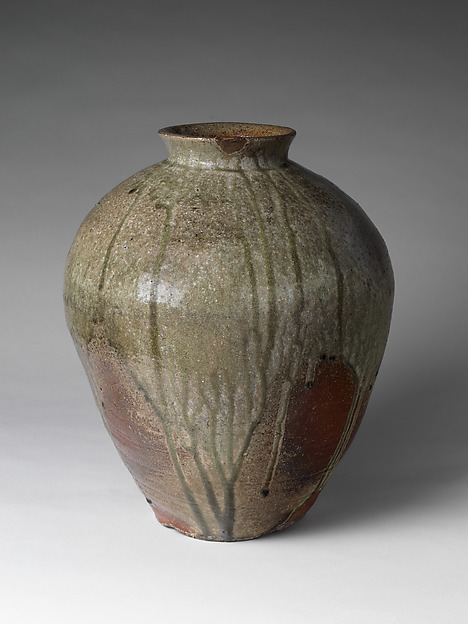
Large Jar (Ōtsubo), 14th–15th century, Stoneware with natural ash glaze (Tanba ware). The Metropolitan Museum of Art, Dr. and Mrs. Roger G. Gerry Collection, Bequest of Dr. and Mrs. Roger G. Gerry, 2000, accession 2002.447.16.
Look closer: the neck is short, the shoulder broad, and olive-grey ash glaze runs down the brown body in long drips. The museum catalogues it as stoneware with natural ash glaze, Tanba ware, of the 14th to 15th century, 45.7 cm high.
Image: The Metropolitan Museum of Art, Open Access (CC0)
The beginnings are placed differently by different sources. The craft-promotion site Kogei Japan says the kiln is thought to have opened at the end of the Heian period, that it was known as Onohara ware until the Azuchi-Momoyama period, and that the early products were large pots, jugs, mortars and kneading bowls, built from coiled clay without a lathe, left unglazed, and fired in ascending kilns dug into hillsides. The craft page at kougeihin.jp agrees on the end of the Heian period and adds that the early kilns were of the anagama type, the hole kiln. JAANUS, by contrast, says folkwares were produced from the Kamakura period to the present.
The vessels JAANUS lists as common forms are the tsubo and kame, both jars, the suribachi, an earthenware mortar, and the tokkuri, a sake bottle. They were usually unglazed or finished with a natural glaze, and the decoration came from the reddish-black colour of the iron-rich Tanba clay. The Met's jar of the fourteenth to fifteenth century pictured here is 45.7 centimetres high.
Pine Ash and a Counter-Clockwise Wheel
The craft page at kougeihin.jp says pots fired in an ascending kiln, a nobori-gama, develop their colouring and surface from pine-log ash blown around the kiln. The ware uses ash glazes and iron glazes, and ash from the pine firewood melts onto the glaze, causing deformations and variations of colour called hai-kaburi, ash marks. Each piece's pattern differs, which gives it individual character.

Jar, ca. 1800, Stoneware with brown drip glaze (Tanba ware, Tachikui type). The Metropolitan Museum of Art, The Harry G. C. Packard Collection of Asian Art, Gift of Harry G. C. Packard, and Purchase, Fletcher, Rogers, Harris Brisbane Dick, and Louis V. Bell Funds, Joseph Pulitzer Bequest, and The Annenberg Fund Inc. Gift, 1975, accession 1975.268.624.
Look closer: a pale glazed body is striped from the shoulder by broad brown drips, and the rim is dark. The museum catalogues it as stoneware with brown drip glaze, Tanba ware of the Tachikui type, of about 1800, 23.2 cm high; the photograph is black and white.
Image: The Metropolitan Museum of Art, Open Access (CC0)
Kogei Japan describes the firing in numbers: about sixty hours in a climbing kiln at roughly 1300 degrees Celsius, with pine ash sprinkled onto the vessels so that it melts with the glaze and the iron in the clay. It also lists the glazes: artificial ash glazes made from wood ash, straw ash, rice-husk ash, chestnut-burr ash and bamboo-leaf ash, as well as iron and white glazes. These figures come from a promotional page and are given here as its account.
Both pages note one more detail, which is the direction of the wheel. The lathes used for this ware turn counter-clockwise, they say, where many other traditions turn clockwise. Shapes are mostly made on the wheel, with slab work, hand-moulding and stamping also used, and the kougeihin.jp page calls the working method piecemeal, each article made individually from start to finish.
The Met's iron-glazed jar of about 1800, catalogued as Tanba ware of the Tachikui type, shows the contrast with the plain medieval jars: broad brown drips stripe a pale body. It is 23.2 centimetres high.
Ko-Tamba and the Tea Room
JAANUS records that Tanba ware made through the Momoyama period is called ko-tanba, old Tanba, and that artificial glazes were introduced in the Momoyama period for tea vessels, among them the mizusashi, water jar, the hanaire, flower vase, and the chaire, tea caddy. The kougeihin.jp page adds that in the Edo period many notable pieces for the tea ceremony were made under the guidance of the tea master Kobori Enshū, and Kogei Japan says that by the middle of the Edo period output had grown to include tea containers, pitchers, tea cups and small sake bottles.
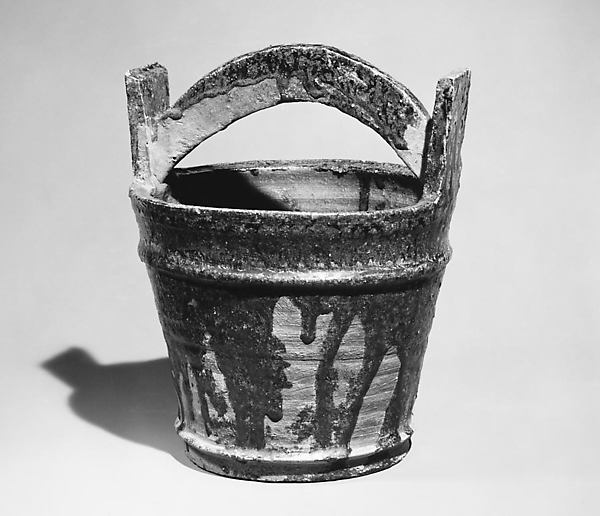
Water Pot for Tea Ceremony (Mizusashi), Stoneware with drip iron glaze (Tanba ware). The Metropolitan Museum of Art, The Harry G. C. Packard Collection of Asian Art, Gift of Harry G. C. Packard, and Purchase, Fletcher, Rogers, Harris Brisbane Dick, and Louis V. Bell Funds, Joseph Pulitzer Bequest, and The Annenberg Fund Inc. Gift, 1975, accession 1975.268.430.
Look closer: the pot is bucket-shaped with a high looped handle, and dark glaze drips down the ribbed wall. The museum catalogues it as stoneware with drip iron glaze, Tanba ware, 23.5 cm high; the photograph is black and white.
Image: The Metropolitan Museum of Art, Open Access (CC0)
The Met's collection shows the range. A bucket-shaped water pot for the tea ceremony, catalogued as Tanba ware with drip iron glaze, has a looped handle; its photograph is black and white, and the museum gives no date. A tea jar of the seventeenth century is catalogued as Tanba ware with a Satsuma-style glaze, and is only 8.3 centimetres high.
The ware also made bottles for the table. The Met's early seventeenth-century bottle in iron glaze and its early eighteenth-century sake bottle, a tokkuri, are both 23.2 centimetres high, and a wine bottle catalogued as dated 1835 is credited to Masamoto Naosaku. For the Meiji period, Kogei Japan says production moved to the neighbouring Tachikui area, when the ware came to be called Tachikui ware, and its market reached Kyushu and Tohoku.
A Village of Fifty Workshops
Visit Hyōgo, the prefecture's official tourism site, places Tachikui in Imata-cho, in Tamba Sasayama City, and calls it the heart of Tamba pottery. It says Tamba ware is one of the Six Ancient Kilns, which it dates to between about 900 and the late 1200s and which were designated Japan Heritage in 2017, and it describes the pottery tradition as preserved for 850 years. The Tamba pottery information centre, kamanjyo, says more than fifty potters' workshops stand together in the village, which it calls rare in Japan.
The same sources describe the firing. The information centre says the traditional climbing kilns are built along a mountain slope, use only red pine as fuel, and are fired continuously for about three days and nights, producing the haikaburi and natural ash glaze to which it credits the ware's look. Visit Hyōgo describes the natural glaze as forming when wood ash lands on pieces in the kiln and melts at high temperature, giving chance patterns instead of applied glaze. It names the Tanzan Kiln's climbing kiln, 47 metres long, as the oldest existing kiln for Tamba pottery.
A dealer's page on Tanba ware, which does not name its publisher, adds a later chapter: in the late Edo period a deep-red glazed ware, akadobe-yu, and a white-clay ware, Shiro Tanba, emerged, and the Japan Arts and Crafts movement of the early twentieth century brought the kiln nationwide recognition. These statements rest on that page alone and are given as its account.
Reading a Tamba Jar
Start with the surface. Natural ash glaze on a dark red-brown body, running in streaks from the shoulder, is the sign of the medieval jars, while the iron-glazed bottles and the striped jar belong to the later, tea-and-table side of the kiln. JAANUS points to the natural reddish-black colour of the clay as the ware's decoration, and the pictures show it.
Then check the shape against the record. The Met's second-half fourteenth-century jar in the gallery is 42.9 centimetres high, and a jar of about 1500 is 35.6 centimetres. The house keeps a plain guide to caring for ceramics, linked below.
Jars, Bottles and Water Pots
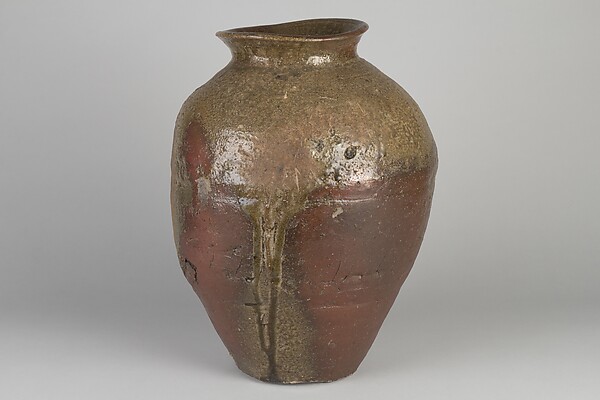
Large Storage Jar (Ōtsubo), second half 14th century, Stoneware with natural ash glaze (Tanba ware). The Metropolitan Museum of Art, The Harry G. C. Packard Collection of Asian Art, Gift of Harry G. C. Packard, and Purchase, Fletcher, Rogers, Harris Brisbane Dick, and Louis V. Bell Funds, Joseph Pulitzer Bequest, and The Annenberg Fund Inc. Gift, 1975, accession 1975.268.427.
Look closer: the rim tilts slightly, the shoulder is covered in olive-brown ash glaze, and drips run down a red-brown body. The museum catalogues it as stoneware with natural ash glaze, Tanba ware, of the second half of the 14th century, 42.9 cm high.
Image: The Metropolitan Museum of Art, Open Access (CC0)
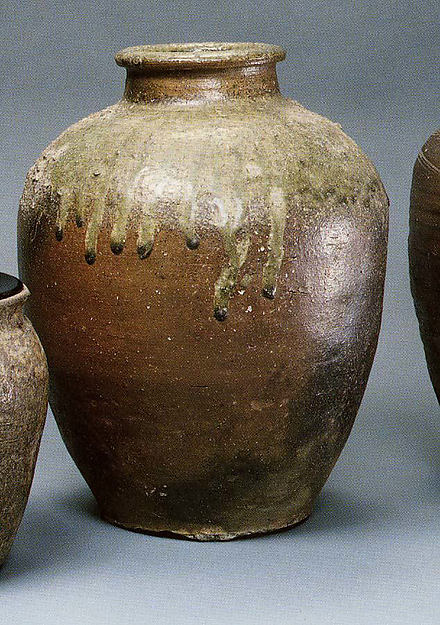
Storage jar, ca. 1500, Stoneware with natural ash glaze (Tanba ware). The Metropolitan Museum of Art, Dr. and Mrs. Roger G. Gerry Collection, Bequest of Dr. and Mrs. Roger G. Gerry, 2000, accession 2002.447.18.
Look closer: a pale ash glaze with a dripping lower edge covers the shoulder, and the lower body is dark red-brown. The museum catalogues it as stoneware with natural ash glaze, Tanba ware, of about 1500, 35.6 cm high.
Image: The Metropolitan Museum of Art, Open Access (CC0)

Bottle, early 17th century, Stoneware with iron glaze (Tanba ware). The Metropolitan Museum of Art, The Harry G. C. Packard Collection of Asian Art, Gift of Harry G. C. Packard, and Purchase, Fletcher, Rogers, Harris Brisbane Dick, and Louis V. Bell Funds, Joseph Pulitzer Bequest, and The Annenberg Fund Inc. Gift, 1975, accession 1975.268.432.
Look closer: the neck is long, the body swells to a pear shape, and the iron glaze is glossy and near black. The museum catalogues it as stoneware with iron glaze, Tanba ware, of the early 17th century, 23.2 cm high; the photograph is black and white.
Image: The Metropolitan Museum of Art, Open Access (CC0)
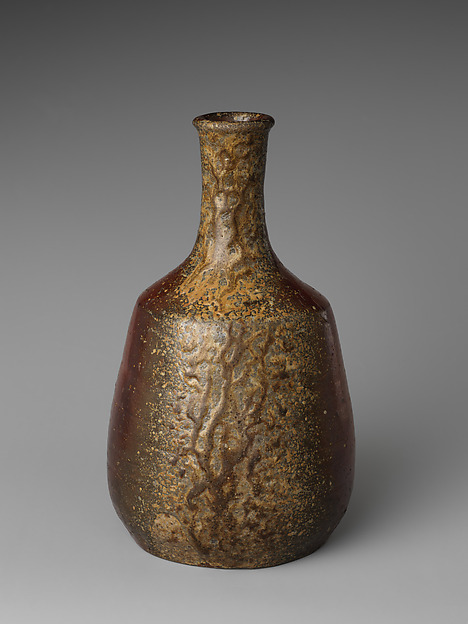
Sake Bottle (Tokkuri), early 18th century, Stoneware with iron slip glaze and green drip glaze (Tanba ware). The Metropolitan Museum of Art, The Harry G. C. Packard Collection of Asian Art, Gift of Harry G. C. Packard, and Purchase, Fletcher, Rogers, Harris Brisbane Dick, and Louis V. Bell Funds, Joseph Pulitzer Bequest, and The Annenberg Fund Inc. Gift, 1975, accession 1975.268.431.
Look closer: the neck is narrow, the body tapers, and the glaze is rippled amber-brown. The museum catalogues it as stoneware with iron slip glaze and green drip glaze, Tanba ware, of the early 18th century, 23.2 cm high.
Image: The Metropolitan Museum of Art, Open Access (CC0)

Tea Jar, 17th century, Clay covered with glaze (Tanba ware, Satsuma style glaze). The Metropolitan Museum of Art, Gift of Mr. and Mrs. Samuel Colman, 1893, accession 93.1.65.
Look closer: the body is low and rounded under a pale lid, and the glaze is dark and mottled. The museum catalogues it as clay covered with glaze, Tanba ware with a Satsuma-style glaze, of the 17th century, 8.3 cm high; the photograph is black and white.
Image: The Metropolitan Museum of Art, Open Access (CC0)

Masamoto Naosaku, Wine Bottle, dated 1835, Clay covered with glaze (Tanba ware). The Metropolitan Museum of Art, Gift of Mr. and Mrs. Samuel Colman, 1893, accession 93.1.4.
Look closer: the neck is long and the body is waisted, under a dark, glossy glaze. The museum catalogues it as clay covered with glaze, Tanba ware, dated 1835, 19.5 cm high, and credits it to Masamoto Naosaku.
Image: The Metropolitan Museum of Art, Open Access (CC0)
Tamba at the Desk
At the time of writing no piece catalogued as Tamba ware is with the house. The concierge desk can say when one arrives. The guide to caring for ceramics and the directory of Japanese pottery centres and kilns are good companions to this chapter.
Answered plainly
What is Tamba ware?
A pottery from Tachikui in Hyōgo Prefecture, one of the Six Ancient Kilns, known for jars with natural pine-ash glaze.
Is it Tamba or Tanba?
Both spellings are used. Wikipedia and Kogei Japan write Tamba, while JAANUS and the Met write Tanba.
What is hai-kaburi?
Ash marks. Ash from pine firewood melts onto the pot in the kiln and causes deformations and variations of colour.
What is Ko-Tamba?
Old Tanba: JAANUS says Tanba ware made through the Momoyama period is called ko-tanba.
Where next
Sources and image credits
- Visit Hyōgo, The Warmth of Tamba Pottery Village
- Tamba pottery information centre, kamanjyo
- Tanba ware, an unnamed dealer page (consulted for the late Edo wares only)
- Tamba ware, Wikipedia
- Tanbayaki, JAANUS
- Tamba Tachikui Yaki (Pottery), kougeihin.jp craft page
- Tamba Tachikui Ware, Kogei Japan (a craft-promotion site)
- Six Ancient Kilns, Wikipedia
- Object record, Large Jar (Ōtsubo), The Metropolitan Museum of Art
- Object record, Jar, The Metropolitan Museum of Art
- Object record, Water Pot for Tea Ceremony (Mizusashi), The Metropolitan Museum of Art
- Object record, Large Storage Jar (Ōtsubo), The Metropolitan Museum of Art
- Object record, Storage jar, The Metropolitan Museum of Art
- Object record, Bottle, The Metropolitan Museum of Art
- Object record, Sake Bottle (Tokkuri), The Metropolitan Museum of Art
- Object record, Tea Jar, The Metropolitan Museum of Art
- Object record, Wine Bottle, The Metropolitan Museum of Art
Last reviewed 28 October 2026. Pictures, where shown, are public-domain or open-access and credited beneath each one.
Looking for a Tamba jar or a view on one you own? The concierge desk replies within one to three business days.
Browse Japanese porcelain and ceramics · Make a private request
Private concierge
Looking for something in particular?
Describe the piece or the project you have in mind. A senior advisor in Tokyo reads every case file personally and replies within two business days, with fees set out in writing before any work begins.