
Mizusashi, Hishaku and Kensui: The Tea Room's Water
Chanoyu Almanac · Jars, Ladles, Basins
Mizusashi, Hishaku and Kensui: The Tea Room's Water
Tea is powder and water, and the water has its own small company of vessels. A lidded jar of cold water comes first into the room and leaves last. A bamboo ladle moves the water from jar to kettle and from kettle to bowl. A rinse bowl takes what is poured away, and a lid rest holds the cover and the ladle between times. This chapter follows each of them, from the well bucket that Rikyū is first recorded to have used to the household jars that became treasures, and from Iga and Bizen to celadon and cobalt.
Fact sheet
At a glance
- First in, last out. Two museums say the water jar is the first utensil to enter the tea room and the last to leave, and call it its anchor.
- Chosen from the household. A pail, a seed jar and a well bucket were taken from daily life and made into tea ware, which the Met and the Tokyo University of the Arts both say.
- Sorted by kiln. Shigaraki, Bizen, Iga, Seto and Kyoto wares stand beside Hizen celadon and blue-and-white in the Met's collection.
- Ladle by season. Tealao sorts the ladle into ro, furo, kennyō and sashi-toshi types, for the cold season, the warm, all year and formal gatherings.
- Out of sight. The rinse bowl is necessary but is kept out of the guests' sight as much as possible, says Wikipedia.
First In, Last Out
The vessel that holds the plain water of the tea room has been called its anchor. The Cincinnati Art Museum, in an exhibition page on mizusashi, calls the jar the visual anchor of the tearoom, and says that it is the first utensil to enter the room and the last to leave. The Fairfield University Art Museum, in its page on a show of twentieth and twenty-first century mizusashi from the Carol and Jeffrey Horvitz Collection, says the same, and adds that it serves as a locational and aesthetic anchor for the gathering. Both say that the jar holds the water used to refill the kettle and to rinse the bowls.
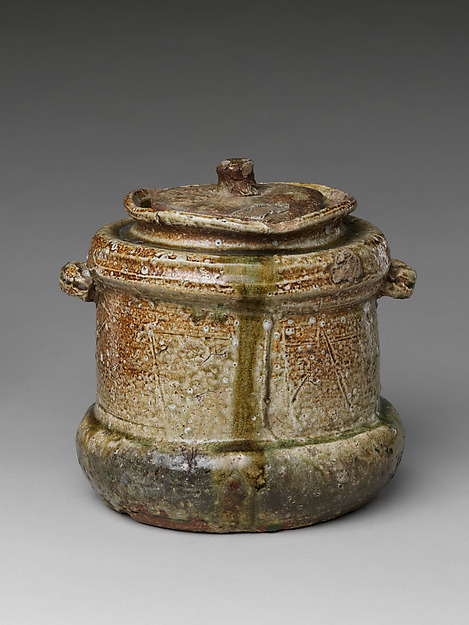
Freshwater Jar (Mizusashi), Named “Hotei”, ca. 1600, Stoneware with natural ash glaze (Iga ware). The Metropolitan Museum of Art, Gift of Peggy and Richard M. Danziger, 2024, accession 2024.553.1a–c.
Look closer: a squat, drum-shaped jar with a stepped base, a band of incised marks round the body, small ear handles at the shoulders and a green streak of ash glaze running down the front. The lid has a small knob at its centre. The museum catalogues it as a Freshwater Jar (Mizusashi), named Hotei, ca. 1600, stoneware with natural ash glaze (Iga ware), 19.1 cm high and 17.5 cm in diameter, a gift of Peggy and Richard M. Danziger, 2024.
Image: The Metropolitan Museum of Art, Open Access (CC0)
The Metropolitan Museum of Art says the same of its Iga jar named Hotei. The catalogue entry calls it the first object brought into the tearoom at the start of a gathering, which holds the water that refills the kettle and stays prominently placed for the whole ceremony. It adds that the jar contributes to the toriawase, the tea master's selection and combination of utensils, which makes each gathering unique. The Brooklyn Museum's entry for an Iga jar of its own says that the jar is a lidded pot holding clean water for tea preparation and cup rinsing, and that it is the first vessel brought into the tea ceremony space.
The jar is not alone. Around it stand a small group of other vessels and implements that handle the water: a pitcher that refills it, a ladle that moves the water, a bowl that takes the rinse, and a rest for the kettle's lid and the ladle. The Wikipedia article on Japanese tea utensils sorts the whole body of utensils into five categories, among them the items for the tea-making service and the items used in the preparation room, and the vessels of this chapter are found in both.
This chapter takes them in turn. It gives the words, follows the path of the water through a gathering in a diagram, and tells how the jar came from imported metal and the well bucket. It turns to the household jars that became treasures, sorts the kilns in a table, and takes the Iga jar as a case with two conflicting labels. It looks at celadon and painted jars, at lids, and at the pitcher. It describes the ladle in a second diagram, the rinse bowl and Rikyū's seven lid rests, then follows the jar into the room and into the present day. The sources are Wikipedia, JAANUS, the Tokyo University of the Arts, Tealao, Isso-an Tea, a ceramics dealer, the Gotheborg glossary and four museums. Retailers and dealers are named wherever they are used and treated as attributed.
Mizusashi, Kensui, Hishaku and Futaoki
The first task is to separate the vessels by their names, and the sources are clear about most of them. Wikipedia says that a mizusashi is a lidded container for fresh cold water used by the host in the tea room, and that the water is mainly used to replenish the water in the kama, the kettle, at the end of certain ceremonies. JAANUS gives the alternative name mizutsubo, glosses the word as a water jar, and says the water is used to fill either the tea bowl or the kettle. The two agree that the jar is for cold water; the hot water stays in the kettle.
A mizutsugi is, in Wikipedia's words, a lidded water pitcher that replenishes the jar at the end of certain ceremonies. A hishaku is a long bamboo ladle with a nodule in the approximate centre of the handle. The article says it pours hot water into the tea bowl from the iron pot and moves cold water from the fresh water container to the iron pot when required. A kensui is the rinse-water receptacle used by the host. JAANUS gives the alternative name koboshi and adds that hot or cold water is poured into it after a tea bowl is rinsed. A futaoki is, again in Wikipedia's account, a rest for the lid of the kettle and for the ladle.
These words belong to the language of the preparation room as much as to that of the tea room. The article names the mizuya dōgu, the items used in the preparation room, as one of its five categories of utensils, along with the decorative items, the items for the tea-making service, the items for the meal and the items for the waiting room and the garden. It lists a chakindarai, a small copper bowl for rinsing the wiping cloths that sits on the bamboo sink-cover in the mizuya, and a larger cypress ladle for the same room. The vessels of this chapter are those that cross from one room to the other.
| Term | Kanji | What the sources say |
|---|---|---|
| Mizusashi | 水指 | A lidded container for fresh cold water, used mainly to replenish the kettle (Wikipedia). JAANUS adds that it also holds water to fill the tea bowl, and gives the alternative name mizutsubo (水壷). |
| Mizutsugi | 水次 | A lidded water pitcher that refills the mizusashi at the end of certain ceremonies (Wikipedia). |
| Hishaku | 柄杓 | A long bamboo ladle with a node near the middle of the handle, used to move hot water from the kettle to the bowl and cold water from the jar to the kettle (Wikipedia). |
| Kensui | 建水 | The rinse-water receptacle used by the host; JAANUS gives the alternative name koboshi (零し). |
| Futaoki | 蓋置 | A rest for the kettle lid and for the ladle, of bamboo, ceramic or metal (Wikipedia). |
| Tomobuta | 共蓋 | A matching lid, of the same ceramic or lacquered wood as the body (Wikipedia; JAANUS). |
| Mizuya | 水屋 | The preparation room, one of five categories of utensils being named for it (Wikipedia). |
How Cold and Hot Water Travel
The path of the water through a gathering is short and has a fixed order. According to JAANUS, the jar is set on a shelf, the daisu, when a large portable shelf or a single portable shelf is used. If the ceremony opens with the carrying in of utensils, the jar comes in first. Because it is relatively large, the entry continues, it is often placed beforehand on the host's mat, on the daisu or on the long board called the naga-ita, so that the other preparations are finished before the guests come in. The guests then admire the alcove, the kettle and the brazier, and finally the water jar and the other utensils, before they sit down.
Diagram by Japonista. Schematic; the roles follow Wikipedia, JAANUS and the Tokyo University of the Arts.
Look closer: four boxes stand in a row, labelled mizusashi, kama and chawan from left to right, with a ladle shown as an arrow from the jar to the kettle and from the kettle to the bowl. Below the bowl, a fourth box, the kensui, takes the rinse water, and a fifth, the futaoki, rests beside the kettle.
Diagram by Japonista
Wikipedia gives the procedural side of this in its section on the types of tea-making. In the hakobi temae, it says, all the essential items other than the kettle, including the fresh water container, are carried into the tea room by the host. In other procedures the water jar is placed in the room before the guests enter. In the obon temae, the simplest, the tea is made with the bowl, whisk, scoop, cloth and caddy on a tray and the water hot in a tetsubin on a brazier, and the article says it can be done at a table or outdoors, with a thermos pot taking the place of the tetsubin.
The roles of the jar and the pot differ. The Tokyo University of the Arts, in the English text of an archive page on the water vessel in wabi-cha, describes the mizusashi as a tea utensil used for controlling the temperature of the hot water boiled in the kettle. That is a different emphasis from that of the museums, which say the jar refills the kettle and rinses the bowl, and the chapter gives both. The Wikipedia article adds a point of its own, that a tetsubin does not require the use of a hishaku.
Imported Metal and the Well Bucket
The history of the jar begins, in the Tokyo University of the Arts archive, with metal. The English text states that initially imported metalware was used for the mizusashi in Japan, and that over time Japanese makers developed their own versions. A ceramics dealer, Turuta, says the same of the early period, that early examples were mostly copper or nanban-dō, a copper alloy, and lists many metal forms. The dealer adds that in the early period many mizusashi imitated folk objects, such as buckets, and the claim is the dealer's own, though it agrees in kind with the archive.
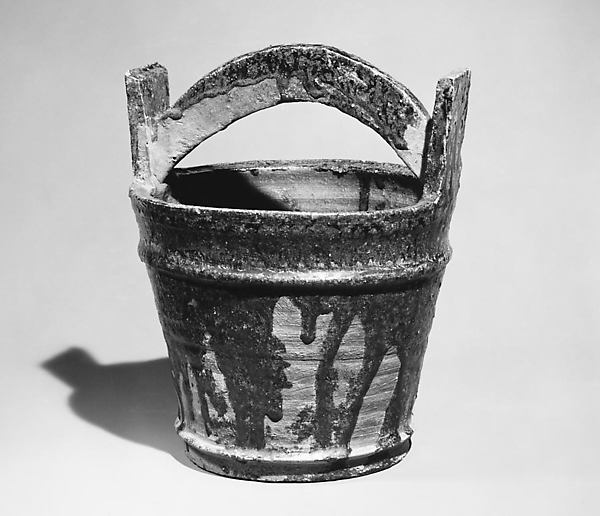
Water Pot for Tea Ceremony (Mizusashi), Stoneware with drip iron glaze (Tanba ware). The Metropolitan Museum of Art, The Harry G. C. Packard Collection of Asian Art, Gift of Harry G. C. Packard, and Purchase, Fletcher, Rogers, Harris Brisbane Dick, and Louis V. Bell Funds, Joseph Pulitzer Bequest, and The Annenberg Fund Inc. Gift, 1975, accession 1975.268.430.
Look closer: a black-and-white photograph of a squat, bucket-shaped pot with two upright posts at the rim carrying an arched handle, a ridged band round its middle and dark glaze running down the lower body in streaks. The museum catalogues it as a Water Pot for Tea Ceremony (Mizusashi), stoneware with drip iron glaze (Tanba ware), 23.5 cm high, from the Harry G. C. Packard Collection of Asian Art, a gift of Harry G. C. Packard, 1975.
Image: The Metropolitan Museum of Art, Open Access (CC0)
The archive then names the first recorded user of a humble form. It says that Sen Rikyū is the first tea man recorded to have used a wooden well bucket as the mizusashi in a tea ceremony. It names two forms taken from daily life. The te-oke is an everyday handled pail, which became, the page says, a striking example when lacquered. The ita-tsurube is a board well bucket modelled on the tool used to draw water from wells, left unlacquered, and the archive calls it a tea utensil that symbolises Sen school tea. The Metropolitan Museum's entry for a zelkova water container of 2022 says the same story in other words, that Rikyū adapted the round wooden bucket into the square wooden mizusashi, which remains popular today. The sources give no date for any of these moves.
The shape of the bucket also appears in clay. The Met's Tanba water pot, a Momoyama piece in stoneware with a drip iron glaze, is described in the catalogue as made in the shape of a wooden bucket. The entry says the splashed glaze adds to its rustic look and shows the potter's control of ash falling in a wood-fired kiln, and that the user drew water out with a long-handled wooden ladle, which required skill. The same entry links the pot to the refined taste and ceramic techniques that tea practice developed.
The wooden vessels also leave a trace in the sources' vocabulary. JAANUS names magemono, wood bent into a circle with a bottom attached, among the materials of the mizusashi, with ceramic, lacquer and bamboo. The Wikipedia article on tea utensils says that mizusashi are generally ceramic but that wooden, glass and metal ones are also used. The sources do not say how often each material has been used, and the chapter does not guess.
Household Jars Raised to Treasures
The Met has two jars that were household vessels before they were tea wares. The first is a pail-shaped freshwater jar of the Shigaraki tradition, of about the sixteenth century and the Muromachi period, called an onioke, which the catalogue glosses as a devil's bucket. The text says it was probably used in the Ōmi area to process hemp or ramie stalks into thread before it became a tea utensil, and that the tea master Takeno Jōō adopted this Shigaraki container as a freshwater jar for the tea room. He favoured simple, rough wares, the entry says, as the foundations of wabi-cha took shape in the 1500s. Unglazed Shigaraki clay fires to golden-orange or ruddy brown, it adds, flecked with white feldspar, and wood ash melting onto the pot can leave irregular greenish-blue patches.

Pail‑shaped freshwater jar (Onioke mizusashi), ca. 16th century, Stoneware with natural ash glaze (Shigaraki ware). The Metropolitan Museum of Art, Mary Griggs Burke Collection, Gift of the Mary and Jackson Burke Foundation, 2015, accession 2015.300.273a, b.
Look closer: a wide, slightly flared cylinder in rough reddish-brown clay, its thick rim rolled outward and its surface speckled and flecked where ash has fallen. It stands without a lid. The museum catalogues it as a Pail-shaped freshwater jar (Onioke mizusashi), ca. 16th century, stoneware with natural ash glaze (Shigaraki ware), 23.5 cm high, from the Mary Griggs Burke Collection, a gift of the Mary and Jackson Burke Foundation, 2015.
Image: The Metropolitan Museum of Art, Open Access (CC0)
The second is a Bizen freshwater jar in the shape of a seed jar, a tane-tsubo, of the late sixteenth century. The catalogue says the seed jar was a vessel used to store seeds for planting. The jar is elongated, with a wide, round mouth, a thick flat rim and two small ears on the shoulder. Its thick body was built from clay coils, smoothed on the wheel, and some seams remain visible. The entry says its reddish-brown, purplish-brown and natural ash-glaze areas came from its position in the kiln, and that a star-shaped maker's mark is incised on the shoulder and underside, a feature it says is unique to Bizen ware and helped potters identify their work after communal firings. The lid is black-lacquered wood.
The entry for the Bizen jar places it in a period when tea spread to wealthy urban merchants, when Bizen vessels replaced prized imported Chinese ceramics, and when Bizen tea utensils began to be commissioned separately from everyday wares. It says that though designed as a freshwater jar for tea gatherings, its form is inspired by a simple household vessel. The two jars thus show, in the Met's account, the same movement from daily use to the tea room that the archive's well bucket does.
Seto, Shigaraki, Bizen and Iga
The wares of the mizusashi are sorted by kiln, and the sources agree on the first names. The Wikipedia article says mizusashi are classified by shape, place of make and other characteristics. JAANUS lists the esteemed wares as Seto, Shigaraki, Bizen and Satsuma, with the wares of Ninsei and Kenzan. The dealer Turuta gives a longer history. It says that during the Tenshō era, under Rikyū, Seto water jars became popular, and that in the time of Furuta Oribe orders went to Seto, Mino, Iga, Bizen, Karatsu and other regions for wares to his taste. Later, the dealer says, kilns in other provinces, including Chikuzen, Buzen, Higo, Satsuma and Omuro, also produced them, and Raku ware favoured by Sōtan appeared. The dealer's account is its own and is given as attributed.
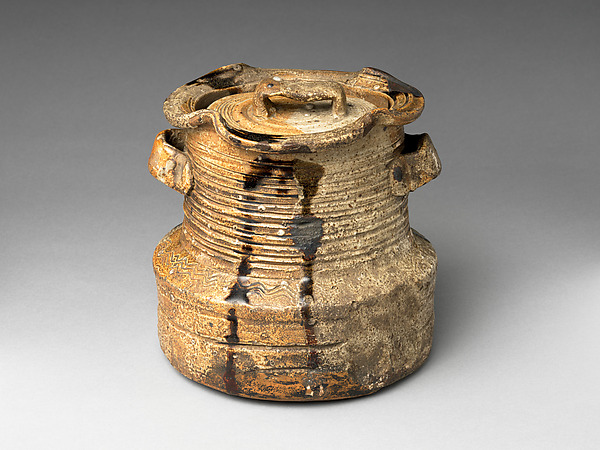
Freshwater Jar (Mizusashi), early 17th century, Stoneware with natural ash, feldspar, and iron glazes (Mino ware, Iga type). The Metropolitan Museum of Art, Rogers Fund, 1918, accession 17.118.83a, b.
Look closer: a squat jar with horizontal ridges round its body, small ears at the shoulders, amber-yellow ash glaze and dark drips running down the front, topped by a small lid with a loop handle. The museum catalogues it as a Freshwater Jar (Mizusashi), early 17th century, stoneware with natural ash, feldspar and iron glazes (Mino ware, Iga type), 19.5 cm high and 19.1 cm in diameter, from the Rogers Fund, 1918.
Image: The Metropolitan Museum of Art, Open Access (CC0)
The dealer sorts the older jars by origin as well. It lists Chinese wares, celadon wares and nanban wares as categories, and names Hodoke, Tenjiku, Saigokin and Moorukin among the first, Unkaku, Kinuta, Tenryūji and Shichikan among the celadons, and Nawanoren among the nanban. It says that the mizusashi is closely tied to tea and treated as a shelf utensil, and it cites an 1816 text, the Chado Sen-tei, as cataloguing water jars by origin and type.
The Met's own jars add the kilns by example. A Mino jar of the Iga type, of the early seventeenth century, is catalogued with natural ash, feldspar and iron glazes. The museum notes that excavations of urban residential sites from the period show a growing market for everyday ceramics, that potters' movement between kilns was generally controlled, and that imitation of other regional styles still happened. Potters at the Motoyashiki kiln in Mino, it says, reproduced the look of Iga ware, which this jar shows through irregular forms and rustic surfaces that reveal the potter's hand. A Bizen water pot of about 1625 has a lacquer cover, and a Shino and Oribe jar with autumn grasses is of the Momoyama period, in earthenware with a Shino and Oribe glaze.
| Kiln or tradition | What the sources say | Examples in the museums |
|---|---|---|
| Shigaraki | JAANUS lists it among the esteemed wares. Met catalogue: Takeno Jōō adopted a Shigaraki pail, the onioke, as a freshwater jar. | Met 670994, ca. 16th century |
| Bizen | On JAANUS's list. The Met says that in the period of its seed-jar mizusashi, Bizen tea utensils began to be commissioned separately from everyday wares. | Met 894321, late 16th century; Met 63103, ca. 1625; Met 47954, a waste-water basin of ca. 1775 |
| Iga | Brooklyn Museum: light-green natural ash glaze, small scorch marks and prominent ear handles are typical of Iga tea wares. | Met 828493, ca. 1600; Brooklyn Museum 80.42.2a-b |
| Mino, Iga type | The Met says potters at the Motoyashiki kiln in Mino reproduced the look of Iga ware. | Met 56164, early 17th century |
| Seto | JAANUS lists it; a dealer says Seto jars became popular in the Tenshō era under Rikyū (attributed). | No Met jar is used in this chapter |
| Tanba | Met catalogue: a bucket-shaped pot with drip iron glaze, made in the Momoyama period. | Met 56168 |
| Shino and Oribe | A dealer says Furuta Oribe ordered wares from Seto, Mino, Iga, Bizen, Karatsu and other regions (attributed). | Met 748293, Shino/Oribe glaze |
| Satsuma | On JAANUS's list of esteemed wares. | No Met jar is used in this chapter |
| Hizen, Arita type | Met catalogue: celadon production began in Hizen in the early 17th century with help from Chinese and Korean potters. | Met 39575, mid-17th century; Met 50186, ca. 1650s |
| Kyoto: Ninsei and Kenzan | JAANUS names Ninsei and Kenzan wares as esteemed. | Met 752044, Nonomura Ninsei; Met 52514, Ogata Kenzan, ca. 1720 |
Hotei, Broken Bag and Two Labels
The Iga jars show best how a rough jar became a prized one. The Brooklyn Museum's jar, of the late sixteenth or early seventeenth century, measures 10.5 by 16.5 centimetres, in stoneware with ash glaze and a lid that the page says is likely lacquered wood. The museum's description says its light-green natural ash glaze, small scorch marks and prominent ear handles are typical of Iga tea wares. It was a gift of Mr. and Mrs. Harry Kahn.
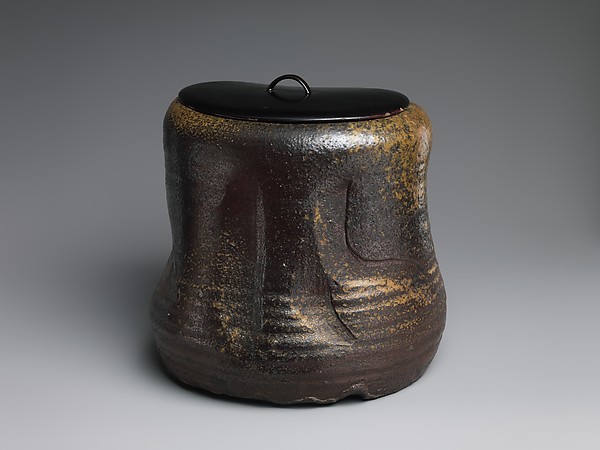
Water pot, ca. 1625, Bizen pottery; lacquer cover. The Metropolitan Museum of Art, Fletcher Fund, 1925, accession 25.215.47a, b.
Look closer: a dark, heavy jar with softly flattened sides, a ridged band near the foot and a glossy black lacquer lid with a small ring handle on top. The museum catalogues it as a Water pot, ca. 1625, Bizen pottery with a lacquer cover, 17.1 cm high and 17.1 cm in diameter, from the Fletcher Fund, 1925.
Image: The Metropolitan Museum of Art, Open Access (CC0)
The Met's Hotei is of about 1600, the Momoyama period, and the museum says it embodies the perfect imperfection aesthetic that tea masters prized in the 1500s. The maker's finger marks and hand impressions remain visible from throwing on the wheel, the entry says, and he cut incisions into the surface. The long wood-fired firing warped the form and left scorch marks and cracks that interact with the green ash glaze. The catalogue does not name the potter. The name Hotei appears in the title, and the chapter offers no reading of it.
The dealer Turuta has a page on a different Iga jar, the form called Yaburebukuro, the broken bag. The page says the jar is a Ko-Iga water jar so called because its lower part is swollen like a bag and because it has streaks of burnt sand that look like lightning. The clay, it says, contains feldspar grains unique to Iga, and ash falling in the kiln gives it a shiny brown colour and a glaze. The page does not give a maker or a date, and the chapter does not add them.
The Brooklyn entry also carries a puzzle that shows how records go wrong. The inscription on the storage box lid calls the jar an early Shigaraki waste water jar, while a paper label on the box calls it an Iga Mukogire mizusashi. The museum notes that the two identifications conflict. It attributes the jar to Iga, and it records the old label beside it.
Celadon, Cobalt and Kenzan's Pines
The jars are not all rustic. The Met's Hizen celadon mizusashi of the mid-seventeenth century, of the Arita type, is porcelain with a celadon glaze and a lacquer cover, 16.2 centimetres high and 18.1 in diameter. The museum calls it an early example of Japanese celadon, and gives the background: celadon originated in China and reached Japan around the tenth century, Japanese elites valued these imports, and the Ashikaga shoguns collected them as karamono, Chinese things. Celadon production began in Hizen Province in the early seventeenth century, with help from Chinese and Korean potters, and Hizen later became the birthplace of the renowned porcelains of Arita, Imari and Nabeshima.
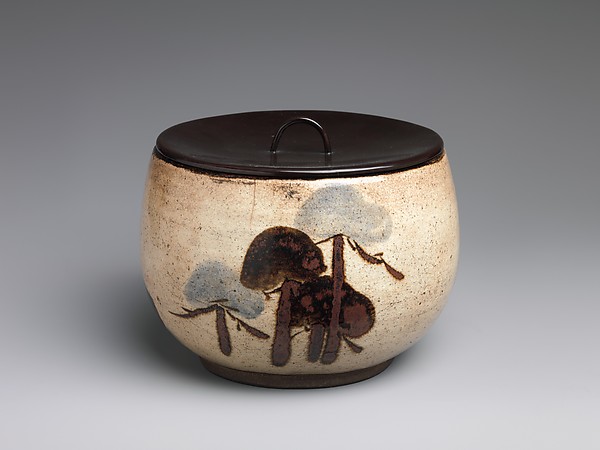
Water Jar (Mizusashi) with Pine Trees, ca. 1720, Stoneware with underglaze iron oxide; lacquer cover. The Metropolitan Museum of Art, H. O. Havemeyer Collection, Bequest of Mrs. H. O. Havemeyer, 1929, accession 29.100.614a, b.
Look closer: a low, wide, rounded jar in a cream glaze with a bold painting of pine trees in brown and grey-blue on its front, and a glossy black lacquer lid with a small ring handle. The museum catalogues it as a Water Jar (Mizusashi) with Pine Trees by Ogata Kenzan, ca. 1720, stoneware with underglaze iron oxide and a lacquer cover, 12.7 cm high and 16 cm in diameter, from the H. O. Havemeyer Collection, Bequest of Mrs. H. O. Havemeyer, 1929.
Image: The Metropolitan Museum of Art, Open Access (CC0)
The Met's Arita jars of the seventeenth and eighteenth centuries are painted in cobalt blue under a clear glaze. One of the 1650s, painted with pines, is 23.2 centimetres high. The museum catalogues several more, with pines, bamboo, the Seven Sages of the Bamboo Grove and other motifs, and a late eighteenth-century tall jar with a striped design. The chapter does not draw on their entries beyond the titles, which are plain records.
Ogata Kenzan's jar, catalogued as a Water Jar with Pine Trees of about 1720, is in stoneware with underglaze iron oxide and has a lacquer cover. It stands 12.7 centimetres high and 16 in diameter. The museum names Kenzan as the maker. JAANUS lists the wares of Kenzan with those of Ninsei among the esteemed wares of the mizusashi, and the Met's Nanban jar with large handles is catalogued under the name of Nonomura Ninsei, of the second half of the seventeenth century, in stoneware with natural ash glaze of Kyoto ware.
That jar's entry explains the word nanban. The museum describes nanban mizusashi as unglazed stoneware vessels that reached Japan in the sixteenth century from Southeast Asia, southern China, the Ryukyu Islands and elsewhere, by trade routes associated with the southern barbarians, the Japanese term for Europeans. These imported wares were later repurposed as freshwater jars for tea, the page says, and Ninsei's later version blends this foreign style with Kyoto's refined sensibility. The museum thus describes a trade ware taken into tea, as it describes a pail and a seed jar.
Matching Clay or Black Lacquer
The lid is part of the jar's identity. The Wikipedia article says that if the mizusashi is ceramic and has a matching lid of the same ceramic, the lid is called a tomobuta, a matching lid, and that often a ceramic mizusashi will have a custom-made lid of lacquered wood, especially if it is a container originally lacking a matching lid. JAANUS says most have a tomobuta of the same ceramic or lacquered wood as the body. The Met's records say the same in their media lines: of its jars here, the Hizen celadon, the Kenzan, the Bizen water pot and the basket-shaped jar all list a lacquer cover, and the Ko-Bizen seed jar lists a black-lacquered wooden lid.
The photographs show what the sources say. The black lacquer covers sit flat on the jars with a small ring handle at the centre, and the clay of the body is rough or painted beneath them. Wikipedia's account is that a lacquered lid is made especially for a container that originally lacked a matching one. The article does not say how often that is, and the Met's records do not say whether any lid was original or later. The chapter keeps to what they say, that the lids are listed as lacquer, and does not call them replacements.
The Brooklyn Museum says of its Iga jar only that the lid is likely lacquered wood, and the Met's Hotei is catalogued with its lid as part of the jar. Neither entry says more, and the chapter adds nothing.
| Jar | Lid as catalogued | Source |
|---|---|---|
| Hizen celadon jar, mid-17th century | Lacquer cover | Met 39575 |
| Kenzan jar with pine trees, ca. 1720 | Lacquer cover | Met 52514 |
| Bizen water pot, ca. 1625 | Lacquer cover | Met 63103 |
| Mino jar, Iga type, early 17th century | Medium line lists glazes only; a lidded jar in the photograph | Met 56164 |
| Ko-Bizen seed-jar mizusashi, late 16th century | Black-lacquered wooden lid | Met 894321 |
| Water jar in the shape of a bamboo basket, 18th to early 19th century | Lacquer cover | Met 47132 |
| Iga jar, late 16th to early 17th century | Likely lacquered wood | Brooklyn Museum 80.42.2a-b |
The Mizutsugi Pitcher
The pitcher that refills the jar is a quiet vessel. Wikipedia says a mizutsugi is a lidded water pitcher used to replenish the mizusashi at the end of certain ceremonies. The article does not say which ceremonies, and the chapter does not say either. The dealer Turuta lists a related form, which it spells te-mizutsuji, with a handle and a spout, and says it can stand in for a mizusashi only when the large mouth, one side of the mouth and the kettle are simplified. The dealer's wording is obscure, and the chapter reports it as given.
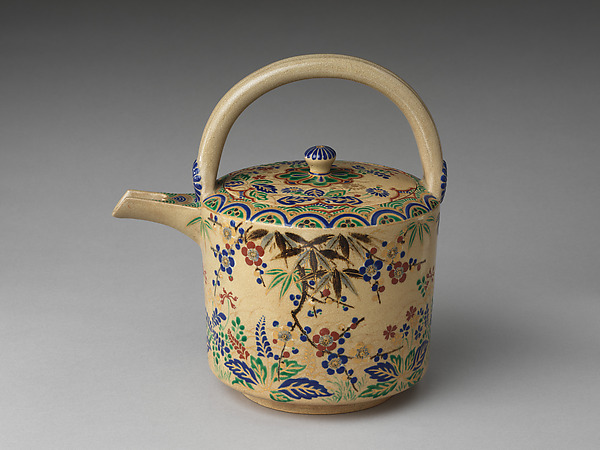
Water pitcher (Mizutsugi), Earthenware with polychrome glaze. The Metropolitan Museum of Art, Gift of Florence and Herbert Irving, 2019, accession 2019.193.62a, b.
Look closer: a cylindrical pitcher with a long spout at the left, an arched handle rising over the top and a domed lid with a small knob, its cream surface covered with bamboo leaves and small flowers in blue, green and brown enamel. The museum catalogues it as a Water pitcher (Mizutsugi), Edo period, earthenware with polychrome glaze, 16.2 by 20.4 by 23.2 cm, a gift of Florence and Herbert Irving, 2019.
Image: The Metropolitan Museum of Art, Open Access (CC0)
The Met's mizutsugi is an Edo-period earthenware pitcher with a polychrome glaze, 16.2 centimetres high, 20.4 wide and 23.2 deep, a gift of Florence and Herbert Irving in 2019. The museum's page gives the form's catalogue data and no narrative, so the chapter does not describe its history. The photograph shows a cylindrical body with a long spout, an arched handle over the top and a domed lid, decorated all over in coloured enamel with bamboo and flowers. It is the clearest picture the chapter has of the vessel that stands behind the jar.
Hishaku for Hearth and Brazier
The ladle is the plainest of the water vessels and the one with the most rules. JAANUS defines it as a long-handled dipper that ladles hot water from the kettle or cold water from the water jar, of wood, metal or bamboo, and as a garden tool as well, used to scoop water from the wash basin in a tea garden. It names the parts: the shakushi or dipper, the soko or bottom, the shinogi or ridge on the dipper's edge, the kuchi or mouth, the kerakubi where handle and dipper meet, the fushi or node, the kijimata or side profile of the handle around the nodes, and the kiridome, the cut at the end of the handle.
Diagram by Japonista. Schematic; the three types follow Tealao.
Look closer: three long handles stand one above another, each with a small dipper at the left and a small node near the middle. At the right-hand end the first handle is cut at an angle facing up, the second at an angle facing down and the third straight across.
Diagram by Japonista
Tealao sorts the ladles into four types. The ro hishaku is for the cold season, with the handle's cut angled toward the top and a larger cup. The furo hishaku is for the warm seasons, mostly summer, with a thinner handle and the angle facing the bottom. The kennyō is for all seasons, with a cup between the ro and the furo in size and a straight cut at the end of the handle. The sashi-toshi, for more formal gatherings, is the original historical style, with the handle running through the cup, which the page says makes it more durable and practical; the other three have a handle made from two separate pieces held together by friction. The page says the ladle moves hot water into a bowl to warm it, adds cold water from the jar to the kettle, and adds water to the matcha just before whisking.
JAANUS words the kinds by hearth. For the fixed hearth, the ro, it describes bamboo of about forty centimetres with a large dipper, the handle's side cut on a diagonal. For the portable brazier, the furo, it describes a shorter handle and a smaller dipper, the inner side cut on a diagonal. It adds that for either hearth the handle end has a straight edge, that the ladle for the display shelf is decorated from the handle through to the dipper, and that the ladle for ordinary tea has a moon-shaped mouth. Wikipedia says different styles are used for different ceremonies and seasons, and that a larger version in cypress is used for the guests' ritual rinsing of hands and mouth before they enter the tea room, or by the host in the preparation room, where it is called a mizuya-bishaku.
| Ladle | What the sources say |
|---|---|
| Ro hishaku | Used in the cold season. Tealao: the cut end is angled up and the dipper is larger. JAANUS: bamboo of about 40 centimetres with a large dipper, the handle's side cut on a diagonal. |
| Furo hishaku | Used in the warm season, mostly summer. Tealao: a thinner handle with the cut end angled down. JAANUS: a shorter handle and a smaller dipper, the inner side cut on a diagonal. |
| Kennyō hishaku | Tealao: for all seasons, with a dipper between the ro and furo in size and a straight cut at the end of the handle. |
| Sashi-toshi hishaku | Tealao: for more formal gatherings, the original historical style, with the handle running through the dipper; the other three have a handle of two pieces held by friction. |
| Daisu hishaku | JAANUS: for a display shelf, decorated from the handle through to the dipper. |
| Mizuya hishaku | Wikipedia: a larger version in cypress, used for the guests' ritual rinsing of hands and mouth or by the host in the preparation room. |
The Bowl Kept Out of Sight
The kensui is the humblest of the vessels and is meant to be. Wikipedia says that it is usually of metal or ceramic, though some are made of lacquered bentwood, and that water used to rinse the tea bowl is emptied into it. It is kept out of sight of the guests as much as possible, being the last item brought into the tea room and the first removed. It is a necessary item and among the implements the host specially selects for the occasion, but it is not among the showpiece items the guests are expected to notice. The article compares its role, analogously but not identically, to that of the slop bowl in a Western-style tea set.
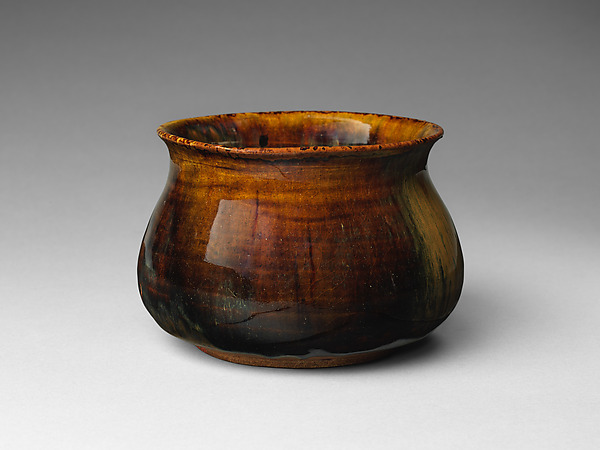
Used-Water Container (Kensui), mid-19th century, Stoneware with iron glaze (Takatori ware). The Metropolitan Museum of Art, Gift of Mrs. V. Everit Macy, 1923, accession 23.225.371.
Look closer: a squat bowl with a waisted body that swells below a flared lip, its iron glaze a glossy amber-brown running to darker streaks near the foot. The museum catalogues it as a Used-Water Container (Kensui), mid-19th century, stoneware with iron glaze (Takatori ware), 9.5 cm high and 14.6 cm in diameter, a gift of Mrs. V. Everit Macy, 1923.
Image: The Metropolitan Museum of Art, Open Access (CC0)
JAANUS agrees about the form and adds some etiquette. It gives the alternative name koboshi, says the kensui was one of the objects on the movable stand, the daisu, which could be wheeled into the tea room, and names the materials as metal, clay or thin bent wood, the magemono. A shallow cylinder is the shape, it says, and the bowl-shaped form is the most common. Some are lacquered. A variant, the efugo kensui, falcon's feeder, has a particularly small mouth and a widely opening rim. The entry adds that a clean kensui is used for each ceremony, that disposing of waste water is considered an unclean task, and that reusing the kensui in front of guests is seen as discourteous. The Gotheborg glossary gives the same account in other words, calling it a low, rounded waste water bowl.
The Met holds two. A Takatori kensui of the mid-nineteenth century is stoneware with iron glaze, 9.5 centimetres high and 14.6 in diameter, and a Bizen waste-water basin of about 1775 is 7 centimetres high and 17.8 in diameter. The museum's pages give catalogue data only, so the chapter says no more of their use. The Takatori bowl is lustrous and waisted, and the Bizen basin is wide and shallow, which is as far as a photograph goes.
Seven Lid Rests Credited to Rikyū
The futaoki is a small thing that is always seen. Wikipedia says it is a rest for the lid of the kettle and for the ladle, made of bamboo, ceramic or metal, in many styles. It names seven kinds attributed to Sen no Rikyū, called Rikyū no nanashu no futaoki: hoyakoro, gotoku, ikkanjin, mitsuningyo, sazae, kani and mitsuba. The Met has an iron futaoki of the eighteenth century, 5.1 centimetres high, a Fletcher Fund purchase of 1925, whose page gives only catalogue data.
A page from Isso-an Tea gives the seven in more detail. The kani is a crab, adapted from rests for the brush and the ink stick, used in spring and summer. The sazae is a turban shell, which was originally a real shell and was later replaced by metal and clay versions. The hoyakoro is a chalice-shaped incense burner, borrowed from a lidded incense container used in Buddhist rites, usually of metal with five or six points. The ikkanjin shows a boy at a well and is named for the idle person, thought to relax when he works and work when he rests. The mitsuningyo shows three Chinese dolls, and the page suggests it may predate Rikyū, since Chinese celadon examples exist in Japanese collections; it can be used all year. The mitsuba is a trefoil, like the edible plant, used in spring and summer. The gotoku is a five-virtues trivet, also called kakureiga, whose base is hidden in the ash, used in the ro and furo seasons.
The seven forms recall a crab, a shell, a censer, a boy at a well, three dolls, a leaf and a trivet, and the page places some of them in spring and summer, one all year and one in the ro and furo seasons. The ladle that rests on a futaoki is a bamboo object, and the lid is the kettle's.
| Futaoki | Gloss | What the sources say |
|---|---|---|
| Kani | Crab | Adapted from brush and ink-stick rests and used mainly in spring and summer (Isso-an Tea). |
| Sazae | Turban shell | Originally a real shell, later made in metal and clay (Isso-an Tea). |
| Hoyakoro | Chalice-shaped censer | Borrowed from a lidded incense container used in Buddhist rites, usually metal with five or six points (Isso-an Tea). |
| Ikkanjin | Idle person at a well | Shows a boy at a well, who is thought to relax when he works and work when he rests (Isso-an Tea). |
| Mitsuningyo | Three Chinese dolls | The page suggests it may predate Rikyū, since Chinese celadon examples exist in Japanese collections; used year round (Isso-an Tea). |
| Mitsuba | Trefoil | Resembles the edible trefoil plant and is used in spring and summer (Isso-an Tea); Wikipedia glosses the name as tree leaves. |
| Gotoku | Five-virtues trivet | Also called kakureiga, its base hidden in the ash, used in the ro and furo seasons (Isso-an Tea). |
Entering the Room Before Guests Sit
The jar and its fellows are seen before the tea is made. JAANUS says that the guests, on entering, admire the alcove first, then the kettle and the brazier, and then the water jar and the other utensils. The jar is relatively large, the entry says, and is often placed in advance on the host's mat, the daisu or the naga-ita. In the hakobi temae, the Wikipedia article says, the host carries it in, and in the other procedures it is already there.

Suzuki Harunobu, Night Rain at the Double-Shelf Stand, from the series Eight Parlor Views (Zashiki hakkei), ca. 1766, Woodblock print (first edition); ink and colors on paper, medium-sized print (chuban). The Metropolitan Museum of Art, The Francis Lathrop Collection, Purchase, Frederick C. Hewitt Fund, 1911, accession JP698.
Look closer: a woodblock print of an interior, in which a standing woman, a seated woman and a small attendant gather at the left, with a window of lattice at the top right and a red-lacquered shelf stand holding a lidded vessel at the right. The museum catalogues it as Night Rain at the Double-Shelf Stand, from the series Eight Parlor Views (Zashiki hakkei), by Suzuki Harunobu, ca. 1766, a woodblock print in ink and colours on paper, from the Francis Lathrop Collection, purchased with the Frederick C. Hewitt Fund, 1911.
Image: The Metropolitan Museum of Art, Open Access (CC0)
The vessels are not all brought in by the same hand at the same time. The jar is the first to enter, in the museums' phrase, and the kensui the last. The ladle rests on its futaoki, and the pitcher is held back for the end of certain ceremonies. A gathering is therefore framed by water: the jar at the start, the kensui at the end, and the rinsing between.
The Met has an eighteenth-century print named for a double-shelf stand. It is Suzuki Harunobu's Night Rain at the Double-Shelf Stand, from the series Eight Parlor Views, of about 1766, a print in ink and colours on paper in the Francis Lathrop Collection. The picture shows a low red stand at the right with a lidded vessel on it. The chapter offers it as an interior of its century and draws no conclusion from it about the vessels of tea.
Contemporary Jars, Zelkova to Akoda
The jar is still made. The Fairfield University Art Museum's show, which ran from 5 June to 14 December 2018 in the Bellarmine Hall Galleries, was devoted to twentieth and twenty-first century mizusashi from the Carol and Jeffrey Horvitz Collection, and the museum says it showed how long-standing tea traditions continue alongside modern ceramic artistry and technical skill. The Cincinnati Art Museum's page says its show presented approaches that Japanese artists have used to make mizusashi over the last ninety years, modern and traditional. The only shape that page names is the pumpkin-shaped Akoda jar, a small, light green, matte-glazed stoneware piece made in 2015 by Katsumata Chieko, born in 1950.
The Met's 2022 zelkova container adds a case in wood. Murase Jihei, a Tokyo-born craftsman and grandson of the first-generation Jihei, carved it, the catalogue says, from a single trunk of a zelkova tree that was roughly four hundred years old. The outside is left unlacquered to show the grain and the inside is lacquered where it meets the water, and the lid is black lacquer. The museum says that Jihei's modern, sculptural style was influenced by Isamu Noguchi, Hans Koper and Brancusi, and that the piece connects to tea culture because Sen no Rikyū adapted the round wooden bucket into the square wooden mizusashi. It measures 15.9 by 27.9 centimetres. Its image is not in the public domain, so the chapter shows none.
What to Ask of a Water Jar
The questions that follow from the sources are short. For a jar: of what is it made, ceramic, wood, lacquer, bamboo, glass or metal; of which kiln or tradition; whether the lid is matching or lacquered, and whether it came with the jar; whether it has a box, and what the inscriptions say. The Brooklyn jar shows why the last matters, for its box and its label give two names for it. A jar said to be of Shigaraki, Bizen, Iga or Seto should be given as attributed until the record shows its basis.
For a ladle: for which season, ro, furo or all, and whether the handle runs through the dipper. For a rinse bowl: of what, and whether it is a bowl-shaped form or a rarer one such as the efugo. For a lid rest: of what, and which of Rikyū's seven forms it recalls. A retailer's note, a dealer's page or a kiln's text is attributed in this chapter, and the museum's wording of attribution is a model. The pottery almanac's chapter on made in Japan and collected in Japan sets out the vocabulary of attribution and style that applies to jars as to bowls, and its chapter on marks, seals and signatures explains the stamps that may accompany them. The Bizen star mark noted by the Met is one.
The concierge desk will say in plain words what an object is, what its record shows and what it does not.
Fun Facts
- Two museums call the water jar the first utensil into the tea room and the last out.
- The Tokyo University of the Arts archive says Sen Rikyū is the first tea man recorded to have used a wooden well bucket as the mizusashi.
- The Met says the onioke, the devil's bucket, was probably used in the Ōmi area to process hemp or ramie into thread before Takeno Jōō adopted it as a freshwater jar.
- A star-shaped mark on a Bizen jar is, in the Met's words, unique to Bizen ware and helped potters identify their work after communal firings.
- A Hizen celadon jar of the mid-seventeenth century is, the Met says, an early example of Japanese celadon.
- JAANUS says the kensui was once among the objects on the movable daisu stand.
- A clean kensui is used for each ceremony, says JAANUS.
- Tealao says the sashi-toshi ladle has its handle running through the cup; the other three are made of two pieces held by friction.
- Isso-an Tea says the sazae lid rest was originally a real turban shell.
- The Met's zelkova water container was carved from a trunk of roughly four hundred years' age.
A Timeline of Water Vessels
Dates are given as the sources give them, with the source named. Where an event is only an account, it is marked as such.
| Date | Event | Source |
|---|---|---|
| 16th century | Takeno Jōō adopts a Shigaraki pail of the kind called onioke as a freshwater jar, according to the Met catalogue. | The Metropolitan Museum of Art |
| 1573 to 1592 | The Tenshō era, in which, a dealer says, Seto water jars became popular under Rikyū. | Turuta (attributed) |
| Late 16th century | A Ko-Bizen jar modelled on a seed jar is made, with a black-lacquered lid. | The Metropolitan Museum of Art |
| Late 16th to early 17th century | An Iga jar with ear handles is made; its box and a paper label give conflicting names. | Brooklyn Museum |
| Ca. 1600 | The Iga jar named Hotei is made. | The Metropolitan Museum of Art |
| Early 17th century | Celadon production begins in Hizen, with help from Chinese and Korean potters; potters at Mino imitate the look of Iga ware. | The Metropolitan Museum of Art |
| Ca. 1625 | A Bizen water pot with a lacquer cover is made. | The Metropolitan Museum of Art |
| Mid-17th century | A Hizen celadon freshwater jar of the Arita type is made. | The Metropolitan Museum of Art |
| Ca. 1650s | An Arita jar with cobalt blue pines is made. | The Metropolitan Museum of Art |
| Ca. 1720 | Ogata Kenzan paints a stoneware jar with pine trees. | The Metropolitan Museum of Art |
| 1816 | A dealer cites a text of this date, the Chado Sen-tei, as cataloguing water jars by origin and type. | Turuta (attributed) |
| Mid-19th century | A Takatori kensui in iron-glazed stoneware is made. | The Metropolitan Museum of Art |
| 2015 | Katsumata Chieko makes the matte-glazed pumpkin-shaped Akoda jar. | Cincinnati Art Museum |
| 2018 | Fairfield University Art Museum shows mizusashi of the 20th and 21st centuries from the Carol and Jeffrey Horvitz Collection. | Fairfield University Art Museum |
| 2022 | Murase Jihei's zelkova water container is dated to this year in the Met's catalogue. | The Metropolitan Museum of Art |
A Glossary of Jars and Ladles
The words of the chapter, with the sense the sources give them.
| Term | Meaning |
|---|---|
| Mizusashi | 水指. The lidded jar of fresh cold water. |
| Mizutsubo | 水壷. JAANUS's alternative name for the mizusashi. |
| Mizutsugi | 水次. A lidded pitcher that refills the mizusashi. |
| Tomobuta | 共蓋. A lid matching the body in material. |
| Kama | 釜. The iron kettle in which the hot water is kept. |
| Tetsubin | 鉄瓶. An iron pot for hot water that, Wikipedia says, does not require a hishaku. |
| Hishaku | 柄杓. The bamboo water ladle. |
| Shakushi | The dipper of the ladle, in JAANUS's list of its parts. |
| Fushi | 節. The node of the bamboo handle. |
| Kiridome | 切止. The cut at the end of the handle. |
| Mizuya-bishaku | 水屋柄杓. The larger cypress ladle for the preparation room. |
| Kensui | 建水. The rinse-water bowl. |
| Koboshi | 零し. JAANUS's alternative name for the kensui. |
| Efugo kensui | 餌畚建水. A kensui with a small mouth and a widely opening rim, according to JAANUS. |
| Magemono | 曲物. Thin wood bent into a circle with a bottom attached. |
| Futaoki | 蓋置. A rest for the kettle lid or the ladle. |
| Mizuya | 水屋. The preparation room behind the tea room. |
| Daisu | 台子. A portable shelf on which utensils are set. |
| Naga-ita | 長板. A long board on which utensils are set. |
| Temaedatami | 点前畳. The host's mat. |
| Tokonoma | 床の間. The alcove, which guests admire first. |
| Toriawase | The host's selection and combination of utensils, in the Met's wording. |
| Te-oke | A handled pail of daily life that was lacquered for tea, according to the Tokyo University of the Arts archive. |
| Tsurube | A wooden well bucket. |
| Ita-tsurube | The unlacquered board well bucket, a utensil that symbolises Sen school tea according to the same archive. |
| Onioke | A pail of the kind that the Met glosses as devil's bucket. |
| Tane-tsubo | A seed jar, here the model for a Bizen water jar. |
| Nanban | A word for the southern barbarians, used of unglazed wares that came from Southeast Asia and elsewhere. |
| Hakobi temae | A procedure in which the host carries in the fresh water container. |
| Zelkova | A hardwood used for the Murase Jihei water container. |
More Water Vessels to Look At
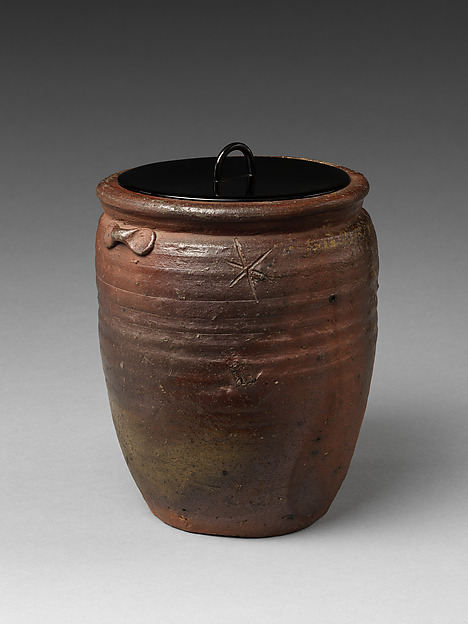
Freshwater Jar (Mizusashi) in the Shape of a Seed Jar (Tane-tsubo), late 16th century, Stoneware with natural ash glaze (Bizen ware, Ko-Bizen type); black-lacquered wooden lid. The Metropolitan Museum of Art, Mary Livingston Griggs and Mary Griggs Burke Foundation Fund, 2023, accession 2023.326a–c.
Look closer: a tall, rounded jar in reddish-brown clay with horizontal ridges, two small ears at the shoulder, a small star-shaped mark incised on the front and a black lacquer lid with a ring handle. The museum catalogues it as a Freshwater Jar (Mizusashi) in the Shape of a Seed Jar (Tane-tsubo), late 16th century, stoneware with natural ash glaze (Bizen ware, Ko-Bizen type), 18.4 cm high and 15.2 cm in diameter, from the Mary Livingston Griggs and Mary Griggs Burke Foundation Fund, 2023.
Image: The Metropolitan Museum of Art, Open Access (CC0)
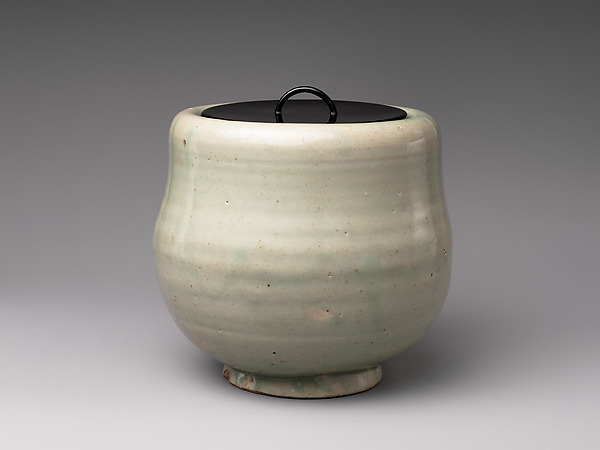
Freshwater Jar (Mizusashi), mid-17th century, Porcelain with celadon glaze (Hizen ware, Arita type); lacquer cover. The Metropolitan Museum of Art, The Harry G. C. Packard Collection of Asian Art, Gift of Harry G. C. Packard, and Purchase, Fletcher, Rogers, Harris Brisbane Dick, and Louis V. Bell Funds, Joseph Pulitzer Bequest, and The Annenberg Fund Inc. Gift, 1975, accession 1975.268.509.
Look closer: a plump, softly rounded jar in a pale grey-green celadon glaze on a short foot, with a glossy black lacquer lid and a ring handle. The museum catalogues it as a Freshwater Jar (Mizusashi), mid-17th century, porcelain with celadon glaze (Hizen ware, Arita type) and a lacquer cover, 16.2 cm high and 18.1 cm in diameter, from the Harry G. C. Packard Collection of Asian Art.
Image: The Metropolitan Museum of Art, Open Access (CC0)
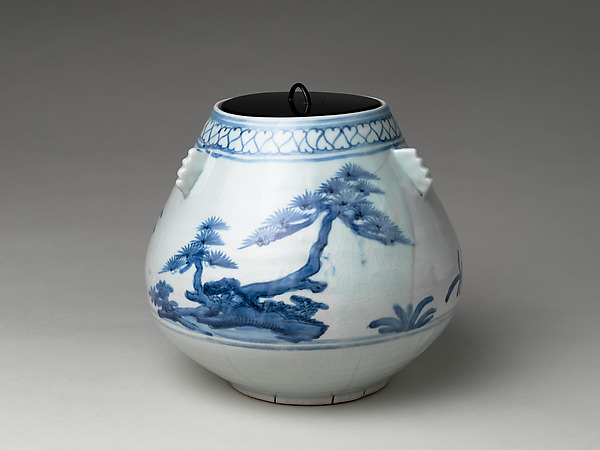
Freshwater Jar (Mizusashi) with Pines, ca. 1650s, Porcelain with cobalt blue under transparent glaze (Hizen ware, Arita type). The Metropolitan Museum of Art, The Harry G. C. Packard Collection of Asian Art, Gift of Harry G. C. Packard, and Purchase, Fletcher, Rogers, Harris Brisbane Dick, and Louis V. Bell Funds, Joseph Pulitzer Bequest, and The Annenberg Fund Inc. Gift, 1975, accession 1975.268.465.
Look closer: a broad-shouldered porcelain jar painted in cobalt blue with two windswept pine trees, a band of lattice pattern round the neck and small handles at the shoulder, with a black lid. The museum catalogues it as a Freshwater Jar (Mizusashi) with Pines, ca. 1650s, porcelain with cobalt blue under transparent glaze (Hizen ware, Arita type), 23.2 cm high, from the Harry G. C. Packard Collection of Asian Art.
Image: The Metropolitan Museum of Art, Open Access (CC0)
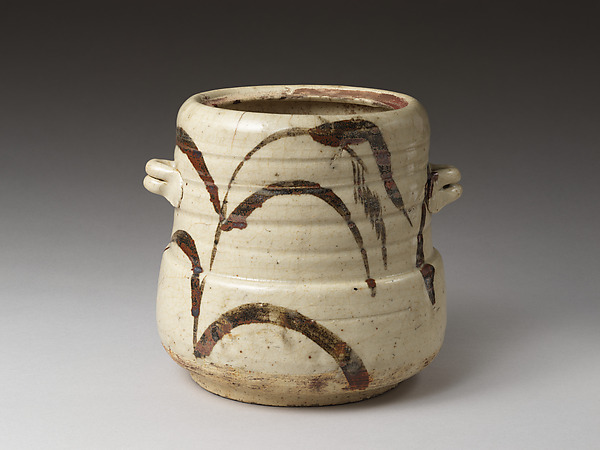
Water jar (Mizusashi) with autumn grasses, Earthenware with Shino/Oribe glaze. The Metropolitan Museum of Art, Gift of Florence and Herbert Irving, 2019, accession 2019.193.55a, b.
Look closer: a cylindrical jar with a wide mouth, a cream glaze and sweeping brown strokes of autumn grasses across its sides, with two small ears at the shoulder. The museum catalogues it as a Water jar (Mizusashi) with autumn grasses, Momoyama period, earthenware with Shino/Oribe glaze, 17.5 cm high, a gift of Florence and Herbert Irving, 2019.
Image: The Metropolitan Museum of Art, Open Access (CC0)
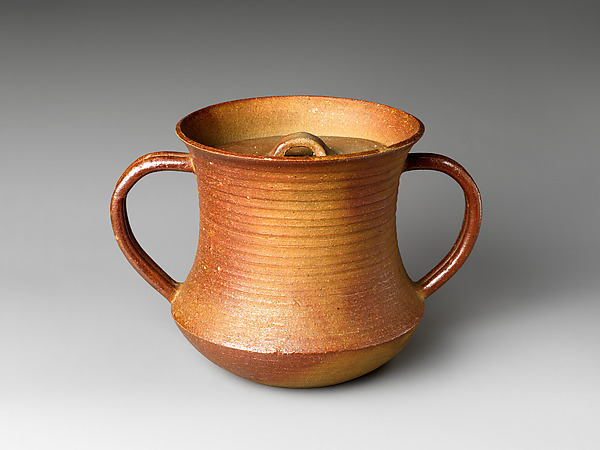
Nonomura Ninsei, Nanban Freshwater Jar (Mizusashi) with Large Handles, second half 17th century, Stoneware with natural ash glaze (Kyoto ware). The Metropolitan Museum of Art, Gift of Peggy and Richard M. Danziger, 2024, accession 2024.553.27a, b.
Look closer: an orange-brown jar with a ridged body, a wide mouth and two large looped handles that rise from the shoulder and curve out, with a small lid. The museum catalogues it as a Nanban Freshwater Jar (Mizusashi) with Large Handles, second half of the 17th century, stoneware with natural ash glaze (Kyoto ware), by Nonomura Ninsei, 16.8 cm high, a gift of Peggy and Richard M. Danziger, 2024.
Image: The Metropolitan Museum of Art, Open Access (CC0)

Waste-water basin, ca. 1775, Pottery (Bizen ware). The Metropolitan Museum of Art, Fletcher Fund, 1925, accession 25.215.44.
Look closer: a black-and-white photograph of a wide, shallow, dark bowl with a heavy rim, a pinched lip at the front and two small lugs at the side. The museum catalogues it as a Waste-water basin, ca. 1775, pottery (Bizen ware), 7 cm high and 17.8 cm in diameter, from the Fletcher Fund, 1925.
Image: The Metropolitan Museum of Art, Open Access (CC0)
Jars, Bowls and Tea-Room Ware
The water vessels pass through the house with the rest of the tea room. The concierge desk will say in plain words what each is made of, who made it where the record says so, whether it has been used or repaired, and what the record does and does not show. The atlas of utensils and the glossary of tea utensils are companions to this chapter.
Answered plainly
What is a mizusashi?
A lidded container of fresh cold water used by the host, mainly to replenish the kettle, according to Wikipedia; JAANUS adds that it also fills the tea bowl.
Why is the water jar first in and last out?
The Cincinnati Art Museum and the Fairfield University Art Museum both say that it is the first utensil to enter the tea room and the last to leave, and call it an anchor of the gathering.
What is the difference between a mizusashi and a mizutsugi?
A mizutsugi is a lidded pitcher that refills the mizusashi at the end of certain ceremonies, says Wikipedia.
What is a tomobuta?
A lid matching the jar in material; a ceramic jar often has a custom-made lid of lacquered wood instead, according to Wikipedia.
Who first used a wooden bucket as a water jar?
The Tokyo University of the Arts archive says Sen Rikyū is the first tea man recorded to have done so.
Which kilns are esteemed for water jars?
JAANUS lists Seto, Shigaraki, Bizen, Satsuma and the wares of Ninsei and Kenzan.
What is a hishaku?
A long bamboo ladle with a node near the middle of the handle, for moving hot and cold water, per Wikipedia.
What are the types of hishaku?
Tealao names the ro for the cold season, the furo for the warm, the kennyō for all seasons and the sashi-toshi for formal gatherings.
What is a kensui?
The rinse-water bowl of the host, kept out of the guests' sight as much as possible, says Wikipedia.
What are Rikyū's seven futaoki?
Wikipedia names hoyakoro, gotoku, ikkanjin, mitsuningyo, sazae, kani and mitsuba as the seven lid rests attributed to Sen no Rikyū.
Is a modern jar a mizusashi?
Yes; Fairfield and Cincinnati both show modern jars as mizusashi, and the Met catalogues a 2022 zelkova water container as a mizusashi.
Where next
Sources and image credits
- Japanese tea utensils, Wikipedia
- Japanese tea ceremony, Wikipedia
- Mizusashi, JAANUS
- Hishaku, JAANUS
- Kensui, JAANUS
- The Water Vessel in Wabi-cha, Tokyo University of the Arts (GEICHA)
- Hishaku Water Ladle, Tealao
- Kensui, Gotheborg glossary
- Rikyu's futaoki, Isso-an Tea
- Mizusashi, Turuta ceramics story (dealer, attributed)
- Yaburebukuro, Turuta ceramics story (dealer, attributed)
- Mizusashi: Japanese Water Jars from the Carol and Jeffrey Horvitz Collection, Fairfield University Art Museum
- Mizusashi: Japanese Water Jars, Cincinnati Art Museum
- Tea Ceremony Fresh Water Jar (Mizusashi), Brooklyn Museum
- Zelkova Freshwater Container (Mizusashi), The Metropolitan Museum of Art
- Object record, Freshwater Jar (Mizusashi), Hotei, The Metropolitan Museum of Art
- Object record, Tane-tsubo mizusashi, The Metropolitan Museum of Art
- Object record, Onioke mizusashi, The Metropolitan Museum of Art
- Object record, Nanban mizusashi, The Metropolitan Museum of Art
- Object record, Hizen celadon mizusashi, The Metropolitan Museum of Art
- Object record, Water Pot, Tanba ware, The Metropolitan Museum of Art
- Object record, Mino ware, Iga type, The Metropolitan Museum of Art
- Object record, Kensui, Takatori ware, The Metropolitan Museum of Art
- Object record, Waste-water basin, Bizen ware, The Metropolitan Museum of Art
- Object record, Water jar in the shape of a bamboo basket, The Metropolitan Museum of Art
- Object record, Water jar with pine trees, Ogata Kenzan, The Metropolitan Museum of Art
- Object record, Blue-and-white mizusashi with pines, The Metropolitan Museum of Art
- Object record, Water pot, Bizen, The Metropolitan Museum of Art
- Object record, Night Rain at the Double-Shelf Stand, The Metropolitan Museum of Art
- Object record, Futaoki, The Metropolitan Museum of Art
- Object record, Mizutsugi, The Metropolitan Museum of Art
- Object record, Water jar (Mizusashi) with autumn grasses, The Metropolitan Museum of Art
Last reviewed 28 October 2026. Pictures, where shown, are public-domain or open-access and credited beneath each one.
Looking for a water jar, a rinse bowl or another piece of tea-room ware? The concierge desk replies within one to three business days.
Browse tea ceremony and chagama pieces · Make a private request
Private concierge
Looking for something in particular?
Describe the piece or the project you have in mind. A senior advisor in Tokyo reads every case file personally and replies within two business days, with fees set out in writing before any work begins.