
Cast Iron and the Singing Kettle
Chanoyu Almanac · Metalwork, Hearth, Water
Cast Iron and the Singing Kettle
Of all the objects in a tea room, the kettle is the one that speaks. It sits over the charcoal, it takes the cold water and brings it slowly to the pitch that thick tea needs, and while it does so it makes a sound that hosts and guests have named for centuries. This chapter follows the iron from the earliest dated kettles to the cast tetsubin of the north, with the stand that holds the fire, the small pieces that serve it and the care it asks.
Fact sheet
At a glance
- A kettle with no spout. The tea-ceremony kama is a round pot with a small mouth, a lid and two lugs for rings. The tetsubin, which has a spout and a handle, belongs to a related family.
- Two early centres. Ashiya in Fukuoka and Tenmyō in Sano, Tochigi, supplied the kettles most in demand until the end of the Muromachi period.
- Kyoto takes over. Many artisans came to the Sanjō quarter of Kyoto, where tea masters ordered kettles to their own taste.
- The north casts the tetsubin. Iwate and Yamagata are best known for tetsubin; the Nambu craft dates its small spouted kettle to about 1750.
- It sings. Tea hosts name the stages of the boil, and the stage called matsukaze, the wind in the pines, is the one used for thick tea.
The Voice of the Room
A tea room has no clock. The Issoan Tea blog, reporting a teacher's lecture, says that the tea room has no clocks and that the kama serves as a timing device. The room is quiet by design, and the one thing that is allowed to make a noise is the iron pot on the fire. Its sound tells the host when the water is ready for thick tea and tells the guests, who have been listening to it since they sat down, that the host is nearly ready to begin.
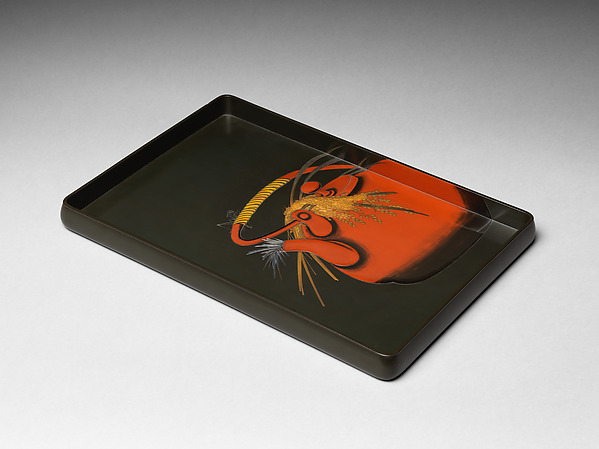
Tray with rice stalks and a grasshopper on a tea kettle, 1880s, Lacquered wood; gold, silver, red, yellow, black hiramaki-e and takamaki-e on “bronze imitation” (seido-nuri) ground. The Metropolitan Museum of Art, Purchase, Henrie Jo Barth Bequest, William R. Appleby Fund, and Gift of Mr. and Mrs. Spielman, by exchange, 2019, accession 2019.107.
Look closer: a red kettle fills the middle of a dark tray, and rice stalks and a small grasshopper are drawn over it in gold and colour. The museum catalogues it as a Tray with rice stalks and a grasshopper on a tea kettle by Shibata Zeshin, 1880s, lacquered wood with hiramaki-e and takamaki-e, 37.5 cm long; the kettle has become the picture.
Image: The Metropolitan Museum of Art, Open Access (CC0)
Japanese tea has two broad families of iron water pot. The first is the kama, also called the chagama, the round-bodied kettle of the tea room that has a lid and no spout, and that the host ladles from. The second is the tetsubin, the spouted and handled kettle that grew up beside it, was taken up by the household and by sencha, and is now the pot that most readers will recognise. Both are cast, both are iron, and both are heated over charcoal. They are not the same object, and a good deal of confusion in the market comes from treating them as if they were.
This chapter takes them in order. It begins with the words, goes through the parts of a kettle, and then follows the history: the early kettles of Ashiya and Tenmyō, the Kyoto makers who came after them, and the families of the north who are credited with the small spouted kettle and whose craft became a national one. It sets the stands beside them, the portable brazier of summer and the hearth of winter, and the small iron pieces that serve the kettle. It listens to the boil, and it ends with care, with a collector's eye and with a timeline and a glossary.
The sources are Wikipedia's articles on the chagama, the tetsubin, the hibachi and the Japanese tea ceremony; the Japanese Architecture and Art Net Users System, JAANUS, on kettles, braziers and lid rests; a Google Arts and Culture exhibit on Nambu Tekki prepared with Kyoto Women's University and the Iwate Museum of Art; Japan Objects on Nambu ironware; a government craft page on Yamagata casting; the Osaka City Museum of Fine Arts record of a dated Tenmyō kettle; the Hikone Castle Museum and Kyoto National Museum pages; a Fukuoka tourism page on Ashiya kettles; and the catalogues of the Metropolitan Museum of Art and the Cleveland Museum of Art. Where they disagree, a box says so.
Two Pots, Many Names
The Wikipedia article on the chagama gives the plainest definition: the chagama is the metal pot or kettle used in the tea ceremony, translated as tea kettle, and its job is to heat the water used to make tea. The article says kama are made of cast iron, though in one passage it says cast iron or copper. JAANUS, the Japanese Architecture and Art Net Users System, calls the kettle the most essential vessel of the ceremony, used only for boiling water, with a small mouth, and says that most are cast iron though copper ones exist.
The tetsubin is defined by the Wikipedia article on that name as a Japanese cast-iron kettle with a pouring spout, a lid and a handle that crosses over the top, used for boiling and pouring hot water such as for tea. It says tetsubin are traditionally heated over charcoal and, in chanoyu, over a portable brazier called a binkake. They are often elaborately decorated in relief and range from about half a litre to about five litres. The same article says the historical origin is uncertain; one authoritative Japanese source holds that it developed from the tedorigama, a spouted and handled kettle used in chanoyu in the era of Sen no Rikyū, and a hypothesis links its popularity to sencha, which China introduced to Japan around the mid-seventeenth century.
The article names five relatives of the tetsubin: the tedorikama, the toyama, the mizusosogi, the dobin and the yakkan. The yakkan, it says, is the closest, and differs chiefly in being made of copper where the tetsubin is traditionally made of iron. Sencha became an informal drink in the eighteenth century, the article continues, and the tetsubin grew more popular alongside it; through that century it became a standard household utensil for heating water for tea, and in the nineteenth century, as infused tea became more popular, tetsubin were considered primarily status symbols rather than functional kitchen items, with designs moving from simple iron kettles to elaborately engraved pieces.
The tea ceremony article places the tetsubin inside chanoyu in one specific procedure. In obon temae, a simple procedure for making thin tea, the tea bowl, whisk, scoop, cloth and caddy are placed on a tray, and the hot water is prepared in a kettle called a tetsubin, which is heated on a brazier. The article adds that this is usually the first temae a student learns, and that it may easily be done sitting at a table, or outdoors, using a thermos pot in place of the tetsubin and portable hearth. So the two words are not exclusive: a tea school can use either, and the kettle of a formal chaji and the tetsubin of a student's first lesson are different tools for different rooms.
| Word | What the sources say | Where it appears |
|---|---|---|
| Kama, chagama | The kettle of the tea room; cast iron, sometimes copper; no spout | Wikipedia, Chagama; JAANUS |
| Tetsubin | A cast-iron kettle with spout, lid and handle | Wikipedia, Tetsubin |
| Tedorigama | Spouted, handled kettle of Rikyū's time; the claimed ancestor of the tetsubin | Wikipedia, Tetsubin |
| Yakkan | The closest relative of the tetsubin, made of copper | Wikipedia, Tetsubin |
| Binkake | The portable brazier on which a tetsubin is heated in chanoyu | Wikipedia, Tetsubin |
| Tetsukyūsu | Iron teapot, enamelled inside, for brewing and not for heating water | Wikipedia, Tetsubin |
The Anatomy of a Kama
The Wikipedia article describes the shape in a few lines. Kama are often round or cylindrical, with a lug on each side for inserting a metal handle called a kan, which is used to carry the kettle, to hang it over the ro, or both. A tripod may support the kettle over the heat source, and some brazier sets are designed so that the kettle needs no tripod. JAANUS adds the vocabulary of form: kettles are usually round, with rounded, squarish or sloping shoulders; the bottoms are rounded, flat and round, or flat and square; the mouths vary, turned inward or outward, wide, narrow or notched; and two loops on the shoulder hold the rings for hanging or carrying.
Diagram by Japonista. Schematic; the part names follow the Wikipedia article on the chagama and JAANUS.
Look closer: the ring on each side of the body is the kan, and the small block it hangs from is the lug, kantsuki. The lid sits on the small mouth, and the whole body is a plain round pot, which is the shape the tea ceremony favours.
Diagram by Japonista
The surface carries the character. JAANUS names rough skin, arehada, sandy skin, sunahada, and a tortoise-shell pattern, and says other kettles show Chinese-style mountains or rivers, the seven gods of fortune, plants, animals, or cloisonné. Ogre faces are common, it adds, as are lion faces, distant mountains, pine cones and bamboo shoots.
The lid is cast with the body, JAANUS says, so that the two fit perfectly, though a lid may also be bronze, copper, brass, silver or made from an ancient bronze mirror. The entry names the shapes: the moributa, high in the centre; the usumoributa, slightly raised and lower than the moributa; the ichimonjibuta, with a straight, flat top; the sukuibuta, with a high rim and an indented centre; the kakegobuta, with a projecting rim and a flat top; the emyōbuta, indented where the knob sits; the ishimebuta, with small embossed dots; and the itomebuta, with a thin linear pattern. The names are a vocabulary for describing a kettle in words without a photograph.
The kettle's pairing with its fire is also a matter of size. Wikipedia and JAANUS agree that kettles for the portable brazier are slightly smaller than those for the sunken hearth, and JAANUS adds that the oldest kettles were cast for the portable brazier, while those for the fixed hearth were set on a trivet or hung on a tripod. The question of which fire a kettle was made for is therefore one of the first a careful reader asks of a piece.
Ashiya and Tenmyō
JAANUS tells the earliest story. The earliest tea kettle is said to have been made for the priest Myōe, who lived from 1173 to 1232, at Kōzanji, by a master kettle maker at Ashiya, in Fukuoka Prefecture. Until the end of the Muromachi period, the entry says, kettles from Sano in Tochigi Prefecture, called tenmyōgama, were most in demand alongside the kettles of Ashiya, the ashiyagama. The entry calls the account one in which the kettle is said to have been made; it is a tradition, and it is dated by the priest's lifetime, not by a surviving object.
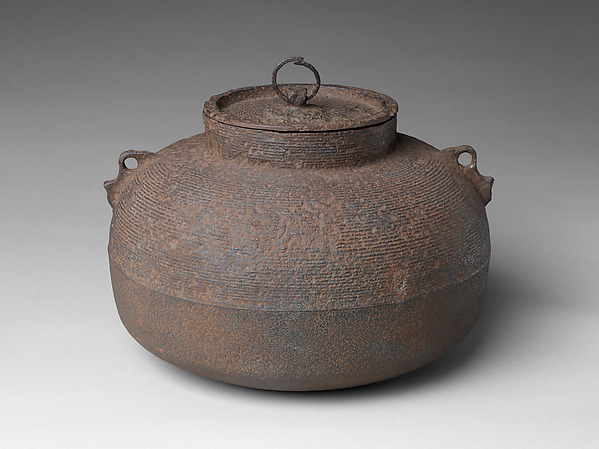
Tenmyō Kettle, Named “Taya Itome”, 16th century, Cast iron. The Metropolitan Museum of Art, Gift of Peggy and Richard M. Danziger, 2024, accession 2024.553.7a–c.
Look closer: a squat iron kettle with fine concentric lines rings the shoulder and a flat lid carries a small loop; two small lugs stand out at the sides where the rings would hang. The museum catalogues it as a Tenmyō Kettle, named Taya Itome, sixteenth century, cast iron, 17.5 cm high and 29 cm across; the lines are the thing to look at.
Image: The Metropolitan Museum of Art, Open Access (CC0)
A Fukuoka tourism page describes the Ashiya kettles as dating to the period of the Northern and Southern Courts, made at the Ashiyatsu Kanaya, which it places near Nakanohama in Ashiya-machi, in Onga District. Production stopped around the early Edo period. The page says they have a graceful form known as shin-nari, and that their decorated bodies were popular with aristocrats in the imperial capital. In modern times, it says, they are prized as centrepieces for tea ceremonies. The page does not name a single maker. The Kyoto National Museum, in its guide to chanoyu, shows a Shinnari type kettle with pines at the seashore, of the Muromachi period, fifteenth century, an Important Cultural Property, though its page does not say where it was made.
The Tenmyō side of the story has a precise anchor. The Osaka City Museum of Fine Arts holds an iron kettle of odare type, Tenmyō ware, whose record on Google Arts and Culture dates it to 1352, the Nanbokuchō period, and describes the name Tenmyō as coming from the town of Tenmyō in Sano, Tochigi Prefecture. Like Ashiya in Fukuoka, the record says, Tenmyō was a major producer of fine tea kettles in the Muromachi period. Inscriptions on the shoulder suggest the kettle was made on 8 December 1352 for a ceremony marking the Buddha's enlightenment, for a sub-temple of Gokuraku-ji, a Shingon Risshū temple in the Kamakura area. It is, the record says, the sole extant example of dated early Tenmyō ware. It is 17.1 centimetres high and an Important Cultural Property.
A smaller Tenmyō kettle can be seen at the Hikone Castle Museum. The museum catalogues a semehimo-gama, a kettle with lugs placed near the lid, of the Muromachi period, sixteenth century, 18.5 centimetres high with a mouth diameter of 11 centimetres, given by the Ii family. The name, the museum explains, refers to the placement of the lugs for the lifting rings near the lid, as on a tea jar, where the custom of tying the lid through lugs near the lid seals the contents firmly. It describes a swelling body and a rugged, undecorated surface that gives the kettle an imposing air.
The Metropolitan Museum owns a Tenmyō kettle too, of the sixteenth century, in cast iron, 17.5 centimetres high and 29 across, with a lid and a small ring on the knob. The shoulder carries fine horizontal lines, and its title includes the word itome, which JAANUS lists as a thin linear pattern, though in the museum's title the word names the kettle and is not explained in the record. The museum's provenance field lists Sen no Rikyū with a date of about 1660, a pairing that does not reconcile, so this chapter leaves the provenance aside.
A Skirt Broken on Purpose
The Cleveland Museum of Art owns an iron kettle of the Muromachi period, catalogued with a crane design, whose lower edge is jagged and broken. The museum's note says water supplied from a jar was transferred to an iron kettle for boiling as part of the tea ceremony, and quotes its former director Sherman Lee calling the broken skirt attractively damaged. Tea masters, it says, valued its worn, coarse surface and its lack of perfect symmetry for its humility. The kettle's diameter is 30.4 centimetres, its mouth 18.6 centimetres across and its height 18.2 centimetres.
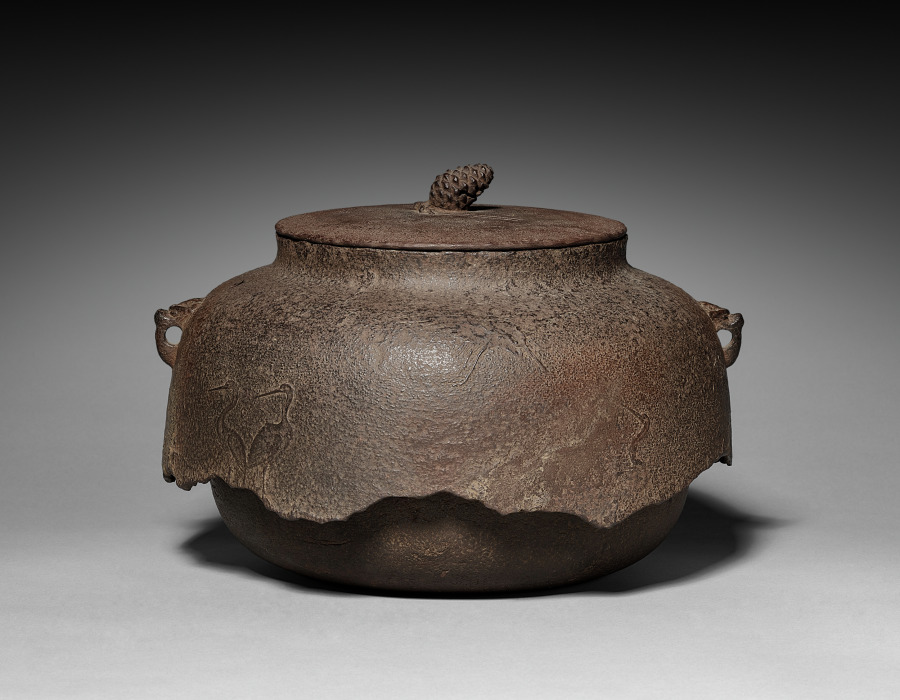
Kettle with Crane Design, 1392–1573, iron. The Cleveland Museum of Art, Purchase from the J. H. Wade Fund, accession 1980.11.
Look closer: a broad kettle sits low, its lower edge broken into a jagged ragged line like a torn hem, with a lid bearing a small knob on top. The museum catalogues it as a Kettle with Crane Design, Muromachi period, 1392 to 1573, iron, 30.4 cm in diameter; faint designs are scratched across the rough metal.
Image: The Cleveland Museum of Art, Open Access (CC0)
That judgement is the one the tea world calls wabi. The Wikipedia article on wabi-cha describes the aesthetic as rustic simplicity, and it observes that in modern times achieving the aura of rustic simplicity can be an expensive endeavour; even the simple, cheap items used by Rikyū and his followers have gained both status and value. A damaged kettle that was once a working tool is now a museum piece, and the condition that made it humble has made it rare.
The lesson for a reader is practical. A kettle that has lost its skirt, whether by accident or by age, is not by that fact a flawed one in the eyes of the tea tradition; but it is a different object from a kettle that has been damaged in later handling, and the two cannot be told apart by looking at a photograph. The right question is what the object's own record says, and the concierge desk's practice is to say in plain words what is known and what is not.
Where Iron Was Cast
The kettle towns lie in two clusters, one in the old west and one in the north, with Kyoto between. Ashiya, in Fukuoka, and Tenmyō, in Sano, Tochigi, are the two early centres named by JAANUS and by the museum records. Kyoto's Sanjō quarter drew the artisans of the Kansai once tea had become a pastime of the capital. The north comes later: Morioka and Mizusawa in Iwate, and Yamagata, are the towns now best known for tetsubin.
Diagram by Japonista. Towns placed to the nearest tenth of a degree; base map Natural Earth, public domain.
Look closer: two towns at the left and centre of the map, Ashiya and Tenmyō, are the early centres; Kyoto is the middle marker; and the three northern markers cluster in the old Nambu and Yamagata lands.
Diagram by Japonista
JAANUS gives the logic of the Kyoto concentration. Because the tea ceremony developed in the Kansai region, it says, many artisans went to Kyoto to make kettles at the Sanjō kilns, and by the late sixteenth century many tea masters ordered kettles to their own preferences. The map shows how far the craft travelled from its first places, and how the later iron towns sit in the cold north, where the Nambu clan, as the next sections describe, had iron sand, clay, charcoal and lacquer to hand.
The Kettle Makers of Kyoto
The Japanese Wiki Corpus entry on the kettle maker, the kamashi, says that founding technicians of tea kettles appeared at the end of the Muromachi period, and that in the Azuchi-Momoyama period the well-known master craftsmen included Nishimura Dōnin and Tsuji Yojirō. The entry on Tsuji says that the years of his birth and death are unknown, that his real name was Sanehisa, that he was born in Ōmi Province, and that he studied under Dōnin at the Sanjō Kamanza, the kettle guild's quarter. While working with Sen no Rikyū, it says, he created new kettle types: round kettles, Amidadō kettles and shiriharigama. He also made garden lanterns and large temple bells.
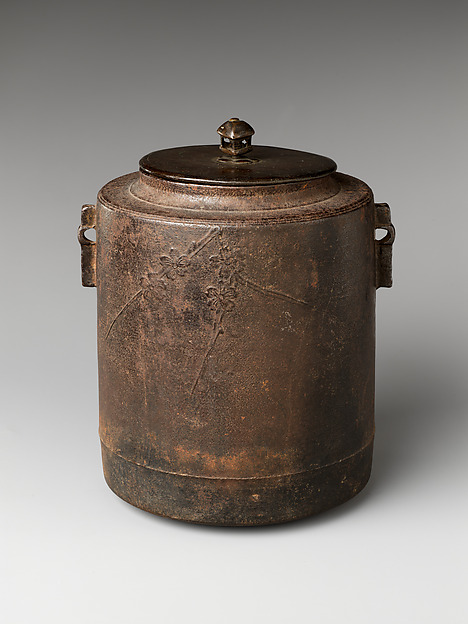
Ōnishi Gorōzaemon, Kettle (Kama) with Willow and Cherry, mid-17th century, Cast iron and bronze. The Metropolitan Museum of Art, Gift of Peggy and Richard M. Danziger, 2024, accession 2024.553.6a, b.
Look closer: a tall cylindrical kettle with a dark lid and a round knob has a small lug on each shoulder, and its brown body carries faint scratched lines that are the willow and cherry. The museum catalogues it as a Kettle (Kama) with Willow and Cherry by Ōnishi Gorōzaemon, mid-seventeenth century, cast iron and bronze, 20.3 cm high.
Image: The Metropolitan Museum of Art, Open Access (CC0)
The same corpus describes the Ōnishi family as one of the ten craftsmen families that serve the Sen houses, the Senke jisshoku. The family, it says, is from Kyoto and traces its heritage back more than 400 years to the late Muromachi period; the fourth head called himself Seiemon and from the sixth head onward each generation took the name, except the ninth. The sixteenth Seiemon, the first son of the fifteenth, became head in 1993 after his father retired, and the workshop stands at the corner of Sanjō-dōri and Kamanza-dōri in Nakagyō Ward, with the Ōnishi Seiemon Museum beside it. The tea schools' ten houses are described in the companion chapter on the three Sen houses.
The Metropolitan Museum owns a kettle from this lineage. It catalogues a kettle with willow and cherry by Ōnishi Gorōzaemon, who lived from 1594 to 1692, of the mid-seventeenth century, in cast iron and bronze, 20.3 centimetres high, given in 2024. The museum's note says that the Ōnishi family is one of the Ten Craftsmen Families that served the tea schools descended from Rikyū and is known for kettles made for tea gatherings. The lineage was founded in Kyoto by Jōrin; his younger brother Jōsei, also called Gorōzaemon, trained under him and refined the craft, and made kettles for tea masters including Furuta Oribe and Kobori Enshū.
The museum's title names the design as willow and cherry. The record does not explain the choice, and this chapter does not guess at it; the plain statement is that the surface carries a faint pattern under that name, which is easier to see in a good light than in a photograph.
Fire Beneath the Kettle
A kettle is only half the pair; the other half is the fire. JAANUS describes the furo as a portable brazier used in spring and summer, when the fixed hearth is closed, or when tea is served in a room without a fixed hearth. It lists the types: bronze, which was the earliest; iron; clay, unglazed and coated with black lacquer, preferred for formal use; and the karakane furo, a Chinese copper brazier sometimes used in semi-formal tea ceremonies. The shapes are varied. The accessories are the ko-ita, a lacquered board that protects the surface beneath a clay brazier from heat damage, the sengawara, a paving tile on which the iron type is set, and a trivet under the kettle with a clay brazier, since bronze and iron braziers take the kettle directly.

Kettle (Kama) and Brazier (Furo), 18th century, Iron. The Metropolitan Museum of Art, Fletcher Fund, 1925, accession 25.215.32.
Look closer: a squat kettle sits on a small brazier inside a shelf stand, with a folding screen behind and a few small vessels and a charcoal basket on the table in front. The museum catalogues the objects as a Kettle (Kama) and Brazier (Furo), iron, eighteenth century, 17.5 cm high; the arrangement shows how the pieces are meant to be seen together.
Image: The Metropolitan Museum of Art, Open Access (CC0)
The Wikipedia article gives the working of the fire. Before lighting, a bed of ash is laid inside the furo and charcoal is placed on top; a fire window or cut-out on the edge provides the draft that keeps the charcoal burning. The ro, the sunken hearth, is used in autumn and winter: a hole is cut in the tatami floor and the kettle sits over the fire in it, the hole framed by a box-like frame called the robuchi. The article says a kettle in this setup warms faster and stays warm longer, and the arrangement suggests warmth in colder seasons. The incense for each differs: neriko, small kneaded balls of woods, spices and herbs, in the colder season, and kōboku, incense made from aromatic wood, in spring and summer.
The Kyoto National Museum puts it more briefly. The sunken hearth is a small hearth built into the floor of a tea room where charcoal starts the fire that boils the kettle's water, and in summer the hearth is too hot, so a brazier is used instead and placed away from the guests. The tea ceremony article adds the weeks in between: when the brazier does not give enough heat to the room but the hearth would be too warm, the host may cover the hearth with its lid and put the brazier on top of it. The seasonal logic is set out in the companion chapter on the room and the tea year.
The Metropolitan Museum's photograph of its kettle and brazier shows the pair in a shelf stand with a folding screen behind it. The kettle is 17.5 centimetres high and the pair is catalogued as iron of the eighteenth century, given by the Fletcher Fund in 1925. The museum's group also includes a feather brush, a lid rest, a lifting ring and a charcoal basket, which together describe the working fire of the tea room.
The Brazier of the Steeped Leaf
Sencha has its own brazier. The Cleveland Museum of Art owns a tall pottery brazier of the Meiji period, made by Seifū Yohei III, who lived from 1851 to 1914, and catalogued as a brazier with a coins motif. The museum's note calls such braziers ryōro and says they are often used to heat the water for the tea served at sencha gatherings. This one sits on three sturdy legs, one of which bears the artist's seal; a horizontal opening above that leg allows air to circulate into the lower part. The top is fitted with three prongs onto which the kettle can be lowered, and below them a basin perforated with round holes holds the charcoal.
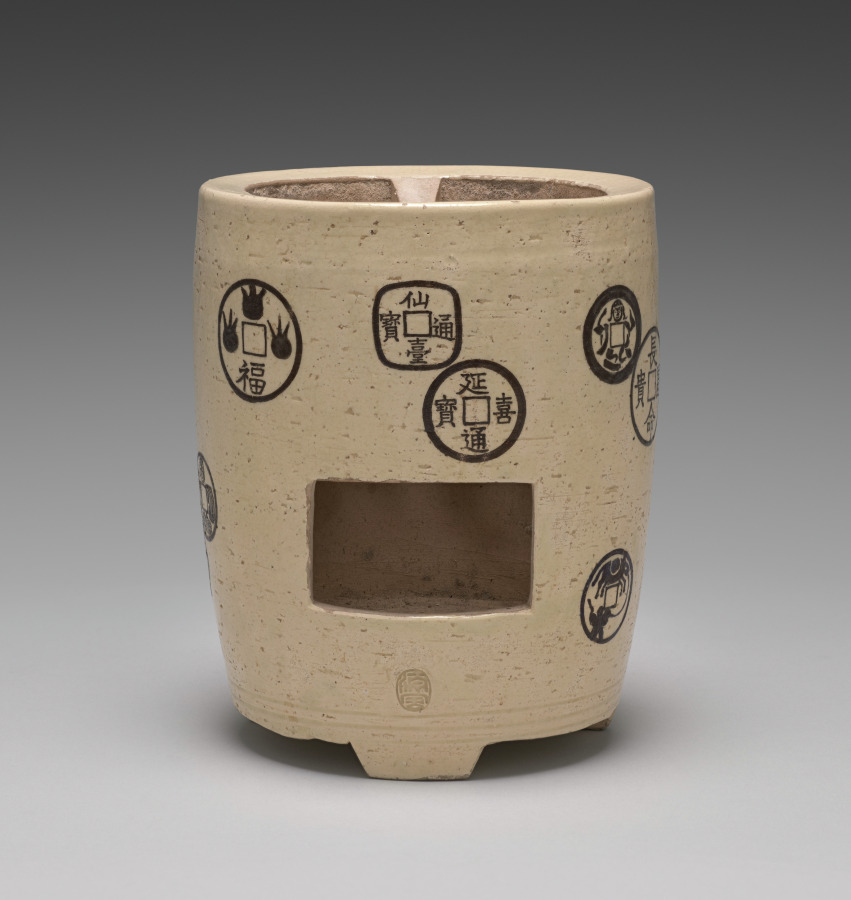
Seifū Yohei III, Brazier with Coins Motif, 1893–1914, Stoneware with underglaze iron oxide designs and crackling. The Cleveland Museum of Art, Gift of James and Christine Heusinger, accession 2022.175.
Look closer: the body is a pale cylinder dotted with round old coins drawn in brown, with a square-cornered opening cut near the base like a small window. The museum catalogues it as a Brazier with Coins Motif by Seifū Yohei III, 1893 to 1914, stoneware with underglaze iron oxide and crackling, 16.5 cm high.
Image: The Cleveland Museum of Art, Open Access (CC0)
The coins on its body are cleverly chosen, the note says, because most older coins are round with a central hole, often square, which echoes the cylindrical form of the brazier with its rectilinear wind gate, the fūmon. The brazier is 16.5 centimetres high and 15.5 across, stoneware with underglaze iron oxide designs and crackling. It is a clear case of a fire stand designed for a different tradition from the matcha tea room, one in which a kettle is lowered onto prongs and the tea is steeped.
The Wikipedia article on the hibachi adds the household family. A hibachi, it says, is a traditional Japanese heating device, a round, cylindrical or box-shaped open-topped container made from or lined with a heatproof material, designed to hold burning charcoal, believed to date back to the Heian period. It heats by radiation and is too weak to warm a whole room; sometimes, the article says, people placed a tetsubin over the hibachi to boil water for tea. It warns that a hibachi must never be used in airtight rooms such as those in Western buildings, because of the risks of burning charcoal.
Rings, Rests and Feathers
Three small iron things serve the kettle. The first is the ring, the kan. The Wikipedia article says the ring is inserted into the lug on each side of the kama to carry it, to hang it over the ro, or both. The Metropolitan Museum catalogues rings to lift a kettle, dated to about 1775, in iron; the one illustrated in its record is 7.6 centimetres in diameter, from the Fletcher Fund of 1925. The museum catalogues the rings as objects in their own right, which is a reminder that a ring and its kettle are separate things.
The second is the lid rest, the futaoki. JAANUS defines it as a stand for the lid of a tea ceremony kettle, made of ceramic, bamboo or metal. It holds the lid when set on the kettle and supports the dipper end of the ladle, the hishaku, and a bamboo one is called a hikikiri. The placement of the bamboo node differs by season: with a portable brazier the node sits near the top, and with a fixed hearth it sits in the middle. The Metropolitan Museum's example is an iron kettle-lid rest of the eighteenth century, 5.1 centimetres high and 7 wide.
The third is the brush that sweeps the ash. The feather brush in the museum's group is described in the companion chapter on the room, and the Metropolitan Museum also catalogues an eighteenth-century iron piece named a fire-iron, 10.8 centimetres high and 22.9 across, a term that the sources consulted do not explain. A reader should treat these pieces as the supporting cast of the kettle and not as ornament; their wear and their fit are as much a mark of an assembled set as the kettle itself.
The Wind in the Pines
The Issoan Tea blog, reporting a lecture by a teacher at the Midorikai, lists the stages of the boil in the kama. The first is silent, the water cold and the kettle wet, with perhaps a slight hiss as water evaporates from the surface. Then come the crab eyes, occasional small sounds matching small bubbles around the rim; the nami, a sound like distant waves; the fish eyes, with larger bubbles rising from the centre and sounds growing louder, closer together and more regular; the worms crying, sometimes a squeaking, as the bubbles form a string of pearls from the bottom of the kettle to the top; and then the matsukaze, the wind in the pine trees, which is the familiar sound of the water at the stage used for thick tea. The last stage is the raime, thunder rolling, the full boil with steam escaping from the lid.
Diagram by Japonista. Stage names after the Issoan Tea blog's report of a teacher's lecture; bar heights are only a visual ladder, not measurements.
Look closer: the bars climb from left to right as the water heats, and the dark red bar is matsukaze, the stage used for thick tea; the last bar is the full boil.
Diagram by Japonista
The blog says thick tea is made at about 80 degrees Celsius, the matsukaze stage, and thin tea at about 70. If the water is too hot, it adds, cold water is added from the water jar; if it is not hot enough, the heat cannot be raised by adjusting the charcoal, so the host listens to the kettle. It also repeats a rule it attributes to Rikyū, that the charcoal is laid so as to boil the water: charcoal placed farther apart lets air in so the fire burns hotter and faster, and charcoal placed closer together has less circulation, so the water takes longer to boil. The temperatures are the blog's report of one teacher's lecture, and they are given here as attributed.
The Seattle Japanese Garden describes the same sound more briefly. It says matsukaze, pine wind, is the final of five stages in boiling water for tea, when the water has reached its best temperature and the host and guests name the stage with a poetic word. The sound is a quiet, steaming whistle, written as shun, shun, resembling a breeze through a grove of pine trees. It states that the chanoyu kettle is a special iron pot with a thin piece of iron fitted to its bottom, and that the slight gap between the two creates a gentle whistle when the water reaches around 190 degrees Fahrenheit. The garden's page describes listening to such a sound as an active behaviour that requires silence.
Nambu Iron and the Tetsubin
The Google Arts and Culture exhibit on Nambu Tekki, prepared with Kyoto Women's University and written and supervised by the chief curator of the Iwate Museum of Art, describes a traditional cast ironwork craft from present-day Iwate Prefecture, known for tetsubin and for chagama. The name comes from the Nambu clan, which built a castle in Morioka and ruled the region in the early Edo period. Morioka had iron sand, clay, charcoal and lacquer, all needed for iron making. In the mid-seventeenth century the Nambu clan invited kettle makers from Kyoto to make chagama, which the exhibit identifies as the origin of Nambu Tekki, and it also invited cast ironworkers from Kyoto and Kōshū and kept them in the domain. Mizusawa, in the south of Iwate, now part of Ōshū, has an older iron casting tradition that the exhibit dates to the Ōshū Fujiwara family in Hiraizumi in the late Heian period.

Covered Tea Kettle, 1615–1868, iron. The Cleveland Museum of Art, Gift of Western Reserve Academy, accession 1955.558.
Look closer: a high handle arches over a squat kettle whose body is cast with a gnarled tree and small figures in relief, and a red-brown lid sits on the top. The museum catalogues it as a Covered Tea Kettle, Edo period, 1615 to 1868, iron, 22.9 cm tall; it is a spouted kettle of the family that the tetsubin belongs to.
Image: The Cleveland Museum of Art, Open Access (CC0)
The exhibit names four craftsman families retained by the clan, the Koizumi, Suzuki, Arisaka and Fujita. Around 1750, it says, the third Koizumi Nizaemon conceived a small kettle with a handle and a pouring spout, more practical for outdoor tea gatherings than the chagama, and this is considered the origin of the tetsubin. Iron conducts heat better than the ceramic kettles previously used to boil water, which helped the tetsubin gain popularity; and in the late nineteenth century a rust-prevention process was adopted and Nambu tetsubin spread widely. A design book, the Tetsubinmoyo-shu, is dated to 1867, and each workshop keeps its own designs, passed down through generations.
The exhibit also tells the making in eight steps. A mould is made from a drawing, with sand packed in a cylindrical wooden frame; the core forms the interior and is made 2 millimetres smaller in radius than the outer mould, the gap setting the wall thickness; the hailstone dots, arare, are stamped one by one into the moist mould with a rod, and some kettles have about 2,000 of them; the mould is fired at 800 to 1,000 degrees Celsius; iron is melted to about 1,500 degrees and poured; the casting is removed while still glowing red and cooled to silvery grey, and the caster taps it with a hammer and listens to check the thickness; the kettle is fired again in charcoal at 900 degrees to form an oxide film inside, a rust-preventing process the exhibit calls kanake-dome, said to be unique to Nambu Tekki; and the surface is lacquered with a brush of bundled water grass and coated with a rust-preventing liquid made from steel bits in acetic acid and brewed tea.
The craft was broken by the Meiji Restoration, which abolished the domains and left Morioka and Mizusawa without clan patronage. Railways and wider markets helped a revival, and exhibitions restored national recognition. In 1914 Nambu Toshiatsu, the former head of the Morioka clan, founded the Nambu Casting Institute to improve quality. In 1938, the exhibit says, regulations required the collection of iron and steel objects and workshops were barred from making kettles; local craftsmen formed a group to preserve the tradition, which allowed it to survive the war. Postwar demand fell as lifestyles changed and as aluminium and stainless steel spread, and the exhibit says a law of 1974 for the promotion of traditional crafts made Nambu tetsubin the first craft officially designated as a traditional craft of Japan.
Japan Objects, in an article of June 2023, tells the story in its own words. It says there were two historic types: Mizusawa ironware, mostly daily goods and some shrine items, thought to date back over 900 years, and Morioka ironware, which developed in the Edo period to meet demand for teapots and kettles. The two were both called Nambu ironware around 1960. It says that in 1908 the emperor saw the production process during a visit to Iwate, which drew newspaper coverage and boosted popularity. It names Iwachu, founded in 1900, Oigen, a fifth-generation producer with over 160 years in business, and Itchu-do as makers.
The Foundries of Yamagata
The Wikipedia article on the tetsubin says that Iwate and Yamagata prefectures are best known for producing tetsubin and iron teapots. A Japanese government craft page on Yamagata casting gives a tradition of about 900 years: it says foundry workers who accompanied Minamoto no Yoriyoshi on a campaign to suppress a rebellion in the Yamagata area in the Heian period found local sand and soil suited to casting, and some of them stayed and began the craft. It adds that about 400 years ago seventeen foundry workers were gathered in one place, and that the town was named Dōmachi.
The page lists the products as tea ceremony kettles, which it says make Yamagata Japan's top producer, iron kettles and pots, bronze vases, ornaments, temple bells and Buddhist statues, and the techniques as sand moulds, pouring molten iron at 1,300 to 1,500 degrees Celsius, and lacquer colouring. It names 17 February 1975 as the date of designation. The page is inconsistent in places, for example in saying that the process has more than sixty steps while describing only six, and the foundation story is an account of origin and not a documented date, so the chapter attributes it and does not extend it.
Tetsubin or Iron Teapot
The Wikipedia article draws the most important distinction for a buyer. Outside Japan, it says, a common variant is a cast-iron teapot that resembles a tetsubin but is glazed with enamel on the inside, which makes it more practical for brewing tea. It cannot be used to heat water, because doing so would break the enamel coating. In the West these are commonly called tetsubin, but the Japanese call them tetsukyūsu, iron teapots, to distinguish them from kettles. They often come with a tea strainer that fits inside.
Japan Objects, in its Nambu article, makes the same point from the maker's side: kettles can be placed directly on a flame, whereas teapots cannot and are only for holding tea; teapots are usually enamel-coated inside, while kettles are not. It says kettles need seasoning before first use, whereas teapots need only a rinse. The consequence for a collector is simple: an object that looks like a tetsubin should be asked what is inside it. A kettle with a bare interior is a boiling vessel and is also a vessel that can rust; an enamelled one is a teapot and should never go over a flame.
Keeping Iron Sound
The sources on care are mostly retailers and craft-promotion pages, and the chapter gives them as such. Japan Objects advises that pieces should be kept from getting too wet to prevent rust; that a trivet or heatproof mat should always be used; that a microwave, a dishwasher and harsh detergents should never be used; and that oven mitts or protective gear should be used to handle kettles. For a new kettle it says to boil water in the kettle, pour it out, and repeat until the water runs clear. The Nambu exhibit's own description of the rust-preventing steps suggests why: the inside of a traditional kettle is protected by a film formed in firing, which one does not want to scour away.
The same page says the kettle keeps tea warm longer and may improve its flavour, and that minerals from the iron seep into the tea, giving a sweeter, rounder taste. It adds that some supporters claim tea brewed this way can help with iron deficiency, and it presents that as a belief and not a verified benefit. This chapter repeats it as the site's claim and no more.
For an antique, the care question is different. A kettle of the Muromachi or Momoyama period is a museum object, and the Cleveland note shows how much of its value lies in its surface. The practical rule that follows is to ask a specialist before cleaning, using or heating an old kettle, and to treat the kettle on a collector's shelf as an object to be looked after rather than used. This is the advice of the chapter and not a claim attributed to any source.
Kettles in the Present Day
The craft survives, in two forms. In the tea world, the kettle makers of Kyoto continue; the Ōnishi family's current head took the name in 1993, and the family's workshop and museum stand at the corner of the Sanjō and Kamanza streets, according to the Japanese Wiki Corpus. In the north, Nambu Tekki and Yamagata casting are national traditional crafts, and the Google Arts exhibit says modern-design teapots have gained overseas recognition.
The household tetsubin has become a fashionable object abroad, and the Wikipedia article on the tetsubin records the confusion that has followed it: the enamel-lined teapot sold in the West under its name. Japan Objects says pieces are still handmade through a labour-intensive process of ten steps, and it names makers it considers good. The Google Arts exhibit says each workshop keeps its own designs, so a signed or marked kettle can often be traced to a workshop; the sources consulted do not set out which marks belong to which, and a reader should ask the maker or a specialist.
For visitors, the Fukuoka tourism page gives practical directions to the Ashiya kettle museum village: Ashiya-kama-no-sato in Ashiya Town, about 40 minutes by car from JR Kokura Station or 70 minutes from JR Hakata Station, with parking available. The page gives a telephone number, which a visitor should confirm before travelling, and the Kyoto National Museum's chanoyu guide lists a Muromachi kettle as on view from 8 October to 4 December in the year of the guide. Museums change their displays, so the visitor should check the museum's own pages.
What to Ask of a Kettle
The questions that the sources suggest are plain. The first is what the kettle is: a kama for the tea room, a tetsubin for pouring, or an iron teapot with an enamel lining. The second is which fire it was cast for, since JAANUS says kettles for the portable brazier are smaller than those for the hearth. The third is the lid: JAANUS says cast iron lids are forged with the body so that they fit perfectly, which means a lid that does not fit well is a matter the description should explain, and the lid's shape has a name that should be given. The fourth is the rings and lugs, and whether the rings are the kettle's own; the Metropolitan Museum catalogues them as separate objects.
The fifth is the surface and its history. The Cleveland note shows that worn, coarse metal was cherished by tea masters, so wear is not in itself a fault. A reader should still ask what has been done to the surface: JAANUS names the finishes arehada and sunahada as made finishes, and the Nambu exhibit describes lacquer and a rust-preventing coat as part of the process. A kettle that has been recoated has a different history from one that has not, and the difference should be stated in the description.
The sixth is the maker, the school and the box. The Ōnishi family name has passed through sixteen heads, according to the Japanese Wiki Corpus; the Metropolitan Museum's maker, Gorōzaemon, is a particular man with a particular lifetime, 1594 to 1692. A box inscription may say who made a piece and for whom, and the journal essay on tomobako and hakogaki explains how to read one. Where a dealer or a catalogue attributes a kettle to a famous master, the claim should be read as attributed unless the record shows its basis; the museum records used in this chapter are the standard to which such claims should be held.
The last question is purpose. A tea kettle for use should be examined for its interior and for rust; one for display should be looked after as an antique. The concierge desk will say in plain words what an object does and does not claim, including whether a kettle is a boiling vessel or an ornament.
Tales of the Iron
The first story is of a priest's kettle. JAANUS says the earliest tea kettle is said to have been made for Myōe, a priest who lived from 1173 to 1232, at Kōzanji, by a master at Ashiya. It is a story of beginnings, told at the start of the entry on kettles, and it is attached to a famous name because that is how origins were remembered.
The second is of a kettle dated by its own shoulder. The Osaka City Museum's Tenmyō kettle carries inscriptions on the shoulder that suggest it was made on 8 December 1352, for a ceremony marking the Buddha's enlightenment, for a sub-temple of Gokuraku-ji. A tea kettle is a rare thing to be dated in so exact a fashion, and the record calls it the sole extant dated early Tenmyō piece.
The third is of a broken skirt. The Cleveland crane kettle's jagged lower edge was called attractively damaged by a museum director, and tea masters valued the worn, coarse surface for its humility. The imperfection is the point.
The fourth is of the sound that has seven names. Tea teachers name the stages of the boil in the poetry of nature: crab eyes, fish eyes, worms crying, the wind in the pines, thunder. The teacher whose lecture the Issoan blog reports says the tea room has no clocks, so the kettle serves as a timing device.
The fifth is of an emperor's visit. Japan Objects says that in 1908 the emperor saw the production process during a visit to Iwate, which drew newspaper coverage and boosted the popularity of Nambu ironware. The story is told by a craft-promotion site and is given here as its claim.
Fun Facts
- The tea-ceremony kettle has no spout; the host ladles the water out.
- Some Nambu kettles carry about 2,000 hand-stamped hailstone dots, according to the Google Arts exhibit.
- The wall of a Nambu kettle is set by a gap of 2 millimetres between the core and the outer mould.
- A Fukuoka page says Ashiya kettles stopped being made around the early Edo period.
- The only dated early Tenmyō kettle known to the Osaka City Museum is the 1352 kettle for Gokuraku-ji.
- An iron lid is cast with its body so that the two fit exactly, according to JAANUS.
- The Wikipedia article on the tetsubin says a small one may hold about 0.5 litres and a large one about 5 litres.
- The stage of the boil used for thick tea is named for wind in pine trees.
- The word yakkan names a close relative of the tetsubin made of copper.
- Sencha has its own brazier, the ryōro, with prongs on which the kettle is lowered.
A Timeline of the Kettle
Dates are given as the sources give them, with the source named. Where an event is only a tradition, it is marked as such.
| Date | Event | Source |
|---|---|---|
| 1173 to 1232 | The dates of the priest Myōe, for whom the earliest tea kettle is said to have been made at Kōzanji by a master at Ashiya. | JAANUS, Chanoyugama |
| Nanboku-chō, 1352 | A dated Tenmyō kettle is made for a sub-temple of Gokuraku-ji, the only extant dated early Tenmyō piece. | Osaka City Museum of Fine Arts, via Google Arts and Culture |
| Muromachi period | Ashiya and Tenmyō kettles are the most in demand until the period's end. | JAANUS |
| End of the Muromachi period | Founding technicians of tea kettles appear. | Japanese Wiki Corpus, Kamashi |
| 16th century | Tenmyō kettles such as the Hikone semehimo-gama are made. | Hikone Castle Museum |
| Azuchi-Momoyama period | Nishimura Dōnin and Tsuji Yojirō are the well-known kettle masters of Kyoto. | Japanese Wiki Corpus, Kamashi |
| Early Edo period | Production of Ashiya kettles stops. | Crossroad Fukuoka |
| 1594 to 1692 | The dates given by the Metropolitan Museum for Ōnishi Gorōzaemon, who made kettles for Furuta Oribe and Kobori Enshū. | The Metropolitan Museum of Art |
| Mid-17th century | The Nambu clan invites Kyoto kettle makers to Morioka. | Google Arts and Culture, Nambu Tekki |
| About 1750 | Koizumi Nizaemon the third conceives a small spouted kettle, the origin of the tetsubin. | Google Arts and Culture, Nambu Tekki |
| 1867 | The Tetsubinmoyo-shu design collection is dated to this year. | Google Arts and Culture, Nambu Tekki |
| Late 19th century | A rust-prevention process is adopted and Nambu tetsubin spread widely. | Google Arts and Culture, Nambu Tekki |
| 1914 | The Nambu Casting Institute is founded by Nambu Toshiatsu. | Google Arts and Culture, Nambu Tekki |
| 1938 | Regulations require collection of iron and steel objects and bar workshops from making kettles. | Google Arts and Culture, Nambu Tekki |
| 1993 | The sixteenth Ōnishi Seiemon takes the name after his father retires. | Japanese Wiki Corpus, Onishi Seiemon |
A Glossary of the Kettle
The words of the chapter, with the sense the sources give them.
| Term | Meaning |
|---|---|
| Kama, chagama | 釜, 茶釜. The kettle that heats the water in tea; usually cast iron, sometimes copper. |
| Tetsubin | 鉄瓶. A cast-iron kettle with a spout, lid and arched handle, for boiling and pouring water. |
| Tedorigama | 手取釜. A spouted, handled kettle of Rikyū's time, from which one Japanese source says the tetsubin developed. |
| Furo | 風炉. The portable brazier of the warm months; bronze, iron or lacquered clay. |
| Ro | 炉. The sunken hearth of the cold months. |
| Robuchi | 炉縁. The box-like frame round the sunken hearth. |
| Kan | 鐶. The metal ring or handle used to lift or hang a kettle. |
| Kantsuki | 鐶付. The lug on the kettle's shoulder that carries the ring. |
| Futaoki | 蓋置. A rest for the kettle lid and the end of the ladle; ceramic, bamboo or metal. |
| Hikikiri | 引切. A bamboo lid rest. |
| Ko-ita | 小板. The lacquered board under a clay brazier. |
| Sengawara | 専瓦. The paving tile under an iron brazier. |
| Shin-nari | 真形. The graceful, upright form of the early Ashiya kettles. |
| Arare | 霰. Hailstone dots, the raised pattern of Nambu kettles. |
| Arehada, sunahada | 荒肌, 砂肌. Rough skin and sandy skin, surface finishes named by JAANUS. |
| Semehimo | 責紐. A kettle with lugs placed near the lid, as on a tea jar, for tying it shut. |
| Kamashi | 釜師. A kettle maker. |
| Kanake-dome | 金気止め. The firing that forms an oxide film inside a Nambu kettle to stop rust. |
| Matsukaze | 松風. Wind in the pines, the sound of water at the stage used for thick tea. |
| Tetsukyūsu | 鉄急須. An iron teapot, enamelled inside; not for heating water. |
| Ryōro | 涼炉. A tall pottery brazier used to heat the water for sencha. |
More Kettles and Their Fire
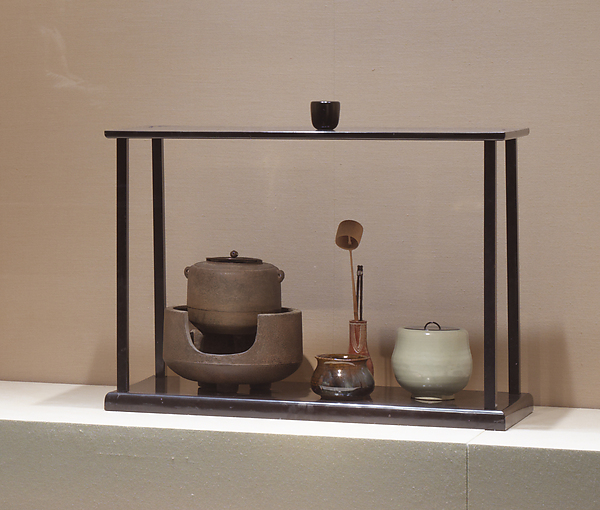
Fire-iron, 18th century, Iron. The Metropolitan Museum of Art, Fletcher Fund, 1925, accession 25.215.31.
Look closer: a squat kettle sits on a brazier under a black frame, with a copper ladle and a pale jar on the shelf beside it. The museum records the object as a Fire-iron, iron, eighteenth century, 10.8 cm high and 22.9 cm across, from the Fletcher Fund of 1925; the photograph shows it in a group with other pieces.
Image: The Metropolitan Museum of Art, Open Access (CC0)
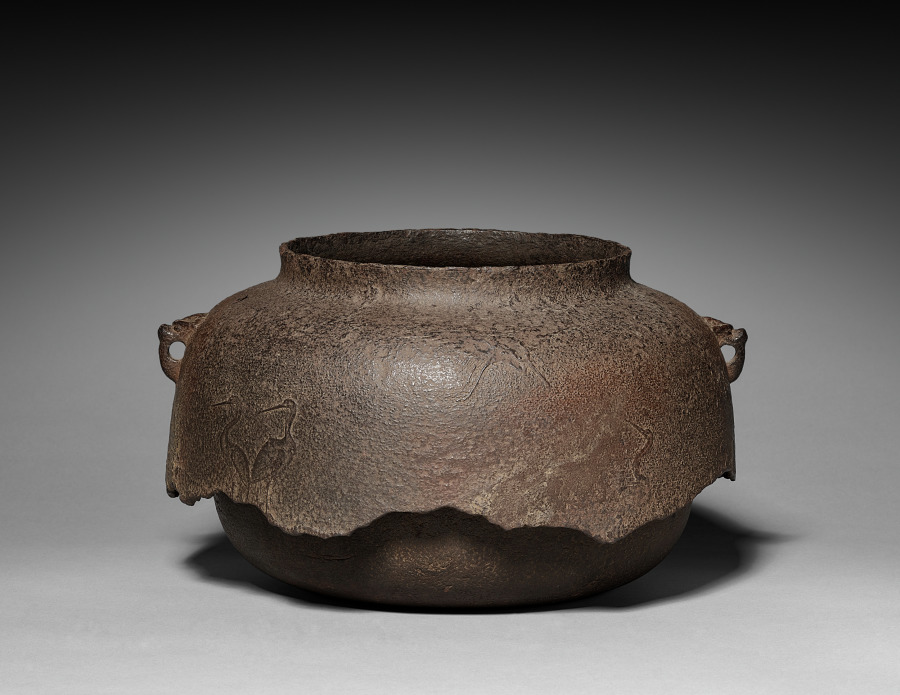
Kettle with Crane Design, 1392–1573, iron. The Cleveland Museum of Art, Purchase from the J. H. Wade Fund, accession 1980.11.a.
Look closer: the kettle is shown without its lid: a broad dark body with a plain rolled mouth, and its lower edge broken into a jagged skirt. The museum catalogues the kettle body as part of the same crane kettle of the Muromachi period.
Image: The Cleveland Museum of Art, Open Access (CC0)
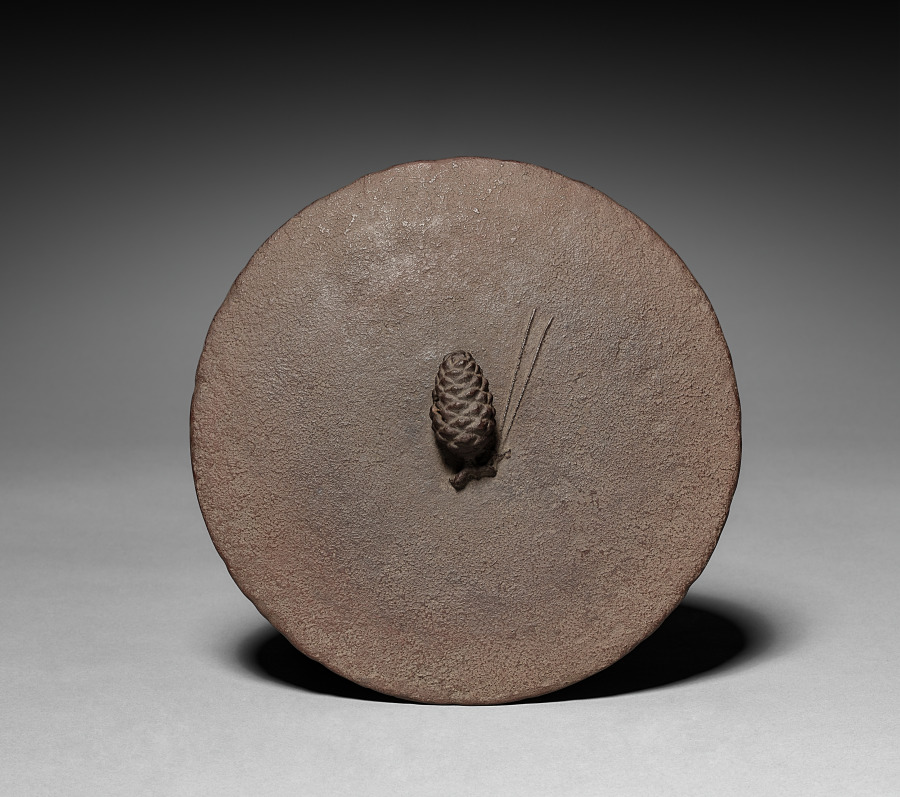
Kettle with Crane Design (lid), 1392–1573, iron. The Cleveland Museum of Art, Purchase from the J. H. Wade Fund, accession 1980.11.b.
Look closer: the lid is a rounded disc with a small knob at the centre and a rough, scarred surface. The museum catalogues it as the lid of the Kettle with Crane Design, Muromachi period, 1392 to 1573, iron.
Image: The Cleveland Museum of Art, Open Access (CC0)
Tetsubin and Kettles on the Shelf
Iron kettles, tetsubin and tea-room pieces pass through the house. The concierge desk will say in plain words what each is, which fire it suits, and what the record does and does not show. The atlas of utensils and the glossary of tea utensils are companions to this chapter.
Answered plainly
What is the difference between a tetsubin and a chagama?
A chagama is the lidded, spoutless kettle of the tea room; a tetsubin has a spout and an arched handle. Wikipedia says one Japanese source derives the tetsubin from the tedorigama, a spouted kettle of Rikyū's time.
Can you boil water in a tetsubin?
A true tetsubin, cast iron with a bare interior, is made for heating water over charcoal. An enamel-lined iron teapot, called a tetsukyūsu in Japan, cannot be used to heat water, because the enamel would break.
Why is the kettle important in the tea ceremony?
JAANUS calls it the most essential vessel of the ceremony. Hosts also use its sound to judge the water; a teacher quoted by the Issoan Tea blog says the kettle serves as a timing device.
What is matsukaze?
The wind in the pines, the sound of the water at the stage used for thick tea. Two sources count the stages of the boil differently, so the number of stages is not given here.
What is the difference between furo and ro?
The furo is a portable brazier used in the warmer months; the ro is a sunken hearth used in the colder ones. Kettles for the furo are slightly smaller than those for the ro.
Where do the oldest tea kettles come from?
JAANUS names Ashiya in Fukuoka and Tenmyō in Sano, Tochigi, as the most demanded kettle towns until the end of the Muromachi period.
Who invented the tetsubin?
The Nambu exhibit credits the third Koizumi Nizaemon with conceiving the small spouted kettle around 1750 in Morioka. Wikipedia says the historical origin is uncertain.
What is Nambu ironware?
A traditional cast ironwork craft from Iwate Prefecture, known for tetsubin and chagama, named for the Nambu clan, which ruled from Morioka.
How do you look after an iron kettle?
Japan Objects advises keeping it from getting too wet, using a trivet, avoiding microwaves, dishwashers and harsh detergents, and seasoning a new kettle by boiling and discarding water until it runs clear.
Does boiling water in iron add iron to tea?
Japan Objects says some supporters claim so, and presents it as a belief and not a verified benefit. This chapter does not endorse the claim.
Are antique kettles safe to use?
The sources do not say. An antique kettle is a museum-grade object, and a specialist should be asked before it is cleaned, heated or used.
Where next
Sources and image credits
- Chagama, Wikipedia
- Tetsubin, Wikipedia
- Hibachi, Wikipedia
- Wabi-cha, Wikipedia
- Japanese tea ceremony, Wikipedia
- Chanoyugama, JAANUS
- Furo, JAANUS
- Futaoki, JAANUS
- Nambu Tekki, Google Arts and Culture, Kyoto Women's University and Iwate Museum of Art
- Nambu, 10 Things to Know, Japan Objects
- Yamagata Imono, Japan traditional crafts page
- Tea Kettle of Odare Type, Temmyo Ware, Osaka City Museum of Fine Arts via Google Arts and Culture
- Semehimo Kettle, Hikone Castle Museum
- The elusive and famous Ashiya-kama, Crossroad Fukuoka
- Chanoyu guide, Kyoto National Museum
- Kamashi, Japanese Wiki Corpus
- Tsuji Yojiro, Japanese Wiki Corpus
- Onishi Seiemon, Japanese Wiki Corpus
- The sound of boiling water, Issoan Tea
- Way of Tea and the Art of Listening, Seattle Japanese Garden
- Object record, Tray with rice stalks and a grasshopper on a tea kettle, The Metropolitan Museum of Art
- Object record, Tenmyō Kettle, Named “Taya Itome”, The Metropolitan Museum of Art
- Object record, Kettle with Crane Design, The Cleveland Museum of Art
- Object record, Kettle (Kama) with Willow and Cherry, The Metropolitan Museum of Art
- Object record, Kettle (Kama) and Brazier (Furo), The Metropolitan Museum of Art
- Object record, Brazier with Coins Motif, The Cleveland Museum of Art
- Object record, Covered Tea Kettle, The Cleveland Museum of Art
- Object record, Fire-iron, The Metropolitan Museum of Art
- Object record, Kettle with Crane Design, The Cleveland Museum of Art
- Object record, Kettle with Crane Design (lid), The Cleveland Museum of Art
Last reviewed 28 October 2026. Pictures, where shown, are public-domain or open-access and credited beneath each one.
Looking for a kettle, a tetsubin or a brazier? The concierge desk replies within one to three business days.
Browse tetsubin, chagama and tea ceremony pieces · Make a private request
Private concierge
Looking for something in particular?
Describe the piece or the project you have in mind. A senior advisor in Tokyo reads every case file personally and replies within two business days, with fees set out in writing before any work begins.