
Chaire and Natsume: Two Caddies for Powdered Tea
Chanoyu Almanac · Chaki, Shifuku, Meibutsu
Chaire and Natsume: Two Caddies for Powdered Tea
Before the whisk moves, the powder has to be somewhere. In the tea room it waits in a small lidded vessel, of clay for thick tea and of lacquer for thin, and the guests look at it as closely as they look at the bowl. This chapter names the shapes of the ceramic caddy, follows its kilns and its ivory lid and silk bag, tells of the caddies that warlords prized and the two that a shogun's tea master named, and then turns to the lacquered jujube, its sizes, its surfaces and its care.
Fact sheet
At a glance
- Two kinds of caddy. Ceramic chaire hold the matcha for thick tea; lacquered natsume and other usucha-ki hold the matcha for thin tea.
- A shape for every name. The eggplant, the apple, the shoulder and the big ocean are the shapes by which a Chinese-style chaire is sorted.
- Sorted by kiln. Japanese chaire are named for kilns and potters, with Seto the original and Bizen, Satsuma, Shigaraki and others among the provincial wares.
- Dressed for the room. A chaire has a lid of ivory or an ivory-like material, a silk shifuku and often layers of wooden boxes with inscriptions.
- A lacquerer's jujube. The natsume is credited to the lacquerer Haneda Gorō and now comes in sizes, joins and finishes from plain black to gold.
The Small Jar Guests Ask to See
A tea caddy is a small thing that the whole room looks at. The Wikipedia article on chaki says that the caddies it means are relatively small lidded containers and not storage vessels. In preparing a tea-making procedure, it says, the host carefully selects the caddy for the matcha and, as an important part of the preparations, neatly places the matcha into it. The caddy is chosen to harmonise with the other equipment used for the occasion, and it is among the items the guests pay particular attention to. The Wikipedia article on the tea ceremony adds that at the end of the gathering each guest in turn examines each item, including the tea caddy and the tea scoop, to show respect and admiration for the host.

Tea Caddy (Chaire), late 16th century, Stoneware with natural ash glaze (Ko-Seto ware). The Metropolitan Museum of Art, H. O. Havemeyer Collection, Bequest of Mrs. H. O. Havemeyer, 1929, accession 29.100.646.
Look closer: a narrow, slightly tapering caddy stands upright, its dark brown body streaked with amber glaze that pools and drips down one side, topped by a small pale lid. The museum catalogues it as a Tea Caddy (Chaire), late 16th century, stoneware with natural ash glaze (Ko-Seto ware), 9.2 cm high and 6.4 cm in diameter, from the H. O. Havemeyer Collection.
Image: The Metropolitan Museum of Art, Open Access (CC0)
There are two families. Wikipedia says that ceramic caddies are normally for thick tea, koicha, and are called chaire, the tea container, or koicha-ki. Caddies of wood or bamboo are normally for thin tea, usucha, and are called usucha-ki, often shortened to usuki. Because they commonly take the shape called natsume, the jujube, usucha-ki in general are loosely called natsume. Tezumi, a tea retailer, says the same of the two: natsume are lacquered wooden containers for matcha used in usucha, and ceramic chaire hold higher-grade matcha for koicha. The chano-yu.com page calls the chaire the most expensive tea ceremony tool, and the statement is the page's.
The standing of the chaire in Japanese history is old. The Wikipedia article on chaki quotes A. L. Sadler's Cha-no-yu of 1962, which says that among the military class the most precious possessions were first tea caddies, second writings and third swords, since this was the order in which the shogun presented them to someone he wished to honour. The chano-yu.com page says that during wartime a daimyo would give a chaire as a reward to a samurai who had performed a deed of arms. The two sources are far apart in kind, one a scholarly handbook and the other a hobbyist's page, but they say the same thing about what a caddy meant.
This chapter takes the ceramic caddy first. It gives the words, follows the history from a Chinese medicine bottle to a named treasure, sets out the shapes in a diagram and a table, runs through the kilns, and describes the ivory lid, the silk bag and the box. It tells of the three caddies that warlords prized and of the two that Kobori Enshū named, and follows the powder back to the jar from which it comes. It then turns to the natsume, its origin, its sizes and joins in a second diagram, its lacquer, its use and its care. The sources are Wikipedia, JAANUS, Tezumi, the chano-yu.com and Tealao pages, the Takatori Miraku Kiln, the MOA Museum of Art, the University of Michigan Museum of Art, the Metropolitan Museum of Art and two pages on the tea jar. Retailers and kilns are named wherever they are used and treated as attributed.
Chaki, Chaire, Usuchaki and Natsume
The first difficulty is vocabulary, and the sources are careful about it. Wikipedia says that chaki, literally tea implement, has three senses in the vocabulary of the tea ceremony. In the widest it means any implement used in the practice of chanoyu. More narrowly it means the caddy for the powdered tea, and usually it implies the caddies used in the procedures for making thin tea. The article on tea utensils says that tea containers are the small lidded caddies for the matcha used in the tea-making procedure, and that all containers for thin tea may be called usucha-ki. Tealao calls chaire a subcategory of chaki beside the natsume.
The same article sorts the ceramic caddies by country of origin: import, karamono; Japan, wamono; and island-made, shimamono. The wamono are classified by potter, region or kiln, and all are also classified according to shape. For the natsume, the article says, the classification is by size or shape. A caddy may therefore be described in three ways at once: by where it was made, by who made it, and by what it looks like. A description that gives only one has left the reader to guess the others.
The two kinds of caddy are not interchangeable, and a gathering does not pick between them freely. Tealao says that chaire have smaller lids than natsume and that they hold the higher-quality matcha. The Wikipedia article on matcha says that in the ceremonies the matcha for koicha and for usucha is stored in chaire and natsume respectively, that the matcha may be sifted before use, and that it is scooped out by the chashaku, the tea scoop, into the chawan, the bowl, before it is whisked. The caddy is thus the first stop of the powder after the mill, and the scoop and the whisk follow it.
From Medicine Bottle to Meibutsu
The Wikipedia article on chaki, citing Sadler, says that chaire were originally used in China in the Song period as bottles for oil or medicine, and were imported into Japan for use as tea caddies up to the end of the Ashikaga period or the start of the Tokugawa. Tealao tells a similar story with a reason attached: in China, it says, doctors originally used such jars as bottles for oil or medicine, and since tea was considered medicine it was often stored in them. Buddhist monks adopted tea into their practice, the page says, and when monks travelled to Japan they brought tea with them. Because the Japanese medicine containers differed from the Chinese ones, the imported containers were literally called cha-ire, tea container.

Tea Caddy (Chaire), late 16th century, Stoneware with natural ash glaze (Bizen ware). The Metropolitan Museum of Art, Mary Griggs Burke Collection, Gift of the Mary and Jackson Burke Foundation, 2015, accession 2015.300.261a, b.
Look closer: a squat, barrel-shaped caddy in warm red-brown clay, with a faint horizontal seam round its middle and a small domed ivory lid on top. The museum catalogues it as a Tea Caddy (Chaire), late 16th century, stoneware with natural ash glaze (Bizen ware), 7.6 cm high, from the Mary Griggs Burke Collection, a gift of the Mary and Jackson Burke Foundation.
Image: The Metropolitan Museum of Art, Open Access (CC0)
The caddy appears in the oldest manuals of connoisseurship. The Wikipedia article on matcha says that illustrations of matcha jars, in this case referring to tea caddies, appear in the Kundaikan sōchōki, a Muromachi-period manual on art connoisseurship and interior decoration compiled by Nōami and Sōami for the shogun Ashikaga Yoshimasa. The Nōami version dates from 1476 and the Sōami from 1511, and the article takes the illustrations as showing that the word matcha was already in use in the late fifteenth century. It adds that in the oldest surviving manuscript of the Sōami version, dated to 1559, the characters for matcha are glossed with the reading suricha tsubo, which may mean that the word was once pronounced suricha.
The article on special tea utensils sets out how such objects became treasures. At the start of the Muromachi period, it says, growing demand for tea led to an appreciation of locally made wares, where before the aristocracy had mainly valued Chinese goods from the Tang dynasty onward. The Ashikaga shoguns kept precious items, tea items among them, in a treasury called the Higashiyama Treasure, which was broken up after the shogunate fell. In the Warring States period Chinese tea wares became symbols of warlord power, and Oda Nobunaga and Toyotomi Hideyoshi collected many important items, often taken from defeated families or given as tribute. They displayed them to guests in the Golden Tea Room and at the Grand Kitano Tea Ceremony, using them to enhance their prestige. The article says that classification as a special utensil depended on more than value; it also depended on who possessed the item and how it was inherited.
The history of the natsume begins in the same period, and a later section tells it. The Takatori Miraku Kiln, in its own page on the shouldered caddy, says that the tea caddy has been the most esteemed utensil since the sixteenth century. That is a kiln's claim for its own product, and it fits the older statements.
Hatsuhana, Nitta and Narashiba
Three caddies stand above the rest in the accounts. The Takatori Miraku Kiln calls them the three great tea caddies of the world, Hatsuhana, Narashiba and Nitta, and says that they are recorded in the Yamanoue Sōji ki, a book on tea utensils by Yamanoue Sōji, a leading disciple of Sen no Rikyū. They were brought from China in the Sengoku period, the page says, and warlords valued them so highly that owning all three was taken as a mark of rule over Japan. The chano-yu.com page repeats the idea, saying that obtaining all three was said to be the same as obtaining the whole of Japan, and that Oda Nobunaga was the only one who could not obtain Narashiba, a name the page spells in two ways.
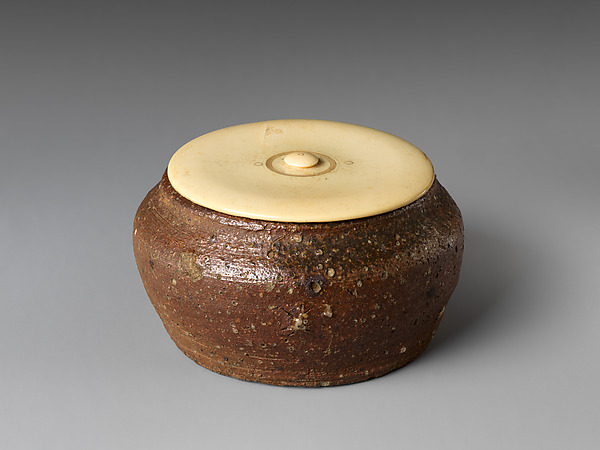
Tea Caddy (Chaire) in Taikai Shape, 16th century, Stoneware with natural ash glaze; ivory lid (Shigaraki type). The Metropolitan Museum of Art, Gift of Peggy and Richard M. Danziger, 2024, accession 2024.553.16a, b.
Look closer: a low, wide jar with a gently rounded shoulder, a speckled brown surface and a broad, flat ivory lid with a small knob. The museum catalogues it as a Tea Caddy (Chaire) in Taikai Shape, 16th century, stoneware with natural ash glaze and an ivory lid, of Shigaraki type, 5 cm high and 8 cm in diameter, a gift of Peggy and Richard M. Danziger, 2024.
Image: The Metropolitan Museum of Art, Open Access (CC0)
The Takatori page gives more. Several political figures, including Nobunaga, owned the caddies over time, and Toyotomi Hideyoshi is the only one known to have held all three at once. Nitta was reportedly damaged in the summer siege of Osaka Castle; on the order of Tokugawa Ieyasu its pieces were collected and repaired with lacquer, and it is now kept in the Shōkōkan Bunko Library at the Tokugawa Museum, according to the page. Hatsuhana, it says, is only about two millimetres thick, which the page calls astonishingly thin even by modern standards, and its thinness is central to the value of the shouldered caddy as a form. The page's own makers, the Miraku Kiln, claim to produce shouldered caddies about one and a half millimetres thick, finer than Hatsuhana; the claim is the kiln's.
The chano-yu.com page adds a legend about Hatsuhana, that it was according to tradition a perfumed oil caddy of Yang Guifei, and names the Tsukumo Nasu as a famous example of the eggplant shape. The Wikipedia article on special tea utensils lists the Tsukumo Kaminasu among the Warring States special utensils, with the three eggplant-shaped caddies it calls the Tenka San Nasu, and lists beside them a Shibata ido bowl, three tea jars named Shōka, Mikazuki and Matsushima, the Ankoku-ji caddy and a number of kettles and other pieces. The article gives no dates for any of the three caddies.
Eggplant, Apple and Shoulder
The Wikipedia article on chaki sorts the Chinese-style caddies by shape, and the diagram draws the shapes it names. The nasu is the eggplant, the bunrin the apple, the bunna a shape between the two, the katatsuki the one with protruding shoulders, the marutsubo the round jar, the taikai the big ocean, the tsurukubi the crane's neck and the shiribukura the bulging hip. The names are plain, and the table gives what the sources say of each.
Diagram by Japonista. Schematic; the names and glosses follow the Wikipedia article on chaki.
Look closer: seven small silhouettes stand on one line, each with a pale cap for its lid. The nasu swells in the middle, the bunrin is low and round, the katatsuki has a sharp shoulder and straight sides, the taikai is wide and flat, the tsurukubi has a long neck, the shiribukura is narrow at the top and broad at the bottom, and the marutsubo is a round jar.
Diagram by Japonista
Tealao says that the katatsuki is the most common shape and that two others, the daikai and the bunrin, are frequently seen. It lists rarer, later shapes, among them the tsurutsuki, yūteki, marutsubo, tsurukubi, hyōtan, mimitsuki, nasu, tegame, shiribari, naikai, suiteki and entsubo. Four of these, it says, with their kanji, are special: the suiteki (水滴), the tegame (手瓶), the yūteki (油滴) and the tsurutsuki (弦付). They are usually sold as a set, called the shiteki chaire, that shares one lid, and are used for usucha and not for koicha. There are no strict rules, the page says, but they are most commonly used when a black natsume serves for koicha, because two natsume in one offering of tea should be avoided.
The chano-yu.com page adds the lore of the two great shapes. Nasu, it says, are described as the masses and katatsuki as the great generals, and samurai especially favoured the katatsuki, reportedly because its shape resembles a warrior seated in seiza. The page tells the story, with the words so the story goes, that a man named Li Jin offered an apple to the Tang emperor Gaozong and was made an official, and that bunrin is therefore an elegant synonym for apple. It names specialty versions of the bunrin, Jukō, Honnōji, Hamuro and Chikushi, without saying what distinguishes them. The page's claims about samurai taste and about the apple are legends and are given as such.
| Shape | Kanji | What the sources say |
|---|---|---|
| Nasu | 茄子 | Wikipedia calls it the medium-sized eggplant caddy, named for its resemblance to an aubergine. The chano-yu.com page adds that it is generally round, plump at the bottom, with a narrow aperture, and that it is thought to have been an oil pot in China and was once the highest-grade Chinese tea container. |
| Bunrin | 文琳 | Wikipedia gives it as the apple shape. The chano-yu.com page calls bunrin an elegant word for apple, tells a story of a Tang official named for an apple, and describes a small pot with a fine shoulder and a low base, counted with the nasu among the finest Chinese tea containers. |
| Bunna | 文茄 | The apple-eggplant, which Wikipedia places between the nasu and the bunrin. |
| Katatsuki | 肩衝 | The protruding-shoulder caddy. Wikipedia and Tealao agree that it is the most common. The chano-yu.com page says its raised shoulders look like a shrug, and that the body widens a little from torso to waist before tapering at the base. |
| Marutsubo | 丸壺 | The round jar, in Wikipedia's list of karamono shapes. |
| Taikai | 大海 | The big ocean: a caddy that is wide in diameter and wide in the mouth for its height, with a smaller subtype called naikai or uchiumi (内海), according to Wikipedia. The chano-yu.com page adds short necks, horizontal shoulders and, on many, a continuous engraved line round the middle. |
| Tsurukubi | 鶴首 | The crane's neck, with a long slender neck. |
| Shiribukura | 尻膨 | The bulging hip, also written shirihari or shiribari (尻張): a caddy with a wide lower part. |
Seto and the Provincial Kilns
The wamono, the Japanese-made caddies, are sorted by kiln and by potter. Wikipedia says the kilns of Seto, in the old province of Owari, now part of Aichi Prefecture, are considered the original Japanese kilns to produce chaire, and so the caddies of Seto do not fall into the category called kuniyakimono, provincial ware. The various kilns of Kyoto are not regarded as provincial ware either. The kilns it lists beyond these are Karatsu, Satsuma, Shigaraki, Sobokai, Takatori, Tanba, Bizen, Shidoro and Zeze, and the potters Maemon, Genjūrō, Shinbei and Tōshirō I to IV. The table sets them beside the examples the Metropolitan Museum holds.
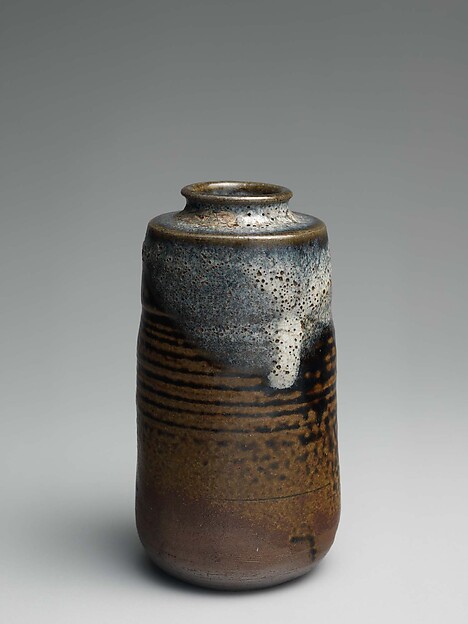
Tea Caddy (Chaire), 18th century, Stoneware with iron and rice-straw ash glazes (Satsuma ware). The Metropolitan Museum of Art, Edward C. Moore Collection, Bequest of Edward C. Moore, 1891, accession 91.1.146.
Look closer: a tall, narrow caddy with horizontal ridges round its lower body and a band of speckled white glaze poured over the shoulder and down one side, standing without a lid. The museum catalogues it as a Tea Caddy (Chaire), 18th century, stoneware with iron and rice-straw ash glazes (Satsuma ware), 10.2 cm high, from the Edward C. Moore Collection, bequest of 1891.
Image: The Metropolitan Museum of Art, Open Access (CC0)
Tezumi gives Seto its own history. It says Seto ware comes from the town of Seto in Aichi Prefecture, goes back almost eight hundred years, and is one of the Six Ancient Kilns of Japan. Early Seto became famous for copying advanced Chinese ceramics, tenmoku and celadon in particular, and later developed styles of its own, which Tezumi names as Shino, Kiseto and Oribe. Tezumi's account of Seto appears on a retail product page for a vintage shouldered chaire with a black glaze and a blue-green drip down the front, which the page gives as 5.4 centimetres wide and 7.4 centimetres high; the dimensions and the description are the retailer's.
The Metropolitan Museum's examples show how various the Japanese caddy is. A tall Satsuma caddy of the eighteenth century, in stoneware with iron and rice-straw ash glazes, is catalogued at 10.2 centimetres high. A flat Seto caddy of the same century, with an iron glaze and an ivory lid, is only 4.4 centimetres high and 10.2 centimetres wide. A small porcelain caddy of the first half of the nineteenth century, decorated in underglaze blue and fitted with an ivory lid, is said by the museum to be perhaps Kyoto ware. And a Bizen caddy of the seventeenth century in natural ash glaze is 8.3 centimetres high. The range runs from tall to flat, from clay to porcelain, and from the sixteenth to the nineteenth century.
| Kiln or potter | What the sources say | Examples in the Metropolitan Museum |
|---|---|---|
| Seto | The kilns of Seto, in the old province of Owari, now Aichi, are, Wikipedia says, regarded as the original Japanese kilns to produce chaire, and so are not counted as provincial ware. Tezumi says Seto ware goes back almost eight hundred years and began by copying Chinese tenmoku and celadon wares. | Met 62554, iron glaze, 18th century; Met 63121, Ko-Seto, late 16th century |
| Kyoto | Wikipedia says the various kilns of Kyoto are likewise not regarded as provincial ware. | Met 62560, porcelain, perhaps Kyoto ware, first half of the 19th century |
| Satsuma | One of the provincial kilns in Wikipedia's list of kilns and potters whose chaire are named. | Met 62543, 18th century |
| Bizen | On the same list. | Met 63139, 17th century; Met 53004, late 16th century |
| Shigaraki | On the same list. | Met 913864, a Taikai-shaped caddy of Shigaraki type, 16th century |
| Karatsu, Sobokai, Takatori, Tanba, Shidoro, Zeze | Also named in Wikipedia's list. The Takatori Miraku Kiln says its ware began when a kiln was opened to serve the Kuroda domain. | Met tea jars in Tanba and Zeze ware, 17th century |
| Potters | Wikipedia names the potters Maemon, Genjūrō, Shinbei and Tōshirō I to IV. | Met 913863, Shinbei, 17th century |
Ivory Lid, Silk Bag and Wooden Box
A chaire is rarely seen as a bare pot. Wikipedia says that its lid, custom-made to fit the jar, was historically made from elephant ivory with a gold-leaf underside, and that contemporary lids are usually made of other materials made to resemble ivory. Tealao says the same, adding that chaire have smaller lids than natsume. Tezumi's product page says the underside of the lid is typically coated with gold or silver leaf, and that the leaf was traditionally believed to discolour in contact with poison, which would warn the user against poisoned tea; the page presents this as the historical belief behind the coating, and the chapter gives it as the retailer's account.

Tea Caddy (Chaire), first half 19th century, Porcelain with underglaze blue decoration (perhaps Kyoto ware); ivory lid. The Metropolitan Museum of Art, Edward C. Moore Collection, Bequest of Edward C. Moore, 1891, accession 91.1.178.
Look closer: a squat, round-bellied caddy painted in dark blue with a band of curling waves above rows of spirals, topped by a pale lid with a tiny knob. The museum catalogues it as a Tea Caddy (Chaire), first half of the 19th century, porcelain with underglaze blue decoration (perhaps Kyoto ware) with an ivory lid, 5.1 cm high and 5.1 cm in diameter, from the Edward C. Moore Collection.
Image: The Metropolitan Museum of Art, Open Access (CC0)
The bag has a name. The Wikipedia article on tea utensils says that shifuku are bags for storing chaire and other tea implements, traditionally made from silk, often patterned or brocaded, with extremely precious implements often held in bags of brocade. They are secured with a silk cord of braided kumihimo, tied in prescribed ways. Tezumi describes the shifuku as a custom-made silk brocade pouch, and on its product page it describes the bag as blue silk brocade with a brown drawstring, tied tightly. The Gotheborg glossary says that chaire are stored in decorative bags called shifuku, and that they can come with an ivory lid that has a gold-leaf underside.
The box is the third layer. The article on tea utensils says that valuable utensils are usually stored in purpose-made wooden boxes, sometimes in several layers, and that the boxes of particularly old and distinguished objects often carry inscriptions that validate their history and provenance. The label of the University of Michigan Museum of Art for its caddy Hitorine says that two silk shifuku were presented with the caddy at ceremonies, and that the caddy came with layered boxes, bags and authenticating certificates, which show how highly successive owners valued it. The MOA Museum of Art says that its caddy Yamazakura comes with a box bearing inscriptions by Kobori Enshū. The record of a caddy is thus partly in its box, its bag and its papers.
The ivory has a modern side. The Wikipedia article on tea utensils says that ivory has historically been valued in tea utensils, particularly for scoops and for the lids of caddies, and that the continued domestic trade in ivory for traditional arts has faced scrutiny from international environmental organisations. It names the Environmental Investigation Agency and TRAFFIC as reporting that Japan's domestic market lacks rigorous traceability for cut ivory pieces, and says that critics argue that the demand for high-status ivory implements undermines efforts to combat elephant poaching. The article on chaki says that the traditional use of ivory links the caddy to contemporary conservation debates and the global illegal ivory trade. The article on tea utensils cites the 2016 report of the Environmental Investigation Agency and the 2017 TRAFFIC assessment. These are the views of those organisations and of critics, and the chapter gives them as reported. The concierge desk will say what the record shows of the material of a lid and of its provenance, and will say so plainly where the record shows nothing.
Hitorine, Yamazakura and White Dew
A great caddy has a name. The University of Michigan Museum of Art holds a Seto caddy named Hitorine, which its label says was chosen and named by Kobori Enshū (1579 to 1647) and made by Seto Shinbei about 1600 to 1647. The label says the name means sleeping alone, that it comes from a poem by Enshū, and that the poem likely alludes to a famous classical love poem by Fujiwara Takanobu (1142 to 1205). It describes a small, thinly potted brown container with a short neck and rounded shoulders, with the dark glaze applied irregularly from the shoulder to the middle of the body, an unglazed bottom without a foot, and a concave ivory lid sloping from the rim to the central knob. The caddy is recorded at 7.6 by 6 by 6 centimetres.
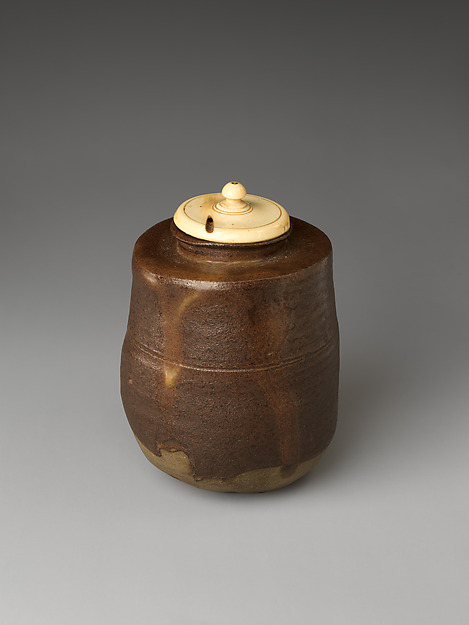
Eggplant-shaped Tea Caddy (Chaire), named Shira Tsuyu (White Dew), 17th century, Stoneware with iron glaze and an ivory lid. The Metropolitan Museum of Art, Gift of Peggy and Richard M. Danziger, 2024, accession 2024.553.15a, b.
Look closer: a plump, upright caddy in streaked brown glaze that deepens towards the base, with a small domed ivory lid and a tiny knob at the top. The museum catalogues it as an Eggplant-shaped Tea Caddy (Chaire), named Shira Tsuyu (White Dew), by Shinbei, 17th century, stoneware with iron glaze and an ivory lid, a gift of Peggy and Richard M. Danziger, 2024.
Image: The Metropolitan Museum of Art, Open Access (CC0)
The MOA Museum of Art in Atami has a shouldered caddy of Seto ware, of the Momoyama period, the sixteenth century, named Yamazakura, wild cherry. It is stoneware with an iron glaze of the type called shibugami-de, because it looks like mulberry paper lacquered with persimmon tannin. The body widens gradually from shoulder to base, and two vertical lines are incised on it. The museum gives the designation Chūkō-meibutsu and does not explain it, and the chapter does not explain it either. It says the name may come from the colour, which resembles the leaves of the wild cherry tree, or from the simple rustic beauty of the caddy, and that the caddy comes with a box bearing inscriptions by Kobori Enshū.
The Metropolitan Museum has a caddy named Shira Tsuyu, White Dew, which it describes as eggplant-shaped, in stoneware with iron glaze and an ivory lid, by Shinbei, of the seventeenth century, a gift of Peggy and Richard M. Danziger in 2024. The museum's record gives the name and the maker but no gallery note, so the chapter says no more of what the name means. The Michigan label names Seto Shinbei as the maker of Hitorine, and the Metropolitan Museum's record names a potter called Shinbei; the chapter does not assume that they are the same man.
Where the Powder Waits
The powder in a caddy has come from a jar. A page on the jar-opening ceremony of Uji says that fresh leaves from the year's first harvest are stored in a chatsubo, a tea jar, sealed with paper and aged until November. The jar holds the top-grade tencha in a paper package, surrounded by lower-grade tencha, which helps keep the top leaves fresh; the page says the tencha is finally ground into matcha and stored in a natsume. It says that the public ceremony in Uji, the chatsubo kuchikiri no gi, differs from the kuchikiri no chaji held in tea schools, and that it began in the Edo period under the Tokugawa shogunate as a special tea procession, in which spring-harvested tea was brought to the shogun each year.

Tea Jar, 17th century, Clay covered with glaze (Seto ware, Tobi kusuri type glaze). The Metropolitan Museum of Art, Gift of Mr. and Mrs. Samuel Colman, 1893, accession 93.1.57a, b.
Look closer: a plump jar with a pale lower body and a dark, tobi kusuri-type glaze that runs down in tongues from the shoulder, capped by a small ivory lid with a knob. The museum catalogues it as a Tea Jar, 17th century, clay covered with glaze (Seto ware, tobi kusuri type glaze), 8.6 cm high, a gift of Mr. and Mrs. Samuel Colman, 1893.
Image: The Metropolitan Museum of Art, Open Access (CC0)
The Nakamura Tokichi shop describes the procession, the chatsubo dōchū, in a blog post of 2025. A chatsubo, it says, is a large ceramic jar in which tea leaves were packed for transport. In the Edo period, it says, Uji tea was treated as a luxury and the best leaves were reserved for the shogun and high-ranking samurai. The jars were escorted by samurai and official envoys from Uji to Edo along the Tōkaidō, a distance the post gives as about five hundred kilometres, and the journey took weeks, with people gathering along the road to watch. Once in Edo, the post says, the tea was offered to the shogun and to high-ranking officials. The post is a retailer's account, and the chapter gives it as attributed.
The Metropolitan Museum catalogues a number of small Japanese vessels of the seventeenth and eighteenth centuries as tea jars, among them Seto, Tanba, Zeze and Bizen pieces whose recorded heights are between about seven and ten centimetres. The museum's title for them is jar, and this chapter keeps it.
The Jujube and the Lacquerer
The natsume is named for a fruit. The name, Wikipedia says, comes from the natsume, the jujube, which some thin-tea caddies are said to resemble, and the word should strictly be used only for vessels with a slightly convex top and a body that gradually narrows towards the base. Since natsume are used for thin tea, they are the first caddy a tea student learns to use. JAANUS says the same of the fruit, calling it the Chinese date, and defines the natsume as a caddy for thin green powdered tea, also called usuchaki.

Tea Container (Natsume) with Phoenix, 19th century, Nashiji ground with gold maki-e. The Metropolitan Museum of Art, Bequest of Stephen Whitney Phoenix, 1881, accession 81.1.279.
Look closer: a small, rounded, lidded caddy in a warm bronze-gold ground, with a fine gold phoenix on its shoulder and lid. The museum catalogues it as a Tea Container (Natsume) with Phoenix, 19th century, with a nashiji ground and gold maki-e, 6 cm high and 5.7 cm wide, from the Bequest of Stephen Whitney Phoenix, 1881.
Image: The Metropolitan Museum of Art, Open Access (CC0)
Both sources credit a lacquerer with the form. JAANUS says the type is traditionally attributed to Haneda Gorō, who lived near the Hokaimon gate of the temple Myōkaku-ji in Kyoto, in the Muromachi period during the rule of Ashikaga Yoshimasa (1433 to 1490), when the tea ceremony was in its earliest stage. Wikipedia says that Haneda Gorō, who lived in the era of Higashiyama culture and did lacquer work for Yoshimasa, is credited as the originator of this style of container for powdered tea, which at first, as a rule, was black-lacquered. It adds that the records of Sen no Rikyū's tea gatherings reveal that he used natsume, and that in his day natsume were used for koicha.
Tezumi gives a longer and slightly different history. It says that natsume-shaped usuchaki were first described in the sixteenth century and may have been used since the fourteenth. The nakatsugi predates the natsume, it says, and descends from the yakki, old wooden medicine containers that may have originated in China. The shin-nakatsugi is often attributed to Sen no Rikyū, though the page notes that it may have predated him. The chano-yu.com page says that before Rikyū used natsume, pottery caddies were the norm, and that natsume were also everyday items, such as pill cases, among townspeople.
That page also says something about the tea. Usucha was originally called packed tea, it says, a low-quality tea used to fill space around the bagged koicha, and from Takeno Jōō to Sen no Rikyū the word tea referred only to koicha. Usucha was looked down upon, so its container was a wooden box called a hikiya, which had originally been the case for the chaire and was later used independently as a caddy for thin tea. The claim is the page's, and the Wikipedia statement that in Rikyū's day natsume were used for thick tea does not conflict with it.
Sizes, Joints and Bevels
Tezumi describes the natsume forms, and the diagram draws five of them. The natsume proper is rounded, wider at the top, with a gently domed lid about a third of the total height. The hira-natsume is flattened. The shiribari has a rounded base wider than the lid. The nakatsugi is a perfect cylinder with a flat top and bottom, the join of lid and body falling exactly in the middle, which gives the form its name. The fubuki is bevelled at the lid and bottom edges, and its name is the word for a snowstorm written backwards, with Tezumi giving one theory that the shape disorients the viewer as a blizzard does. Artisans, the page adds, still make new forms, a gourd shape among them.
Diagram by Japonista. Schematic; the forms follow Tezumi's guide to the natsume.
Look closer: five dark silhouettes stand in a row. The first is rounded and wider at the top with its join a third of the way down, the second is low and flat, the third is a plain cylinder with its join in the middle, the fourth has bevelled top and bottom edges, and the fifth is narrow at the top and fuller at the bottom.
Diagram by Japonista
Wikipedia gives the Rikyū shape, the basic form, in three sizes, large, medium and small, with orthodox examples finished in plain black lacquer inside and out, and the lid joining the body about seven tenths of the way up from the base. That position agrees with Tezumi's lid of about a third of the height. Wikipedia says that the diameter of the flat natsume is generally about twice its height, and Tezumi gives the ratio as about three to two or two to one. JAANUS adds the shapes it records: long and flat examples, examples with bevelled edges, the Sen Rikyū shape, also called kawatarō, the shirifukurami with its large bulging bottom, the chaoke or tea-pail type, the dōbari with a bulge in the middle, and the kōaka with a red top. It records two lid types, the okibuta, an overlapping lid, and the inrō-zukuri, a lid in the style of a medicine box.
The sizes are given in centimetres by two sources, and they are not the same. The chū-natsume, the medium and most common, is about 6.8 centimetres in both height and diameter according to Tezumi and 6.6 centimetres according to the chano-yu.com page, which says that tea students basically use this size when they learn how to handle the fukusa in their first lesson. That page gives the large natsume as 8 centimetres and the small as 5.0, and says that the small are also used for koicha but must have no design. Tezumi says the small natsume is usually paired with a shifuku or wrapped in a fukusa, and used in place of a chaire to hold higher-grade matcha for koicha.
| Form | Kanji | What the sources say |
|---|---|---|
| Natsume | 棗 | Rounded, wider at the top, with a gently domed lid about a third of the total height (Tezumi). |
| Hira-natsume | 平棗 | The flat natsume, with a diameter of about three to two, or two to one, against its height (Tezumi); about twice the height (Wikipedia). |
| Ippuku natsume | 一服棗 | Smaller, holding enough tea for one serving of thick tea (Tezumi). |
| Shiribari | 尻張 | A rounded base wider than the lid (Tezumi); JAANUS gives shirifukurami (尻膨) for a large, bulging bottom. |
| Nakatsugi | 中次 | A cylinder with flat top and bottom, the join of lid and body exactly in the middle, which gives it its name (Tezumi). |
| Shin-nakatsugi | 真中次 | Roughly chū-natsume in size, usually in plain black lacquer, often attributed to Sen no Rikyū though it may be older (Tezumi). |
| Men-nakatsugi | 面中次 | A nakatsugi with a chamfered lid, easier to tie in a shifuku or wrap in a fukusa (Tezumi). |
| Fubuki | 雪吹 | Bevelled at lid and bottom; its kanji are those of snowstorm reversed, and Tezumi gives one theory that the shape disorients the viewer as a blizzard does. |
| Rikyū-gata | 利休形 | The basic Rikyū shape in three sizes, large, medium and small, with the lid joining the body about seven tenths of the way up from the base (Wikipedia); JAANUS also records it as kawatarō (河太郎). |
| Koma | 独楽 | Named for the spinning top and decorated with horizontal stripes, according to Wikipedia and Tezumi. |
| Kōdai-ji bun natsume | 高台寺文棗 | Named for Kōdai-ji in Kyoto, bearing the imperial chrysanthemum seal and the paulownia seal of the regent Toyotomi Hideyoshi (Wikipedia). |
Black, Red and Gold Lacquer
Tezumi says that natsume are traditionally of turned wood coated in urushi lacquer, and that cheaper plastic and resin versions are common for practice. The shin-natsume, in undecorated black lacquer, is the most formal finish, it says; red, vermilion, decorated and unlacquered versions are more informal. It gives maki-e, lacquer painting, as a common decoration, with egret and golden bamboo as examples; negoro, small black smears on a red base that imitate outer red lacquer worn away to show black beneath; and the koma, a spinning top, with horizontal stripes of green, red and white. It says a nakatsugi may be in maki-e, unlacquered, or made from cherry bark. Wikipedia says that usucha-ki are traditionally hand-carved from wood or bamboo and usually lacquered, and that they may carry designs painted, applied or carved into them, using maki-e or raden, with cheaper plastic ones also available.

Tea Caddy (Natsume), second half 19th century, Stoneware with polychrome overglaze enamels and gold. The Metropolitan Museum of Art, Edward C. Moore Collection, Bequest of Edward C. Moore, 1891, accession 91.1.264a, b.
Look closer: a rounded, lidded caddy with a soft yellow ground covered in a net of fine gold lines, a fish swimming across the front and a brown patch on the lid. The museum catalogues it as a Tea Caddy (Natsume), second half of the 19th century, stoneware with polychrome overglaze enamels and gold, 7.6 cm high and 7.6 cm in diameter, from the Edward C. Moore Collection.
Image: The Metropolitan Museum of Art, Open Access (CC0)
JAANUS gives the longest list. The materials it names for the natsume are wood and dry lacquer, bamboo, layered-paper lacquer, and also ceramic, metal and black quartz. The finishes are black wax coating, a red lacquer called shutame, shunkei-nuri, which lets the grain show through a coloured lacquer, rubbed lacquer, gold or silver powder sprinkled over pear-skin lacquer, carved lacquer and shell inlay, with oil paint used at times. The entry is a reference for the maker and the collector, and its list shows that the natsume is not only a lacquered wooden form, since a ceramic natsume is a natsume by shape.
The Metropolitan Museum's lacquer caddies show a good deal of this range. A natsume with a phoenix in gold maki-e on a pear-skin ground is of the nineteenth century. A low round caddy in sprinkled gold lacquer is dated to the early seventeenth century. A taller gold-lacquer caddy with a pattern of blossoms is of the late eighteenth century. A caddy in lacquer on wood with a bamboo sprig is of the early nineteenth. Two more are catalogued under the names of lacquer artists, one by Ogawa Haritsu, called Ritsuō, and one by Shibata Zeshin. And a stoneware natsume of the second half of the nineteenth century, painted in overglaze enamels and gold with a fish among scales, shows the ceramic variant that JAANUS records. The museum calls most of these tea caddies and not natsume, and the chapter uses its titles.
Filling, Sifting and Choosing
The caddy is filled before the guests arrive. Tezumi says that most natsume are not airtight unless fitted with an inner lid, so they are not for long-term storage; matcha is taken from its storage tin or bag and sifted into the natsume for a gathering or personal use. Historically, it says, hosts ground only enough matcha for their guests and stored it in a chaire or an usuchaki, aiming to use it all during the event. Its author suggests sifting about one week's worth of matcha into the natsume and keeping the rest in an airtight container. The advice is the retailer's and a modern one.
The student comes to the caddy early. The Wikipedia article on the tea ceremony says that once students have mastered the basics they are instructed on how to prepare the powdered tea for use, how to fill the tea caddy, and finally how to measure the tea and the water and whisk it to the proper consistency. The simplest procedure they practise first, obon temae, places the bowl, whisk, scoop, chakin and caddy on a tray. The chabako procedure takes its caddy, with the bowl, whisk and scoop, from a special box. In both the caddy is one of the objects the host places in an exact arrangement.
The choice of caddy belongs to the host's toriawase, the selection of utensils to suit an occasion or to create a desired atmosphere, in Tezumi's phrase. Wikipedia says the host chooses it to harmonise with the other equipment. Tealao notes that a black natsume used for koicha is the usual partner of the four special usucha chaire, and that two natsume in one offering of tea should be avoided. The chano-yu.com page adds that the small natsume used for koicha must have no design. These are rules of taste and not of law, and the sources state them with different degrees of firmness; the chapter gives them as each source's own.
Cloth, Tray and the Guest's Hands
The cloth comes first. The Wikipedia article on tea utensils says that the fukusa, a double-layer silk cloth about thirty centimetres square, is used for the symbolic cleansing of the tea scoop and the tea caddy, and that the host and assistants wear it tucked into the obi. By tradition the host of a formal gathering uses a new, previously unused fukusa, and the colours differ for men, usually purple, and women, orange or red. The article says that the size and way of making the fukusa were purportedly established by Sen Sōon, Rikyū's second wife. The first things new students learn, the article on the tea ceremony says, include how to fold the fukusa, and tea students basically use the medium natsume when learning how to handle it, according to the chano-yu.com page.

Tea caddy, Lacquer. The Metropolitan Museum of Art, The Howard Mansfield Collection, Purchase, Rogers Fund, 1936, accession 36.100.161a, b.
Look closer: a squat cylinder with a fine, dark wood-like surface and a small inlaid and coloured scene on its front, rising to a flat lid. The museum catalogues it as a Tea caddy by Ogawa Haritsu (Ritsuō), lacquer, 7.9 cm high and 6.7 cm in diameter, from the Howard Mansfield Collection, purchased with the Rogers Fund in 1936.
Image: The Metropolitan Museum of Art, Open Access (CC0)
Two smaller cloths protect the caddy in the guest's hands. The article says that a kobukusa is a cloth of about fifteen centimetres square, generally of a rich, thick brocade, which in the Urasenke school both the host and the guests each carry, and which the guests sometimes use to protect the implements while examining them. The dashibukusa, a double-layer silk cloth like the fukusa, is used by Omotesenke practitioners in the same way as the kobukusa; the host and each guest carry one, and the host will put one out with the tea bowl when serving thick tea. The caddy that passes round the room is thus often held in a cloth.
The Wikipedia article on the tea ceremony says that after all the guests have taken tea, the host cleans the utensils and the guest of honour will request that the guests may examine some of them; each guest in turn examines each item, including the caddy and the scoop, to show respect and admiration for the host. The items are treated with extreme care, since they may be priceless, irreplaceable, handmade antiques, and guests often use a special brocaded cloth to handle them. A small caddy with a famous name, a silk bag and a box of inscriptions is the sort of object that sentence describes.
Clay, Lacquer and the Damp Cabinet
The sources give care only for the lacquer. Tezumi's guide to the natsume says that handling the lacquer gently polishes its outer layer, that metal and rough ceramics, such as the unglazed feet of bowls and cups, can scratch it, and that lacquerware should be kept in a slightly humid place and not in a bone-dry cabinet. Genuine lacquerware, it says, is often wrapped in paper inside its wooden box to retain moisture. It advises never to soak a natsume, but to wipe it with a dry cloth, or with a damp cloth for residue; a quick wash in lukewarm water with a soft sponge and mild detergent is acceptable, followed by drying with a soft cloth, since soaking can weaken and discolour the lacquer. It also says to limit direct sunlight, because ultraviolet rays can damage lacquer.

Tea caddy, 19th century, Lacquer. The Metropolitan Museum of Art, The Howard Mansfield Collection, Purchase, Rogers Fund, 1936, accession 36.100.170.
Look closer: a black lacquer caddy with a rounded, gently waisted body and a lid in the grain of a warm wood, with a delicate gold grass sprig and fine lines across the front. The museum catalogues it as a Tea caddy by Shibata Zeshin, 19th century, lacquer, 10.5 cm high and 7.6 cm in diameter, from the Howard Mansfield Collection, purchased with the Rogers Fund in 1936.
Image: The Metropolitan Museum of Art, Open Access (CC0)
For the chaire the sources give no care instructions. The Tezumi product page for a chaire gives no care or cleaning instructions for the caddy or its bag, and the Wikipedia article on chaki gives none. The chapter therefore gives none, and says only that an old caddy, a bag or a box that has been used should be asked about before it is used again, which is the chapter's advice and not a source's.
A third point belongs to the care of the box. The article on tea utensils says that boxes of particularly old and distinguished objects often carry inscriptions that validate their history and provenance, and that they hold importance in the practice of chanoyu though they are not equipment in themselves. A caddy that has lost its box has lost part of its record. A chaire kept in layered boxes with its bags and papers, as the Michigan label describes, has kept it.
What to Ask of a Caddy
The questions that follow from the sources are short. For a chaire: for which tea; of which origin, karamono or wamono; of which kiln or potter; in which shape; and with what lid, bag and box. If the caddy has a name, who gave it and what do the papers say; the Michigan and MOA examples show that a name and an inscription by a known tea master are the sort of facts that belong in a record. If the caddy is said to be by a famous maker, or to come from a famous collection, the claim is to be read as attributed until the record shows its basis. A retailer's note, a dealer's catalogue or a kiln's page is attributed in this chapter, and the museum's wording of attribution is a model.
For a natsume: of what is it made, and of which lacquer; of what size and form; at what level of finish, in plain black or in decorated lacquer; and whether it carries a maker's name or seal, a box or a cloth. A natsume of the nineteenth century in gold maki-e is a different object from a plain black natsume of the Rikyū shape, and the description should say which. The pottery almanac's chapter on made in Japan and collected in Japan sets out the vocabulary of attribution and style that applies to caddies as to bowls, and its chapter on marks, seals and signatures explains the stamps and inscriptions that may accompany them.
The last question is of material, and it is the one the ivory raises. The article on tea utensils has said what the environmental organisations say of Japan's domestic trade in cut ivory, and the article on chaki says that contemporary lids are usually made of other materials that resemble ivory. A lid of ivory, a lid of a substitute and a lid that has been replaced are three different facts. The concierge desk will say in plain words what an object is, what its record shows and what it does not.
Fun Facts
- Wikipedia says natsume are the first caddy a tea student learns to use.
- Tezumi says the nakatsugi takes its name from the join of lid and body, which falls exactly in the middle.
- The fubuki's name is the word for snowstorm written backwards, according to Tezumi.
- A. L. Sadler, as cited by Wikipedia, says that among warriors the most precious possessions were first tea caddies, second writings, third swords.
- The Takatori Miraku Kiln says Hatsuhana is only about two millimetres thick.
- The Takatori page says Toyotomi Hideyoshi is the only one known to have held all three great caddies at once.
- JAANUS says the natsume is traditionally attributed to Haneda Gorō, a lacquerer who lived near a gate of Myōkaku-ji in Kyoto.
- Tealao says four special chaire are usually sold as a set that shares one lid.
- The MOA Museum of Art says the name Yamazakura may come from the colour of wild cherry leaves.
- The label for Hitorine says its name means sleeping alone and comes from a poem by Kobori Enshū.
A Timeline of Chaire and Natsume
Dates are given as the sources give them, with the source named. Where an event is only an account, it is marked as such.
| Date | Event | Source |
|---|---|---|
| Song period, 960 to 1279 | Chaire are used in China as bottles for oil or medicine, according to A. L. Sadler as cited by Wikipedia. | Wikipedia, Chaki |
| 1433 to 1490 | Life of the shogun Ashikaga Yoshimasa, under whom the lacquerer Haneda Gorō is said to have originated the natsume. | JAANUS, Natsume; Wikipedia, Chaki |
| 1476 and 1511 | The Nōami and Sōami versions of the Kundaikan sōchōki include illustrations of what Wikipedia glosses as matcha jars, here meaning tea caddies. | Wikipedia, Matcha |
| 1467 to 1615 | The Sengoku period, in which the three great caddies are said to have come from China and been prized as marks of rule. | Takatori Miraku Kiln (attributed) |
| 1522 to 1591 | Life of Sen no Rikyū, whose gatherings were recorded as using natsume for thick tea. | Wikipedia, Chaki |
| 1579 to 1647 | Life of Kobori Enshū, who named the Seto caddy Hitorine and whose inscriptions are on the box of Yamazakura. | UMMA; MOA Museum of Art |
| 16th century | Natsume-shaped usuchaki are first described, and may have been used from the 14th century. | Tezumi |
| Late 16th century | Met caddies in Ko-Seto and Bizen wares are dated to this period. | The Metropolitan Museum of Art |
| 17th century | A Seto eggplant-shaped caddy by Shinbei, named Shira Tsuyu, belongs to this century. | The Metropolitan Museum of Art |
| Edo period | An annual procession carries Uji tea in jars from Kyoto to Edo, as a retailer relates. | Tokichi (attributed) |
| 2016 and 2017 | Reports by the Environmental Investigation Agency and TRAFFIC criticise the traceability of Japan's domestic ivory trade. | Wikipedia, Japanese tea utensils |
| Today | Ceramic chaire hold the thick-tea matcha and lacquered natsume the thin-tea matcha, and a caddy is still chosen to harmonise with the rest of the gathering. | Wikipedia, Chaki; Wikipedia, Matcha |
A Glossary of Caddies
The words of the chapter, with the sense the sources give them.
| Term | Meaning |
|---|---|
| Chaki | 茶器. Literally tea implement; more narrowly the small lidded caddies for powdered tea. |
| Chaire | 茶入. The ceramic caddy for thick tea, also called koicha-ki. |
| Usucha-ki | 薄茶器. A caddy for thin tea, often shortened to usuki, usually wood or bamboo. |
| Natsume | 棗. The jujube-shaped lacquered caddy; also loosely any usucha-ki. |
| Koicha | 濃茶. Thick tea, the main part of the gathering. |
| Usucha | 薄茶. Thin tea. |
| Karamono | 唐物. Caddies made in China or in the Chinese manner. |
| Wamono | 和物. Caddies made in Japan, sorted by kiln and potter. |
| Kuniyakimono | 国焼物. Provincial ware, from Japanese kilns outside Seto and Kyoto. |
| Shimamono | 島物. Island-made ware, the third category in the Wikipedia article on tea utensils. |
| Katatsuki | 肩衝. The shouldered caddy, the most common shape. |
| Nasu | 茄子. The eggplant shape. |
| Bunrin | 文琳. The apple shape. |
| Taikai | 大海. The wide-mouthed big-ocean shape. |
| Tsurukubi | 鶴首. The crane's-neck shape. |
| Shiribukura | 尻膨. The bulging-hip shape. |
| Shifuku | 仕覆. A silk bag, often brocaded, that holds a chaire. |
| Kumihimo | 組紐. The braided silk cord that closes a shifuku. |
| Fukusa | 帛紗. The silk cloth used to cleanse the caddy and scoop symbolically. |
| Kobukusa | 古帛紗. A small brocade cloth used to protect implements. |
| Mizuya | 水屋. The preparation room. |
| Meibutsu | 名物. A named, famous utensil, in the Wikipedia article on special tea utensils. |
| Mei | 銘. A name given to an object, here to a caddy. |
| Nakatsugi | 中次. The cylindrical caddy joined at the middle. |
| Hira-natsume | 平棗. The flat natsume. |
| Fubuki | 雪吹. The caddy bevelled at both ends. |
| Maki-e | 蒔絵. Sprinkled-gold lacquer decoration. |
| Raden | 螺鈿. Shell inlay. |
| Nashiji | 梨地. Pear-skin lacquer, with gold or silver powder sprinkled over it. |
| Negoro | 根来. A red surface worn to show black beneath, imitated on natsume, according to Tezumi. |
| Chatsubo | 茶壺. The large jar in which tea leaves are packed and aged. |
| Kuchikiri | 口切り. The opening of the jar, held in November in Uji and in tea schools. |
| Tencha | 碾茶. The leaf that is ground into matcha. |
More Caddies to Look At

Tea Caddy (Chaire), 17th century, Stoneware with natural ash glaze (Bizen ware). The Metropolitan Museum of Art, H. O. Havemeyer Collection, Bequest of Mrs. H. O. Havemeyer, 1929, accession 29.100.664.
Look closer: a tall, rounded caddy with a deep olive-brown glaze flecked with gold and a smooth shoulder, topped by a small pale lid. The museum catalogues it as a Tea Caddy (Chaire), 17th century, stoneware with natural ash glaze (Bizen ware), 8.3 cm high and 6.4 cm in diameter, from the H. O. Havemeyer Collection.
Image: The Metropolitan Museum of Art, Open Access (CC0)
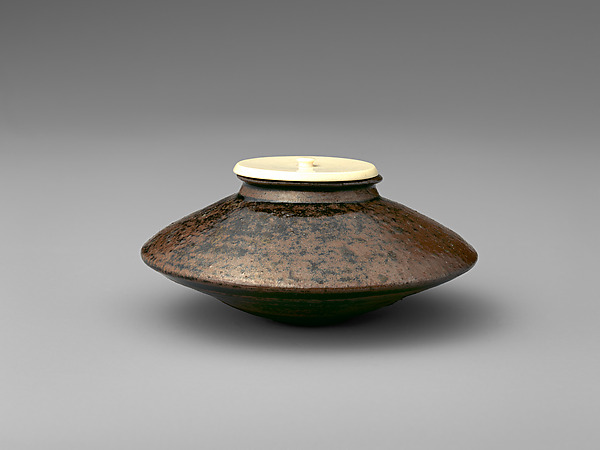
Tea Caddy (Chaire), 18th century, Stoneware with iron glaze (Seto ware); ivory lid. The Metropolitan Museum of Art, Edward C. Moore Collection, Bequest of Edward C. Moore, 1891, accession 91.1.157.
Look closer: a low, saucer-like caddy in dark, mottled iron glaze with a pale lid sitting in the centre. The museum catalogues it as a Tea Caddy (Chaire), 18th century, stoneware with iron glaze (Seto ware) and an ivory lid, 4.4 cm high and 10.2 cm wide, from the Edward C. Moore Collection.
Image: The Metropolitan Museum of Art, Open Access (CC0)

Tea Caddy, early 17th century, Sprinkled gold lacquer. The Metropolitan Museum of Art, Bequest of Stephen Whitney Phoenix, 1881, accession 81.1.362a, b.
Look closer: a low, rounded caddy whose lid and body are covered in a bold repeating pattern of leaves in sprinkled gold on dark ground, with a diagonal band across the top. The museum catalogues it as a Tea Caddy, early 17th century, sprinkled gold lacquer, from the Bequest of Stephen Whitney Phoenix, 1881.
Image: The Metropolitan Museum of Art, Open Access (CC0)

Tea Caddy with Cover, late 18th century, Gold lacquer. The Metropolitan Museum of Art, Gift of Mrs. Charles Page, 1922, accession 22.42.2a, b.
Look closer: a tall, softly rounded caddy in a warm gold lacquer scattered with cherry blossoms. The museum catalogues it as a Tea Caddy with Cover, late 18th century, gold lacquer, 7.3 cm high and 6.4 cm in diameter, a gift of Mrs. Charles Page, 1922.
Image: The Metropolitan Museum of Art, Open Access (CC0)
Caddies, Bowls and Tea-Room Ware
Caddies pass through the house with the rest of the tea room. The concierge desk will say in plain words what each is made of, who made it where the record says so, whether it has been used or repaired, and what the record does and does not show. The atlas of utensils and the glossary of tea utensils are companions to this chapter.
Answered plainly
What is the difference between a chaire and a natsume?
A chaire is a ceramic caddy for the matcha used in thick tea; a natsume is a lacquered wooden or bamboo caddy, in the jujube shape, for thin tea. Wikipedia and Tezumi give the pair.
Why is a chaire called a tea container?
Tealao says imported medicine and oil jars were literally called cha-ire, tea container, because Japanese medicine containers differed from the Chinese ones.
What are karamono and wamono chaire?
Wikipedia says karamono originated in China or were made to resemble Chinese ones, and wamono originated in Japan and are sorted by kiln and potter.
What is the most common chaire shape?
Wikipedia and Tealao both say the katatsuki, the shouldered shape.
Why do chaire have ivory lids?
Wikipedia says the custom-made lid was historically elephant ivory with a gold-leaf underside, and that today's lids are usually made of other materials made to resemble ivory.
What is a shifuku?
A silk bag, often brocaded, for a chaire or other implement, closed with a braided silk cord, according to the Wikipedia article on tea utensils.
What are Hatsuhana, Nitta and Narashiba?
Three famous caddies that the Takatori Miraku Kiln calls the three great tea caddies, recorded in the Yamanoue Sōji ki and prized by warlords; the sources give no description of them here.
Who invented the natsume?
JAANUS and Wikipedia credit the lacquerer Haneda Gorō of the Yoshimasa era; Tezumi gives a longer history through the nakatsugi.
How big is a natsume?
Tezumi gives a medium natsume at about 6.8 centimetres and the chano-yu.com page at 6.6 centimetres; the sources differ and neither is a standard.
How should a lacquer natsume be cleaned?
Tezumi says to wipe it with a dry cloth, or a damp one for residue, and never to soak it.
Is ivory used on tea caddies today?
Wikipedia says ivory has been valued for caddy lids and that the traceability of Japan's domestic ivory trade has been criticised; contemporary lids are usually of other materials.
Where next
Sources and image credits
- Chaki, Wikipedia
- Japanese tea utensils, Wikipedia
- Japanese tea ceremony, Wikipedia
- Matcha, Wikipedia
- Special tea utensils, Wikipedia
- Natsume, JAANUS
- Natsume: A Guide to the Ceremonial Tea Caddy, Tezumi
- Japanese Chaire, Katatsuki Seto-yaki Tea Caddy with Shifuku, Tezumi (retail page, attributed)
- Types of tea caddies, chano-yu.com
- Chaire, Tealao
- Chaire, Gotheborg glossary
- Katatsuki Tea Caddies, Takatori Miraku Kiln (attributed)
- Tea Caddy of the Katatsuki type, named Yamazakura, MOA Museum of Art
- Seto ware tea caddy Hitorine, University of Michigan Museum of Art
- Chatsubo Kuchikiri no Gi, My Japanese Green Tea
- Cha-tsubo Dōchū, Nakamura Tokichi (retailer blog, attributed)
- Object record, Tea Caddy (Chaire), The Metropolitan Museum of Art
- Object record, Tea Caddy (Chaire), The Metropolitan Museum of Art
- Object record, Tea Caddy (Chaire) in Taikai Shape, The Metropolitan Museum of Art
- Object record, Tea Caddy (Chaire), The Metropolitan Museum of Art
- Object record, Tea Caddy (Chaire), The Metropolitan Museum of Art
- Object record, Eggplant-shaped Tea Caddy (Chaire), named Shira Tsuyu (White Dew), The Metropolitan Museum of Art
- Object record, Tea Jar, The Metropolitan Museum of Art
- Object record, Tea Container (Natsume) with Phoenix, The Metropolitan Museum of Art
- Object record, Tea Caddy (Natsume), The Metropolitan Museum of Art
- Object record, Tea caddy, The Metropolitan Museum of Art
- Object record, Tea caddy, The Metropolitan Museum of Art
- Object record, Tea Caddy (Chaire), The Metropolitan Museum of Art
- Object record, Tea Caddy (Chaire), The Metropolitan Museum of Art
- Object record, Tea Caddy, The Metropolitan Museum of Art
- Object record, Tea Caddy with Cover, The Metropolitan Museum of Art
Last reviewed 28 October 2026. Pictures, where shown, are public-domain or open-access and credited beneath each one.
Looking for a caddy, a bowl or another piece of tea-room ware? The concierge desk replies within one to three business days.
Browse tea ceremony and chagama pieces · Make a private request
Private concierge
Looking for something in particular?
Describe the piece or the project you have in mind. A senior advisor in Tokyo reads every case file personally and replies within two business days, with fees set out in writing before any work begins.