
Fakes, Copies and Style Names
Pottery Almanac · Authenticity
Fakes, Copies and Style Names
Two journeys run through Japanese ceramics. Some wares were made in Japan and collected abroad, and arrived under names the potters never used. Others were collected in Japan and made elsewhere, and are still prized there. A third path runs between them, the copy, which can be a courtesy to a great model or a lie about it. This chapter teaches the difference.
Fact sheet
At a glance
- A name is a claim. Imari names a look, Kakiemon a family and a look, Satsuma began as a place and became a palette, and Kutani is a style supposed to come from a village.
- Prized, not made, in Japan. Chinese karamono and Korean kōraimono shaped the tea tradition, and Japanese potters answered with wares of their own.
- Copying is old. Japanese kilns copied Chinese wares, and Europe and China copied Imari and Kakiemon in turn.
- Fakes follow fame. Satsuma was so popular that other wares were sold under its name, and famous names were painted on pieces that were not theirs.
- Ask four questions. Where was the body made, where was it painted, when, and what does the name claim?
A Name Is a Claim, Not a Fact
Every name in this almanac makes a claim. Some claim a place, as Bizen or Hagi does. Some claim a family, as Kakiemon and Tokuda do. Some claim a century, as Ko-Kutani does, and some claim a look. The difficulty for anyone holding a piece is that the same word can make more than one claim at once, and that the claim changed over time. A name that began as an address can become a manner, and a manner can be applied by anyone who can copy it.

Dish with rocks, flowers, and birds, 1710–30, Hard-paste porcelain with colored enamels under transparent glaze (Hizen ware; Imari type). The Metropolitan Museum of Art, The Hans Syz Collection, Gift of Stephan B. Syz and John D. Syz, 1995, accession 1995.268.66.
Look closer: a dense border in blue, red and gold frames a central panel with a bird. The museum catalogues it as Hizen ware, Imari type, 1710 to 1730, 19.4 cm across.
Image: The Metropolitan Museum of Art, Open Access (CC0)
Wikipedia's article on Imari ware is the plainest example. It calls Imari a Western term for a brightly coloured style of Arita ware, made in the area of Arita in the former Hizen Province and shipped from the port of Imari to Nagasaki, where the Dutch East India Company and the Chinese had trading posts. In the West, it says, the multi-coloured wares became known as Imari, a different group as Kakiemon and the blue-and-white wares as Arita, though the types were in fact often produced at the same kilns. Today, it adds, Imari as a descriptor has declined, and the wares are more often called Arita or Hizen wares.
Kakiemon is more complicated still. The article on Arita ware says the term generates confusion because it is the name of a family, of one or more kilns and of a brightly coloured overglaze style, which the family kilns mainly produced but other kilns also made, while the family kilns made other styles as well. Satsuma, in the article on that ware, "ceased to be a geographical marker and began to convey an aesthetic" in the years after the Paris exposition of 1867. Kutani ware is described as a style of porcelain "traditionally supposed to be from Kutani". The table gathers what the sources say each name claims.
There are, then, three questions behind every label. Where was the body made, and where was it decorated? When was it made? And what does the name on the label claim: a place, a person, a period or a look? A piece can be perfectly genuine in one answer and wrong in another. A Chinese porcelain dish painted in the Kakiemon manner is truly Chinese. A nineteenth-century Kyoto vase sold as Satsuma is truly Kyoto. The fault lies in the sentence that joins the object to the name.
| Name | What the sources say it names | The complication |
|---|---|---|
| Imari | A Western term for a brightly coloured style of Arita ware, taken from the port of shipment | Types were often produced at the same kilns, so the name sorts by look and not by workshop. |
| Kakiemon | A family, one or more kilns and a style | Other kilns also made the style, and the family kilns made other styles. |
| Satsuma | Earthenware from the Satsuma region, then a look | By the 1870s workshops far from Satsuma were painting wares sold under the name. |
| Kutani | A style of porcelain traditionally supposed to be from Kutani | Much Ko-Kutani is now thought to have been made around Arita. |
| Karamono | Refined tea implements from China, valued in Japan after import | For tea caddies it also covers wares made to resemble Chinese ones. |
| Kōraimono | Tea utensils from the Korean Peninsula, mainly of the Yi dynasty | Compared with karamono in the tea tradition. |
| Wamono | Wares that originated in Japan | Classified by potter, region or kiln, and by shape. |
| Chinese Imari | A copy of the Imari style made in China | The name states the copying; the pieces are not Japanese. |
Prized in Japan, Made Elsewhere
The first reversal is that the tea tradition, the most Japanese of the arts in this almanac, began with borrowed pots. The Wikipedia article on the tea bowl says the earliest chawan in Japan were imported from China between the thirteenth and sixteenth centuries. The article on matcha adds that in the Muromachi period, among the elite, it became fashionable to drink tea from expensive Chinese ceramics known as karamono, and that in the sixteenth century tea masters such as Murata Jukō and Sen no Rikyū emphasised simplicity, giving rise to the Japanese tea ceremony. The article on wabi-cha puts it in similar words: it evolved as part of a movement to appreciate local wares and simpler styles, against a preference for expensive wares of Chinese origin.

Tea bowl with decoration of chrysanthemums and wavy lines, first half of the 17th century, Stoneware with stamped, white-slip design. The Metropolitan Museum of Art, The Howard Mansfield Collection, Gift of Howard Mansfield, 1936, accession 36.120.502.
Look closer: stamped bands of small flowers circle the body. The museum catalogues it as Probably Korea, first half of the 17th century, stoneware with stamped white-slip design, 8.3 cm high.
Image: The Metropolitan Museum of Art, Open Access (CC0)
That turn did not mean a rejection of the foreign. The same tea bowl article says that, with the rise of wabi tea in the late Muromachi period, the Ido chawan, which originated from a large rice bowl used in Korea, also became highly prized in Japan, and that the bowls were favoured by Sen no Rikyū for their rough simplicity. The Japanese site turuta.jp describes Ido bowls as the king of Korean tea bowls and says they were made in great number and variety across Joseon Korea; it reports that the kilns proposed for particular types have not been confirmed by excavation. A bowl can therefore be among the most valued objects in Japanese tea and still be, in origin, a Korean rice bowl whose kiln is uncertain.
The Met's catalogue shows the same uncertainty in its own wording. A tea bowl with a stamped white-slip design of chrysanthemums and wavy lines, from the Howard Mansfield collection, is catalogued as made "Probably Korea" in the first half of the seventeenth century. The museum does not guess beyond that, and the label is a model of honesty: it tells the reader that the origin is a judgement, and that the judgement is hedged. A shop or a catalogue that writes only Korean or only Japanese for such a bowl is claiming more than the museum would.
Karamono, Kōraimono and Wamono
The tea world has its own vocabulary for exactly this problem, and it classifies by origin before it classifies by anything else. Wikipedia's page on the water jar defines karamono as the term for refined tea implements, mainly ceramics, produced in China, particularly in the Song, Yuan and Ming dynasties, which when imported to Japan were selected for their excellence and have been highly valued there ever since. Kōraimono, literally Goryeo things, is the term for tea utensils produced on the Korean Peninsula mainly during the Yi dynasty, sometimes compared with karamono.
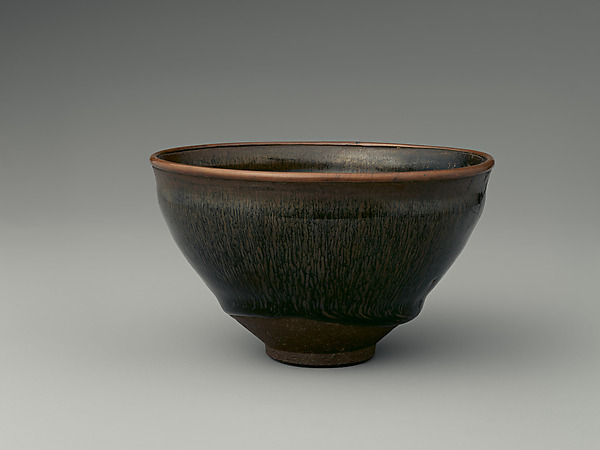
Teabowl, 11th–12th century, Stoneware with hare fur glaze (Jian ware), metal rim. The Metropolitan Museum of Art, Edward C. Moore Collection, Bequest of Edward C. Moore, 1891, accession 91.1.241.
Look closer: fine streaks run down the dark glaze inside and out. The museum catalogues it as China, 11th to 12th century, stoneware with hare fur glaze (Jian ware), 7.5 cm high.
Image: The Metropolitan Museum of Art, Open Access (CC0)
The same page says that the ceramic caddies used for thick tea, the chaire, are classified by country of origin: import, called karamono, Japan, called wamono, or island-make, called shimamono. The wamono are classified in turn by potter, region or kiln, and all are classified by shape. The separate article on the caddy adds a detail that matters for the argument of this chapter. It says that karamono caddies are those that originated in, or are made to resemble, those created in China. The category therefore includes imitations by design, and the word karamono is already a statement about style as well as place.
The article on the caddy also records that, according to a standard English authority it cites, chaire were originally used in China in the Song period as bottles for oil or medicine and were imported to Japan for use as tea caddies up to the end of the Ashikaga or the start of the Tokugawa period. A thing made as a medicine bottle became the centrepiece of a ceremony. Origin and use are separate facts, and tea has always known it.
The Bowl Named for a Mountain
Tenmoku is the cleanest case of a name that crossed the sea. Wikipedia says it originates in imitating Chinese Jian ware of the southern Song dynasty, that the original examples are also called tenmoku in Japan, and that the name comes from the Tianmu mountain temple in China, where iron-glazed bowls were used for tea; Tianmu, it explains, is read in Japanese as tenmoku and means heaven's eye. It reports, from chronicles of 1406, that the Yongle Emperor of the Ming dynasty sent ten Jian ware bowls to the shōgun Ashikaga Yoshimitsu, and that Japanese monks who travelled to monasteries in China also brought pieces home. Three of the Song vessels are so highly valued that they are included among the National Treasures of Japan.

Tea Bowl with Hare’s-Fur Decoration, 16th century, Stoneware with iron-oxide glaze; metal rim (Seto ware). The Metropolitan Museum of Art, H. O. Havemeyer Collection, Bequest of Mrs. H. O. Havemeyer, 1929, accession 29.100.234.
Look closer: golden-brown streaks radiate across a dark interior. The museum catalogues it as Japan, 16th century, stoneware with iron-oxide glaze and a metal rim (Seto ware), 7.3 cm high.
Image: The Metropolitan Museum of Art, Open Access (CC0)
The article then turns to the Japanese response. The style, it says, was eventually produced in Japan as well, where it endures to this day, and the Japanese term gradually replaced the Chinese one for the general class of ware. The kilns of Seto were of particular renown. The Met's collection lets a reader make the comparison with the eye. A Chinese Jian ware tea bowl of the eleventh or twelfth century with a hare's-fur glaze and a metal rim sits beside a Seto ware tea bowl of the sixteenth century with iron-oxide glaze, also catalogued with the hare's-fur decoration and a metal rim. One is collected in Japan and made in China. The other is made in Japan in the manner of the first.
The Honest Copy
Not every copy is a deception, and the Japanese tradition has always known the difference. A copy that says what it is belongs to a long line of homage. The Met catalogues a red Raku tea bowl of the eighteenth century as a copy of the Kaga Kōetsu tea bowl, naming the model it follows. It catalogues a tea bowl by Kiyomizu Rokubei I of the second half of the eighteenth century as gohon, Korean-style, with cranes. In each case the word that matters is the one that states the relation: copy of, style, type.

Red Raku Tea Bowl (copy of the Kaga Kōetsu Tea Bowl), 18th century, Earthenware with red slip under clear lead glaze (Raku ware). The Metropolitan Museum of Art, The Howard Mansfield Collection, Gift of Howard Mansfield, 1936, accession 36.120.492.
Look closer: the form is rounded and the glaze orange-red with brown streaks. The museum catalogues it as Raku ware, 18th century, earthenware with red slip under clear lead glaze, 13 cm high, a copy of the Kaga Kōetsu tea bowl.
Image: The Metropolitan Museum of Art, Open Access (CC0)
The Arita article notes that Japanese kilns made plain white hakuji porcelain, often imitating the Chinese equivalent from Dehua. Karatsu is described as made with techniques believed to have been imported from the Korean Peninsula during the Japanese invasions of Korea of the late sixteenth century, though some theories suggest the techniques were in use earlier, and the Karatsu article lists varieties by style, among them Korean Karatsu. The article on the Hagi tradition and the Takatori article link the founding of those wares to Korean potters and to the same war. Whole traditions of Japanese ceramics, in other words, began as acts of imitation or transfer, and became in time the models that others copied.
The problem arises only when the words fall away. A Kyoto bowl made as a gohon tribute in 1780 is a fine and honest thing. The same bowl, sold without the word gohon, with a box that says Korean, becomes a claim that the maker never made. The eye alone cannot always tell the two, which is why the vocabulary of the label matters as much as the object.
Imari and Kakiemon in Foreign Hands
The second journey is the one that made the names. Wikipedia's article on Imari ware says that the Dutch had a monopoly on the export trade, that the first large order was placed at Arita by the Dutch East India Company in 1656, that the trade peaked in the late seventeenth century and was slowly replaced by Chinese kilns in the early eighteenth, and that it ended in 1756. Export of Imari to Europe stopped, the article says, when China resumed export, since Imari could not compete against Chinese products because of its high labour costs. By then Imari and Kakiemon were so popular among Europeans that Chinese export porcelain copied both, in a type known as Chinese Imari.

Ewer with Strap Handle and Floral Decoration, ca. 1680, Porcelain with overglaze enamels (Arita ware, Kakiemon-related type). The Metropolitan Museum of Art, Dr. and Mrs. Roger G. Gerry Collection, Bequest of Dr. and Mrs. Roger G. Gerry, 2000, accession 2002.447.66.
Look closer: red flowers and a small bird are painted over the glaze on a milky body. The museum catalogues it as Arita ware, Kakiemon-related type, about 1680, porcelain with overglaze enamels, 22.5 cm high.
Image: The Metropolitan Museum of Art, Open Access (CC0)
Europe did the same. The Imari article reports that European centres imitated the style, at first in faience at Delft, and that Imari patterns and the Kakiemon palette influenced the early orientalising wares of Meissen and Chantilly, later of Vincennes and Vienna, and, in the early nineteenth century, of Robert Chamberlain's Worcester factory and of Crown Derby, where Imari patterns remain popular. English potteries such as Johnson Bros. and Royal Crown Derby also imitated the styles. The article on Kakiemon names Chelsea and Worcester among the English factories that adopted the style in the 1750s, and Samson Ceramics in the nineteenth century.
The Kakiemon article records how close the copying could be. Meissen copies, it says, could be extremely close to the originals, while at other times the factory painters borrowed only designs and used them on other shapes. It adds that by about 1760 the style had largely fallen from fashion in Europe. The Met's collection carries the evidence of both journeys: a Japanese ewer of about 1680 catalogued as Arita ware of a Kakiemon-related type, a Japanese dish catalogued as Hizen ware of the Kakiemon type, a Chinese plate of about 1755 with a Kakiemon-style tiger and bamboo, and a snuffbox of the 1750s in enamel on copper catalogued as Kakiemon-style. The last is not porcelain at all. A style, once admired, can travel into any material.
Chinese Porcelain in Japanese Dress
The Chinese side of the story deserves its own attention, because it supplies the most common cases of confusion today. The article on Chinese export porcelain says that Chinese potters copied the popular Japanese Imari porcelains, which Japan continued to make for export into the second half of the eighteenth century, and that the Chinese Imari wares of that century eclipsed the original Japanese exports. The Arita chapter of this almanac notes that the classic Imari colour scheme of underglaze blue with overglaze red and gold was not found in China at the time. The copy was thus a Chinese reading of a Japanese invention.
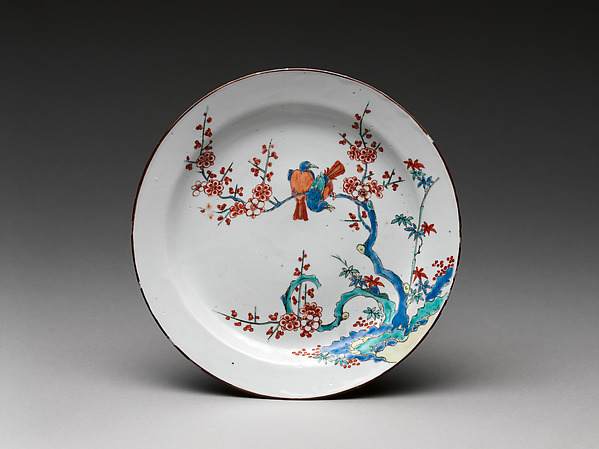
Dish with flowers and birds, 18th century, Hard-paste porcelain (Jingdezhen ware). The Metropolitan Museum of Art, The Hans Syz Collection, Gift of Stephan B. Syz and John D. Syz, 1995, accession 1995.268.94.
Look closer: the painting echoes the Kakiemon manner. The museum catalogues it as Jingdezhen ware, 18th century, hard-paste porcelain, 21.1 cm across.
Image: The Metropolitan Museum of Art, Open Access (CC0)
The article describes a division of labour that is useful for any reader of labels. Canton porcelain, it says, was made as blanks at Jingdezhen, then carried to Canton, where it was painted in styles designed for Western markets. A body and its decoration may therefore have come from different places. It also reports that blue-and-white wares in the Kangxi style were produced in large quantities by the end of the nineteenth century, that almost every earlier style was copied into the twentieth, and that production of imitations of historic wares continues. The Met's Hans Syz collection shows the consequence: a dish painted with flowers and birds in the Kakiemon manner is catalogued as Jingdezhen ware, while a dish in the Imari manner is catalogued as Hizen ware, Imari type. They look like cousins. The catalogue states which is Chinese and which is Japanese.
A parallel from China shows how a market for a famous name tends to behave. The article on famille verte reports that famille noire wares were once highly appreciated by Western collectors, leading to high prices and to counterfeiting, and that, as a result, a large proportion of the pieces now believed to survive are actually forgeries. Fame produces forgery in every ceramic culture. The Japanese story is the same story, told with different names.
Satsuma from Region to Palette
Satsuma ware supplies the longest account in the sources, and the chapter on Satsuma tells it in full. Here it matters for one point. Wikipedia says the first major presentation of Japanese arts to the West was at the Paris Exposition Universelle of 1867, that Satsuma ware figured prominently, and that the region's governor displayed ceramics, lacquerware, wood, tea implements, bamboo and textiles under the banner of Satsuma and not of Japan, as a sign of the daimyō's antipathy to the national shogunate. After the popularity of the ware at that exhibition, and its mention in Audsley and Bowes' Keramic Art of Japan in 1875, the two major workshops, those headed by Boku Seikan and Chin Jukan, were joined by many others.
From that point the word moved. By 1873, the article says, etsuke workshops specialising in painting blank-glazed stoneware items from Satsuma had sprung up at Kobe and Yokohama, and in places such as Kutani, Kyoto and Tokyo, workshops made their own blanks, eliminating any actual connection with Satsuma. From the early 1890s through the early 1920s there were more than twenty etsuke factories producing Satsuma ware, as well as small independent studios of high quality. A page on Kyoto Satsuma by the Gotheborg site describes the result: a stoneware body, often decorated with raised enamels called moriage, made mostly in the Meiji period, more ornate than the muted traditional Satsuma style, with base marks that are usually related to product or trade.
The market responded in the way markets do. Collectors, the article says, sought older and more refined pieces that they erroneously called early Satsuma, and these were in fact better-quality pre-Meiji pieces, works from other potteries such as Kyoto's Awata ware, or counterfeits. The article states that some manufacturers and dealers deliberately misrepresented the age and origin of items, that some sold Awata or Seto ware as Satsuma, and that some falsely used the names of famous artists or studios. It gives two practical cautions: earlier pieces tend to have a high-quality glaze and finish, and genuine bodies do not ring when tapped since they are stoneware and not porcelain. The Satsuma chapter treats the second as one rule of thumb among several, which is the right weight to give it.
The article also records the critical reaction. It quotes the art historian Gisela Jahn to the effect that in no other style of ceramics did the Japanese go to such extremes to appeal to Western taste, and says serious collectors turned away from export wares, while the studios that set up around 1880 in Kyoto turned back to a restrained style. The lesson for a reader is that the name Satsuma now covers two quite different things: a regional ware of the Satsuma domain, and an international palette made in many places.
Kutani, a Name and Its Claims
Kutani carries the question of this chapter in its first sentence. Wikipedia describes it as a style of Japanese porcelain traditionally supposed to be from Kutani, in what is now Kaga, Ishikawa, in two phases, Ko-Kutani of the seventeenth and early eighteenth centuries and Saikō-Kutani of the revived production in the nineteenth. The more prestigious Ko-Kutani wares, the article says, are recognised by scholars as a complex and much misrepresented group, very often not from Kutani at all. In recognition of the modern understanding that much, if not most, of the Ko-Kutani production was around Arita, the wares are now sometimes grouped with Imari ware, perhaps as Ko-Kutani type, or with the wider groupings of Arita ware or Hizen ware.
The Arita article supports the point from the ground. It says evidence from modern excavation of kiln sites shows that much of the Kutani ware, supposedly from Honshu, was in fact made around Arita, largely for export to South-East Asian markets. The sources do not agree on who the wares were for, as the Kutani chapter notes, and this chapter gives no choice between them. What matters here is the label. A piece sold as Ko-Kutani is making an age claim and an origin claim, and the scholarship has loosened the second.
The nineteenth-century and modern wares raise a different question. The Kutani article says that the revival began in 1804, or possibly 1807, with several kamamoto, that the style of producing Kutani was named a traditional craft in 1975, and that there are now several hundred companies that produce Kutani ware. In the normal production process it describes, the artisan receives a plain white ceramic piece and paints it. Kutani in this modern sense is therefore a tradition of decoration and of firing practice as well as a place: the word names a craft that can be practised by many hands and many companies in a region.
The line between style and authenticated work is drawn by the maker's own hand. The article on Tokuda Yasokichi records that Yasokichi I produced works that became indistinguishable from Ko-Kutani and from the Yoshidaya style, and that he began to sign them to keep them differentiated. It records that works resembling those of Yasokichi III by firms such as the Musubi Kiln tend to be unsigned or to carry a red mark for the firm. A signature, a firm's mark and a Living National Treasure's designation are three different kinds of claim, and the Potters chapter sets them out. The sensible reading is that Kutani may be a style, an age, a region or a named master, and the label should say which.
Signatures, Boxes and the Burden of Proof
The sources agree on one principle, though they state it in different places: no single mark proves a piece. The Satsuma article warns that a crest is painted on pieces of any age. The chapter on marks reports that the Nippon and Made in Japan marks follow the rules of American import law, and that transfer-printed Nippon marks were applied to imported porcelain in the 1960s. The potters chapter reports that some of the greatest potters of the twentieth century never signed. A mark is a clue. A glaze, a body, a painting and a history are other clues, and the strongest cases are those in which the clues agree.
A box adds a clue of its own. In tea ceramics the box, with its inscription and seal, is part of the object's history. The journal essay on tomobako and hakogaki explains how such boxes document provenance, and the chapters on tea utensils in this almanac take up the same subject. The Cleveland Museum of Art's Kenzan and Kōrin dish shows a different kind of signature evidence: the museum records that each brother signed, Kōrin beside his design and Kenzan on the back. Where a piece bears two hands, the question is whether the two signatures belong to the same period and style.
The honest conclusion is a method rather than a rule. Ask where the body was made and where it was painted. Ask whether the age fits the glaze and the finish. Ask whether the name on the label states a place, a family, a period or a look. Ask whether the mark is consistent with the dates the sources give for such marks. And ask for the word that states the relation: copy of, style, type, probably, attributed to. The Met's labels are the best guide in print, and a table of its wording follows.
Five Journeys Worth Telling
The first journey is that of a dish. The Wikipedia article on Ogata Kenzan illustrates a square dish with grapes by Kenzan that was exhibited at the Vienna World Exposition of 1873, and says it was later salvaged from the sunken ship Le Nil, which was transporting it back to Japan. A piece sent abroad as a showpiece of the new Japan nearly ended on the sea floor on the way home. It is a reminder that every object in this chapter has travelled, and that some of the journeys went badly.
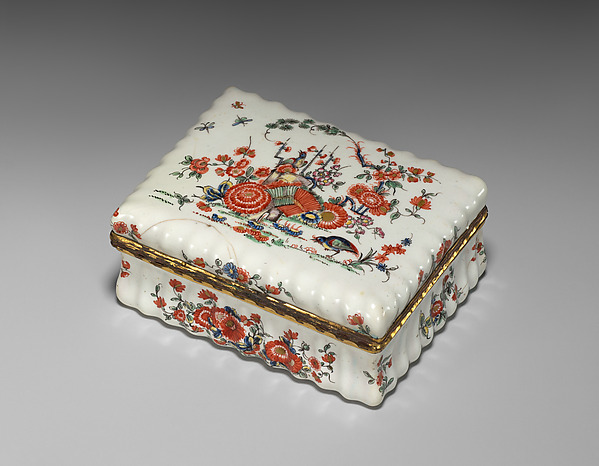
Kakiemon-style snuffbox, 1750s, Enamel on copper. The Metropolitan Museum of Art, Gift of Mrs. James M. Kellogg, in memory of her husband, 2023, accession 2023.441.21.
Look closer: red and orange flowers cover the lid and the sides of a scalloped box. The museum catalogues it as a Kakiemon-style snuffbox, 1750s, enamel on copper.
Image: The Metropolitan Museum of Art, Open Access (CC0)
The second is a political stunt. At Paris in 1867, according to the Satsuma article, the domain showed its ceramics, lacquer and textiles under its own regional banner and not Japan's, to signal the daimyō's antipathy to the shogunate. A ware that conquered the West was first a flag. The article adds that Britain supported the daimyō in the 1868 rebellion against the shogunate, which puts a porcelain exhibition in a diplomatic setting.
The third is a pair of vases and a town. The Kakiemon article says that the hexagonal vases with covers known as Hampton Court vases were named after a pair at Hampton Court Palace near London, recorded in an inventory of 1696, that the shape was copied at Meissen about 1730, and that Meissen entered into a sister-city contract with Arita in 1979. A shape in the royal inventory of a European palace became, three centuries later, the basis of a friendship between two porcelain towns.
The fourth is a cooling accident. The Tokuda article says that in the 1980s, after changing to an electric kiln, Tokuda Yasokichi III forgot to switch the kiln off at the normal time, that the glazes liquefied and blended, and that the ceramic took on the look of blown glass. He turned an error into a technique, and the technique earned a designation as a Living National Treasure in 1997. Not every copy or variation is a fake; some are the beginning of something new.
The fifth is a price. The Japanese site turuta.jp reports that during the Tenshō era, 1573 to 1592, one Ido tea bowl was reportedly exchanged for between ten thousand and fifty thousand koku of rice, and says some are worth several million to several tens of millions of yen today. The page does not give a date or a name for the bowl, so the figure is best read as a story told about value and not as a record. It shows how highly a Korean rice bowl could be prized by Japanese tea masters.
Fun Facts
- Tenmoku means heaven's eye in Japanese, from the Tianmu mountain in China where iron-glazed bowls were used for tea, according to Wikipedia.
- Three Chinese Song-dynasty tea vessels preserved in Japan are classed among Japan's National Treasures (crafts: others), according to the same article.
- The first large Dutch order for Arita porcelain was placed in 1656, and the Dutch export trade is said to have ended in 1756.
- The tea caddy was originally a bottle: Wikipedia, citing a standard authority, says chaire were first used in Song China as bottles for oil or medicine.
- Meissen and Arita signed a sister-city contract in 1979, according to the Kakiemon article.
- Kakiemon's white nigoshide body was used only for open forms, never for closed shapes such as vases, bottles and teapots, figures or animals.
- Liquid gold, suikin, used by Kyoto Satsuma studios in the early twentieth century, was originally developed by Meissen, says the Satsuma article.
- The Met catalogues a Kakiemon-style object that is not porcelain at all: a snuffbox of the 1750s in enamel on copper.
- Ko-Kutani is increasingly grouped with Imari, as Ko-Kutani type, rather than with the village for which it is named.
- Japan's Kutani ware was named a traditional craft in 1975, and several hundred companies now produce it, according to Wikipedia.
News from the Kiln and the Saleroom
Kutani is in the news for a sad reason. The Japanese government's Kizuna magazine reported on 5 January 2026 that a magnitude 7.6 earthquake struck the Noto region of Ishikawa Prefecture on 1 January 2024, damaging or destroying many buildings and workshops. It says Kutani ware, a porcelain from Nomi dating back about 370 years, and Suzu ware, originally produced between the twelfth and fifteenth centuries, were among the traditions affected. A company founded in Nomi in 2023, CACL, collected about ten tons of broken ceramic fragments from Nomi workshops and Suzu kilns. Wajima lacquer artisans repaired fragments with kintsugi, and other artisans added maki-e. The company reports plates for Givenchy Parfums made from Kutani and Suzu fragments and a collaboration with the Nigerian artist Otobong Nkanga shown at the 21st Century Museum of Contemporary Art, Kanazawa.
The Wallpaper magazine report of 20 January 2024 puts the quake in its first weeks, with the devastation concentrated mainly in Wajima and Suzu, and the lacquer district of Wajima among the worst affected. It mentions Kutani only as one of Ishikawa's crafts and reports no specific damage to it, so the two accounts should be read together and not merged. What is clear is that the crafts of Ishikawa are a living industry and a living community, and that a good deal of the news about them concerns repair.
In the saleroom, the same names recur. A Vienna house, Zacke, offered on 5 December 2025 a rectangular incense container of the Meiji period signed Yabu Meizan, 2.3 by 6 by 8 centimetres, bearing a four-character Yabu Meizan mark on the base, at an estimate of 8,000 euros. The catalogue page cites a comparable incense container by Yabu Meizan sold at Christie's in London on 16 May 2013 for 18,750 pounds. A Philadelphia house, Freeman's, lists in its 2026 Asian Works of Art sale a Satsuma-type Momotarō bowl signed Yabu Meizan at an estimate of 1,500 to 2,000 dollars; the page shows no result. The phrase Satsuma-type in the second catalogue is itself a small lesson in the vocabulary of this chapter.
A last modern note concerns museums. The Metropolitan Museum of Art publishes its Japanese ceramics as open-access images with their catalogue wording, which is why the labels in this chapter can be read against the objects. The Met uses phrases such as Hizen ware, Imari type, and Probably Korea.
A Glossary of Names and Claims
The glossary gathers the words used in this chapter, with the sense each source gives. It is not exhaustive. The house's wider glossary of ceramics terms and the glossary of tea utensils carry further entries.
| Term | Sense in the sources |
|---|---|
| Karamono | 唐物, literally Tang items. Refined tea implements, mainly ceramics, made in China, selected for excellence when imported to Japan. |
| Kōraimono | 高麗物, literally Goryeo items. Tea utensils made on the Korean Peninsula, mainly during the Yi dynasty. |
| Wamono | Tea implements, such as tea caddies, that originated in Japan, as against karamono. |
| Shimamono | Literally island-make. The third class of tea caddy in the classification given on Wikipedia's page for the water jar. |
| Ido chawan | A Korean-influenced tea bowl of the well type, said to descend from a Korean rice bowl and favoured by Sen no Rikyū for its rough simplicity. |
| Gohon | Korean-style. The Met uses the word for a tea bowl by Kiyomizu Rokubei I, made in Kyoto in the second half of the eighteenth century. |
| Tenmoku | A glaze type that began in imitation of Chinese Jian ware; original Chinese examples are also called tenmoku in Japan. |
| Hizen ware | The wider grouping, after the old province, to which Arita and Imari wares belong. |
| Imari type | The Met's phrase for Hizen wares in the brightly coloured style that Europe called Imari. |
| Kakiemon type | The Met's phrase for Hizen wares in the manner of the Kakiemon style. |
| Nigoshide | The milk-white body used for the finest Kakiemon wares, and only for open forms. |
| Chinese Imari | Chinese export porcelain made in the Imari style, produced in the eighteenth century. |
| Jingdezhen ware | The Met's term for Chinese porcelain from Jingdezhen, whose blanks were also carried to Canton to be painted. |
| Etsuke | 絵付け. A workshop that paints blank-glazed wares; the etsuke workshops of Kobe and Yokohama painted Satsuma blanks from 1873. |
| Ko-Kutani | Old Kutani, of the seventeenth and early eighteenth centuries, now thought to include much made around Arita. |
| Saikō-Kutani | Revived Kutani, from 1804 or possibly 1807, with new overglaze painting techniques. |
| Gosai-de | 五彩手. The five-colour style: green, blue, yellow, purple and red. |
| Aka-e kinran-de | A red-painted design combined with the gold technique called kinran-de, characteristic of nineteenth-century Kutani. |
| Saiyū | 彩釉. The blending of glaze colours that Tokuda Yasokichi III developed. |
| Kintsugi | Repair with gold-dust lacquer, used in 2025 to mend fragments of Kutani and Suzu ware broken in the Noto earthquake. |
Reading the Label
The best practical help is to read the words that museums use, and to ask the house offering any piece for equivalent words. The table lists labels from the Met's catalogue, each with the claim it makes and an object that carries it. None of them is an accusation or a flattery. They are statements of what the museum is prepared to say.
| Label wording | The claim it makes | Example in this chapter |
|---|---|---|
| Hizen ware; Imari type | Japanese, from the Arita region, in the style Europe called Imari | Dish with rocks, flowers and birds, 1710 to 1730 |
| Hizen ware; Kakiemon type | Japanese, in the Kakiemon manner | Dish with dragon, 1680 to 1700 |
| Arita ware, Kakiemon-related type | Japanese, from Arita, close to but not called Kakiemon | Ewer with strap handle, about 1680 |
| Kakiemon-style | Made in the manner, not necessarily in Japan or at Arita | Plate with tiger and bamboo, China, about 1755; snuffbox, 1750s |
| Jingdezhen ware | Chinese porcelain, whatever its decoration | Dish with flowers and birds, 18th century |
| Probably Korea | The museum itself is not certain | Tea bowl with stamped design, first half of the 17th century |
| Gohon (Korean-style) | Made in Japan in a Korean manner, by a named Kyoto potter | Tea bowl with cranes, second half of the 18th century |
| Copy of the Kaga Kōetsu Tea Bowl | Made in Japan as a copy of a named model | Red Raku tea bowl, 18th century |
Four Further Pieces and Their Labels

Dish with dragon, 1680–1700, Hard-paste porcelain painted with colored enamels over transparent glaze (Hizen ware; Kakiemon type). The Metropolitan Museum of Art, The Hans Syz Collection, Gift of Stephan B. Syz and John D. Syz, 1995, accession 1995.268.175.
Look closer: a ring in turquoise sits at the centre of a white dish with small coloured motifs. The museum catalogues it as Hizen ware, Kakiemon type, 1680 to 1700, 25.1 cm across.
Image: The Metropolitan Museum of Art, Open Access (CC0)
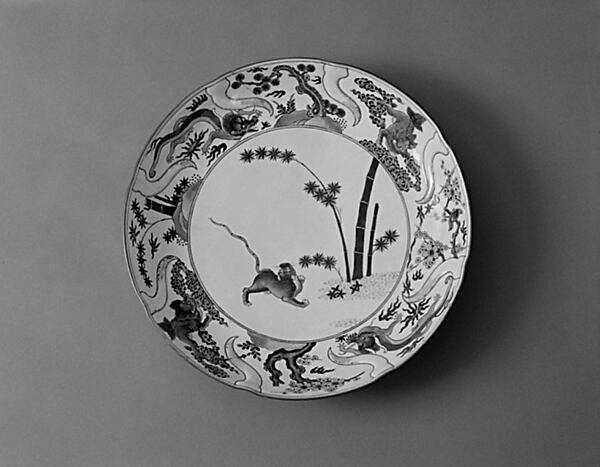
Plate with molded rim and decoration of Kakiemon-style tiger and bamboo, ca. 1755, Porcelain painted in underglaze cobalt blue (Jingdezhen ware). The Metropolitan Museum of Art, Dr. and Mrs. Roger G. Gerry Collection, Bequest of Dr. and Mrs. Roger G. Gerry, 2000, accession 2002.447.107.
Look closer: the photograph is in black and white, and a tiger stands beside bamboo at the centre. The museum catalogues it as China, about 1755, Jingdezhen ware, porcelain painted in underglaze cobalt blue, 34.9 cm across.
Image: The Metropolitan Museum of Art, Open Access (CC0)

Gohon (Korean-Style) Tea Bowl with Cranes, second half of the 18th century, Stoneware with white-slip inlay, underglaze iron, and red and white slip under transparent glaze (Kyoto ware, Kiyomizu type). The Metropolitan Museum of Art, The Howard Mansfield Collection, Gift of Howard Mansfield, 1936, accession 36.120.518.
Look closer: a single crane is drawn in dark slip on a warm yellow glaze. The museum catalogues it under Kiyomizu Rokubei I, Japan, second half of the 18th century, Kyoto ware, Kiyomizu type, 9.5 cm high.
Image: The Metropolitan Museum of Art, Open Access (CC0)

Jar with Chrysanthemums and Rocks, 18th century, Porcelain painted with colored enamels over transparent glaze (Hizen ware; Kakiemon type). The Metropolitan Museum of Art, The Harry G. C. Packard Collection of Asian Art, Gift of Harry G. C. Packard, and Purchase, Fletcher, Rogers, Harris Brisbane Dick, and Louis V. Bell Funds, Joseph Pulitzer Bequest, and The Annenberg Fund Inc. Gift, 1975, accession 1975.268.524.
Look closer: chrysanthemums and blue rocks are painted in colours over the glaze beneath a patterned band. The museum catalogues it as Hizen ware, Kakiemon type, 18th century.
Image: The Metropolitan Museum of Art, Open Access (CC0)
Names on the Shelf
Pieces under the Kutani, Arita, Imari and Satsuma tags pass through the house, and the concierge desk will say in plain words what each name does and does not claim. The glossary of Japanese ceramics terms and the directory of kilns are companions to this chapter.
Answered plainly
Is Imari the same as Arita?
Imari is a Western term for a brightly coloured style of Arita ware, taken from the port of Imari. The wares were made around Arita in Hizen Province, and Arita and Hizen are the more common names today.
What is the difference between Kakiemon and Imari?
Wikipedia says the West called the multi-coloured wares Imari and a different group Kakiemon, though the types were often produced at the same kilns. Kakiemon also names a family and its kilns.
How can you tell real Satsuma ware?
No single test is enough. Wikipedia says earlier pieces tend to have high-quality glaze and finish and that their stoneware bodies do not ring when tapped, but it also says some dealers sold other wares as Satsuma and that early ceramics rarely bore signatures.
Is Ko-Kutani really from Kutani?
Often not. Wikipedia says scholars consider Ko-Kutani a complex and much misrepresented group very often not from Kutani at all, and that much of it was made around Arita.
What does Chinese Imari mean?
It is the name for Chinese export porcelain painted in the Imari style, made in the eighteenth century when China copied Japanese designs.
What is karamono?
It names refined tea implements, mainly ceramics, made in China and selected for their excellence when imported to Japan. For tea caddies it also covers pieces made to resemble Chinese ones.
Is a Korean-style tea bowl Korean?
Not necessarily. The Met catalogues a gohon tea bowl as made in Kyoto by Kiyomizu Rokubei I, and a similar bowl as Probably Korea. The words matter.
Did Europe copy Japanese porcelain?
Yes. Wikipedia says Delft, Meissen, Chantilly, Chelsea, Worcester and others imitated the Imari and Kakiemon styles, and that by about 1760 Kakiemon was largely out of fashion in Europe.
Is a Kakiemon-style piece a fake?
Not by that word. Kakiemon-style states that the piece follows the manner. It becomes a fake only if it is sold as made by the Kakiemon family or in Japan when it was not.
What happened to Kutani ware in the Noto earthquake?
A magnitude 7.6 earthquake struck Noto on 1 January 2024. The Japanese government's Kizuna magazine reports that Kutani and Suzu ware workshops were affected and that about ten tons of broken fragments were collected for repair and reuse.
Where next
Sources and image credits
- Imari ware, Wikipedia
- Kakiemon, Wikipedia
- Arita ware, Wikipedia
- Satsuma ware, Wikipedia
- Kutani ware, Wikipedia
- Chinese export porcelain, Wikipedia
- Famille verte, Wikipedia
- Chawan, Wikipedia
- Mizusashi, Wikipedia
- Chaire, Wikipedia
- Tenmoku, Wikipedia
- Matcha, Wikipedia
- Wabi-cha, Wikipedia
- Karatsu ware, Wikipedia
- Hagi ware, Wikipedia
- Takatori ware, Wikipedia
- Ogata Kenzan, Wikipedia
- Tokuda Yasokichi, Wikipedia
- Ido tea bowls, turuta.jp
- Kyoto Satsuma, Gotheborg
- Piecing pottery together, Japan government magazine Kizuna, 5 January 2026
- In the aftermath of Japan's Noto earthquake, what's next for Ishikawa crafts, Wallpaper, 20 January 2024
- Yabu Meizan incense container, Zacke, 5 December 2025
- Object record, Dish with rocks, flowers, and birds, The Metropolitan Museum of Art
- Object record, Tea bowl with decoration of chrysanthemums and wavy lines, The Metropolitan Museum of Art
- Object record, Teabowl, The Metropolitan Museum of Art
- Object record, Tea Bowl with Hare’s-Fur Decoration, The Metropolitan Museum of Art
- Object record, Red Raku Tea Bowl (copy of the Kaga Kōetsu Tea Bowl), The Metropolitan Museum of Art
- Object record, Ewer with Strap Handle and Floral Decoration, The Metropolitan Museum of Art
- Object record, Dish with flowers and birds, The Metropolitan Museum of Art
- Object record, Kakiemon-style snuffbox, The Metropolitan Museum of Art
- Object record, Dish with dragon, The Metropolitan Museum of Art
- Object record, Plate with molded rim and decoration of Kakiemon-style tiger and bamboo, The Metropolitan Museum of Art
- Object record, Gohon (Korean-Style) Tea Bowl with Cranes, The Metropolitan Museum of Art
- Object record, Jar with Chrysanthemums and Rocks, The Metropolitan Museum of Art
Last reviewed 28 October 2026. Pictures, where shown, are public-domain or open-access and credited beneath each one.
Holding a piece whose name you cannot place? The concierge desk replies within one to three business days.
Browse Japanese porcelain and ceramics · Make a private request
Private concierge
Looking for something in particular?
Describe the piece or the project you have in mind. A senior advisor in Tokyo reads every case file personally and replies within two business days, with fees set out in writing before any work begins.