
Satsuma: Dark Clay and Gilded Ivory
Pottery Almanac · Southern Kyushu
Satsuma: Dark Clay and Gilded Ivory
Satsuma is two potteries that share a name. One is a plain dark stoneware from southern Kyushu, made by Korean potters from about 1600. The other is the ivory-bodied, gold-and-enamel ware that conquered the world fairs, and much of it was never made in Satsuma at all.
Fact sheet
At a glance
- A name that became a style. After 1867 the word Satsuma stopped marking a place and began to describe a look. Wikipedia says workshops in Kyoto, Tokyo, Kobe and Yokohama made it, some with no link to Satsuma.
- Two quite different wares. Ko-Satsuma is stoneware from iron-rich dark clay, practical and often plain. Kyo-Satsuma is ivory-bodied, crackle-glazed and painted in gold and enamel.
- Korean hands. Korean potters brought to Kyushu at the end of the 1590s settled mainly at Naeshirogawa and Tateno, which became the centres of the local industry.
- Fame and a bad reputation. Satsuma became one of Japan's most profitable exports, then a byword for mass production, which critics at the time and since have judged harshly.
- Marks that mislead. The Shimazu crest, the word Satsuma and Dai Nippon all appear on pieces, but the crest in particular became a marketing convention.
Two Wares Under One Name
Satsuma ware is a type of Japanese pottery originally from Satsuma Province in southern Kyushu. Wikipedia divides it today into two categories. The first is the plain dark-clay Ko-Satsuma, early Satsuma, made in Satsuma from around 1600. The second is Kyo-Satsuma, the elaborately decorated, ivory-bodied export ware that began to be produced in the nineteenth century in various Japanese cities.
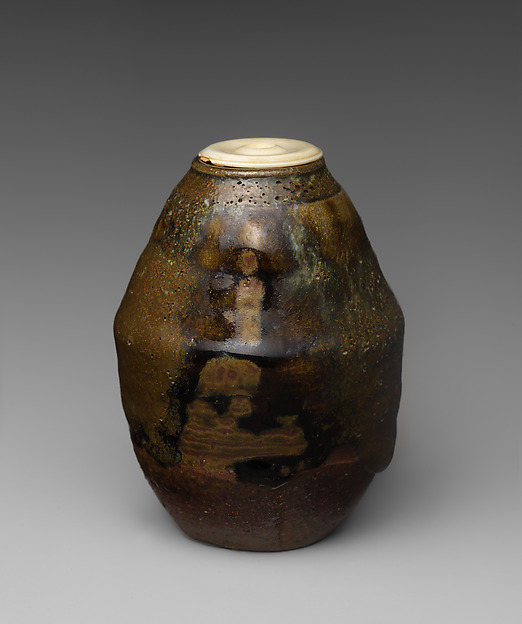
Tea Jar, 17th century, Clay with glaze (Satsuma ware). The Metropolitan Museum of Art, Edward C. Moore Collection, Bequest of Edward C. Moore, 1891, accession 91.1.148.
Look closer: the glaze is dark and uneven, pooled in places, over a body that has been left with irregular, slightly lumpy contours. There is no painted decoration at all.
Image: The Metropolitan Museum of Art, Open Access (CC0)
The name is therefore a trap for the unwary. A catalogue that says Satsuma may mean a farmhouse jar fired in the south in the seventeenth century, or a gilded vase painted in Kyoto in the 1890s, and the two have almost nothing in common except the word. The rest of this chapter keeps them apart.
The tea jar pictured here, from the Met, is of the first kind. It is catalogued as Satsuma ware of the seventeenth century and is only 8.3 centimetres high, a small dark-glazed jar of the sort used in the tea room.
The Korean Potters of Naeshirogawa
Most scholars, Wikipedia says, date the appearance of Satsuma ware to the late sixteenth or early seventeenth century. In 1597 and 1598, at the end of Toyotomi Hideyoshi's incursions into Korea, Korean potters were captured and forcibly brought to Japan, in the article's words to kick-start Kyushu's non-existent ceramic industry. Hagi ware and Arita ware share similar peninsular origins.
The Satsuma region proved a good place for kilns because of its local clay and its nearness to Korea. The potters settled mainly at Naeshirogawa and Tateno, which became the hub of the local industry. The article singles out the Shim family, written Chin Jukan in Japanese, who have continued to make Chin Jukan-brand pottery to this day.
The Satsuma Domain article supplies the political setting. The domain was based at Kagoshima Castle, ruled throughout its existence by the Shimazu clan, and established in 1600. It was one of the most powerful domains of the Edo period, and its distance from Edo, the article notes, helped to give it room to act on its own account.
Ko-Satsuma and the Plain Pot
Satsuma ware up to the first years of the Genroku era, 1688 to 1704, is often called Early Satsuma or Ko-Satsuma. The oldest surviving examples, the article says, are stoneware made from iron-rich dark clay under a dark glaze. Before 1790 the pieces were not ornately decorated. They were humble articles of folk-ware for everyday use in rustic settings, or for the tea ceremony, and the potters relied on raised relief, stamped impressions and carving to give them interest.

Teabowl, 18th century, Clay with a transparent glaze (Satsuma ware). The Metropolitan Museum of Art, Gift of Mr. and Mrs. Samuel Colman, 1893, accession 93.1.186.
Look closer: fine vertical ribs run around the whole body, and the glaze is pale and clear. Plain, tactile surface work of this kind is what the article describes for the early ware.
Image: The Metropolitan Museum of Art, Open Access (CC0)
The nineteenth-century collecting boom confused the picture. Collectors sought older and more refined pieces that they wrongly called early Satsuma, and these were in fact, according to the article, simply better pre-Meiji nineteenth-century wares, works from other potteries such as Kyoto's Awata ware, or counterfeits. The label Ko-Satsuma deserves a measure of suspicion for that reason.
Among the old types the article lists are Shiro Satsuma, white-glazed ware first made only for the daimyo's household, and Kuro Satsuma, black-bodied with a dark overglaze. The Met teabowl pictured here is catalogued simply as Satsuma ware of the eighteenth century, in clay with a transparent glaze, and it is ribbed in a way that has nothing to do with later gilt decoration.
Nishikide, the Painted Ivory
From about 1800, Wikipedia records, brocade decoration called nishikide began to flourish. The palette it describes is a delicate iron-red, a glossy blue, a bluish green, a soft purple-black and a very sparingly used yellow. A slightly later innovation added painted gilding, kin nishikide. The enamel and gold were painted onto delicate ivory-bodied pieces with a finely crackled transparent glaze.
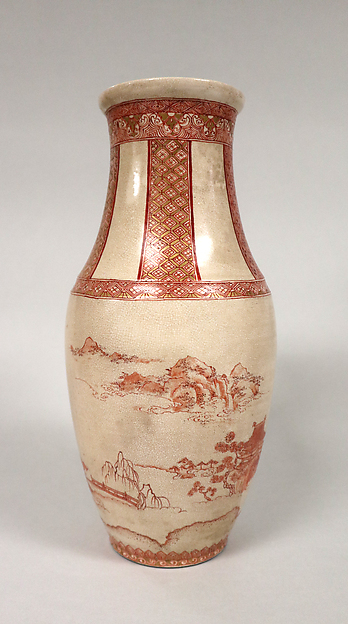
Vase, ca. 1800, Pottery with design in red and gold (Satsuma ware). The Metropolitan Museum of Art, Gift of Mrs. V. Everit Macy, 1923, accession 23.225.360.
Look closer: a landscape of hills and water is drawn in thin red lines on the body, with lattice panels and gold bands at the neck and a wide pale ground left open. Compare it with the crowded export pieces below.
Image: The Metropolitan Museum of Art, Open Access (CC0)
The designs were often light, simple floral patterns, influenced by Kyoto pottery and by the Kano school of painting, and the result was an emphasis on negative space. Many believe, the article says, that this came from Satsuma potters visiting Kyoto in the late seventeenth century to learn overglaze painting.
The Met vase pictured here, of about 1800 and catalogued as Satsuma ware with a design in red and gold, shows how restrained the manner could be. The painting sits in bands and a landscape, and the pale ground between them is left to breathe.
From Paris to the World's Fairs
The first major presentation of Japanese arts to the West was at the Paris Exposition Universelle of 1867, and Satsuma ware, Wikipedia says, figured prominently. The domain's daimyo understood early the economic and political advantages of trade with the West, and the exhibits of ceramics, lacquerware, tea implements and textiles were shown under Satsuma's regional banner and not Japan's, a sign of the daimyo's antipathy to the national shogunate. Britain, the article adds, offered the daimyo support in the 1868 rebellion against the shogunate.
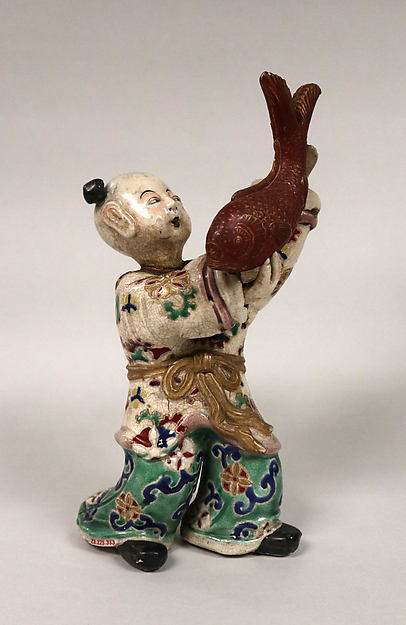
Boy Holding up a Carp, 1860, Faience decorated in colored enamels and gold (Satsuma ware). The Metropolitan Museum of Art, Gift of Mrs. V. Everit Macy, 1923, accession 23.225.353.
Look closer: the boy's jacket and trousers are painted in dense scrolls and blocks of colour, and the carp he holds up is a flat iron-red. The museum dates the piece to about 1860 and classes it as faience in coloured enamels and gold.
Image: The Metropolitan Museum of Art, Open Access (CC0)
Satsuma ware was then mentioned in Audsley and Bowes's Keramic Art of Japan in 1875. The two major workshops, those headed by Boku Seikan and Chin Jukan, were joined by many others across Japan, and the word Satsuma ceased to be a geographical marker and began to convey an aesthetic. By 1873 workshops in Kobe and Yokohama were painting blank-glazed stoneware from Satsuma. In Kutani, Kyoto and Tokyo, workshops made their own blanks, which removed any actual connection with Satsuma. From the early 1890s to the early 1920s there were more than twenty such decorating factories.
The export style, the article explains, was adapted to what foreign buyers were thought to want. Surfaces were covered in packed-flower hanazume or all-over nuritsubushi painting, with motifs such as pagodas, folding fans and kimono-clad women, and the palette darkened, with generous raised gold called moriage. There was a new interest in okimono, decorative figures of beautiful women, animals, children and religious subjects. The Met's boy holding up a carp, of about 1860, is an example of the figural work.
The Critics, and the Restrained Studios
The mid-1880s brought an export slump, linked in part to a loss of quality and novelty through mass production. By the 1890s, Wikipedia says, contemporary Satsuma had been generally denigrated by critics and collectors, and it was badly received at Chicago's Columbian Exposition of 1893. Yet it remained a popular export into the twentieth century and became, in a phrase the article quotes, virtually synonymous with Japanese ceramics in the Meiji period.
The art historian Gisela Jahn, quoted there, judged that in no other style of ceramics did the Japanese go to such extremes to appeal to Western taste, and that the harm of mass production showed nowhere more plainly. There was never a domestic demand for these pieces, which were viewed in Japan as a betrayal of tradition.
The same article is careful, however, to say that not every maker sacrificed quality. It names Chin Jukan XII (1835 to 1906), Togo Jukatsu (1855 to 1936), Taizan Yohei IX, Ito Tozan, Kinkozan Sobei VI and VII, Yabu Meizan and Miyagawa Kozan, among others. Most set up their decorating workshops around 1880, and their work shows a wish to return to tradition, with a restrained style, sparing motifs, and subjects drawn from literary classics and heroic legend. Kinkozan, active from 1645 to 1927, was the largest producer of export Satsuma.
| Type | What the article says | What it looks like |
|---|---|---|
| Shiro Satsuma | White-glazed, first made only for the daimyo's household | Pale, undecorated or lightly decorated |
| Kuro Satsuma | Black-bodied with a dark overglaze | Dark and plain |
| Mishima Satsuma | Light bluish-grey glaze with inlaid or impressed geometric patterns filled with white slip | Patterned in white on grey |
| Nishikide and kin nishikide | Brocade enamel decoration, from about 1800, with gilding added later | Ivory body, fine crackle, red and gold |
| Export Satsuma | Hanazume and nuritsubushi painting, moriage gold, many figural subjects | Crowded, rich and dark in palette |
Crests, Marks and Counterfeits
Older Japanese ceramics often carry no stamp or signature, the article observes, while pieces made after 1870 can bear several marks besides the artist's. On Satsuma the commonest is the Shimazu crest, a red cross within a red circle, placed above any signatures or stamps. It once signified a link to the domain and the Shimazu clan's direct involvement. In the age of mass production and export it simply became a marketing convention, and the article is explicit that the crest appears on many pieces regardless of age or authenticity.
Beneath the crest the word Satsuma or satsuma yaki is sometimes painted or stamped, in kanji, hiragana or Latin letters. The Dai Nippon mark, Great Japan, was applied during the Meiji period to show the place of origin at a time of rising nationalism, and it commonly appears to the right of the maker's mark.
The counterfeits are an old problem. The article reports that some manufacturers and dealers deliberately misrepresented age and origin, selling Awata or Seto ware as Satsuma and borrowing the names of famous artists or studios. Because early ceramics rarely bore signatures, dating can be hard. One telling feature of older pieces is a high-quality glaze and finish. Another, the article says, is that the bodies do not ring when tapped, since they are stoneware and not porcelain. It is a single rule of thumb and should not be mistaken for proof.
Plain Jars and Gilded Gods

Jar with Double Cover, 1680, Clay covered with a transparent crackled, streaked glaze (Satsuma ware). The Metropolitan Museum of Art, Gift of Charles Stewart Smith, 1893, accession 93.3.160a–c.
Look closer: the glaze streaks and crackles down the jar and shades from pale grey to near black. This is the plain, tactile Ko-Satsuma tradition, dated by the museum to 1680.
Image: The Metropolitan Museum of Art, Open Access (CC0)

Teabowl, ca. 1853, Clay; brilliant glaze with irregular splashes (Satsuma ware, Betsukafu type). The Metropolitan Museum of Art, The Howard Mansfield Collection, Gift of Howard Mansfield, 1936, accession 36.120.532.
Look closer: a thick dark glaze pools and splashes across the whole inside and outside of the bowl. The museum catalogues it as Satsuma ware of the Betsukafu type, of about 1853.
Image: The Metropolitan Museum of Art, Open Access (CC0)

Incense Burner (koro) and Cover with Molded and Reticulated Design, 18th century, Satsuma ware, earthenware with clear glaze. The Metropolitan Museum of Art, Rogers Fund, 1919, accession 19.14.2a–c.
Look closer: the cover is pierced in a lattice so that scent can escape, and the body is moulded with small handles. It is a pale, clear-glazed piece, earthenware under a clear glaze.
Image: The Metropolitan Museum of Art, Open Access (CC0)

Goddess Benten, late 19th century, Faience decorated with colored enamels (Satsuma ware). The Metropolitan Museum of Art, Gift of Mrs. V. Everit Macy, 1923, accession 23.225.361.
Look closer: the robes carry fine all-over patterns and the figure stands about 60 centimetres high, a very large piece. It belongs to the export figural tradition the article describes.
Image: The Metropolitan Museum of Art, Open Access (CC0)
A Shelf of Satsuma
The house sometimes holds Satsuma pieces, and the concierge desk can say which of the two Satsumas a piece belongs to. Two are with the house at the time of writing: a late Edo to Meiji gilt export incense burner and a Satsuma kinrande okimono of a seated immortal with a deer.
Answered plainly
What is the difference between Ko-Satsuma and Kyo-Satsuma?
Ko-Satsuma is the early dark-clay stoneware made in Satsuma from about 1600. Kyo-Satsuma is the decorated, ivory-bodied export ware made from the nineteenth century in Kyoto and other cities.
Is all Satsuma ware made in Satsuma?
No. By 1873 decorating workshops in Kobe and Yokohama were painting blanks from Satsuma, and in Kutani, Kyoto and Tokyo workshops made their own blanks, so Satsuma came to name a style.
What does the red cross in a circle mean?
It is the Shimazu family crest. It once marked a link to the ruling house of Satsuma, but later became a marketing convention that appears on pieces of any age.
Was Satsuma ware admired?
At first it was, at the 1867 Paris exposition. By the 1890s critics and collectors had largely turned against the mass-produced export wares, while the restrained studios of the Meiji and Taisho periods kept a better reputation.
Where next
Sources and image credits
- Satsuma ware, Wikipedia
- Satsuma Domain, Wikipedia
- Object record, Tea Jar, The Metropolitan Museum of Art
- Object record, Teabowl, The Metropolitan Museum of Art
- Object record, Vase, The Metropolitan Museum of Art
- Object record, Boy Holding up a Carp, The Metropolitan Museum of Art
- Object record, Jar with Double Cover, The Metropolitan Museum of Art
- Object record, Teabowl, The Metropolitan Museum of Art
- Object record, Incense Burner (koro) and Cover with Molded and Reticulated Design, The Metropolitan Museum of Art
- Object record, Goddess Benten, The Metropolitan Museum of Art
Last reviewed 28 October 2026. Pictures, where shown, are public-domain or open-access and credited beneath each one.
Looking for a Satsuma piece, or a view on a mark or a crest? The concierge desk replies within one to three business days.
Browse Japanese porcelain and ceramics · Make a private request
Private concierge
Looking for something in particular?
Describe the piece or the project you have in mind. A senior advisor in Tokyo reads every case file personally and replies within two business days, with fees set out in writing before any work begins.