
Tsuboya: Naha's Yachimun Kilns
Pottery Almanac · Okinawa
Tsuboya: Naha's Yachimun Kilns
Yachimun is the Okinawan word for pottery, and Tsuboya is the quarter of Naha where it has been made since the kingdom gathered its scattered kilns there in 1682. Its unglazed storage jars and its slip-and-glaze tableware are one tradition, and a century of mingei admirers made it famous.
Fact sheet
At a glance
- A royal decision. In 1682 the Ryukyu government concentrated the island's kilns in Tsuboya, which Kogei Japan calls the start of present-day Tsuboya ware.
- Rough and fine. Arayachi is generally unglazed and made for large jars, while jōyachi is slipped, glazed and decorated.
- An anticlockwise wheel. The Ritsumeikan story says the potter's wheel turns anticlockwise, unlike the clockwise wheels it says are common on the mainland.
- The mingei connection. Hamada Shōji stayed at Tsuboya, and Yanagi Sōetsu collected Okinawan pottery.
- Kilns leave the city. Smoke from climbing kilns led some potters to move to Yomitan, where Kinjō Jirō built a climbing kiln.
Three Kilns Joined in 1682
Tsuboya ware, in Okinawan Cibuja-jaci, is made in Tsuboya, a pottery district of the city of Naha in Okinawa Prefecture. Kogei Japan, a craft-promotion site, gives the background in dates. Imported ceramics and ceramic-making techniques from China and Southeast Asia helped local production grow between the fourteenth and sixteenth centuries, with later influences from the Korean peninsula. In 1609 Satsuma invaded the Ryukyu Kingdom, and the royal government went on promoting pottery as a local industry.
Diagram by Japonista. Naha and Kagoshima are placed to the nearest tenth of a degree; Satsuma's 1609 invasion is dated by Kogei Japan.
Look closer: Naha lies on the main island of Okinawa, far to the south-west of Kagoshima, the base of the Satsuma domain.
Diagram by Japonista
The decisive date is 1682. In that year, Kogei Japan says, the royal government consolidated three kilns into the present Tsuboya area of Naha, at Chibana, Takaraguchi in Shuri and Wakuta in Naha. The Ritsumeikan University story on Okinawan ceramics, published through Google Arts and Culture, gives the same year and the same three sites, and Wikipedia agrees that Okinawan craftsmen began working in this form of pottery in 1682. The Visit Okinawa tourism guide adds that in 1660 Shuri Castle had burned, creating a need for roof tiles.
The same guide traces older roots. It says Chinese pottery first appeared in the Ryukyu Islands in the twelfth century, that earthenware in the islands has a history of over 6,000 years, and that in the fifteenth and sixteenth centuries large storage vats and other vessels for awamori, the island liquor, were fired in kilns on Okinawa Island. It says that the glazed type, jōyachi, owes its firing technique to Korea, introduced by the Satsuma domain in the early seventeenth century.
Rough and Fine: Arayachi and Jōyachi
Both Kogei Japan and the Ritsumeikan story divide traditional Okinawan pottery into two kinds. Arayachi, which Wikipedia glosses as rough pottery, is generally unglazed, so the colour and texture of the clay show. Kogei Japan says it is used for larger vessels such as sake jars, water jars and funerary urns, and Visit Okinawa describes it as made from black soil and red clay from the south, with a burnished red colour, used early on for vases, jars and roof tiles. Visit Okinawa also says shisa, the guardian lions seen on roofs and entrances, are most often associated with arayachi.
Jōyachi is the decorated kind. Kogei Japan says it is finished with slips and glazes and used for tableware, sake vessels and flower vases, often with white slip over reddish clay. The glazes it lists are transparent, amber, green and black. The Ritsumeikan story says the common glazes are transparent, iron, cobalt and ash, and that one, which it calls oogusuya, is a green glaze made from ash of the Ficus retusa tree mixed with brass. Visit Okinawa says the clay for jōyachi comes from central and northern Okinawa, red clay and white soil.
The forms Kogei Japan lists are jars, large storage vessels, plates, bowls, sake vessels, dachibin, which it describes as portable bottles, karakara, sake vessels, shisa, and zushigame, funerary urns. The Ritsumeikan story pictures a green-glazed bottle of the nineteenth century used to carry awamori as a festive gift, which was returned to the giver afterwards. The Kyushu Ceramic Museum catalogues a bottle of the tonaki form, with a linked-circles design in iron-brown glaze, as Tsuboya ware of the second half of the eighteenth to the first half of the nineteenth century.
Red Clay, White Slip, Anticlockwise Wheel
The Ritsumeikan story gives the working method in some detail. Red clay is found mainly in Yomitan, Onna and around Nago, and white clay around Onna, and in the kingdom's time the clay was shipped by boat to Naha port. The clay is kneaded thoroughly before throwing, in a process called kikumomi, which leaves a chrysanthemum-like pattern. The wheel, it says, turns anticlockwise, unlike the clockwise wheels it says are common on the mainland. The ware is air-dried without a biscuit firing, and underglaze decoration is painted before glazing.
Kogei Japan describes decoration by line carving, by scraping away selected areas of white slip to show the clay beneath, by inlay and applied relief, and by hand painting in mineral pigments with plants, fish, birds and geometric patterns, and by red overglaze painting that is applied after the main firing and fired again at a lower temperature. Jōyachi is fired once, it says, at about 1,200 degrees Celsius. Wikipedia names a slip made from a clay it says is unique to Tsuboya, called gushitou, and glazes of natural materials such as coral or rice husks.
The kilns shape the result. Kogei Japan says traditional climbing kilns are warmed with wood and fired chamber by chamber, that flame, ash and placement produce variation, and that gas and other precise kilns are now widely used. The Ritsumeikan story describes the Yomitanzanyaki North Kiln, opened in 1992, whose thirteen chambers are fired five times a year, each firing taking about 72 hours, with five or six test pots placed in each chamber to judge the glaze.
Hamada, Yanagi and Kinjō Jirō
Kogei Japan says that in the early Shōwa period Yanagi Sōetsu, Hamada Shōji and Kawai Kanjirō, the founders of the mingei movement, renewed attention to Okinawan pottery, and Wikipedia's article on mingei says Yanagi's collection included Okinawan pottery. Wikipedia's biography of Hamada says that after returning from England he stayed for weeks at Tsuboya, and the Ritsumeikan story says he visited Okinawa every year to work there. The Wikipedia article on Tsuboya ware says the style was popularised by folk-art proponents such as Yanagi.
Diagram by Japonista. Dates from Kogei Japan, Visit Okinawa and the Ritsumeikan story; spacing is even, not to scale.
Look closer: The dates run from the 1609 invasion to the opening of a new climbing kiln in 1992.
Diagram by Japonista
Among Tsuboya's makers, Kogei Japan names Kinjō Jirō, who was recognised as a Living National Treasure in 1985 for his mastery of Ryukyuan pottery. Wikipedia calls him the first Okinawan Living National Treasure and lists two more notable potters, Kobashigawa Eishō and Aragaki Eisaburo. The Ritsumeikan story says Kinjō built a climbing kiln in Yomitan Village. Kogei Japan adds that the craft was designated a Traditional Craft of Japan on 2 June 1976.
The war left its mark on the district. The Ritsumeikan story says Naha was largely destroyed in the Second World War, but Tsuboya suffered less damage and production resumed soon after, and Visit Okinawa says the same. It says the Naha Municipal Tsuboya Pottery Museum stands at an entrance to Tsuboya Yachimun-dōri, the pottery street, and describes the street as lined with dozens of workshops, shops and cafés.
Climbing Kilns Leave the City
The Ritsumeikan story says that around the time of Okinawa's return to Japanese sovereignty, Tsuboya's urbanisation led to restrictions on climbing kilns because of smoke, that some potters switched to gas, and that others moved to the outskirts to build climbing kilns. It says Tsuboya's kilns produced smoke until the Agarinu Kiln ended production in 1974, and that the Yachimun-no-Sato project in Yomitan, on a former military base, increased the number of kilns there, so that Yomitan and Tsuboya are now the two representative Okinawan pottery centres.
Visit Okinawa, for its part, says artisans who wanted to keep wood-fired production moved to the Yomitan area in the 1970s and that the remaining workshops switched to gas or electric kilns. It also says that beside the museum a climbing kiln fires arayachi, and that deeper in Tsuboya stands an agarinu kiln with nine separate chambers used to fire jōyachi. Wikipedia likewise says the climbing kiln is restricted because of smoke in residential areas and that gas kilns are now used.
Reading a Tsuboya Piece
Begin with the surface. An unglazed, burnished red body points to arayachi and a large vessel, while white slip, carved or scraped lines, and glaze point to jōyachi and the table. Then ask where the clay came from: the Ritsumeikan story says red clay is found mainly around Yomitan, Onna and Nago, and a catalogue entry that says only Okinawa may mean Tsuboya or Yomitan.
The museum record is the safest guide. A search of the Met and Brooklyn Museum catalogues for this chapter found no pottery catalogued as Tsuboya ware, and the Staatliche Museen in Berlin hold a hip bottle by Kinjō Jirō whose image carries a non-commercial licence, so it cannot be shown here. The pictures in the gallery below are therefore not pottery. They are Ryukyuan court arts from the Met, and are shown as context for the kingdom that made the kilns.
Ryukyuan Court Arts Beside the Pottery

Footed Tray with Figures in a Landscape, early 17th century, Basketry and red lacquer with gold and litharge painting. The Metropolitan Museum of Art, Gift of Florence and Herbert Irving, 2015, accession 2015.500.2.5.
Look closer: this is basketry and lacquer, not pottery. The rim is red lacquer with a gold border, and pierced bands run round the woven foot. The museum catalogues it as Ryūkyū Islands, early 17th century, basketry and red lacquer with gold and litharge painting, 17.8 cm high.
Image: The Metropolitan Museum of Art, Open Access (CC0)
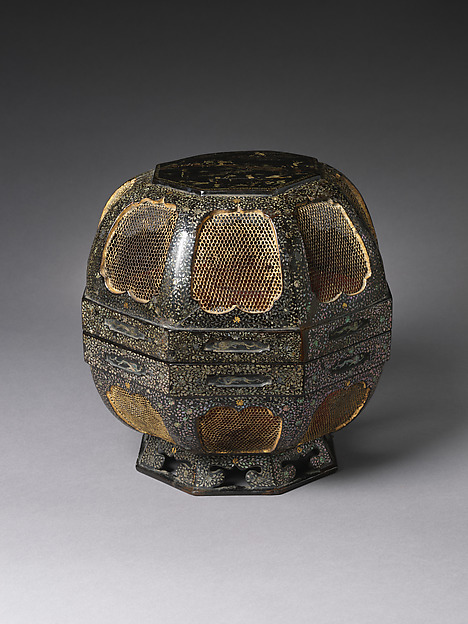
Octagonal food box with Chinese immortals and floral design, 18th century, Lacquered wood; mother-of-pearl inlay, gold leaf application on black ground and gilded metal net inserts. The Metropolitan Museum of Art, Purchase, Friends of Asian Art Gifts, 2019, accession 2019.106a, b.
Look closer: this is lacquer, not pottery. The box has eight sides, on a foot, with net-patterned panels in gilded metal set into black lacquer. The museum catalogues it as Ryūkyū Islands, 18th century, lacquered wood with mother-of-pearl inlay, 27 cm high.
Image: The Metropolitan Museum of Art, Open Access (CC0)

Tray with Pair of Dragons, 18th century, Black lacquer inlaid with mother-of-pearl. The Metropolitan Museum of Art, Gift of Florence and Herbert Irving, 2015, accession 2015.500.2.4.
Look closer: this is lacquer, not pottery. Two dragons in mother-of-pearl chase each other round the centre of a black tray. The museum catalogues it as Ryūkyū Islands, 18th century, black lacquer inlaid with mother-of-pearl, 69.3 cm across.
Image: The Metropolitan Museum of Art, Open Access (CC0)

Robe, 19th century, Resist-dyed and painted (bingata) silk crepe. The Metropolitan Museum of Art, Purchase, Seymour Fund, Gift of Mr. and Mrs. Harold Bach, by exchange, 1983, accession 1983.417a, b.
Look closer: this is silk, not pottery. A yellow ground carries birds in flight, flowering plants and bands of roundels in red and blue. The museum catalogues it as Okinawa, Ryūkyū Islands, 19th century, resist-dyed and painted (bingata) silk crepe, 142.2 cm long.
Image: The Metropolitan Museum of Art, Open Access (CC0)
Tsuboya at the Desk
At the time of writing no piece catalogued as Tsuboya ware is with the house. The concierge desk can say when one arrives. The folk-art page and the directory of Japanese pottery centres and kilns are good companions to this chapter.
Answered plainly
What does yachimun mean?
Pottery, in the Okinawan language, according to the Ritsumeikan story.
What is the difference between arayachi and jōyachi?
Arayachi is generally unglazed and used for large vessels, while jōyachi is slipped, glazed and decorated.
When did Tsuboya ware begin?
Kogei Japan, the Ritsumeikan story and Wikipedia all date it to 1682, when the government gathered the kilns in Tsuboya.
Why did potters move to Yomitan?
Smoke from climbing kilns became hard to accommodate in urban Naha, and some potters built kilns in Yomitan.
Where next
Sources and image credits
- Tsuboya Yaki, Kogei Japan (a craft-promotion site)
- Ceramics from Okinawa, Google Arts and Culture (Lifestyle Design Laboratory, Kyoto Women's University)
- Tsuboya Yachimun Street, Visit Okinawa
- Tonaki bottle, Kyushu Ceramic Museum
- Tsuboya ware, Wikipedia
- Shōji Hamada, Wikipedia
- Mingei, Wikipedia
- Hip bottle with shrimp decoration by Kinjō Jirō, Museum für Asiatische Kunst, Berlin (image not reused)
- Object record, Footed Tray with Figures in a Landscape, The Metropolitan Museum of Art
- Object record, Octagonal food box with Chinese immortals and floral design, The Metropolitan Museum of Art
- Object record, Tray with Pair of Dragons, The Metropolitan Museum of Art
- Object record, Robe, The Metropolitan Museum of Art
Last reviewed 28 October 2026. Pictures, where shown, are public-domain or open-access and credited beneath each one.
Looking for an Okinawan piece or a view on one you own? The concierge desk replies within one to three business days.
Browse Japanese porcelain and ceramics · Make a private request
Private concierge
Looking for something in particular?
Describe the piece or the project you have in mind. A senior advisor in Tokyo reads every case file personally and replies within two business days, with fees set out in writing before any work begins.