
Firing, Kilns and Glaze
Pottery Almanac · Technique
Firing, Kilns and Glaze
Every surface in this almanac was made by fire. A cave of clay and a bank of stacked wood, a slope of chambers rising up a hill, a small kiln opened while red hot: each gave Japanese potters a different kind of glaze, and each can be read in the piece.
Fact sheet
At a glance
- Wood makes glaze. In a wood-fired kiln, ash settles on the pots and, with the minerals of the clay, forms a natural ash glaze.
- A hill of chambers. A noborigama is built on a slope with each chamber higher than the last, so that the heat of one warms the next.
- Fire takes days. An anagama firing can take from 48 hours to twelve days or more, and the kiln needs about as long to cool.
- White arrived late. Wikipedia calls Shino the first white glaze used in Japanese ceramics.
- Colour sits over or under. Arita used underglaze blue first and overglaze enamels by the middle of the seventeenth century.
Earthenware, Stoneware and Porcelain
Wikipedia's article on Japanese pottery lists earthenware, pottery, stoneware, porcelain and blue-and-white ware among the types made in Japan. Its companion articles give the ranges that separate them. Earthenware is normally fired below 1,200 degrees Celsius and stays porous unless it is glazed. Stoneware is fired at between about 1,100 and 1,300 degrees. Ash glaze, the same source says, needs around 1,170 degrees, high enough to make the body into stoneware, or, above about 1,200 degrees and with the right materials, porcelain.
Raw materials, Wikipedia adds, are chosen largely for local availability. Kilns were traditionally built at the sites of clay deposits, and many clays are found in Kyushu because of naturally occurring kaolin. That is one reason the kiln chapters of this almanac read like a map of clay: Bizen, Shigaraki and Tokoname are stoneware regions, Arita is a porcelain region, and Raku, in the Met's catalogue wording, is earthenware.
| Body | Firing range reported | Example in this almanac |
|---|---|---|
| Earthenware | Below about 1,200 degrees Celsius | Raku tea bowls |
| Stoneware | About 1,100 to 1,300 degrees Celsius | Bizen, Shigaraki, Tokoname, Karatsu, Mino |
| Porcelain | Above about 1,200 degrees, with suitable materials | Arita, Kutani |
The Cave and the Climbing Kiln
An anagama, Wikipedia says, is a cave kiln: a single firing chamber, built as a sloping tunnel, with a firebox at one end and a flue at the other and no wall between the fire and the ware. It burns wood, and the wood must be fed without a break, because logs thrown into a hot kiln are consumed very quickly. The heat can reach 1,400 degrees, and the length of a firing, depending on the size of the kiln, runs from 48 hours to twelve or more days, with about the same time again to cool. The article adds that loading is held to be the hardest part, because the potter must imagine the path of the flame through the kiln and place the pieces to suit it.
Diagram by Japonista. Schematic, not to scale. Structure as described by Wikipedia.
Look closer: The anagama is one long tunnel; the noborigama steps up a hill in separate chambers.
Diagram by Japonista
The noborigama, the chambered climbing kiln, is also built on a slope, and each succeeding chamber is higher than the one before. The chambers are pierced at intervals with stoking ports. According to Wikipedia, climbing kilns have been used in Japan since the seventeenth century, and the largest working example in the country stands at Shigaraki. Their chief advantage is the re-use of heat: exhaust from the lower chambers preheats the chambers above, so firing the upper ones needs only the extra fuel to bring the ware to peak temperature. The article lists a waritake kiln as a variant of the anagama, with partition walls every few metres, each of which can be stoked from the side.
The two kinds matter to the collector because the kiln leaves marks of its own. A piece near the firebox of an anagama may take a heavy coat of ash or lie in embers, while one deeper in the kiln is only softly touched; the same article says that the way pieces are placed beside one another changes the flame path and so the look of pieces in each part of the kiln.
Ash That Becomes Glaze
Wood does more than heat the kiln. Wikipedia explains that burning wood produces fly ash and volatile salts, that the ash settles on the pieces, and that the interaction of flame, ash and the minerals of the clay forms a natural ash glaze. It may be smooth and glossy or rough and sharp, and it varies in colour, texture and thickness. In an article on ash glaze it adds that natural ash tends to collect thickly on the shoulders of storage jars and to begin to drip down the walls, and that rice-straw ash produces an opaque, creamy white glaze.
The result can be seen in the Met's catalogue entries, which name natural ash glaze again and again: a stoneware long-necked jar of the seventh century, made as Sue ware in an anagama, and the Echizen, Tamba, Bizen and Shigaraki jars shown on the chapters of the Six Ancient Kilns. The ash article makes a further point that explains why such pieces are individual: the chemical composition of ash varies with the plant, the soil and the place, and even two pieces taken from the same batch can come out differently.
Black, White and Green for the Tea Bowl
The tea-bowl glazes have names of their own. Tenmoku, Wikipedia says, began as an imitation of Chinese Jian ware of the southern Song dynasty. It is made of feldspar, limestone and iron oxide, and the faster a piece cools, the blacker the glaze. Black Seto, the Mino tea bowl of the late sixteenth century in the Met's collection, is catalogued with a black glaze, and Raku, the hand-formed bowls of Kyoto, belongs to the low-fired tradition described in its own chapter.
Shino is the opposite. Wikipedia calls it Japanese stoneware from Mino, with thick white glazes, red scorch marks and a texture of small holes, and the first white glaze used in Japanese ceramics. It was made from ground local feldspar with a small amount of clay, and was fired in anagama kilns. The article says it was supplanted by the glazes of Oribe ware as the multi-chambered noborigama replaced the anagama in the first decade of the seventeenth century. The origin of the name is uncertain: it may come from shiro, white, or from the tea master Shino Sōshin.
Oribe supplies the green. The Met catalogues several Mino pieces of the early seventeenth century as copper green glaze, among them a water jar of about 1610, and the museum's Brown Oribe flower holder shows the dark, ash-and-iron side of the same family. Wikipedia lists Oribe sub-styles including Ao-Oribe, Aka-Oribe and Kuro-Oribe, and says the style developed under the guidance of the lord Furuta Oribe.
Raku Opened Hot
Wikipedia's account of Raku begins with Sen no Rikyū, who had a tile-maker named Chōjirō produce hand-moulded tea bowls for the wabi style of tea. It records that Raku vessels are fired at low temperatures and cooled in the open air, and it gives the working reason: Raku glazes mature at much lower temperatures than high-fired stoneware, so the kiln can be heated quickly and loaded and unloaded while hot. A firing takes an hour or two, against up to sixteen hours for a high-temperature stoneware firing.
The article also draws a line that matters for anyone meeting the word in a modern setting. The reduction chamber of straw, sawdust or newspaper, into which hot pieces are placed after the firing, was introduced, it says, by the American potter Paul Soldner in the 1960s, to make up for the difference between the wood-fired Japanese raku kilns and American gas kilns. Western raku and the tea bowls of the Raku family in Kyoto are therefore related, not identical.
Blue Beneath, Enamel Above
Wikipedia dates the first Japanese porcelain to the discovery of porcelain clay near Arita near the end of the sixteenth century. Early wares used underglaze blue decoration, and by the middle of the seventeenth century Arita was making wares with overglaze enamels. The type called kinrande, known in the West as Imari, is typically decorated in underglaze blue, then with red, gold and black outlines and sometimes other colours added over the glaze.
Kakiemon is the lighter relative. The article names the family and the style, a brightly coloured overglaze palette of soft red, yellow, blue and turquoise green, and says the potter Sakaida Kakiemon is popularly credited with being among the first in Japan to master enamel decoration on porcelain, called akae. A double climbing kiln in Arita used for Kakiemon firing is a designated National Historic Site, a reminder that even the finest porcelain was fired on a slope.
Celadon was the difficult one. Wikipedia's article on celadon says Japanese potters mostly avoided greenware because of a loss rate of up to 80 per cent, and that kaolin is not abundant in Japan, with Amakusa in Kyushu one source. It places production in the style of Longquan around Arita under the Nabeshima lords, and adds that Japanese artists and clients tend to prefer the bluish white of seihakuji to a fully green glaze. In the stricter, Chinese definition cited there, true celadon needs at least 1,260 degrees and a reducing atmosphere.
What the Surface Tells You
The sources allow a few plain observations. A drip of glaze on the shoulder of a jar is natural ash settled where ash collects. A thick white glaze with red scorch marks and small holes is, in Wikipedia's description, Shino. A copper green glaze on Mino ware is catalogued by the Met as Oribe. A black glaze that is blacker for having cooled quickly belongs to the tenmoku family. On porcelain, blue sits under the clear glaze and enamel colours sit over it, which is what the terms underglaze and overglaze mean.
None of this proves a date or a kiln. Glazes of these names were revived by later potters, as the Shino article records for the 1930s and 1940s, and the gallery below shows what the Met itself calls each. The chapter on made in Japan and collected in Japan explains why a style name alone is not an attribution.
Nine Surfaces from the Fire

Long-Necked Jar (Chōkeiko), 7th century, Stoneware with natural ash glaze (Sue ware). The Metropolitan Museum of Art, The Harry G. C. Packard Collection of Asian Art, Gift of Harry G. C. Packard, and Purchase, Fletcher, Rogers, Harris Brisbane Dick, and Louis V. Bell Funds, Joseph Pulitzer Bequest, and The Annenberg Fund Inc. Gift, 1975, accession 1975.268.419.
Look closer: a tall flaring neck rises from a round body, and green and brown ash runs in streaks over the shoulder. The museum catalogues it as Sue ware, 7th century, stoneware with natural ash glaze, 28.6 cm high.
Image: The Metropolitan Museum of Art, Open Access (CC0)

Black Seto (Seto-guro) Tea Bowl, named Iron Mallet (Tettsui), late 16th century, Stoneware with black glaze (Mino ware, Black Seto type). The Metropolitan Museum of Art, Mary Griggs Burke Collection, Gift of the Mary and Jackson Burke Foundation, 2015, accession 2015.300.272.
Look closer: the glaze is dark and thick over a straight-sided body. The museum catalogues it as Mino ware, Black Seto type, late 16th century, stoneware with black glaze, 9.3 cm high.
Image: The Metropolitan Museum of Art, Open Access (CC0)
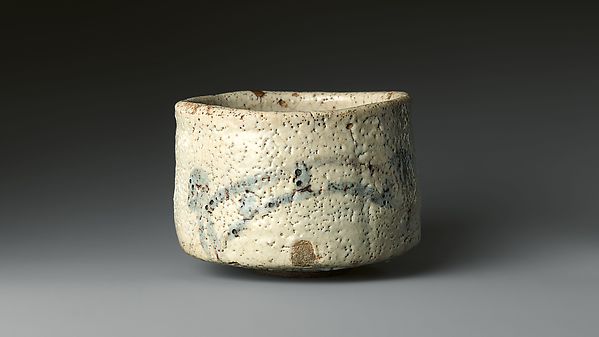
Shino Tea Bowl with Bridge and Shrine, Known as “Bridge of the Gods” (Shinkyō), late 16th–early 17th century, Stoneware with iron oxide under glaze (Mino ware, Shino type). The Metropolitan Museum of Art, Mary Griggs Burke Collection, Gift of the Mary and Jackson Burke Foundation, 2015, accession 2015.300.271.
Look closer: the glaze is thick and white with small pits, a painted line runs across the wall, and a reddish patch sits near the foot. The museum catalogues it as Mino ware, Shino type, late 16th to early 17th century, 10.5 cm high.
Image: The Metropolitan Museum of Art, Open Access (CC0)

Water jar, ca. 1610, Stoneware with copper green glaze (Mino ware, Ofuke type). The Metropolitan Museum of Art, Anonymous Gift, 1985, accession 1985.400.18.
Look closer: a dark green glaze covers the ribbed body, two scrolled handles sit at the shoulder, and the foot is unglazed. The museum catalogues it as Mino ware, Ofuke type, about 1610, stoneware with copper green glaze, 14.6 cm high.
Image: The Metropolitan Museum of Art, Open Access (CC0)

Black Raku Tea Bowl, early 17th century, Earthenware with black raku glaze (Raku ware). The Metropolitan Museum of Art, Rogers Fund, 1917, accession 17.118.74.
Look closer: the form is almost cylindrical with a faintly squared outline, and the glaze is a deep black. The museum catalogues it as Raku ware, early 17th century, earthenware with black raku glaze, 9.2 cm high.
Image: The Metropolitan Museum of Art, Open Access (CC0)
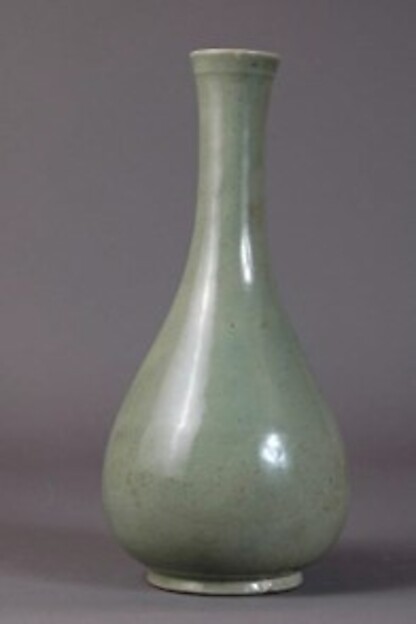
Celadon Flower Vase (Hanaire), mid-17th century, Porcelain with celadon glaze; Hizen ware. The Metropolitan Museum of Art, Mary and Cheney Cowles Collection, Gift of Mary and Cheney Cowles, 2024, accession 2024.443.2.
Look closer: a long, slender neck rises from a pear-shaped body glazed in soft grey-green. The museum catalogues it as Hizen ware, mid-17th century, porcelain with celadon glaze, 29.7 cm high.
Image: The Metropolitan Museum of Art, Open Access (CC0)

Bowl, ca. 1640, Porcelain with underglaze blue (Hizen ware). The Metropolitan Museum of Art, The Harry G. C. Packard Collection of Asian Art, Gift of Harry G. C. Packard, and Purchase, Fletcher, Rogers, Harris Brisbane Dick, and Louis V. Bell Funds, Joseph Pulitzer Bequest, and The Annenberg Fund Inc. Gift, 1975, accession 1975.268.488.
Look closer: the photograph is in black and white, and the painting of a branch with a small bird sits under the clear glaze. The museum catalogues it as Hizen ware, about 1640, porcelain with underglaze blue, 8.9 cm high.
Image: The Metropolitan Museum of Art, Open Access (CC0)
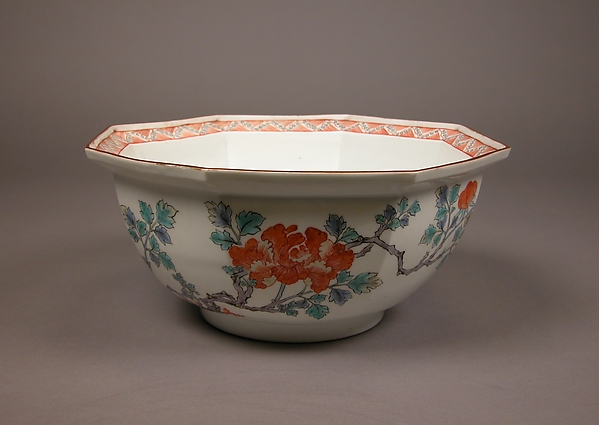
Octagonal Bowl with Design of Peonies, 1670–1710s, Porcelain with overglaze enamels (Hizen ware, Arita region, Kakiemon style). The Metropolitan Museum of Art, Dr. and Mrs. Roger G. Gerry Collection, Bequest of Dr. and Mrs. Roger G. Gerry, 2000, accession 2002.447.58.
Look closer: red peonies and green leaves are painted over the glaze, with a red band at the rim. The museum catalogues it as Hizen ware, Arita region, 1670s to 1710s, porcelain with overglaze enamels, 25.7 cm across.
Image: The Metropolitan Museum of Art, Open Access (CC0)

Platter (Ōzara) with Pine Tree, early 17th century, Stoneware with underglaze iron oxide decoration (Hizen ware, Karatsu type). The Metropolitan Museum of Art, Mary Griggs Burke Collection, Gift of the Mary and Jackson Burke Foundation, 2015, accession 2015.300.266.
Look closer: a dark iron-painted tree spreads across a pale ground. The museum catalogues it as Hizen ware, early 17th century, stoneware with underglaze iron oxide decoration, 32 cm across.
Image: The Metropolitan Museum of Art, Open Access (CC0)
A Shelf of Glazed Wares
Pieces carrying these glazes pass through the house under the tags Kutani, Arita, Imari and Satsuma, and as tea-ceremony wares. The concierge desk can say which surface a piece shows and what the museums call it. For tea ironware see the guide to tetsubin and chagama care.
Answered plainly
What is the difference between an anagama and a noborigama?
An anagama is a single sloping tunnel with a firebox at one end and a flue at the other. A noborigama is a row of chambers on a slope, each higher than the last, with stoking ports.
What is a natural ash glaze?
A glaze formed when wood ash settles on the pieces in a wood-fired kiln and combines with the minerals of the clay.
Is Raku fired at a high temperature?
No. Wikipedia says Raku glazes mature at much lower temperatures than high-fired stoneware, so the firing is short.
Which glaze is the first white glaze in Japan?
Wikipedia calls Shino the first white glaze used in Japanese ceramics.
Where next
Sources and image credits
- Japanese pottery and porcelain, Wikipedia
- Anagama kiln, Wikipedia
- Ash glaze, Wikipedia
- Stoneware, Wikipedia
- Earthenware, Wikipedia
- Tenmoku, Wikipedia
- Shino ware, Wikipedia
- Furuta Oribe, Wikipedia
- Raku ware, Wikipedia
- Arita ware, Wikipedia
- Kakiemon, Wikipedia
- Celadon, Wikipedia
- Object record, Long-Necked Jar (Chōkeiko), The Metropolitan Museum of Art
- Object record, Black Seto (Seto-guro) Tea Bowl, named Iron Mallet (Tettsui), The Metropolitan Museum of Art
- Object record, Shino Tea Bowl with Bridge and Shrine, Known as “Bridge of the Gods” (Shinkyō), The Metropolitan Museum of Art
- Object record, Water jar, The Metropolitan Museum of Art
- Object record, Black Raku Tea Bowl, The Metropolitan Museum of Art
- Object record, Celadon Flower Vase (Hanaire), The Metropolitan Museum of Art
- Object record, Bowl, The Metropolitan Museum of Art
- Object record, Octagonal Bowl with Design of Peonies, The Metropolitan Museum of Art
- Object record, Platter (Ōzara) with Pine Tree, The Metropolitan Museum of Art
Last reviewed 28 October 2026. Pictures, where shown, are public-domain or open-access and credited beneath each one.
Wondering how a surface was made, or what a glaze should look like? The concierge desk replies within one to three business days.
Browse Japanese porcelain and ceramics · Make a private request
Private concierge
Looking for something in particular?
Describe the piece or the project you have in mind. A senior advisor in Tokyo reads every case file personally and replies within two business days, with fees set out in writing before any work begins.