
Seto and Mino: Glaze Country
Pottery Almanac · Central Japan
Seto and Mino: Glaze Country
In Japanese the word for a piece of pottery can be setomono, a thing from Seto. Next door, in Mino, potters from the Seto area went on to make the white of Shino, the green of Oribe and some of the most daring tea bowls ever made.
Fact sheet
At a glance
- A word for all pottery. Setomono, a thing of Seto, is also used in Japanese as a generic term for all pottery.
- The first glazes. Wikipedia says Seto was the place in Japan that used glazes in the Kamakura period, at first in imitation of Song Chinese wares.
- Mino and the tea room. Craftsmen from the Seto area settled in Mino, and its technical and artistic peak came when it made vessels for the tea ceremony.
- Four tea styles. Yellow Ki-Seto, black Setoguro, white Shino and green-and-black Oribe, all strongly tied to the tea ceremony.
- A contested master. Whether Furuta Oribe really guided the ware that bears his name is debated by scholars.
Seto and the First Glazes
Seto ware is a type of pottery, stoneware and ceramics produced in and around the city of Seto in Aichi Prefecture. Wikipedia notes that the Japanese term for it, setomono, is also used as a generic term for all pottery, and that Seto was the location of one of the Six Ancient Kilns of Japan.
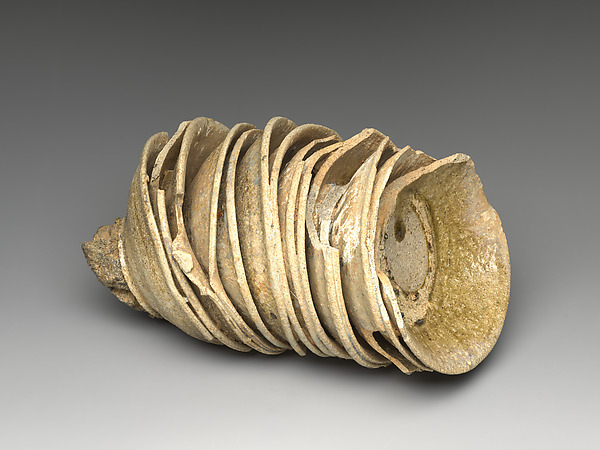
Cluster of mountain tea bowls (yama-chawan), 13th century, Stoneware with ash glaze (Seto ware). The Metropolitan Museum of Art, Purchase, Olive Lam Fund, 1980, accession 1980.152.
Look closer: many bowls have fused into one long rolled stack, rim to foot, the ash glaze running pale and thin over them. The museum dates it to the 13th century, the earliest period of Seto pottery.
Image: The Metropolitan Museum of Art, Open Access (CC0)
Pottery at Seto dates back to the thirteenth century. Kato Shirozaemon is credited as the first to produce wares in the town: in the 1220s he is said to have studied pottery in China, and after several failed attempts in other places he founded a successful kiln at Seto. The article adds that the earliest Seto ceramics may have evolved from failed attempts to reproduce Chinese celadons, and that during the Kamakura period the wares imitated the pottery of Song China, green celadon and dark brown tenmoku among them. In the Muromachi period, 1337 to 1573, the glazes were refined and the styles spread to other areas, such as modern Gifu Prefecture.
This glazed pottery is called Ko-Seto, old Seto. The article says it influenced the development of bowls for the tea ceremony, and that the clay at Seto is a high-quality kaolin and porcelain stone that fires white and helps to produce coloured glazes. In the Kan'ei era, 1624 to 1644, the first daimyo of Owari, Tokugawa Yoshinao, had a kiln built at Nagoya Castle and invited Seto potters to make pottery there.
The cluster of 13th-century bowls pictured here, from the Met, is a kiln relic, a stack of mountain tea bowls, yama-chawan, fused together in the firing. The museum catalogues it as Seto ware, stoneware with ash glaze.
Mino, Where the Tea Bowls Were Made
Mino ware is produced in the former Mino Province, mainly in Tajimi, Toki, Mizunami and Kani in Gifu Prefecture. The pottery of the Toki area appears to have begun more than 1,300 years ago, Wikipedia says, since kiln traces and earthenware in the seventh-century style have been found there. Craftsmen around Seto fled wars before the Azuchi-Momoyama period and settled in the region under the protection of the lords of Toki, and the pottery was founded by Kato Yosabei, whose sons started other potteries in the area.

Black Seto (Seto-guro) Tea Bowl, named Iron Mallet (Tettsui), late 16th century, Stoneware with black glaze (Mino ware, Black Seto type). The Metropolitan Museum of Art, Mary Griggs Burke Collection, Gift of the Mary and Jackson Burke Foundation, 2015, accession 2015.300.272.
Look closer: a deep, straight-walled bowl glazed black all over, with a slightly uneven rim and a little glaze wear. The museum catalogues it as Mino ware of the Black Seto type and gives it a name, Iron Mallet.
Image: The Metropolitan Museum of Art, Open Access (CC0)
The technical merit and artistic impression of Mino reached new heights, the article says, when crockery for the tea ceremony was produced there. Daimyo lords highly admired the vessels. From the early Edo period more emphasis was placed on everyday necessities, and with mass production in the Meiji period Mino ware became widely available. The article gives a striking figure: ceramics from the Mino region amount to around 50 per cent of Japanese pottery.
Four styles developed over the centuries, with strong connections to the tea ceremony: yellow Ki-Seto, black Setoguro, Shino, which is often grey with white autumn grasses, and green-and-black Oribe. The Met's black teabowl pictured here is of the Setoguro type, catalogued as Black Seto and named Iron Mallet, Tettsui, and it dates to the later sixteenth century.
Shino, the First White
Shino ware, Wikipedia says, emerged in the sixteenth century and is identified by thick white glazes, red scorch marks and a texture of small holes. The first Shino was developed in the Momoyama period in kilns in the Mino and Seto areas. The glaze, made mainly of ground local feldspar and a little local clay, gave a satiny white, and the article calls it the first white glaze used in Japanese ceramics. It was fired in anagama kilns, single-chambered trenches in a hillside under an earthen roof.
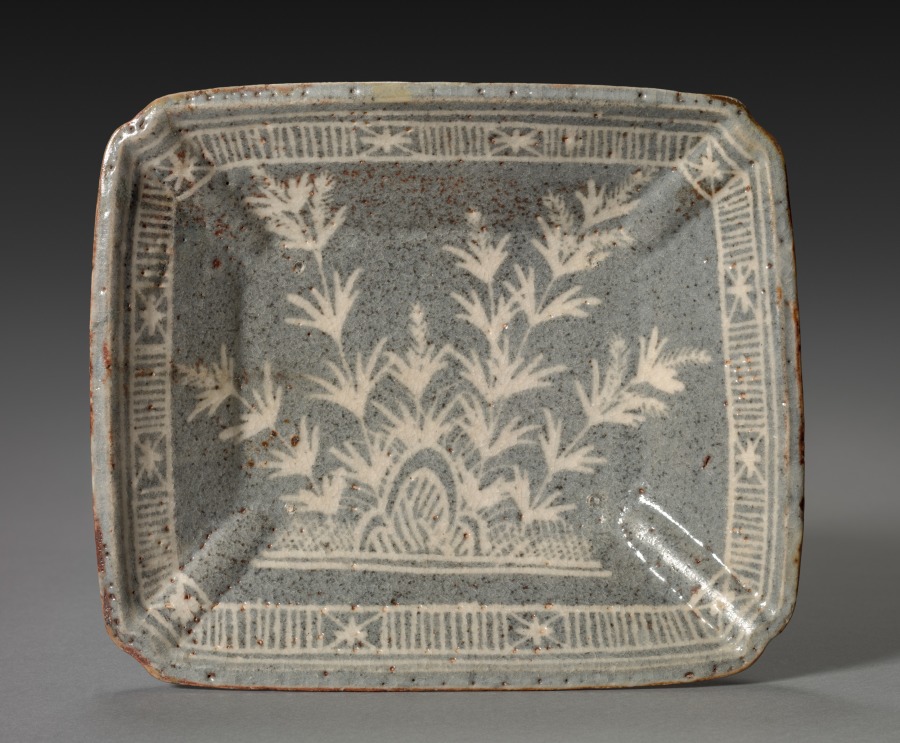
Dish with Autumn Grasses and Rocks, late 1500s–early 1600s, Stoneware with underglaze iron oxide slip and incised designs (Mino ware, Shino type). The Cleveland Museum of Art, John L. Severance Fund, accession 1966.24.
Look closer: white grasses rise from a rock at the centre, drawn by carving through a dark slip to the pale clay beneath, and the rim carries a border of short strokes. The glaze is thick and a little uneven in tone.
Image: The Cleveland Museum of Art, Open Access (CC0)
The origin of the word is uncertain. It may come from shiro, white, or it may refer to the tea master Shino Soshin (1444 to 1523). Whichever it is, the article reports that as the multi-chambered noborigama replaced the anagama in the first decade of the seventeenth century, Shino was supplanted by the Oribe glazes of the newer kilns. It had a brief revival in the nineteenth century and then faded, until the 1930s and 1940s, when two Japanese potters, Toyozo Arakawa and Hajime Kato, developed the first modern Shino glaze by studying Momoyama pots.
The Cleveland Museum describes the grey Shino dish pictured here as nezumi-shino, mouse-grey Shino, after the glazing technique. An iron oxide slip is applied to the surface and carved through to the white clay, and the whole is covered in glaze and fired, so the grasses appear white on grey. Its shape, the museum observes, recalls the wooden and lacquered trays commonly used in Japan at the time.
Oribe and the Deformed Bowl
Oribe ware is a style that first appeared in the sixteenth century. Wikipedia describes it as recognised by its freely applied glaze and by a dramatic departure from the more sober, monochrome shapes common in Raku ware at the time. The ceramics were often asymmetric and eccentric, and deformed shapes were not uncommon, achieved by moulding and not by turning on the wheel. Some bowls were so deformed that even whisking tea became difficult.
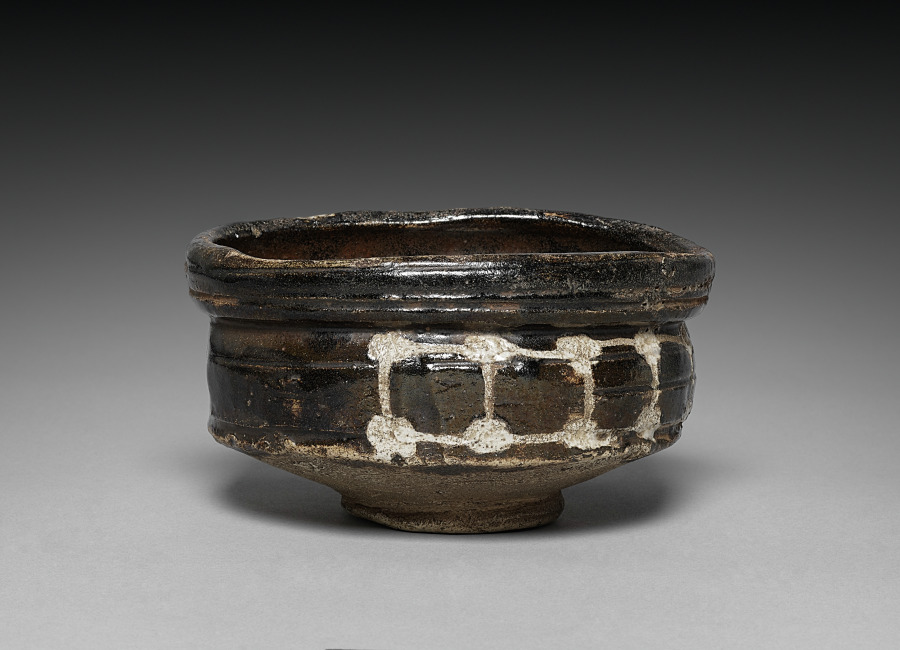
Clog-shaped Teabowl, early 1600s, Glazed stoneware (Mino ware, Oribe type). The Cleveland Museum of Art, Severance and Greta Millikin Purchase Fund, accession 2020.214.
Look closer: the rim is pinched into an oblong, clog-like outline and the black glaze carries a ladder of white strokes and blobs. The museum's own catalogue text names the bold abstract design as the signature style of the age.
Image: The Cleveland Museum of Art, Open Access (CC0)
The designs are richly coloured, with blue, green and copper glazes most often, and often include lustrous hand-drawn iron designs of plants or ponds. Green Oribe, Ao-Oribe, is the best known: its copper glaze is not brushed but poured or ladled, and it is fired in oxidation at 1,220 degrees Celsius, in a noborigama. The article says that multi-chambered kiln was introduced from northern Kyushu by Korean potters in the late sixteenth century, and that it allowed the higher, steadier temperatures that give Oribe its lustrous shine. Black Oribe, Kuro-Oribe, is black-glazed with unglazed spots.
The name comes from Furuta Oribe, who was born in 1544 in Mino Province and died in 1615. He was a daimyo and a celebrated tea master, a student of Sen no Rikyu who became the foremost tea master in the land after Rikyu's death, and the Cleveland Museum says the clog-shaped teabowl pictured here is in the signature style of the period, named Oribe for the tea master who championed the aesthetic.
Reading a Mino Label
Wikipedia's Oribe article makes an honest admission: many researchers claim that differentiating Shino, Oribe, Yellow Seto, Seto Black and Mino Iga is extremely difficult, and often rests solely on aesthetic criteria. Some experts, the Shino article adds, believe Shino should not be treated as distinct from Oribe but described as white Oribe, with the usual Oribe called green Oribe.
For the reader of a catalogue this means that the words matter, but the particular piece matters more. A label that says Mino may name a late-sixteenth-century tea bowl, a revival piece, or one of the very large number of modern tableware items made in the region. Ask for the period, the glaze type and the evidence, and look at the way the glaze sits on the clay.
A modern art has grown from the old one. Among the modern Oribe artists the article names is Suzuki Osamu (born 1934), who was designated a Living National Treasure in 1994, and the Shino article credits Arakawa Toyozo and Kato Hajime with the first modern Shino glaze. A directory of such makers is linked below.
| Style | Colour and look, as the sources give it | Pictured in this chapter |
|---|---|---|
| Ki-Seto | Yellow glaze | Cleveland yellow Seto bowl of about 1590 |
| Setoguro | Black glaze | The Met's Iron Mallet teabowl |
| Shino | Thick white or grey glaze, scorch marks and small holes; white grasses on grey in nezumi-shino | Two dishes and a water jar |
| Oribe | Green copper glaze and black, bold and deformed shapes, iron-drawn designs | A clog-shaped teabowl, a dish, a tile platform and a flower holder |
Bowls, Jars and Tile

Wine Flask, c. 1300, Stoneware with ash glaze and underglaze stamped and incised decoration (Seto ware). The Cleveland Museum of Art, John L. Severance Fund, accession 1983.22.
Look closer: the body carries a stamped and incised pattern under a pale ash glaze. The museum says Seto ware was made in imitation of Chinese Song prototypes, and was unique among Japanese ceramics for being glazed from the start.
Image: The Cleveland Museum of Art, Open Access (CC0)
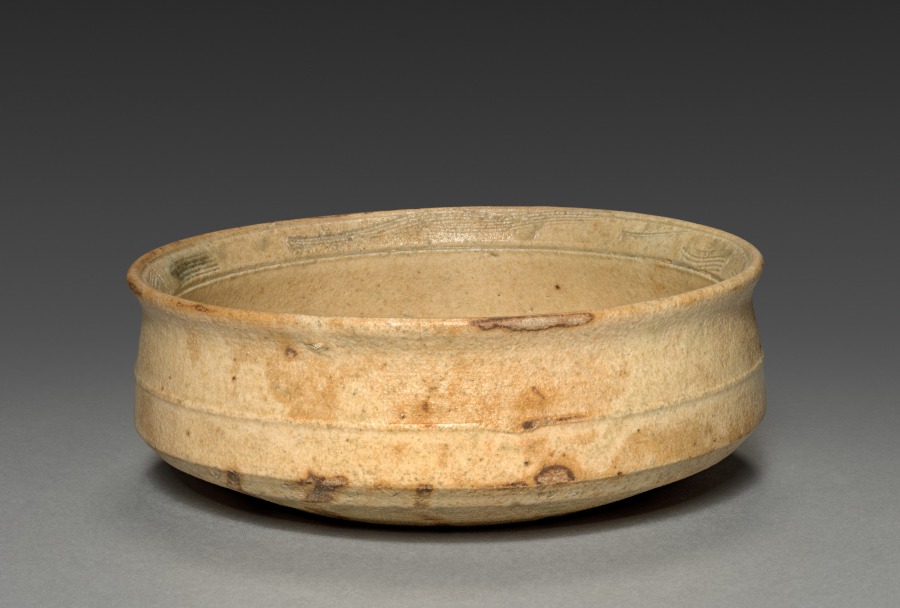
Bowl: Yellow Seto Ware, c. 1590, glazed stoneware with incised decoration (Seto ware). The Cleveland Museum of Art, John L. Severance Fund, accession 1982.67.
Look closer: a soft, buttery surface with fine incised lines inside the wide mouth. This is the kind of glaze called Ki-Seto, which the Mino article lists as the first of its four tea styles.
Image: The Cleveland Museum of Art, Open Access (CC0)
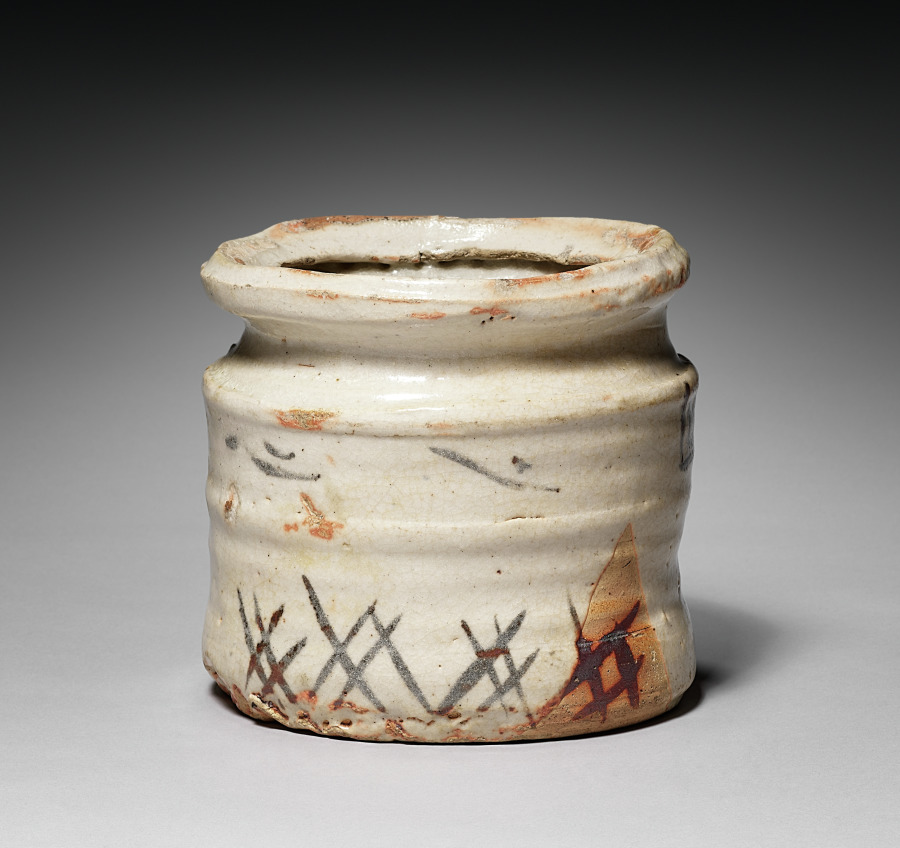
Water Container (Mizusashi) with Riverscape, late 1500s–early 1600s, Stoneware with underglaze iron oxide slip decoration (Mino ware, Shino type). The Cleveland Museum of Art, John L. Severance Fund, accession 1972.9.a.
Look closer: reeds and small boats are drawn in brown iron slip on a thick, creamy glaze, and the shape is irregular. The museum calls it an e-shino, picture Shino, water jar, considered one of the finest of its type in existence.
Image: The Cleveland Museum of Art, Open Access (CC0)

Dish with Design of Three Wild Geese in Flight: "Nezumi" Shino Ware, c. 1600, stoneware with underglaze iron slip decoration. The Cleveland Museum of Art, John L. Severance Fund, accession 1959.35.
Look closer: three white geese fly across a mouse-grey ground, and the rim is picked out in dots and cross-hatching. The museum catalogues it as nezumi Shino ware, of about 1600.
Image: The Cleveland Museum of Art, Open Access (CC0)
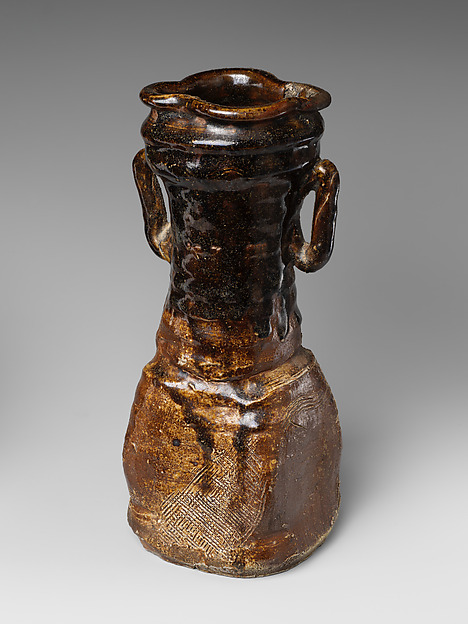
Brown Oribe Flower Holder (Hanaire) with Handles, early 17th century, Stoneware with natural ash, feldspar, and iron glaze (Mino ware, Kuro-Oribe type). The Metropolitan Museum of Art, Purchase, William R. Appleby Fund and Gift of Mrs. Samuel T. Peters, by exchange, 2024, accession 2024.123.
Look closer: black glaze runs down from a pinched, wavy mouth to a roughly textured brown base, and two ear-like handles hang at the shoulders. The museum catalogues it as Mino ware of the Kuro-Oribe type.
Image: The Metropolitan Museum of Art, Open Access (CC0)
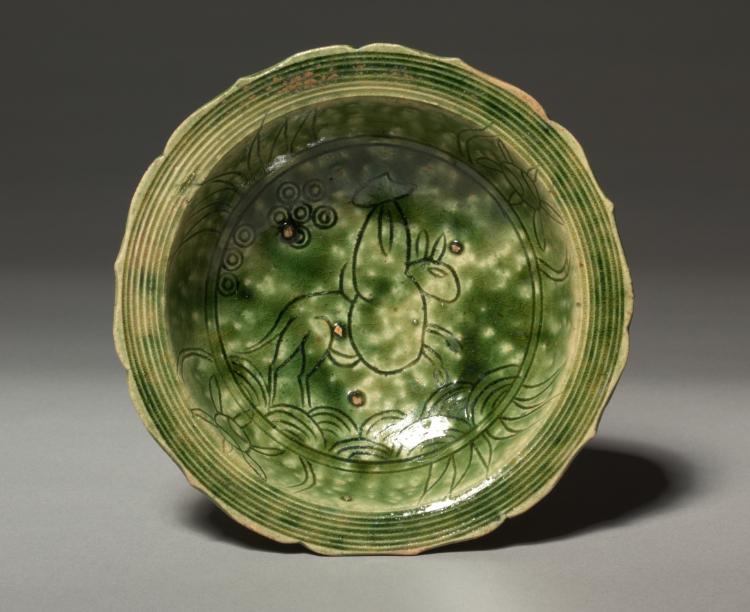
Dish with Incised Design of a Rider on a Mule, c. 1600, Buff stoneware covered with copper-green glaze (Mino ware, Oribe type). The Cleveland Museum of Art, Norman O. Stone and Ella A. Stone Memorial Fund, accession 1970.151.
Look closer: the copper-green glaze pools in the incised lines of the rider and the ribbed border. The museum catalogues it as Mino ware of the Oribe type, in buff stoneware under a copper-green glaze.
Image: The Cleveland Museum of Art, Open Access (CC0)

Tile Platform for Tea in Summer, c. 1600, glazed stoneware with painted slip decoration (Mino ware, Oribe type). The Cleveland Museum of Art, Anonymous Gift, accession 1965.79.
Look closer: white square spirals and scattered small flowers are painted in slip on a warm red-brown ground. The museum catalogues it as an Oribe-type tile platform for tea in summer.
Image: The Cleveland Museum of Art, Open Access (CC0)

Jar in Meiping Shape with Incised Floral Design, 14th century, Stoneware with brown iron glaze (Ko-Seto ware). The Metropolitan Museum of Art, Dr. and Mrs. Roger G. Gerry Collection, Bequest of Dr. and Mrs. Roger G. Gerry, 2000, accession 2002.447.13.
Look closer: a tall, elegant vase shape is incised with flowers and covered in a dark brown iron glaze. The museum dates it to the 14th century and catalogues it as Ko-Seto.
Image: The Metropolitan Museum of Art, Open Access (CC0)
Seto and Mino at the Desk
The house does not keep a separate shelf for Seto or Mino ware. Pieces from the region appear among the Japanese porcelain and ceramics from time to time, and the concierge desk can say which style a piece is catalogued in. The journal's guide to Shino, Oribe and Mino ware is a good companion to this chapter.
Answered plainly
What is the difference between Seto and Mino ware?
Seto is the older centre, in Aichi, whose glazed pottery dates from the 13th century. Mino, in Gifu, grew from Seto craftsmen who settled there, and made the Ki-Seto, Setoguro, Shino and Oribe tea wares.
Why is pottery called setomono?
Seto was the site of one of the Six Ancient Kilns, and setomono, a thing of Seto, is used in Japanese as a generic term for all pottery.
What is Shino glaze?
A thick, satiny white glaze made mainly of ground local feldspar, usually with red scorch marks and small holes. It was the first white glaze used in Japanese ceramics.
Did Furuta Oribe make Oribe ware?
He was the tea master after whom it is named, but scholars disagree on how far he guided it, and some doubt it was made in his lifetime.
Where next
Sources and image credits
- Seto ware, Wikipedia
- Mino ware, Wikipedia
- Shino ware, Wikipedia
- Oribe ware, Wikipedia
- Furuta Oribe, Wikipedia
- Object record, Cluster of mountain tea bowls (yama-chawan), The Metropolitan Museum of Art
- Object record, Black Seto (Seto-guro) Tea Bowl, named Iron Mallet (Tettsui), The Metropolitan Museum of Art
- Object record, Dish with Autumn Grasses and Rocks, The Cleveland Museum of Art
- Object record, Clog-shaped Teabowl, The Cleveland Museum of Art
- Object record, Wine Flask, The Cleveland Museum of Art
- Object record, Bowl: Yellow Seto Ware, The Cleveland Museum of Art
- Object record, Water Container (Mizusashi) with Riverscape, The Cleveland Museum of Art
- Object record, Dish with Design of Three Wild Geese in Flight: "Nezumi" Shino Ware, The Cleveland Museum of Art
- Object record, Brown Oribe Flower Holder (Hanaire) with Handles, The Metropolitan Museum of Art
- Object record, Dish with Incised Design of a Rider on a Mule, The Cleveland Museum of Art
- Object record, Tile Platform for Tea in Summer, The Cleveland Museum of Art
- Object record, Jar in Meiping Shape with Incised Floral Design, The Metropolitan Museum of Art
Last reviewed 28 October 2026. Pictures, where shown, are public-domain or open-access and credited beneath each one.
Looking for a tea bowl or a piece in the Shino or Oribe manner? The concierge desk replies within one to three business days.
Browse Japanese porcelain and ceramics · Make a private request
Private concierge
Looking for something in particular?
Describe the piece or the project you have in mind. A senior advisor in Tokyo reads every case file personally and replies within two business days, with fees set out in writing before any work begins.