
Kyūsu and the Sencha Table: Side-Handled Teapots of Japan
Chanoyu Almanac · Clay, Leaf, Water
Kyūsu and the Sencha Table: Side-Handled Teapots of Japan
The tea of the powdered ceremony is whisked in a bowl. The tea of the sencha table is steeped in a small pot and poured into small cups, and the pot has its own story. It has a side handle that suits the turning of the wrist, a spout shaped so that no drop runs back, and a strainer pressed into the clay. This chapter follows the pot from the Chinese monks who brought leaf tea to Japan to the red clay of Tokoname, the literati pots of Kyoto, and the little set of boiler, cooling bowl, jar and cups that makes up a sencha table.
Fact sheet
At a glance
- A word with three handles. Kyūsu means teapot. Wikipedia names the side-handled yokode, the back-handled ushirode and the top-handled uwade.
- A town of red clay. Tokoname is known for its kyūsu, and its red shudei clay is the hallmark of its teaware, say two retailers and a university exhibition.
- A way of tea beside the way of tea. Senchadō uses loose leaf and a small pot, and in many schools two infusions, the first with cooled water.
- A tea vendor on the Kamo. Baisao, a Zen monk, served tea around Kyoto from about 1735 and is regarded as the first sencha master.
- Tools of the table. A boiler, a cooling bowl, a tea jar, small cups and a basket complete the set that Wikipedia and a bilingual Kyoto corpus list.
A Pot That Pours Sideways
The teapot of Japan is a small object that carries a large vocabulary. Wikipedia describes the kyūsu as a traditional Japanese teapot mainly used for brewing green tea, and its article on sencha says that sencha, the leaf that the pot is made for, is the most popular tea in Japan and about eighty per cent of the tea produced there. The teapot for that leaf is therefore one of the commonest household objects in the country and one of the most carefully worked.
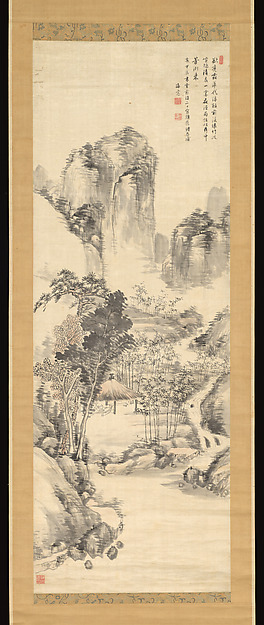
Nukina Kaioku, Making Sencha by a Bamboo Grove and Stream, 1844, Hanging scroll; ink and color on satin. The Metropolitan Museum of Art, Mary and Cheney Cowles Collection, Gift of Mary and Cheney Cowles, 2024, accession 2024.577.2.
Look closer: a tall hanging scroll on satin showing a landscape in ink and light colour, with steep rock faces, pale trees in the foreground and a thin stream below, and columns of inscription across the top. The museum catalogues it as Making Sencha by a Bamboo Grove and Stream, 1844, hanging scroll, ink and colour on satin, by Nukina Kaioku, from the Mary and Cheney Cowles Collection, gift of Mary and Cheney Cowles, 2024.
Image: The Metropolitan Museum of Art, Open Access (CC0)
The article on the pot makes a point about its name. The common misconception, it says, is that a kyūsu always has a side handle, but the word merely means teapot, even though in everyday use it usually names a teapot with a side handle. Behind that small correction stands a history of Chinese monks, a wandering Zen vendor of tea, a red clay from the Chita peninsula and a century of Kyoto potters who made little pots for scholars.
This chapter takes those things in order. It gives the vocabulary of the pot and draws its parts. It looks at the three handle positions in a second diagram and weighs two accounts of why the side handle came to be. It tells of the Ōbaku monks who brought leaf tea, of Baisao, of the clay and kilns of Tokoname, and of the literati teapots of Kyoto, the Satsuma ware pot and the Banko ware pot. It sets out the sencha table and its utensils, the water and the infusions, and the baskets in which the set was carried. It ends with the schools of senchadō, the workshops of today and the questions a buyer should put to a pot. The sources are Wikipedia, an exhibition of the Art Research Center of Ritsumeikan University on Google Arts & Culture, a bilingual corpus of Kyoto articles, the catalogue pages of the Metropolitan Museum of Art and several tea retailers, whose claims are marked as attributed wherever they are used.
Kyūsu, Yokode, Ushirode and Uwade
The Wikipedia article gives the pot its types. The two most common are the yokode kyūsu, the side-hand teapot, which has a side handle and is the more common, and the ushirode kyūsu, the back-hand teapot, which has a rear handle just like teapots in other parts of the world. It adds that there are also uwade kyūsu, the top-hand teapots. The article says that Tokoname ware is known for its kyūsu and notes two points of craft. In smaller types, some of the lids can be made so that they do not fall off through the adhesion of water, and the spout must be cut at an angle so that no drops run back from it while pouring.

Sencha Teapot (Kyūsu), early 19th century, Stoneware with crackled transparent glaze (Satsuma ware). The Metropolitan Museum of Art, Gift of Charles Stewart Smith, 1893, accession 93.3.122a, b.
Look closer: a small, plump teapot in a pale cream crackled glaze, with a ring-shaped handle at the back, a short curved spout at the front and a domed lid with a small button. The museum catalogues it as a Sencha Teapot (Kyūsu), early 19th century, stoneware with crackled transparent glaze (Satsuma ware), 9.8 cm high, 14 cm wide and 8.6 cm deep, a gift of Charles Stewart Smith, 1893.
Image: The Metropolitan Museum of Art, Open Access (CC0)
The Met's pot of the Satsuma kilns shows the second type. It is catalogued as a Sencha Teapot (Kyūsu), early nineteenth century, in stoneware with a crackled transparent glaze, 9.8 centimetres high. The photograph shows a small round pot with a handle at the back, a short curved spout and a domed lid with a button, which is an ushirode in the Wikipedia sense. It is a useful reminder that the word for the pot does not decide the place of the handle.
Other words gather round the pot. Wikipedia's article on senchadō lists the hōhin, a handleless kyūsu, and the yuzamashi, a small vessel for cooling boiled water. The Wikipedia article on gyokuro names small pots such as the koburi or the hōhin, small teapots without a handle, as common in the service of that tea. Retailers add terms from the workshop. Rishi Tea, a retailer, names the sasame, the perforations formed directly in the clay near the spout, and Native & Co, another retailer, describes a side handle that is hollow. These are retailers' claims and are marked as attributed.
| Term | Kanji | What the sources say |
|---|---|---|
| Kyūsu | 急須 | A traditional Japanese teapot mainly used for brewing green tea; the word means teapot, not necessarily one with a side handle (Wikipedia). |
| Yokode kyūsu | 横手急須 | The side-handled teapot, the more common type (Wikipedia). |
| Ushirode kyūsu | 後手急須 | The back-handled teapot, with a handle at the rear like teapots elsewhere in the world (Wikipedia). |
| Uwade kyūsu | 上手急須 | The top-handled teapot, the third type that Wikipedia names. |
| Hōhin | 泡瓶 | A small handleless pot used in sencha service (Wikipedia, Senchadō; Wikipedia, on gyokuro, also names it). |
| Yuzamashi | 湯冷 | A small vessel for cooling the boiled water (Wikipedia, Senchadō). |
| Sasame | Perforations pressed into the clay itself near the spout, according to Rishi Tea (a retailer, attributed). | |
| Shudei | 朱泥 | The red clay that is the signature of Tokoname teaware (Native & Co, a retailer; Rishi Tea, a retailer). |
Lid, Spout, Handle and Strainer
The parts of the pot are few and each has a task. The lid keeps the heat in and, in the small pots, is shaped so that it stays on when the pot is tilted. The spout is angled so that no drops run back. Inside, at the base of the spout, is a strainer that keeps the leaf from the cup. The Wikipedia article's gallery includes a photograph of the sieve on the inside of a kyūsu.
Diagram by Japonista. Schematic; the parts follow Wikipedia and the retailers named in the chapter.
Look closer: a round pot is seen from above, with a round lid and a small knob at its centre, a straight handle running out to the right, and a spout pointing straight down. A cluster of dots at the base of the spout marks the strainer. Labels run along the right and left edges.
Diagram by Japonista
Retailers describe the strainer in some detail. Native & Co, in a note on Tokoname, describes the sasame filter as a set of small holes made in a piece of clay and attached inside the base of the spout, and says the interior of its black pot is left unglazed. Rishi Tea names three kinds: the sasame, with perforations formed directly in the clay, which it says keeps the vessel all clay; a flatter, slightly concave filter that pours faster and clogs less and is useful with fine or broken leaves such as fukamushi sencha; and the obiami, a fine metal screen set inside the pot. It adds that some studios use high-speed air through a steel mould to make precise perforations. All of these are retailers' accounts and the chapter reports them as such.
The Kettl retailer, writing on teapots, says the handle is generally hollow and set at a slight angle for easy pouring, and that the strainer can become blocked with leaf particles, which a water pick or a tooth can clear with care. It also says that Japanese ceramic teapots will crack if they are put directly on a stove.
Why the Handle Moved to the Side
The side handle is the pot's most striking feature and the sources offer two reasons for it. Yuki Ishii, the founder of the Singapore company TeaLife, writes that tea came to Japan from China with teapots that had back handles, the symmetrical design that much of the world still uses, and that Japan knew this design and deliberately moved away from it. He says the yokode handle lets the pourer rotate the wrist smoothly instead of jerking it upward, and that the final-drop shake is easier through a small tilting arc. He also says it suits sencha, kabusecha and gyokuro, which are brewed at lower temperatures in smaller volumes and poured between several cups. He joins this to a personal note, that his own first reaction to a yokode pot was confusion, and that he joked about holding it like an oar.
Diagram by Japonista. Schematic; the names follow Wikipedia and the position of the top handle is indicative.
Look closer: three round pots stand in a row, each with a short spout pointing to the left. The first has a straight handle running down from the body, labelled yokode. The second has a loop at the right, labelled ushirode. The third has two arched bars across the lid, labelled uwade.
Diagram by Japonista
Rishi Tea gives a different reason. It says the yokode kyūsu was designed for pouring while seated on tatami mats, and that the ushirode may feel more familiar to users of Western-style teapots. Native & Co says of the ushirode that its ring handle stays safe to touch while pouring, because the clay is heat-retentive and gets very hot. The retailers thus describe the same two shapes in terms of the wrist, the mat and the heat, and none of them gives a date or a maker for the change.
Wikipedia says only that the side handle is the more common type and that the word kyūsu does not require it. The Met's pots show the range. A Kyoto ware pot in the gallery has a straight tubular handle projecting from the body, which is a side handle in Wikipedia's sense, and the Satsuma ware pot above has a loop at the back, which is a back handle.
Ōbaku Monks and Chinese Pots
Leaf tea came to Japan with Zen monks of a Chinese lineage. Wikipedia's article on senchadō gives the sequence: in the late seventeenth century Chinese merchants visiting Nagasaki showed how brewed tea should be drunk, as at the Ming court, and the practice then spread, particularly among literati merchants, from the eighteenth century to the beginning of the Meiji era. A retailer's blog on senchadō names the monk. Ingen Ryūki, it says, founded the Ōbaku school of Zen in the seventeenth century, established the Mampuku temple at Uji in 1661, taught Japanese monks how tea was prepared and drunk in China and brought Chinese teaware. The blog is a retailer's and is attributed.
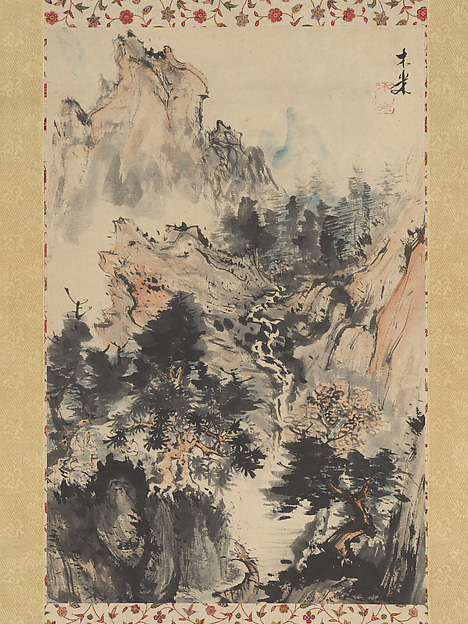
Aoki Mokubei, Brewing Tea in the Shade of Trees, 1820s, Hanging scroll; ink and color on paper. The Metropolitan Museum of Art, Mary and Cheney Cowles Collection, Gift of Mary and Cheney Cowles, 2020, accession 2020.396.36.
Look closer: a tall hanging scroll in grey ink and pale colour showing steep, misty mountains above a group of trees, with a short inscription at the upper right and a patterned border round the picture. The museum catalogues it as Brewing Tea in the Shade of Trees, 1820s, hanging scroll, ink and colour on paper, by Aoki Mokubei, from the Mary and Cheney Cowles Collection, gift of Mary and Cheney Cowles, 2020.
Image: The Metropolitan Museum of Art, Open Access (CC0)
Wikipedia's article on Baisao frames the contrast. Matcha brewing had come from Song-dynasty China with Zen monks. The Ōbaku school, it says, instead specialised in loose-leaf green tea, which had grown popular in Ming-dynasty China. Sencha supporters opposed the rigid, elaborate formalism of chanoyu, and its simplicity appealed to monks and intellectuals who admired the carefree ideals of ancient Chinese sages. A bilingual corpus of Wikipedia's Kyoto articles adds that the literati who met over sencha cared little for formal manners and discussed matters of rectitude over a cup.
The utensils followed the leaf. Rishi Tea says Japanese potters based the kyūsu partly on Chinese Yixing teapots, adapting the form to Japanese taste and to sencha brewing, and that in the Edo period the rise of loose-leaf sencha as a less formal alternative to matcha created demand for a new teapot style. The Met has Yixing pots in its Chinese collection, but the claim is a retailer's and the chapter gives it as attributed. It does not fix a date for the first Japanese kyūsu from this source; the exhibition of the Art Research Center, which gives one, appears below.
Baisao and the Walking Tea Stall
Baisao is the figure around whom the sencha table is told. Wikipedia gives his dates as 1675 to 1763 and says he was a monk of the Ōbaku school, called Shibayama Kikusen as a child, with the priest's name Gekkai Gensho. Baisao, a name that means old tea vendor, was a nickname. After he left the priesthood he took the lay name Ko Yugai. He began to serve tea at scenic spots around Kyoto in about 1735, carrying his equipment in a woven bamboo basket that he called Senka, hung from a pole over his shoulder. He set no price, and carried a bamboo tube to collect donations.

Aoki Mokubei, Preparing Tea by a Mountain Gorge, 1825, Folding fan mounted as a hanging scroll; ink and color on paper. The Metropolitan Museum of Art, Mary Griggs Burke Collection, Gift of the Mary and Jackson Burke Foundation, 2015, accession 2015.300.180.
Look closer: a folding fan opened out and mounted as a scroll, with a landscape in grey ink and a little colour: a narrow gorge, rocks and a few trees, on a plain dark blue backing. The museum catalogues it as Preparing Tea by a Mountain Gorge, 1825, folding fan mounted as a hanging scroll, ink and colour on paper, by Aoki Mokubei, from the Mary Griggs Burke Collection, gift of the Mary and Jackson Burke Foundation, 2015.
Image: The Metropolitan Museum of Art, Open Access (CC0)
The Wikipedia account says that he viewed tea as a path to spiritual enlightenment and expressed this in his poetry, of which more than a hundred poems survive. In 1745, at seventy, he renounced monasticism. He stopped serving tea in 1755. Wary of his fame and of a ritualised sencha that resembled chanoyu, the article says, he burned many of his tea utensils shortly before his death, which defied the chanoyu custom of revering the tools of famous tea masters. His friend Kimura Kenkadō published detailed descriptions and illustrations of the utensils and had copies of some burned pieces made, and a codified sencha ceremony based on his methods later emerged.
The Path of Cha blog, a retailer's, agrees on the burning of the utensils and on the copies. It says Baisao's followers later codified his practice into the formal Way that he had tried to avoid, and that he is less widely known in Japan than Sen no Rikyū. The essay on gjtea.org, written for the 350th anniversary of his birth, adds that he held informal outdoor gatherings along the Kamo River and at viewpoints in Kyoto, that poets, scholars and Zen masters came, and that the painter Itō Jakuchū enjoyed his tea and made a portrait of him. These are given as the sites' accounts.
Tokoname, Shudei and the Chita Peninsula
Most of the Japanese kyūsu seen today come from Tokoname, on the coast of Aichi Prefecture. Wikipedia describes Tokoname ware as Japanese stoneware made in and around the town and names Tokoname as one of Japan's Six Ancient Kilns. It says pottery production there dates to the twelfth century, that the ware was already in everyday use in the Heian period, and that the Takasaka kiln was built in the fourteenth century. Late in the Edo period, it adds, Koie Hokyu completed a chambered climbing kiln, and his son Koie Hoju established the reputation of modern Tokoname ware, laid the foundations for earthenware pipe making and introduced the redware for which the town became known.
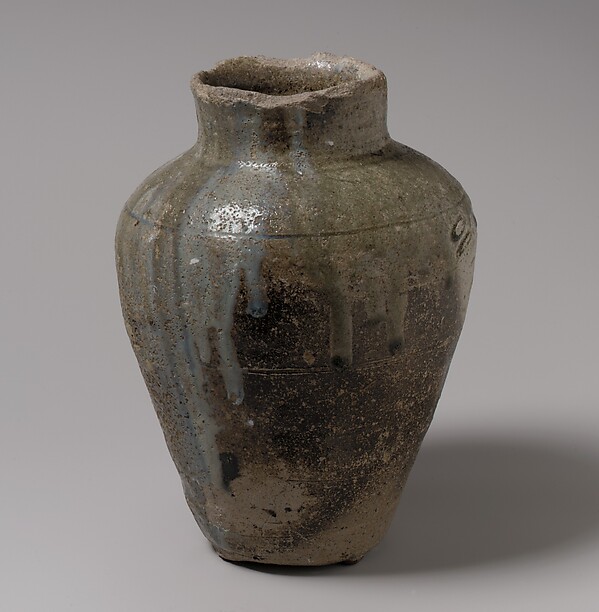
Jar for Sutra Burial (Sankinko), early 12th century, Stoneware with natural ash glaze (Tokoname ware). The Metropolitan Museum of Art, Dr. and Mrs. Roger G. Gerry Collection, Bequest of Dr. and Mrs. Roger G. Gerry, 2000, accession 2002.447.12.
Look closer: a tall, narrow-mouthed jar in dark grey-brown clay, its shoulder streaked with natural ash glaze that has run in thick drips and its lower body left rough. The museum catalogues it as a Jar for Sutra Burial (Sankinko), early 12th century, stoneware with natural ash glaze (Tokoname ware), 24.8 cm high and 19.1 cm wide, from the Dr. and Mrs. Roger G. Gerry Collection, Bequest of Dr. and Mrs. Roger G. Gerry, 2000.
Image: The Metropolitan Museum of Art, Open Access (CC0)
The exhibition of the Art Research Center of Ritsumeikan University, shown on Google Arts & Culture, puts numbers on the medieval kilns. It says that the earliest Tokoname ware dates to the late Heian period, about nine hundred years ago, and that an estimated two to three thousand anagama, tunnel kilns, stood across the Chita peninsula. Early products were large storage jars and other vessels shipped across Japan by sea, and the jars for burying sutras, the sankinko, were fired often in the late twelfth century, with production stopping quickly at the start of the Kamakura period. The Met holds one such jar, which it dates to the early twelfth century, 24.8 centimetres high, in stoneware with natural ash glaze.
The exhibition then turns to the pot. Kyūsu, it says, are said to have first been made at Tokoname in the Bunka and Bunsei eras, about 1804 to 1830. Sugie Jumon, who lived from 1827 to 1897, was a popular producer of shudei kyūsu, which have unglazed, burnished red clay surfaces. The text adds that the idea that all Tokoname kyūsu are shudei is a postwar notion. The Living National Treasure Yamada Jōzan III, it says, combined traditional forms with a modern, individual style, and his work increased appreciation of Tokoname kyūsu nationwide. Wikipedia lists the kilns' other products, among them redware teapots, roof tiles, water pipes and bonsai pots.
Red, Black and Seaweed Patterns
The look of a Tokoname pot comes from its clay and its fire. Native & Co describes Tokoname ware as a high-fired and ash-glazed ceramic and calls the region the red city because of its natural red clay. Rishi Tea says the clay comes from deposits formed from ancient lake sediments on the Chita peninsula, is rich in iron, quartz and mica, and turns brick red when fired in an oxidising atmosphere. That red clay, it says, is called shudei and is a hallmark of Tokoname teaware. It adds that the clay has low porosity and seasons gradually, so the pot keeps a fairly neutral character over time.
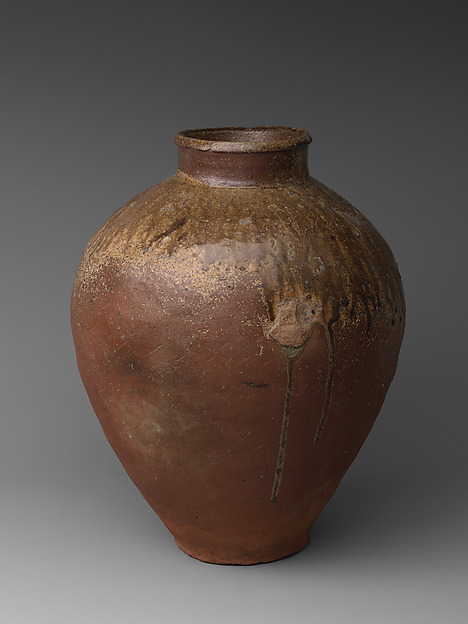
Large Storage Jar (Ōtsubo), 16th century, Stoneware with natural ash glaze (Tokoname ware). The Metropolitan Museum of Art, Mary Griggs Burke Collection, Gift of the Mary and Jackson Burke Foundation, 2015, accession 2015.300.275.
Look closer: a large jar with high rounded shoulders, a small mouth and a russet-brown body, its upper half streaked with ash glaze and its surface left rough. The museum catalogues it as a Large Storage Jar (Ōtsubo), 16th century, stoneware with natural ash glaze (Tokoname ware), 54.6 cm high, from the Mary Griggs Burke Collection, gift of the Mary and Jackson Burke Foundation, 2015.
Image: The Metropolitan Museum of Art, Open Access (CC0)
Native & Co describes its black pot as made of highly porous, iron-rich clay with an unglazed interior, and says that the clay absorbs flavours over time and that the iron reduces the astringency of the tea. Kettl, a third retailer, says clay is mildly porous when unglazed and can absorb aromas, so that one pot is best kept for one style of tea.
Rishi Tea names four finishes. Shudei is the classic brick red of oxidising firing. Kokudei is a deep black made by reduction firing, which uses little oxygen. Mogake is a flowing, one-of-a-kind pattern made by wrapping seaweed round the vessel before firing, and Japan Experience says the seaweed carbonises in the kiln and leaves a crackled pattern. Yōhen is the natural variation of colour shaped by flame, oxygen and a piece's place in the kiln. The same site notes that shinmaru pots are rounder and larger, suit leafier teas and give more tea per steep.
Mokubei, Shūhei and Literati Teapots
The Met's pots for sencha are mostly Kyoto work of the early nineteenth century, made for the scholars who gathered round the leaf. One is catalogued as a Sencha Teapot (Kyūsu) with Chinese Children Engaged in Literati Activities, in stoneware with polychrome overglazes, early nineteenth century, 10.8 centimetres high, by Ogata Shūhei. The photograph shows a round pot, crowded with small figures, with a spout at one side and a straight tubular handle at the other. The Japanese title on the object page names the first-generation Ogata Shūhei as maker.

Ogata Shūhei, Sencha Teapot (Kyūsu) with Chinese Children Engaged in Literati Activities, early 19th century, Stoneware with polychrome overglazes (Kyoto ware). The Metropolitan Museum of Art, Gift of Charles Stewart Smith, 1893, accession 93.3.181a, b.
Look closer: a black-and-white photograph of a round, deep teapot covered all over with tiny figures of children at play, with a short spout on the left, a straight tubular handle projecting to the right and a lid with a small knob. The museum catalogues it as a Sencha Teapot (Kyūsu) with Chinese Children Engaged in Literati Activities, early 19th century, stoneware with polychrome overglazes (Kyoto ware), 10.8 cm high, by Ogata Shūhei, a gift of Charles Stewart Smith, 1893.
Image: The Metropolitan Museum of Art, Open Access (CC0)
A second pot, catalogued as a Sencha Teapot (Kyūsu) with Literati, is of porcelain with red overglaze and gold, only 3.8 centimetres high. The Met's essay on the object says its refined decoration reflects several aspects of literati culture in Japan: an inscription refers to Su Shi's Second Ode on the Red Cliff, handscrolls and books appear in the decoration, and the design shows antiquities and tea utensils and alludes to scholarly conversation. A third, a Sencha Teapot with Jewel-Chasing Dragons, is in porcelain with moulded patterns and a celadon glaze, and the Met's record gives Aoki Mokubei as maker. These two are shown in the gallery.
The same collections hold Mokubei's paintings, two of which, Brewing Tea in the Shade of Trees and Preparing Tea by a Mountain Gorge, are shown above. The chapter does not say more of the painter than the museum's titles do. It draws the plain point that the teapot and the picture of tea belonged to one world, in which poems, pictures and pots were exchanged between scholars.
Satsuma, Banko and Their Teapots
Other kilns made pots for the same table. The Met has a Satsuma ware sencha pot and a Satsuma ware water pitcher for sencha, both early nineteenth century in stoneware with a crackled transparent glaze. The pitcher, a suichū, is 12.7 centimetres high with its lid, in a double-gourd shape with a tall curved spout and a large loop handle. The pot appears earlier in the chapter. Both are catalogued under the word sencha, which names the table they served.
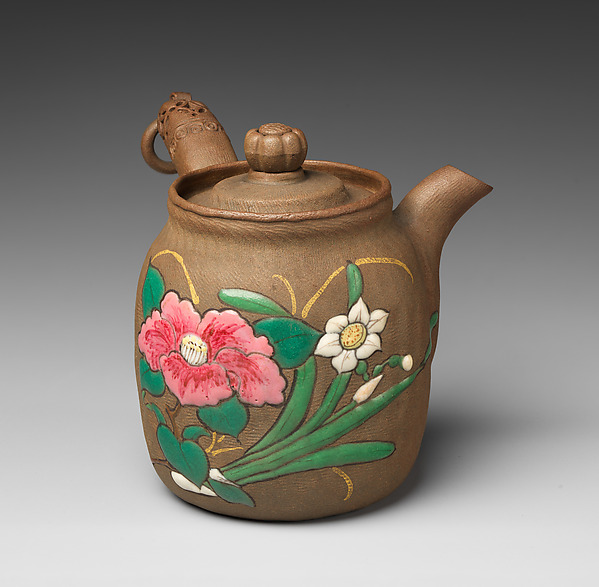
Teapot, early 19th century, Pottery ornamented with enamels (Banko ware). The Metropolitan Museum of Art, Edward C. Moore Collection, Bequest of Edward C. Moore, 1891, accession 91.1.204.
Look closer: a squat, rounded teapot of brown unglazed-looking pottery with a pink peony and white narcissus in enamel colours across its front, green leaves, a domed lid with a knob and a short spout to the right. The museum catalogues it as a Teapot, early 19th century, pottery ornamented with enamels (Banko ware), 6.8 cm high, 8.3 cm wide and 6.4 cm deep, from the Edward C. Moore Collection, Bequest of Edward C. Moore, 1891.
Image: The Metropolitan Museum of Art, Open Access (CC0)
Banko ware is the third. Wikipedia says that Banko ware, Banko-yaki, is Japanese stoneware from Yokkaichi in Mie Prefecture, also called Yokkaichi-Banko ware, believed to have originated in the eighteenth century, and that most of its products are teacups, teapots, flower vases and sake vessels. The Met has an early nineteenth-century pottery teapot of Banko ware ornamented with enamels, 6.8 centimetres high. The photograph shows a squat brown pot with a peony and narcissus in enamel colours. The page gives catalogue data only.
These small pots belong to the same time as the Kyoto pieces, and the chapter says no more than the museum does. The credit lines show that several of them reached the Met as gifts of Charles Stewart Smith in 1893 and of Mrs. V. Everit Macy in 1923, and the Banko pot came with the bequest of Edward C. Moore in 1891.
The Sencha Table, One Utensil at a Time
The pot is one of a small group. Wikipedia's article on senchadō and a bilingual corpus of its Kyoto articles name the utensils of the table. The corpus says that the same utensil may have different names in different schools, and that identically named utensils may differ entirely between schools. The pieces below are given with that warning.
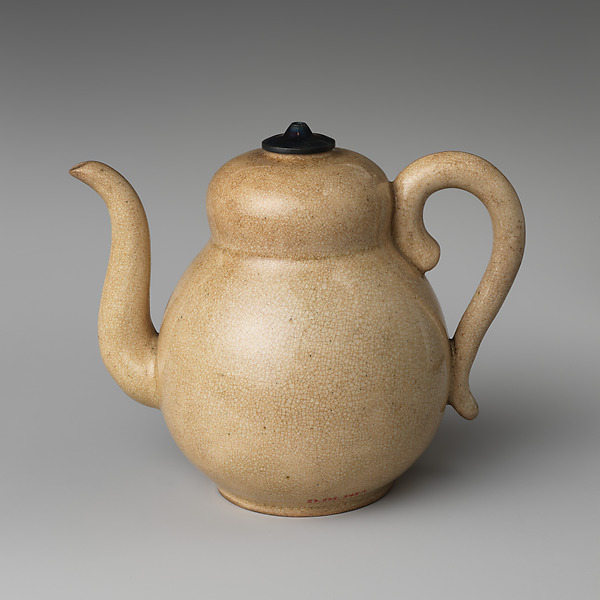
Sencha Water Pitcher (Suichū), early 19th century, Stoneware with finely crackled transparent glaze (Satsuma ware). The Metropolitan Museum of Art, Gift of Mrs. V. Everit Macy, 1923, accession 23.225.345a, b.
Look closer: a pear-shaped pitcher in a cream glaze finely crackled all over, narrowing to a gourd-like neck, with a tall curved spout to the left, a large loop handle to the right and a small dark knob on the lid. The museum catalogues it as a Sencha Water Pitcher (Suichū), early 19th century, stoneware with finely crackled transparent glaze (Satsuma ware), 12.7 cm high with its lid and 14.9 cm from spout to handle, a gift of Mrs. V. Everit Macy, 1923.
Image: The Metropolitan Museum of Art, Open Access (CC0)
Hot water is made in a small boiler, the bōfura. The corpus's page on it describes a round earthenware pot of biscuit-fired clay, because it sits directly on the fire, with a notably round body. The page names two forms, the uwateshiki, with the handle at the top, generally larger and used with a small brazier, and the yokoteshiki, with the handle at the side, used with a brazier. It adds that practitioners avoid metal boilers, said to spoil the flavour, and that the water boiled in a bōfura is prized. The name is thought to derive from the Portuguese word for pumpkin, from its shape. Imported pieces of the Bunsei era are rare, it says, and valued, while domestic pieces are cheaper.
The water for the second pot is held in a pitcher. The corpus lists a water vessel written with the characters read suichū, and the Met's early nineteenth-century Satsuma pitcher is catalogued as a Sencha Water Pitcher (Suichū), in the double-gourd shape described earlier. The corpus also gives the fresh-water container as the mizutsugi, which it says is also called a mizusashi. The cups are small, of white porcelain, and Wikipedia calls them chawan, also kumidashi or yunomi. Each has a coaster, the chataku, of metal, wood or lacquer, and the set is stored in tubes, the kintō for the cloth and the wantō for the cups. A small jar, the chaire or chatsubo, holds the leaf, and a tea scoop moves it into the pot.
| Utensil | Kanji | What the sources say |
|---|---|---|
| Kyūsu | 急須 | The small pot that holds the leaves; hot water is poured into it (a bilingual Kyoto corpus; Wikipedia, Senchadō). |
| Hōhin | 泡瓶 | A handleless kyūsu (Wikipedia, Senchadō). |
| Yuzamashi | 湯冷 | A small vessel for cooling boiled water (Wikipedia, Senchadō; the corpus). |
| Bōfura | ボーフラ | A small round earthenware boiler of unglazed clay set directly on the fire; the corpus names uwateshiki (handle above) and yokoteshiki (handle at the side) forms. |
| Suichū | 水注 | A water pitcher; the Met catalogues a Satsuma example as a sencha water pitcher. The corpus gives the fresh-water container as mizutsugi, also called mizusashi. |
| Kensui | 建水 | The waste-water container (Wikipedia, Senchadō); the corpus adds the names koboshi and others. |
| Chaire or chatsubo | 茶入 | The tea container, a small jar for the leaf (Wikipedia, Senchadō; the corpus). |
| Chawan | 煎茶碗 | A small white porcelain cup, also called kumidashi or yunomi (Wikipedia, Senchadō). |
| Chataku | 煎茶托 | A coaster for the cup, of metal, wood or lacquer (Wikipedia, Senchadō). |
| Kintō | 巾筒 | A tube that keeps the cloth that wipes the cups (Wikipedia, Senchadō). |
| Wantō | 碗筒 | A tube, usually of woven bamboo, that stores the cups (Wikipedia, Senchadō). |
| Teiran | 提籃 | A basket for the tea set (the corpus; Wikipedia lists a utensil box under the same characters). |
Water Temperature, Cooling Bowl and Two Infusions
The Wikipedia infobox for sencha gives a brewing guide of 80 degrees Celsius for one minute and says that cooler water gives a mellower cup and hotter water a more astringent one. It gives the ideal colour as a greenish gold. The article on gyokuro is more exact about the shaded tea. It says gyokuro is generally brewed with water of 40 to 70 degrees, with about five grams of leaf to 150 millilitres of water, for a first infusion of about two minutes, and that the leaves can then be infused three or four more times for twenty to thirty seconds.
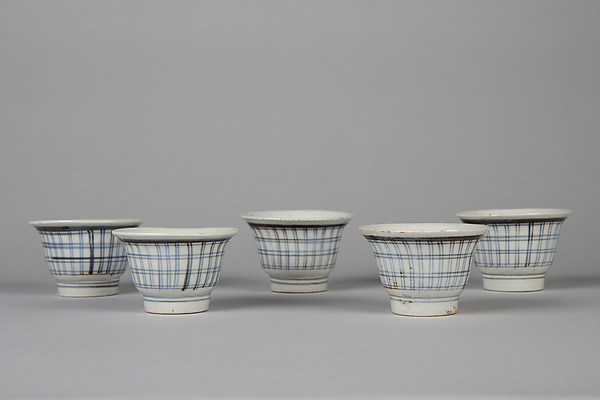
Set of Five Sencha Teacups (Sencha wan) with Lattice Pattern, 18th century, Porcelain painted with cobalt blue under a transparent glaze (Hizen ware). The Metropolitan Museum of Art, The Harry G. C. Packard Collection of Asian Art, Gift of Harry G. C. Packard, and Purchase, Fletcher, Rogers, Harris Brisbane Dick, and Louis V. Bell Funds, Joseph Pulitzer Bequest, and The Annenberg Fund Inc. Gift, 1975, accession 1975.268.676.
Look closer: five small, flaring white porcelain cups in a row, each painted in blue with a lattice of fine crossing lines. The museum catalogues them as a Set of Five Sencha Teacups (Sencha wan) with Lattice Pattern, 18th century, porcelain painted with cobalt blue under a transparent glaze (Hizen ware), each 5.4 cm high and 8.3 cm in diameter, from the Harry G. C. Packard Collection of Asian Art, 1975.
Image: The Metropolitan Museum of Art, Open Access (CC0)
The article then names the senchadō method. In many schools, it says, a two-step brewing is used. First, low-temperature water, cooled by being poured into a separate cooling vessel, is used to extract sweetness. Then high-temperature water is used to extract bitterness. Some schools add a third step with water of intermediate temperature to extract astringency, but because of the time each session takes, the two-step method is more common at large gatherings. Small pots such as the koburi and the hōhin are often used, and the cups are smaller than those used for sencha. Two retailers' blogs, My Japanese Green Tea and Path of Cha, say that two infusions are served, with sweets, and that talking is allowed, unlike in sadō.
The size of the pot follows the portion. Kettl, a retailer, says the most popular kyūsu range from about 150 to 266 cubic centimetres, that smaller pots are easier to pour because a heavier, water-filled pot is harder to control, and that a gyokuro portion of 30 to 90 millilitres suits a pot of about 120. This is attributed, and the chapter gives it as a retailer's guidance, not a rule. The Met's white cups, a set of five with a lattice pattern, are of the eighteenth century and show the scale of the cup.
| Case | Water and time | What the sources say |
|---|---|---|
| Sencha, Wikipedia infobox | 80 °C (175 °F) for 1 minute | Cooler water gives a mellower cup, hotter water a more astringent one. |
| Superior sencha, Wikipedia caffeine section | 70 °C for 1 minute, 6 g in 170 mL | 305.30 mg of caffeine per litre. |
| Deep-steamed sencha, Wikipedia caffeine section | 90 °C for 1 minute, 6 g in 260 mL | 373.70 mg of caffeine per litre. |
| Gyokuro, Wikipedia | 40 to 70 °C, about 5 g of leaf to 150 mL | A first infusion of about 2 minutes, then three or four more of 20 to 30 seconds. |
| Senchadō, many schools (Wikipedia, on gyokuro) | Two steps: cooled water first, then hot water | The first step extracts sweetness and the second bitterness; some schools add a middle step for astringency. |
| Pot size, Kettl (a retailer, attributed) | 150 to 266 cc is the most popular range | Gyokuro, in portions of 30 to 90 mL, is better served from a smaller pot of about 120 cc. |
Baskets, Braziers and the Travelling Set
The sencha set was made to be carried. The Met holds a basket for transporting sencha tea-ceremony utensils, a chakago or teiran, of about 1877 to the 1880s, 31 centimetres high, in rattan and brocaded silk, by Hayakawa Shōkosai I, a gift of Diane and Arthur Abbey in 2019. The bilingual Kyoto corpus lists the teiran as the basket for the tea set and the kikyoku as the cabinet for the utensils, and Wikipedia's article on senchadō lists a utensil box, a stand, a tea board and a tea cabinet among the pieces of the table.

Chinese-Style Charcoal Basket (Sairō-sumitori) for Sencha Tea Ceremony, mid-19th century, Timber bamboo, dwarf bamboo, and rattan. The Metropolitan Museum of Art, Edward C. Moore Collection, Bequest of Edward C. Moore, 1891, accession 91.1.2081.
Look closer: a low, round, lidded basket woven in tight bands of dark brown bamboo and rattan, with a fine interlaced lattice on the lid, a plain woven band round the wall and small feet. The museum catalogues it as a Chinese-Style Charcoal Basket (Sairō-sumitori) for Sencha Tea Ceremony, mid-19th century, timber bamboo, dwarf bamboo and rattan, 13.3 cm high and 25.4 cm in diameter, from the Edward C. Moore Collection, Bequest of Edward C. Moore, 1891.
Image: The Metropolitan Museum of Art, Open Access (CC0)
The heat has its own basket. The Met has a Chinese-style charcoal basket for the sencha tea ceremony, a sairō-sumitori, of the mid-nineteenth century, 13.3 centimetres high and 25.4 centimetres across, in timber bamboo, dwarf bamboo and rattan, from the Edward C. Moore Collection. Wikipedia's article on senchadō lists the stove and its fire tools among the utensils: a furnace fan, a feather broom, fire chopsticks, a kettle stand, charcoal and a fire screen.
The Met's baskets are of Chinese style, and its catalogue calls another basket of the 1870s and 1880s a Karamono-Style Flower Basket. That wording matches Wikipedia's article on senchadō, which says that hosts displayed their collections, mostly objects imported from China or made in Japan in Chinese style, the karamono. The set was an arrangement of objects as much as a method of making tea, and the table, with its screen, basket and cabinet, was a small room within the room.
From Literati to a National Federation
The practice that Baisao started was gradually put in order. The Kyoto corpus says the sencha preference first mostly imitated Chinese culture, then developed its own style in the middle of the Edo period, led by Baisao, and spread to the upper classes, mainly in Edo, Kyoto and Osaka. The Sōsho school, it says, was founded during this movement and added a degree of formal structure and manners, modelled on established sadō, to enjoy the taste of tea better. A retailer's blog adds that by the end of the Edo period several schools existed and that Ogasawaryū appears among them in a video it cites.

Shibata Zeshin, Lacquer Paintings of Various Subjects: Sencha Tea Set, 1882, Lacquer on paper. The Metropolitan Museum of Art, The Howard Mansfield Collection, Purchase, Rogers Fund, 1936, accession 36.100.108.
Look closer: a small painting in lacquer showing a tall bamboo tube standing at the left, a small dark teapot with a spout and a handle at the right and a gourd-shaped dish lying in front, with sprigs of a plant trailing across a pale ground. The museum catalogues it as Lacquer Paintings of Various Subjects: Sencha Tea Set, 1882, lacquer on paper, by Shibata Zeshin, from the Howard Mansfield Collection, Purchase, Rogers Fund, 1936.
Image: The Metropolitan Museum of Art, Open Access (CC0)
The Meiji and Taishō eras brought decline. The corpus says that during the trend of civilisation and enlightenment Western culture gained popularity and sencha-dō temporarily declined. In the Shōwa era a revival grew across Japan, and in 1956 the Zen Nihon Senchadō Renmei, the national federation of sencha schools, was founded. The corpus says that senchadō peaked in the 1960s and 1970s, and that as sencha became widely popular public interest waned and the activity has reached a plateau.
The federation's headquarters, the corpus says, are at Ōbakusan Mampuku-ji in Kyoto, and its chairman traditionally also serves as chief abbot of the temple. As of 2008, thirty-nine schools belonged to the federation, and many small schools did not. The corpus contrasts this with sadō, which is dominated by the three Sen houses, Omotesenke, Urasenke and Mushakōjisenke, and says that senchadō has no comparable dominant group.
Tokoname Workshops and the Living Tradition
Tokoname is still a working town. Wikipedia names among its products the redware teapots, wind chimes, shochu servers and industrial tiles, and notes the INAX museums, which document industrial production. The Tōei kiln, built in 1887 and used until 1974, is the largest climbing kiln in Japan, with eight firing chambers on a seventeen-degree incline and ten chimneys, and it was designated an Important Tangible Cultural Property in 1982. The Ritsumeikan exhibition gives its dimensions as 22 metres long and 9.6 metres wide, and says that a record of 1912 counted about sixty climbing kilns at Tokoname, of which the Tōei kiln is the only one of its era to survive intact.
The exhibition names the potter Shimizu Genji, born in 1945, of the workshop Hōjō Tōbō, who is a designated holder of intangible cultural property. It quotes his aim, craftsmanship from the heart of the maker to the heart of the user, and the qualities he values: a lightness when held, good pouring quality of the spout and a surface sheen when used for a long time. It also records that the Tokoname Tounomori Ceramic Art Institute was founded in 1961 with the funding of Ina Chōzaburō, the founder of Ina Seitō, now LIXIL, in a building designed by Horiguchi Sutemi.
Techniques named by the exhibition include the folded clay rim, called a sash, which reduces cracking during firing, forming on the potter's wheel, and natural ash glazes alongside the burnished unglazed red clay. Japan Experience describes the Pottery Footpath through the town, where brick chimneys along the path are remnants of climbing kilns, and says that spouts, handles and lids are made separately and attached. These are a travel site's notes and are attributed.
What to Ask of a Kyūsu
The questions that follow from the sources are short. Where was it made, and by whom: Tokoname, Kyoto, Satsuma, Banko or another kiln? Is the clay shudei, and is it burnished and unglazed or glazed, bearing in mind the exhibition's remark that the idea that every Tokoname kyūsu is shudei is a postwar notion? Where is the handle, at the side, the back or the top? What is the strainer made of, and is it intact? Does the lid fit and stay on? Is there a box and a mark, and what do they say?
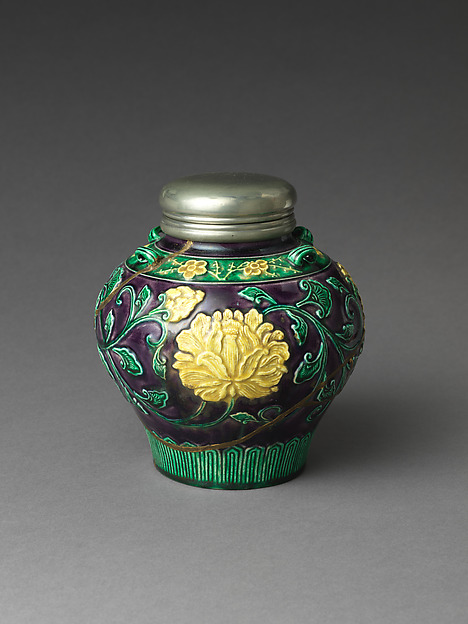
Eiraku Tokuzen, Sencha Tea Jar with Peony Arabesque and Plum in Cochin (Kōchi) Style, late 19th century, Stoneware with relief decoration and polychrome glazes; imitation gold lacquer repair (kintsugi); pewter cover (Kyoto ware, Eiraku type). The Metropolitan Museum of Art, Rogers Fund, 1925, accession 25.60.31a, b.
Look closer: a squat, dark glazed jar with a raised peony in yellow and green leaves round its shoulder, a ribbed foot and a small pewter cover. The museum catalogues it as a Sencha Tea Jar with Peony Arabesque and Plum in Cochin (Kōchi) Style, late 19th century, stoneware with relief decoration and polychrome glazes, imitation gold lacquer repair (kintsugi) and a pewter cover (Kyoto ware, Eiraku type), by Eiraku Tokuzen, 14.6 cm high, Rogers Fund, 1925.
Image: The Metropolitan Museum of Art, Open Access (CC0)
For a pot attributed to a named maker, the Met's usage is a model. It names Ogata Shūhei and Aoki Mokubei where its catalogue does and leaves other pots unnamed. A retailer's claim about clay, kiln or maker is attributed here until the record shows its basis. The pottery almanac's chapter on made in Japan and collected in Japan sets out the vocabulary of attribution and style, and its chapter on marks, seals and signatures explains the stamps that may accompany a pot.
Care is a matter for the owner. Kettl, a retailer, advises keeping one pot for one tea style, avoiding flavoured teas in an unglazed pot, and never placing a pot on a stove. The concierge desk will say in plain words what a pot is, what its record shows and what it does not.
Fun Facts
- Kyūsu simply means teapot, says Wikipedia, whatever the position of the handle.
- About eighty per cent of the tea produced in Japan is sencha, according to Wikipedia.
- Small lids can be made so that water adhesion keeps them from falling off, says Wikipedia.
- The Tokoname Tounomori exhibition says that kyūsu are said to have first been made there in the Bunka and Bunsei eras.
- Baisao set no price on his tea and carried a bamboo tube for donations, according to Wikipedia.
- Baisao burned many of his own tea utensils shortly before his death, says Wikipedia.
- The Tōei climbing kiln at Tokoname has eight chambers and ten chimneys, says Wikipedia.
- Gyokuro is shaded for about twenty days, and kabusecha for a shorter period, Wikipedia says.
- A bilingual corpus says the bōfura's name is thought to come from a Portuguese word for pumpkin.
- The Met catalogues a literati teapot only 3.8 centimetres high.
A Timeline of the Kyūsu and Sencha
Dates are given as the sources give them, with the source named. Where an event is only an account, it is marked as such.
| Date | Event | Source |
|---|---|---|
| Late Heian period | The earliest Tokoname ware is made, about 900 years ago by the Tokoname Tounomori exhibition's count. | Art Research Center, Ritsumeikan University, on Google Arts & Culture |
| Early 12th century | A Tokoname jar for burying sutras is made. | The Metropolitan Museum of Art |
| 1661 | Ingen founds Mampuku-ji at Uji, according to a tea retailer's blog. | My Japanese Green Tea (attributed) |
| Late 17th century | Chinese merchants at Nagasaki show how brewed tea is drunk, in the manner of the Ming court. | Wikipedia, Senchadō |
| 1675 | Baisao is born in Hizen. | Wikipedia, Baisao |
| About 1735 | Baisao begins to serve tea at scenic spots around Kyoto. | Wikipedia, Baisao |
| 1738 | Sencha, in the sense of a steamed and rolled leaf, is said to be developed at Uji. | Wikipedia, Baisao; retailer blogs name Nagatani Sōen (attributed) |
| 1745 | Baisao renounces monastic life at the age of seventy. | Wikipedia, Baisao |
| 1748 | Baisao's writings are published as a collection of tea documents. | Wikipedia, Baisao |
| 1755 | Baisao stops serving tea. | Wikipedia, Baisao |
| 1763 | Baisao dies. | Wikipedia, Baisao |
| About 1804 to 1830 | The Bunka and Bunsei eras, in which kyūsu are said to have first been made at Tokoname. | Art Research Center, Ritsumeikan University |
| 1827 to 1897 | The lifespan of Sugie Jumon, a popular maker of shudei kyūsu. | Art Research Center, Ritsumeikan University |
| 1835 | Yamamoto Kahei is said to have found that covering the plants changes the tea; the result is gyokuro. | Wikipedia, Gyokuro |
| 1882 | Shibata Zeshin paints a sencha tea set in lacquer on paper. | The Metropolitan Museum of Art |
| 1887 | The Tōei climbing kiln is built at Tokoname. | Wikipedia, Tokoname ware |
| 1956 | The Zen Nihon Senchadō Renmei is founded. | A bilingual Kyoto corpus, from Wikipedia's Kyoto articles |
| 1961 | The Tokoname Tounomori Ceramic Art Institute is founded. | Art Research Center, Ritsumeikan University |
| 1998 | Yamada Jōzan III is named a Living National Treasure. | Wikipedia, Tokoname ware |
A Glossary of Pots and Leaf
The words of the chapter, with the sense the sources give them.
| Term | Meaning |
|---|---|
| Kyūsu | 急須. The traditional Japanese teapot, mainly for green tea. |
| Yokode | 横手. The side handle, or a pot with one. |
| Ushirode | 後手. The back handle. |
| Uwade | 上手. The top handle. |
| Hōhin | 泡瓶. A small handleless pot. |
| Yuzamashi | 湯冷. A vessel in which boiled water is cooled. |
| Bōfura | ボーフラ. A round unglazed earthenware boiler. |
| Sasame | Perforations formed in the clay near the spout. |
| Obiami | A fine metal screen set inside the pot, according to Rishi Tea. |
| Shudei | 朱泥. The red clay of Tokoname, burnished and left unglazed in a classic kyūsu. |
| Kokudei | A deep black finish made by reduction firing, according to Rishi Tea. |
| Mogake | A pattern left by seaweed wrapped round the unfired pot, which carbonises in the kiln. |
| Yōhen | Colour variation made by flame, oxygen and a piece's place in the kiln. |
| Anagama | 穴窯. A tunnel kiln; thousands are said to have worked on the Chita peninsula. |
| Noborigama | 登り窯. A multi-chambered climbing kiln. |
| Sencha | 煎茶. Infused tea, made from whole leaves. |
| Senchadō | 煎茶道. The way of sencha, the formal art of enjoying sencha. |
| Gyokuro | 玉露. A shaded tea, shaded for about twenty days. |
| Kabusecha | かぶせ茶. Tea shaded for a shorter period than gyokuro. |
| Shincha | 新茶. The first flush of the year. |
| Fukamushi | 深蒸し. Deeply steamed tea, steamed for one to two minutes. |
| Karamono | 唐物. Chinese things, a word also used of objects in Chinese style. |
| Baisaō | 売茶翁. The old tea vendor of Kyoto, regarded as the first sencha master. |
| Ōbaku | 黄檗. The Zen school brought from China by Ingen. |
| Chataku | 煎茶托. A cup coaster. |
| Teiran | 提籃. A basket for carrying the tea set. |
| Zen Nihon Senchadō Renmei | 全日本煎茶道連盟. The national federation of sencha schools, founded in 1956. |
More Pots, Cups and Baskets to Look At
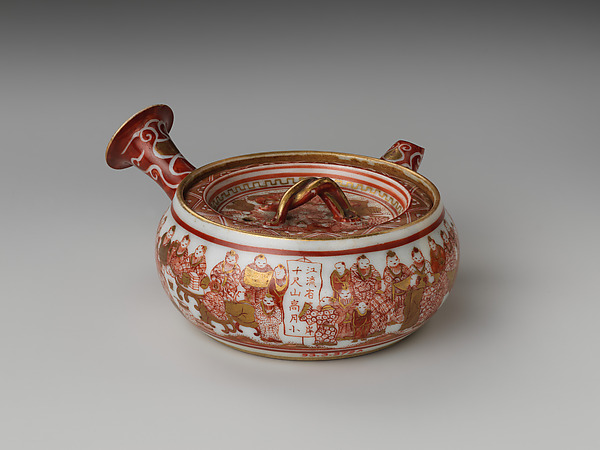
Sencha Teapot (Kyūsu) with Literati, first half 19th century, Porcelain with red overglaze and gold decoration (Kyoto ware). The Metropolitan Museum of Art, Gift of Charles Stewart Smith, 1893, accession 93.3.372a, b.
Look closer: a low, wide pot painted in red and gold with a frieze of tiny figures round its wall, a short spout at the left, a small stub at the right and a lid with a bar-shaped grip. The museum catalogues it as a Sencha Teapot (Kyūsu) with Literati, first half of the 19th century, porcelain with red overglaze and gold decoration (Kyoto ware), 3.8 cm high, a gift of Charles Stewart Smith, 1893.
Image: The Metropolitan Museum of Art, Open Access (CC0)
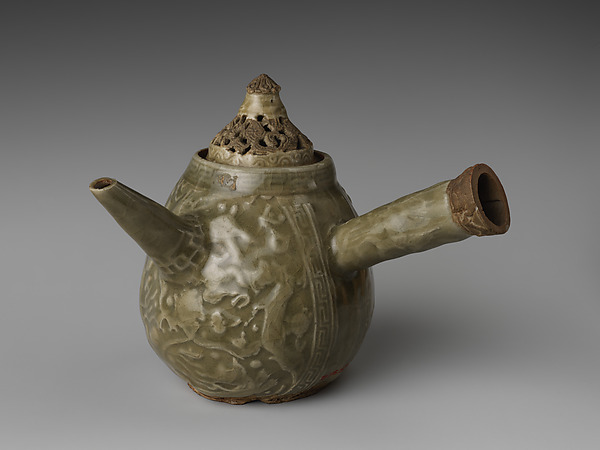
Aoki Mokubei, Sencha Teapot (Kyūsu) with Jewel-Chasing Dragons, early 19th century, Porcelain with molded patterns and celadon glaze (Kyoto ware). The Metropolitan Museum of Art, Gift of Mrs. V. Everit Macy, 1923, accession 23.225.267a, b.
Look closer: a pear-shaped teapot in a greyish olive celadon glaze with dragons moulded in relief, a pierced finial on the lid, a short spout at the left and a straight tubular handle to the right. The museum catalogues it as a Sencha Teapot (Kyūsu) with Jewel-Chasing Dragons, early 19th century, porcelain with moulded patterns and celadon glaze (Kyoto ware), 12.1 cm high, 12.7 cm wide and 14.9 cm deep, a gift of Mrs. V. Everit Macy, 1923. The record names Aoki Mokubei.
Image: The Metropolitan Museum of Art, Open Access (CC0)

Teapot (Kyūsu), mid-19th century, Stoneware with polychrome overglaze enamels (Kyoto ware). The Metropolitan Museum of Art, Gift of Charles Stewart Smith, 1893, accession 93.3.195a, b.
Look closer: a black-and-white photograph of a low, round pot with a band of pattern at the shoulder and tall iris leaves incised and painted on the body, a short spout at the left and a flared tubular handle at the right. The museum catalogues it as a Teapot (Kyūsu), mid-19th century, stoneware with polychrome overglaze enamels (Kyoto ware), 6.4 cm high, a gift of Charles Stewart Smith, 1893.
Image: The Metropolitan Museum of Art, Open Access (CC0)
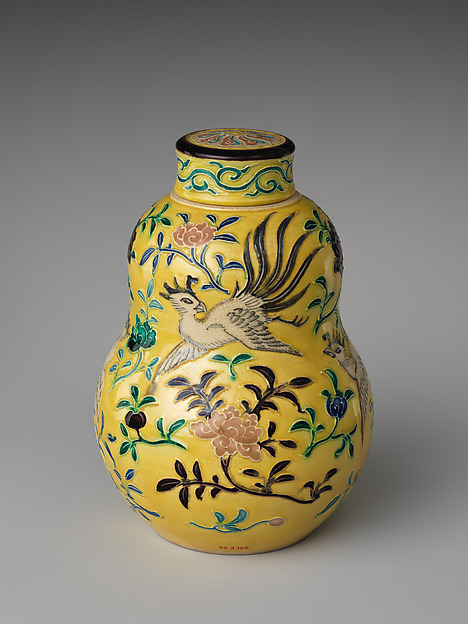
Eiraku Hozen, Sencha Tea Jar with Phoenixes and Peonies in the Cochin (Kōchi) Style, first half 19th century, Stoneware with relief decoration and polychrome glazes (Kyoto ware, Eiraku type). The Metropolitan Museum of Art, Gift of Charles Stewart Smith, 1893, accession 93.3.159a, b.
Look closer: a tall, double-gourd jar in a bright yellow glaze with a phoenix and peonies raised in relief and picked out in green, blue and brown, with a small cover at the top. The museum catalogues it as a Sencha Tea Jar with Phoenixes and Peonies in the Cochin (Kōchi) Style, first half of the 19th century, stoneware with relief decoration and polychrome glazes (Kyoto ware, Eiraku type), by Eiraku Hozen, 14.6 cm high, a gift of Charles Stewart Smith, 1893.
Image: The Metropolitan Museum of Art, Open Access (CC0)
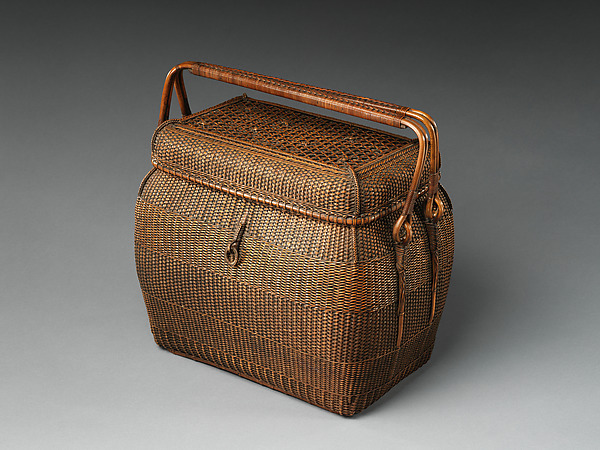
Hayakawa Shōkosai I, Basket for Transporting Sencha Tea-Ceremony Utensils (Chakago or Teiran), ca. 1877–80s, Rattan and brocaded silk. The Metropolitan Museum of Art, Gift of Diane and Arthur Abbey, 2019, accession 2019.424.4a–c.
Look closer: a squarish, deep basket woven of brown rattan, with two arched handles that meet over the lid and a small clasp at the front. The museum catalogues it as a Basket for Transporting Sencha Tea-Ceremony Utensils (Chakago or Teiran), ca. 1877 to the 1880s, rattan and brocaded silk, by Hayakawa Shōkosai I, 31 cm high, a gift of Diane and Arthur Abbey, 2019.
Image: The Metropolitan Museum of Art, Open Access (CC0)
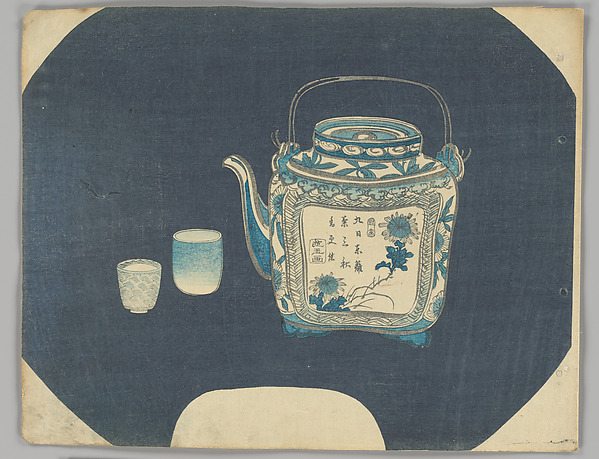
Yamada Hōgyoku, Sometsuke Sencha Teapot and Cups, 1830s, Blue-colored woodblock print (aizuri-e); ink and color on paper; fan print (uchiwa-e) on horizontal aiban sheet. The Metropolitan Museum of Art, Purchase, JoAnn Edinburg Pinkowitz and Richard Pinkowitz Gift, 2020, accession 2020.125.
Look closer: a print on a deep blue ground showing a square-bodied teapot with an arched bail handle and a short spout, its panel painted with flowers and characters, and two small cups to the left of it. The museum catalogues it as Sometsuke Sencha Teapot and Cups, 1830s, blue-colored woodblock print (aizuri-e), ink and colour on paper, fan print on a horizontal aiban sheet, by Yamada Hōgyoku, a purchase of the JoAnn Edinburg Pinkowitz and Richard Pinkowitz Gift, 2020.
Image: The Metropolitan Museum of Art, Open Access (CC0)
Teapots, Cups and Tea-Room Ware
Tea ware passes through the house with the rest of the tea room. The concierge desk will say in plain words what each piece is made of, who made it where the record says so, whether it has been used or repaired, and what the record does and does not show. The atlas of utensils and the glossary of tea utensils are companions to this chapter.
Answered plainly
What is a kyūsu?
A traditional Japanese teapot mainly used for brewing green tea, according to Wikipedia; the word means teapot, not necessarily one with a side handle.
What are yokode, ushirode and uwade?
Wikipedia names them as the side-handled, back-handled and top-handled kyūsu, the side-handled being the more common.
Why is the handle at the side?
Retailers give reasons, among them an easier turn of the wrist and pouring while seated on tatami, and the chapter gives them as attributed; no source here dates the change.
Where do most kyūsu come from?
Wikipedia says Tokoname ware is known for its kyūsu, and the Ritsumeikan exhibition says kyūsu are said to have first been made there in the Bunka and Bunsei eras.
What is shudei?
The red, iron-rich clay of Tokoname that is the hallmark of its teaware, according to two retailers; the exhibition says the idea that all Tokoname kyūsu are shudei is a postwar notion.
What is a sasame?
Perforations formed in the clay near the spout to hold back the leaves, according to Rishi Tea, a retailer.
Who was Baisao?
A monk of the Ōbaku school, 1675 to 1763, who served tea around Kyoto from about 1735 and is regarded as the first sencha master.
What is senchadō?
The way of sencha, the formal art of enjoying sencha, which generally involves the high-grade gyokuro class, says Wikipedia.
What water does gyokuro need?
Wikipedia says 40 to 70 degrees Celsius, about five grams of leaf to 150 millilitres of water.
What is a hōhin?
A small handleless pot used in sencha service, listed in Wikipedia's article on senchadō and named in its article on gyokuro.
Can a kyūsu go on the stove?
A retailer, Kettl, says Japanese ceramic teapots will crack if placed directly on a stove.
Where next
Sources and image credits
- Kyūsu, Wikipedia
- Tokoname ware, Wikipedia
- Sencha, Wikipedia
- Gyokuro, Wikipedia
- Baisao, Wikipedia
- Senchadō, Wikipedia
- Banko ware, Wikipedia
- Tokoname ware, Art Research Center, Ritsumeikan University, Google Arts & Culture
- Sencha-do tea service, a bilingual corpus of Wikipedia's Kyoto articles
- Bofura, a bilingual corpus of Wikipedia's Kyoto articles
- Baisaō and the Popularization of Sencha in Japan, gjtea.org
- Senchado, My Japanese Green Tea (retailer, attributed)
- History of Senchado, Path of Cha (retailer, attributed)
- Tokoname: The Ancient Ceramic City That Shaped Sencha Brewing, Rishi Tea (retailer, attributed)
- Tokoname: A Major Centre of Japanese Ceramics, Native & Co (retailer, attributed)
- The genius behind the yokode handle, TeaLife (retailer, attributed)
- Japanese Tea Pots Demystified, Kettl (retailer, attributed)
- Tokoname, Japan's pottery capital, Japan Experience (travel site, attributed)
- Object record, Sencha Teapot (Kyūsu), Satsuma ware, The Metropolitan Museum of Art
- Object record, Sencha Water Pitcher (Suichū), The Metropolitan Museum of Art
- Object record, Sencha Teapot (Kyūsu) with Literati, The Metropolitan Museum of Art
- Object record, Chinese-Style Charcoal Basket, The Metropolitan Museum of Art
- Object record, Sencha Teapot (Kyūsu) with Chinese Children, The Metropolitan Museum of Art
- Object record, Making Sencha by a Bamboo Grove and Stream, The Metropolitan Museum of Art
- Object record, Brewing Tea in the Shade of Trees, The Metropolitan Museum of Art
- Object record, Preparing Tea by a Mountain Gorge, The Metropolitan Museum of Art
- Object record, Jar for Sutra Burial (Sankinko), The Metropolitan Museum of Art
- Object record, Large Storage Jar (Ōtsubo), The Metropolitan Museum of Art
- Object record, Teapot, The Metropolitan Museum of Art
- Object record, Set of Five Sencha Teacups (Sencha wan) with Lattice Pattern, The Metropolitan Museum of Art
- Object record, Lacquer Paintings of Various Subjects: Sencha Tea Set, The Metropolitan Museum of Art
- Object record, Sencha Tea Jar with Peony Arabesque and Plum in Cochin (Kōchi) Style, The Metropolitan Museum of Art
- Object record, Sencha Teapot (Kyūsu) with Jewel-Chasing Dragons, The Metropolitan Museum of Art
- Object record, Teapot (Kyūsu), The Metropolitan Museum of Art
- Object record, Sencha Tea Jar with Phoenixes and Peonies in the Cochin (Kōchi) Style, The Metropolitan Museum of Art
- Object record, Basket for Transporting Sencha Tea-Ceremony Utensils (Chakago or Teiran), The Metropolitan Museum of Art
- Object record, Sometsuke Sencha Teapot and Cups, The Metropolitan Museum of Art
Last reviewed 28 October 2026. Pictures, where shown, are public-domain or open-access and credited beneath each one.
Looking for a teapot, a tea jar or another piece of tea-room ware? The concierge desk replies within one to three business days.
Browse tea ceremony and chagama pieces · Make a private request
Private concierge
Looking for something in particular?
Describe the piece or the project you have in mind. A senior advisor in Tokyo reads every case file personally and replies within two business days, with fees set out in writing before any work begins.