
Showa Playthings: A Dated Chronicle
Toys Almanac · Chronology
Showa Playthings: A Dated Chronicle
The Showa era lasted sixty-two years, from the end of 1926 to the beginning of 1989, and in that time Japanese toys passed from printed tin to vinyl, die-cast alloy and plastic kits. This chapter lays the dates side by side, each with the source that gave it.
Fact sheet
At a glance
- The longest reign. fun-japan.jp calls Showa the longest single-reign era in Japanese history, from 25 December 1926 to 7 January 1989.
- A relay of materials. Tin, then vinyl, then die-cast alloy, then plastic kits: each gave a decade its toy.
- Television set the agenda. Tetsujin 28 in 1963, Ultraman in 1966 and Gundam in 1979 each opened a toy line.
- Looking back began early. Wikipedia cites nostalgia booms dated 1974, 1986, 2005, 2012 and 2017.
- Different questions, different dates. The peak of exports, the end of mass production and the closing of the last firms are three separate dates.
Sixty-Two Years in One Reign
The Showa era ran from 25 December 1926 to 7 January 1989, a span of sixty-two years that fun-japan.jp calls the longest single-reign era in Japanese history. It includes the building of an industrial toy trade, a war that stopped it, an Occupation that restarted it for export, and a television age that gave it its characters. A toy collector who says Showa without a date is therefore saying very little, and the clearest service a catalogue can do is to put a decade beside every object.
Diagram by Japonista. Dates from fun-japan.jp, Wikipedia and the sources named in the text; spacing is even, not to scale.
Look closer: The spacing is even and the years are not. The long gaps are where the sources read for this chapter give fewer firm dates, not where nothing happened.
Diagram by Japonista
A New York exhibition notice read for this chapter says character toys peaked from the 1960s to the 1980s, and lists the three kinds that the era is remembered for: tin toys such as Tetsujin 28 and Tetsuwan Atom, vinyl figures of Godzilla made during the kaiju boom, and die-cast chogokin figures from Mazinger Z to Gaiking. That is a useful shorthand, and this chapter adds the dates around it.
The practical value of a chronicle is that it lets a reader test a claim. If a description says a robot is from the 1950s and its box names a character who did not appear until 1963, one of the two is wrong, and the dated record shows which. If a vinyl monster is said to be a Marusan original from the early 1960s, the dates above show that the firm's recorded figures begin in 1964 and 1966, and a claim of an earlier date would need its own evidence. The sources read here do not cover every maker or every toy, and this chapter says so: it is a spine for the almanac and not a register.
Looking back began while the era was still running. Wikipedia's article on Showa nostalgia cites nostalgia booms dated to 1974, 1986, 2005, 2012 and 2017, and says that by 2017 about three-quarters of Japanese people had been born in the Showa era. The toys in this almanac are therefore objects of two histories: the one in which they were made, and the one in which they were remembered.
Copies, Cars and a Halted Trade
The Collectors Weekly interview with the collector Philippe de Lespinay gives Japan's tin toy start as the 1880s, with cheap copies of mostly German toys, and says that by 1905 Japanese makers were building car models from lithographed sheet steel. By 1939 the firm CK, Kuramochi Co., was making large clockwork models of American cars, he says, and the Journal of Antiques notes that the Depression hurt the five-and-dime trade that sold them.
Justin Pinchot dates the first Japanese tin robot, Lilliput, to between about 1938 and 1941, and suggests Atomic Robot Man may have been designed before the war and released shortly after it. The Yokohama Museum of Tin Toys says trade restrictions and the war halted manufacture and exports in the 1940s, and the Journal of Antiques adds that metal shortages made the toys that survived scarcer. Prewar pieces are therefore rare, and a collector should expect a prewar claim to be supported by marks, construction and provenance.
| Period | What the sources read say | Chapter |
|---|---|---|
| 1880s to 1905 | Copies of German toys; car models in lithographed steel | Tin Plate |
| 1938 to 1941 | Lilliput, in Pinchot's dating | Tin Robots |
| 1945 to 1952 | Occupation; exports marked Made in Occupied Japan | Tin Plate |
| 1947, 1950 | Marusan founded 1947, incorporated 1950; Bandai founded 5 July 1950 | Tin Plate |
| 1953 | Marusan's 1951 Cadillac released; a milk-drinking vinyl doll by Masudaya, by tradition the first | Soft Vinyl |
| 1956 | Tetsujin 28 manga begins; Forbidden Planet released | Tin Robots |
| 1963 to 1966 | Tetsujin 28 anime from 20 October 1963; plastic replaces tin in cars by 1963; Ultraman from 2 January 1966 | Tin Robots; Soft Vinyl |
| 1964 to 1969 | Marusan's walking Godzilla 1964; bankruptcy 1968; Bullmark founded 1969 | Soft Vinyl |
| 1972 | Popy's chogokin: GA-01 Mazinger Z | Mecha and Gunpla |
| 1979 to 1980 | Gundam on television 1979; Bandai's kits from 1980 | Mecha and Gunpla |
| 1986 | Yokohama Museum of Tin Toys opened by Teruhisa Kitahara | Tin Plate |
| 1989 | Showa ends; Metal House established | Tin Robots |
Occupied Japan and the Battery Motor
Under the Allied occupation, led by General Douglas MacArthur from 1945 to 1952, exports were marked Made in Occupied Japan, the Journal of Antiques says, and the Occupation helped restart toy making. Marusan was founded in 1947 by relatives Haruyasu and Minoru Ishida and Yasuo Arai and incorporated in 1950, and Wikipedia says it released its 1951 Cadillac in 1953. Bandai was founded on 5 July 1950 by Naoharu Yamashina, trading then as Bandai-ya.
The Journal of Antiques puts the heyday of the postwar tin toy at about 1952 to 1962 and notes that by the mid-1950s miniature battery motors had replaced many wind-up mechanisms. In the same decade, Pinchot dates Flashy Jim to about 1955 and Robby the Robot's film, Forbidden Planet, to 1956, and Wikipedia dates the Tetsujin 28 manga to July 1956 in the magazine Shonen.
The same decade also saw the start of vinyl. Wikipedia's article on soft vinyl toys says Masudaya's milk-drinking doll of 1953 is believed to be the first soft vinyl doll made in Japan, and that a US ban on flammable celluloid pushed Japanese exporters towards vinyl. Both points are reported there as belief and history, and the chapter on soft vinyl returns to them.
Monsters, Robots and the Small Screen
Television turned toys into licences. Tetsujin 28-go, the manga, was followed by an anime that ran from 20 October 1963 to 25 May 1966, with the American version, Gigantor, dubbing only 52 of 97 episodes, according to Wikipedia. The Ultraman series began on 2 January 1966, and Wikipedia's Marusan article says the firm released Ultra-kaiju PVC figures that year and a walking Godzilla toy in 1964.

Horikawa's Star Strider, which Wikipedia calls its last all-tin robot design; the Commons record gives no date. Photograph by D J Shin, CC BY-SA 3.0. Wikimedia Commons, File:S.H Horikawa – Star Strider Robot (スターストライダーロボット) – Close Up.jpg.
Look closer: A late tin design is a reminder that the dates overlap. A robot of this kind was in production while plastic and die-cast alloy were already taking over.
Image: D J Shin, CC BY-SA 3.0, via Wikimedia Commons
The fortunes of the vinyl makers are set out in the same sources. Marusan was renamed Maruzan in 1967 and went bankrupt in 1968, and in 1969 Minoru Ishida rebuilt the company while former staff founded Bullmark and Fuji Hobby. Wikipedia's Bullmark article says the firm closed in 1977, and that Saburo Ishizuki revived it as an independent company in 2009. Wikipedia's article on soft vinyl toys says the kaiju boom faded in the mid-1970s and that adults who had grown up with the toys began collecting them as vintage items in the 1980s.
Plastic was the rival of tin throughout. De Lespinay says plastic had largely replaced tin plate in cars by 1963, and All About Japan says tin plate production ended with the arrival of plastic in the early 1970s. Wikipedia's article on the Metal House robots has the industry growing from the late 1950s to the mid-1970s and declining sharply in the 1980s, with most companies closed by the end of that decade.
Die-Cast Heroes and Gundam Kits
Chogokin means super alloy, a fictitious metal from Go Nagai's Mazinger Z, says Wikipedia. Popy adopted the name in 1972 for a die-cast robot and character line, and its first release, the GA-01 Mazinger Z, sparked a 1970s toy craze despite engineering problems that led to a free replacement campaign. Bandai, Popy's parent company, still continues the line. Mattel sold selected chogokin toys in the United States in the late 1970s as Shogun Warriors, and after a child died choking on a Battlestar Galactica missile toy, later Shogun Warriors missiles were changed to child-safe projectiles.
Gundam followed. Wikipedia says the Mobile Suit Gundam television series debuted in 1979, that Bandai obtained the rights to make Gundam models in 1980, and that over 100 million units were sold between 1980 and 1984. Snap-fit kits that needed no glue arrived in 1987 and 1988, the High Grade line in 1990, and the Master Grade line at 1:100 in summer 1995. The detail belongs in the chapter on mecha and Gunpla; here it marks the point at which the toy was no longer finished at the factory but assembled by the buyer.
The 1980s also brought the end of the era's old trades. Pinchot says the unpopularity of Japanese tin in the 1970s and 1980s reversed after the Sotheby's sale of 1996, and Wikipedia says Horikawa closed in the late 1980s and Metal House was established in 1989, the year the era ended.
Reissues, Reproductions and Retro
Reproduction began as soon as nostalgia did. Wikipedia says Marusan began selling reproductions of its 1960s and 1970s toys in the 1980s, and reproduced its original PVC monster series in 1997. The firm still makes old-style toys under its own brand, according to the Marusan article. Reissues and revivals such as these are honest products when they are labelled as such, and a source of confusion when they are not.
There is a human side to the dates as well. Wikipedia's account of Showa nostalgia lists museums that keep the period's objects, among them the Showa Retro Packaging Museum in Ome in Tokyo, a retro space in Nishi Ward, Sapporo, the Showa Era Lifestyle Museum in Kitanagoya and the Sagamihara Vending Machine Park. The same article names handheld versions of arcade games and the Fujicolor disposable camera of 1986 among the revived tastes. The toys of the chapter sit inside a larger taste for the period, and collectors who buy them are often buying a childhood as much as an object.
That is the reason for the dated approach. A Showa toy is not only an object but a claim about when it was made. A good description gives the maker, the evidence for the period and the nearest dated event in this timeline, and it says plainly when something is a later production. The Myths chapter sets out the common confusions, and the Collector's Guide sets out how condition and boxes are described.
A New Year's Day in 1963
Wikipedia's article on Astro Boy gives the television age a precise starting day. The first anime series premiered on New Year's Day 1963 on Fuji TV, produced by the first Mushi Production, and ran for four seasons and 193 episodes, ending on New Year's Eve 1966. At its peak it was reportedly watched by 40 per cent of the Japanese people who had a television, and the article describes it as the first popular Japanese animated television series and the one that established the look later known as anime. Only the first 104 episodes were dubbed into English for the American market, and the other 89 were never released in English.
The manga was older. It was written and drawn by Osamu Tezuka and serialised in the magazine Shonen from 3 April 1952 to 12 March 1968, in 112 chapters collected in 23 volumes, and the character first appeared in April 1951 as a supporting figure in another story. The article says the series has sold more than 100 million copies, making it Tezuka's best-selling work, and that franchise merchandise reached about three billion dollars by 2004, in products from figures and food to clothing, stamps and trading cards. In the story, Astro's birthday is 7 April 2003, when the town of Niiza in Saitama registered him as a resident, and the article notes that the date is inconsistent with its own account of the 2003 anime premiere, so the almanac prints only the birthday.

Special effects director Eiji Tsuburaya, 1901 to 1970, photographed on the set of Ultraman by Tsuburaya Productions. Photograph by Tsuburaya Productions, Public domain. Wikimedia Commons, File:Eiji Tsuburaya 1966.jpg.
Look closer: The 1960s television age was built by effects directors as well as by animators. Tsuburaya worked on the first Godzilla film of 1954 and then on Ultraman.
Image: Tsuburaya Productions, Public domain, via Wikimedia Commons
The importance for a toy collector is the licence. A tin Atom bus, a racing car with Atom at the wheel or a battery-operated Atom with a machine gun, such as the house has held, are not only toys but evidence of a broadcast. The dated record tells a reader the earliest year in which such a toy could have been made with the character's licence, and a description of a toy as earlier than 1963 would need strong evidence. The same logic runs through every character toy in this chronicle.
Licca-chan and the Rival from California
The sixties had toys for girls as well as for boys, and the best documented is the doll Licca-chan. Wikipedia's article says Takara, now Takara Tomy, launched her on 4 July 1967. Her designer, the former girls' manga artist Miyako Maki, illustrated the first advertisements, and the public chose the name in a July 1967 poll in the manga magazine Ribon. The doll is 21 centimetres tall and takes her look from anime heroines. Takara's first idea, the article says, was a portable dollhouse, which proved impractical for Japanese homes.
The competition was American. By 1969, the article says, Mattel, the maker of Barbie, had moved production abroad and Licca-chan had begun to outsell Barbie in Japan. More than 48 million dolls had been sold by 2002 and over 53 million by 2007. The doll passed through four recorded generations: the first in 1967 with brown curly hair, the second in 1972 with three stars in her eyes and magnetic heels, the third in 1982 with an open mouth and the fourth in 1987, a centimetre taller. Sales slipped in the 1990s under pressure from anime-based dolls such as Sailor Moon figures, and Licca-chan regained the top dress-up doll position in 1996.
One detail shows how a toy company's story becomes part of the toy. The article says Licca is eleven, goes to school, has a Japanese mother and a French father, and likes Anne of Green Gables and Doraemon, a biography that most customers do not know. It adds that Takara tried to launch the doll in the United States as Lisa in the early 1980s, a short-lived effort, and that the line returned to the American market in 2026 under its original name, aimed at adult collectors. The last claim is made in the article without a source, so it is repeated here as the article's own.
A Crank, a Capsule and Three Billion Toys
The cheapest Showa toys were not sold in toy shops. Wikipedia's article on gashapon explains that capsule vending began with American gumball machines in the 1880s, that machines dispensing toys in capsules became popular in the United States, and that capsule machines were exported to Japan from the United States in 1965 and spread across the country in the 1970s. It names Ryuzo Shigeta, called the Grandfather of Gacha, as the man who set up Japan's first machine, and says Bandai has expanded the business and sold toys since at least 1977. The name is onomatopoeic: gasha is the sound of the crank and pon is the capsule landing in the tray.
The scale is considerable. As of March 2021, according to the article, Bandai Namco had sold about 3.711 billion toys priced between 100 and 500 yen. The early customers were children from kindergarten to the middle of primary school, and early products included erasers shaped like supercars and kaiju, and figures from Kinnikuman and Super Deformed Gundam, most of them PVC figures that did not rub out anything. Since the late 1990s the audience has expanded to older age groups, and the article says that in the 2020s adults have expressed Showa nostalgia through capsule toys.
The same article describes the trading habit that gave the capsule toy its second life. Nearly all gashapon are released in sets, purchases are blind, and buyers who receive duplicates trade them to complete sets, which is why they are called trading toys. Enthusiasts buy complete sets at gashapon stores in Akihabara in Tokyo and Nipponbashi in Osaka, where sets are usually cheaper than random machine purchases. The page also records the downside, that critics compare the blind purchase with gambling, and that Bandai has used age restrictions of fifteen years or over for some figures although the machines have no age verification.

A shop of capsule-toy machines in Akihabara, Tokyo. Photograph by Ubahnverleih, CC0. Wikimedia Commons, File:Gashapon Shop in Akihabara, Tokyo, Japan.jpg.
Look closer: The shops are specialist places. The article notes that since the 2000s such stores have offered dozens or over a hundred machines.
Image: Ubahnverleih, CC0, via Wikimedia Commons

Capsule toys of Gachagacha no Mori. Photograph by KKPCW, CC BY-SA 4.0. Wikimedia Commons, File:Capsule toys of Gachagacha no mori.jpg.
Look closer: A capsule toy is a small figure in a plastic ball. Collecting the set is the point of the game.
Image: KKPCW, CC BY-SA 4.0, via Wikimedia Commons
Game & Watch and the Red-and-White Machine
The decade that closed the era also changed what a toy was. Wikipedia's article on Game & Watch says the handheld, created by Gunpei Yokoi, the head of Nintendo's R&D1 department, with his assistant Satoru Okada, was launched in Japan on 28 April 1980. Its first title, Ball, was also sold under other names abroad. The article says it sold 43.4 million units worldwide, 12.87 million in Japan and 30.53 million overseas, about 14 million of them in the first year, and that the introductory price was 5,800 yen. Yokoi's philosophy, the article says, was lateral thinking with withered technology, the use of mature and inexpensive parts.
The device had lasting offspring. The Multi Screen series, introduced in mid-1982 with Oil Panic, used two screens to double the play area, and the article says its clamshell design later inspired the Game Boy Advance SP, the Nintendo DS and the 3DS. The directional pad, it says, was invented when Donkey Kong was adapted for the format, and earned a Technology and Engineering Emmy in 2008. A yellow Super Mario Bros. unit, modelled on the mascot of the Famicom Disk System, was given as a prize to winners of an F-1 contest, about 10,000 of them, and never sold.
The Family Computer followed on 15 July 1983. Wikipedia's article on the Nintendo Entertainment System says the Japanese machine launched at 14,800 yen with Donkey Kong, Donkey Kong Jr. and Popeye, that its red, white and gold scheme was chosen after the designers saw a billboard, and that about 500,000 units sold in the first two months. A defective integrated circuit led the company's president to order a full recall and a revised motherboard, and sales then rose sharply, so that by the end of 1984 it was Japan's best-selling console. By June 1989 the article says it was in 37 per cent of Japanese households, a figure that places the machine firmly in the last months of the Showa era.
From the point of view of the toy trade, these dates show the competition that tin and vinyl faced. A child in 1983 could choose between a tin robot, a kit and a cartridge, and the cartridge was winning. The chronicle of the toy industry in the final decade of the era is therefore a chronicle of a medium moving from the shelf to the screen, and of the shelf finding a second life among adults.
From a Studio in Tokyo to a Row of Shelves
A chronicle of Showa toys has to include the film that began the monster. The first Godzilla film was released in 1954, and the Commons photographs reproduced here, which are public domain, show a production still, the sculptor Teizo Toshimitsu working on an early design, behind-the-scenes images and a period poster. The Wikipedia article on Marusan, read for this almanac, records that a walking Godzilla toy was released in 1964, and the article on soft vinyl toys describes the kaiju boom that followed. The special effects director Eiji Tsuburaya, who lived from 1901 to 1970, is seen in the photographs on the set of Ultraman, which began on television on 2 January 1966.

Teizo Toshimitsu sculpting an early Godzilla design, a public domain production photograph. Photograph by Unknown authorUnknown author, Public domain. Wikimedia Commons, File:Godzilla (1954) Teizô Toshimitsu.jpg.
Look closer: The monster begins as sculpture. Every later toy, vinyl or die-cast, is a copy of an image that began in a modeller's hands.
Image: Unknown authorUnknown author, Public domain, via Wikimedia Commons

The Japanese poster for the 1954 film Godzilla, public domain. Photograph by Toho Company Ltd. (東宝株式会社), Public domain. Wikimedia Commons, File:Gojira 1954 Japanese poster.jpg.
Look closer: The poster gives the monster scale by setting it against the city. Toys later reduced that scale to something a child could hold.
Image: Toho Company Ltd. (東宝株式会社), Public domain, via Wikimedia Commons

The Showa Retro Packaging Museum, Ome, Tokyo, as the Commons file title gives it. Photograph by Asturio Cantabrio, CC BY-SA 4.0. Wikimedia Commons, File:Showa Retro Packaging Museum ac (1).jpg.
Look closer: The museum is housed in a street-front building of the period. Packaging is the memory of the era, and boxes are what survive when the product is gone.
Image: Asturio Cantabrio, CC BY-SA 4.0, via Wikimedia Commons
The Showa Retro Packaging Museum in Ome, in Tokyo, which the Wikipedia article on Showa nostalgia lists among the museums that keep the period's objects, is one place where the packaging of such toys survives as an exhibit. The same article names a retro space in Nishi Ward, Sapporo, the Showa Era Lifestyle Museum in Kitanagoya and the Sagamihara Vending Machine Park. The sources read for this chapter do not describe what is in them toy by toy, so the almanac names them as places to look and makes no further claim.
One Hundred Years On
The Showa era began on 25 December 1926, and 2025 marked a hundred years from the start of the Showa year numbering, an anniversary that museums and shopping centres across Japan marked with exhibitions. A SoraNews24 report describes one of them, Otemachi Timeslip 2025, a free event in the Otemachi district of Tokyo from 8 to 12 December 2025, which re-created a Showa living room with tatami flooring, tube televisions and wooden furniture, and showed real objects such as small juice vending machines, enamel signs and a mechanical calculator. The report notes that popular nostalgia centres on the 1960s to the 1980s and does not mention toys, so no toy is claimed for it here.
The chronicle's purpose is the same as the exhibition's: to make the period legible to those who did not live in it. The Wikipedia article on Showa nostalgia says that by 2017 about three-quarters of Japanese people had been born in the Showa era, and the next generations are already further from it. Toys are among the easiest objects through which to remember a period, because they were made for use, wore out in use, and were thrown away. What survives is a self-selected record, and a collector should remember that it favours the toys that were valued, boxed and kept.
Placing an Object Inside the Chronicle
The sections above give dated anchors rather than a complete calendar, and the anchors can be used as a method. Start with the material. A printed tin body belongs with the first half of the chronicle, the alloy body with the 1970s, the soft vinyl monster with the years after 1953 and the television boom that followed Ultraman in 1966, and the kit that the buyer assembles with the Gundam years that begin in 1979. A material is never proof of a date, but it narrows the field, and a description that names the material first is easier to check.
Next, look for the dated event nearest to the object's subject. An Astro Boy toy sits near the television series, a capsule toy near the vending habit, a hand-held game near the Game & Watch of 1980 and the Family Computer of 1983. The nearest event gives the earliest sensible date, not the actual one, because a popular character was produced for years after its first appearance. The honest wording is therefore 'after' followed by the event, or 'by' followed by the latest dated reference on the box.
Finally, ask whether the object could be a later production. The chronicle records that reproductions of early toys began in the 1980s and that Marusan reproduced its monster series in 1997. A mark, a box or a make-up of materials that fits a reissue should be named as such. The house gives the date it can support, says what it cannot, and leaves the rest to the buyer's own eye and the evidence on the table.
A Dated Spine, Ten Years at a Time
The table collects the dated facts of this chronicle in order. Each row states its source, and none is a date supplied from memory.
| Date | Event | Source |
|---|---|---|
| 1880s | Japan's tin toy trade begins with copies of German toys | Collectors Weekly, de Lespinay |
| 25 December 1926 | The Showa era begins | fun-japan.jp |
| 1947 | Marusan founded | Wikipedia, Marusan |
| 5 July 1950 | Bandai founded as Bandai-ya | Takara Tomy and Bandai histories read for the tin chapter |
| 1952 to 1962 | Heyday of the postwar tin toy, by one account | Journal of Antiques |
| 3 April 1952 | Tetsuwan Atom manga begins in Shonen | Wikipedia, Astro Boy |
| 1953 | Masudaya's milk-drinking doll, believed the first soft vinyl doll | Wikipedia, Soft vinyl toys |
| 1954 | First Godzilla film | Commons file descriptions |
| 1 January 1963 | Astro Boy anime premieres on Fuji TV | Wikipedia, Astro Boy |
| 4 July 1967 | Licca-chan launched by Takara | Wikipedia, Licca-chan |
| 1965 | Capsule machines exported from the United States to Japan | Wikipedia, Gashapon |
| 2 January 1966 | Ultraman series begins | Wikipedia, Marusan |
| 1972 | Popy introduces the chogokin line | Wikipedia, Chogokin |
| 1977 | Bandai expands gashapon | Wikipedia, Gashapon |
| 28 April 1980 | Game & Watch launched | Wikipedia, Game & Watch |
| 1980 | Bandai obtains the Gundam model rights | Wikipedia, Gunpla |
| 15 July 1983 | Famicom launched at 14,800 yen | Wikipedia, NES |
| 7 January 1989 | The Showa era ends | fun-japan.jp |
A Short Glossary of Showa Toys
The terms below are used in this chapter; each is explained by the source named.
| Term | Meaning | Source |
|---|---|---|
| Showa | The era from 25 December 1926 to 7 January 1989 | fun-japan.jp |
| Gashapon | A capsule toy from a crank-operated vending machine; Bandai's name | Wikipedia |
| Chogokin | Super alloy, a fictional metal from Mazinger Z; a die-cast toy line | Wikipedia |
| Kaiju | Monster, the genre of Godzilla and Ultraman | Wikipedia, Soft vinyl toys |
| Famicom | The Family Computer, launched 15 July 1983 | Wikipedia, NES |
| Licence toy | A toy made under a broadcast character's licence | This almanac's usage |
| Showa nostalgia | Waves of interest in the era, dated to 1974, 1986, 2005, 2012 and 2017 | Wikipedia |
Twelve Small Surprises
Each item comes from a source named in the chapter.
- Astro Boy's first television run ended on New Year's Eve 1966, after 193 episodes (Wikipedia).
- At its peak, the Astro Boy anime was reportedly watched by 40 per cent of television owners (Wikipedia).
- Licca-chan was named in a readers' poll in a girls' manga magazine (Wikipedia).
- Licca-chan began outselling Barbie in Japan by 1969 (Wikipedia).
- The first Game & Watch cost 5,800 yen (Wikipedia).
- The directional pad was invented for a handheld Donkey Kong and won an Emmy in 2008 (Wikipedia).
- About 10,000 Game & Watch prize units were never sold (Wikipedia).
- The Famicom was recalled after a defective chip, then became Japan's best-selling console (Wikipedia).
- By June 1989 the Famicom was in 37 per cent of Japanese households (Wikipedia).
- Capsule machines reached Japan from the United States in 1965 (Wikipedia).
- About 3.711 billion capsule toys had been sold by Bandai Namco by March 2021 (Wikipedia).
- A free Showa 100 event in Tokyo in December 2025 re-created a living room with tube televisions (SoraNews24).
What People Ask About Showa Toys
People ask what counts as a Showa toy. The era ran from 25 December 1926 to 7 January 1989, so anything made in those years qualifies, and the more useful question is which decade. The tin toys of the Occupation, the vinyl monsters of the 1960s, the chogokin of the 1970s and the handhelds of the 1980s are four different worlds.
People ask how to date a character toy. Find the date of the character's first broadcast or publication, and the toy cannot be older. Astro Boy's manga began in 1952 and his anime on 1 January 1963, so a toy that uses the anime's design cannot be earlier than the broadcast. People ask whether the 1950s were the peak. For tin toys, one account says the heyday ran from about 1952 to 1962. For character toys, a New York exhibition notice says the peak ran from the 1960s to the 1980s.
People ask why Showa toys are fashionable now. The sources give two reasons: a long tradition of nostalgia waves, in 1974, 1986, 2005, 2012 and 2017 by one account, and the centennial of the era in 2025. A third reason is more practical. The toys were mass-produced, so many survive, and the best of them are well documented.
Two Ends of the Tin Century
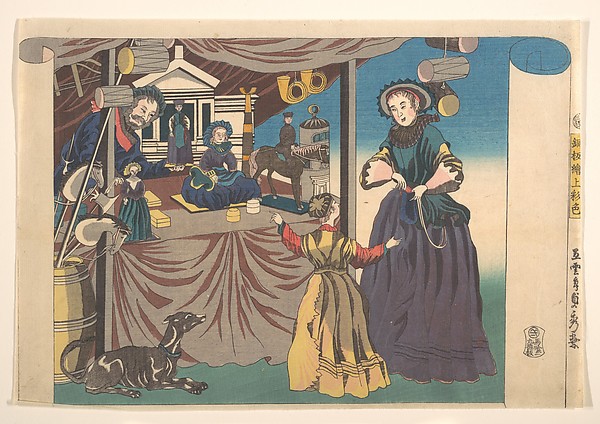
Utagawa (Gountei) Sadahide, Color Print of a Copperplate Picture of a Toy Shop, 1860, Woodblock print; ink and color on paper. The Metropolitan Museum of Art, Bequest of William S. Lieberman, 2005, accession 2007.49.114.
Look closer: This print is from before the Showa era and before the tin trade. It shows that toys were being sold to foreign visitors long before the factory age.
Image: The Metropolitan Museum of Art, Open Access (CC0)

The lithographed box of a Masudaya battery tank. Photograph by D J Shin, CC BY-SA 3.0. Wikimedia Commons, File:Masudaya Battery Powered Army Tank M-99 Tin Toy Box Art.jpg.
Look closer: Box art is a dated document. The lettering, the printing and the importer's marks place a toy in the market it was made for.
Image: D J Shin, CC BY-SA 3.0, via Wikimedia Commons

Exterior of the Yokohama Museum of Tin Toys. Photograph by 妖精書士, CC BY-SA 3.0. Wikimedia Commons, File:Tintoy museum.JPG.
Look closer: The museum opened in 1986, near the end of the era it records.
Image: 妖精書士, CC BY-SA 3.0, via Wikimedia Commons
Showa Pieces at the Desk
The house holds a run of Showa tin toys, among them a Masudaya Tetsuwan Atom racing car, a 1960s Atom bus in friction tin and a battery-operated Atom machine gun, 53 cm. Stock changes; the shelf page shows what is here now.
Answered plainly
When was the Showa era?
From 25 December 1926 to 7 January 1989, according to fun-japan.jp.
When did Japanese tin toys end?
It depends on the question. The sources give about 1963 for cars, 1962 as the end of a heyday, the early 1970s for production and the 1980s for the last firms.
When did kaiju toys begin?
Wikipedia says Marusan released Ultra-kaiju figures in 1966, with a walking Godzilla toy in 1964.
When did Gunpla begin?
Wikipedia says Bandai obtained the rights to Gundam models in 1980, a year after the television series debuted.
When did the Showa era end?
On 7 January 1989, after sixty-two years.
When did Astro Boy first appear on television?
On 1 January 1963 on Fuji TV, according to Wikipedia.
When was the Famicom launched?
On 15 July 1983 at 14,800 yen, according to Wikipedia.
What is gashapon?
A capsule toy sold from a crank-operated machine, a business Bandai has run since at least 1977.
Is there a Showa museum?
Several, according to Wikipedia: the Showa Retro Packaging Museum in Ome, the Showa Era Lifestyle Museum in Kitanagoya and others.
Where next
Sources and image credits
- Explaining the Showa Era in Simple Terms, fun-japan.jp
- Showa Era Icons to celebrate Japan's toy design legacy, Bucks County Herald
- Shōwa nostalgia, Wikipedia mirror
- Japanese Tin Toys: A Craze That Rebuilt Post-War Japan, Journal of Antiques, 20 September 2023
- Japan's Best Postwar Export? Tinplate Cars, interview with Philippe de Lespinay, Collectors Weekly, 9 July 2010
- Attack of the Vintage Toy Robots, interview with Justin Pinchot, Collectors Weekly, 18 November 2010
- Marusan Shōten, Wikipedia
- Bullmark, Wikipedia
- Soft vinyl toys, Wikipedia
- Chogokin, Wikipedia
- Gunpla, Wikipedia
- Tetsujin 28-go, Wikipedia
- Metal House Robots, Wikipedia
- Mechanical Marvels: Japanese Tin Toys, All About Japan, updated 27 July 2018
- Yokohama Museum of Tin Toys, Yokohama 150
- Astro Boy, Wikipedia
- Licca-chan, Wikipedia
- Gashapon, Wikipedia
- Game & Watch, Wikipedia
- Nintendo Entertainment System, Wikipedia (the Famicom section)
- Tokyo event lets you travel back in time for free to celebrate 100 years since Showa era start, SoraNews24, 11 December 2025
- Object record, File:S.H Horikawa – Star Strider Robot (スターストライダーロボット) – Close Up.jpg, Wikimedia Commons
- Object record, File:Eiji Tsuburaya 1966.jpg, Wikimedia Commons
- Object record, File:Gashapon Shop in Akihabara, Tokyo, Japan.jpg, Wikimedia Commons
- Object record, File:Capsule toys of Gachagacha no mori.jpg, Wikimedia Commons
- Object record, File:Godzilla (1954) Teizô Toshimitsu.jpg, Wikimedia Commons
- Object record, File:Gojira 1954 Japanese poster.jpg, Wikimedia Commons
- Object record, File:Showa Retro Packaging Museum ac (1).jpg, Wikimedia Commons
- Object record, Color Print of a Copperplate Picture of a Toy Shop, The Metropolitan Museum of Art
- Object record, File:Masudaya Battery Powered Army Tank M-99 Tin Toy Box Art.jpg, Wikimedia Commons
- Object record, File:Tintoy museum.JPG, Wikimedia Commons


Last reviewed 28 October 2026. Pictures, where shown, are public-domain or open-access and credited beneath each one.
Looking for a particular tin toy, doll or figure, or a view on one you own? The concierge desk replies within one to three business days.
Browse Retro, Vintage, Antique and Modern Toys · Make a private request
Private concierge
Looking for something in particular?
Describe the piece or the project you have in mind. A senior advisor in Tokyo reads every case file personally and replies within two business days, with fees set out in writing before any work begins.