
Tin Plate: Japan's Printed Steel Century
Toys Almanac · The Mechanical Age
Tin Plate: Japan's Printed Steel Century
A Japanese tin toy is a small piece of printed steel that moves. Made in the thousands, thrown away by the million, it became after 1945 one of the country's first export successes, and now it is kept in glass cases by people who were not yet born when the last factories closed.
Fact sheet
At a glance
- Older than the robots. Collectors Weekly dates Japan's tin toy industry to the 1880s, with car models in sheet steel by 1905.
- A job for the rebuilt nation. After 1945 the American military helped restart the industry, and toys became a major export.
- A dating clue. Occupation-era exports were marked Made in Occupied Japan; later toys say Made in Japan.
- Boxes count. A large car's original box can be worth as much as the toy, according to the collector Philippe de Lespinay.
- The record is in Yokohama. Teruhisa Kitahara opened his museum there in 1986.
Copies of German Toys, Then Cars of Their Own
Tin plate is steel sheet with a thin coating of tin, stamped into shape and printed in colour. Wikipedia's article on the tin toy says the material came into use for toys in the middle of the nineteenth century, that spring-driven tin toys began in Germany in the 1850s, and that offset lithography came into use in the late 1880s. Germany was the great producer in the early twentieth century, and Japan, at first, was a student.
Diagram by Japonista. Dates from Collectors Weekly, the Journal of Antiques and the Yokohama museum guide; spacing is even, not to scale.
Look closer: Read it left to right as a story of power, from a wound spring to a battery. Each step let the toy do more: walk, light up, steer.
Diagram by Japonista
The Collectors Weekly interview with the collector Philippe de Lespinay gives Japan's start as the 1880s, with cheap copies of mostly German toys. By 1905, he says, Japanese makers were building automobile models from lithographed, hand-bent sheet steel, and by 1914 their exports had tripled. The Yokohama Museum of Tin Toys puts the same story in its own words: Japanese makers began producing tin toys in the Meiji era, first imitating Western designs and then developing their own style, with exports to the United States and Europe growing.
The prewar industry was more ambitious than its reputation. De Lespinay describes large clockwork models of American cars made by the firm CK, Kuramochi Co., by 1939: a Graham-Paige, a Packard, a Buick, a Plymouth and a Chrysler, in sizes from four to twelve inches. An article in the Journal of Antiques adds that Japanese firms made detailed models of American cars between the wars, and that the Great Depression hurt the five-and-dime trade that sold them. All About Japan offers a more homely detail, that early makers often used recycled American food cans, Californian tomato cans being a favourite. That account sits oddly with the factory methods described elsewhere, and it is best read as a story about thrift rather than as a method.
Then came the war. The Yokohama museum's history says trade restrictions and the war halted manufacture and exports in the 1940s, and the Journal of Antiques notes that metal shortages limited toy production, making the toys that survived scarcer and more treasured.
Toys for a Nation Turned to Peace
The post-war story is told with a certain moral neatness by the Journal of Antiques, and it is worth keeping the neatness in view. The 1947 constitution, in Article 9, ended Japan's manufacture of weapons and war material. The Allied occupation, led by General Douglas MacArthur, governed Japan from 1945 to 1952. Exports of that period, the article says, were marked Made in Occupied Japan, and workers and designers turned towards cheerful, playful products. De Lespinay says that the American military helped restart the toy industry, and that export demand was large while Japanese households had little money for toys.
Labour is part of the picture. Both the Journal of Antiques and de Lespinay stress that much of the work was done by women, who took up the work because of wartime losses, and who decorated and assembled parts at home and took them to a local factory for final assembly. De Lespinay mentions photographs of women assembling 1951 Cadillacs at the shop of Matsuzo Kosuge, who worked as a subcontractor to Marusan, and observes that there is a great deal of handwork in the pieces. Marusan's 1951 Cadillac Series 62, about twelve inches long, ran to roughly 175 pieces, he says, in friction or electric versions.
The Journal of Antiques dates the heyday of the post-war tin toy to about 1952 to 1962. Early toys of the period used celluloid parts, and by the mid-1950s miniature battery motors had replaced many wind-up mechanisms, allowing longer running times and lighting effects. The same article says Japan made 95 per cent of the world's battery-operated toys in this period. That is a bold number and the article gives no source for it, so treat it as an indication of scale rather than a statistic. The Collectors Weekly interview with Justin Pinchot agrees on the direction: Japan, he says, was the first to put small battery motors into toys, while other countries still mostly made clockwork, and Japan dominated the toy market from the early 1950s to the late 1960s on innovation and low prices.
Price was the other weapon. Pinchot says a large tin robot could be sold for about six dollars, where American production would have cost fifteen to twenty. The Journal of Antiques puts the original shop prices of the cheaper toys at about $1.95 to $3.95 at stores such as Woolworth and Ben Franklin.
Who Made What, and Where
Makers are the first thing a collector asks about, and the sources give a patchwork rather than a register. The table sets out what could be read, house by house, with the source of each fact stated in the chapter text and the full list in the sources below. The house Directory of Showa Tin Toy Makers carries the marks that appear on the toys; this table is about the firms behind them.
A geographical correction is due. The collection that made Yokohama the home of tin toys in the collecting world is a museum, not a factory district. The firms that can be placed on a map from the sources read for this chapter stand in Tokyo: Marusan in Taito, Bandai at Komagata in Taito, Yonezawa and Alps in Tokyo, and Tomy's founder trained at a workshop in Asakusa. No source read for this chapter names a Yokohama toy maker, and none is invented here. Where one comes to light, it belongs in the table.

A reproduction of a Yonezawa robot sold under the American importer's name Cragstan, from the Osaka Tin Toy Institute's Tin Age Collection. Photograph by D J Shin, CC BY-SA 3.0. Wikimedia Commons, File:Osaka Tin Toy Institute The Tin Age Collection Cragstan Yonezawa Reproduction Mr. Atomic Side.jpg.
Look closer: Two names are printed on one toy: the importer's on the belly, and in the file title the maker's. This is why the chapter treats marks and importers as separate clues. This example is a reproduction, not a toy of the 1950s.
Image: D J Shin, CC BY-SA 3.0, via Wikimedia Commons
| House | Facts read in the sources | Known for |
|---|---|---|
| Marusan Shoten | Founded 1947 by relatives Haruyasu and Minoru Ishida and Yasuo Arai; incorporated 1950; Taito, Tokyo | The 1951 Cadillac tin car; later Godzilla and soft vinyl kaiju |
| Bandai | Founded 5 July 1950 by Naoharu Yamashina as Bandai-ya; Komagata, Taito | Cars from 1956; the Toyopet Crown, by de Lespinay's account, made its name |
| Tomy | Eiichiro Tomiyama founded Tomiyama Toy Seisakusho on 2 February 1924 with capital of 1,000 yen | The founder was an apprentice at Kawano Toy Seisakusho in Asakusa before starting alone; company history on the Takara Tomy site |
| Yonezawa | Founded 1950 by Yasuhei Yonezawa, Tokyo | Large friction cars, robots, jet racers |
| Alps Shoji | Founded in Tokyo in 1948 | Well-marked battery toys; 15-inch Packards |
| Asahi (ATC) | Named by de Lespinay among the leading car makers | A 14-inch 1962 Chrysler Imperial |
| Ichiko | Named by de Lespinay | Buicks, such as a gold model made from 1959 to 1963 |
| CK (Kuramochi) | Prewar; large clockwork American-car models by 1939 | Graham-Paige, Packard, Buick, Plymouth, Chrysler |
Kitahara's White House in Yamate
The Yokohama Museum of Tin Toys was founded in 1986 by Teruhisa Kitahara, a collector who, the Yokohama 150 guide says, began buying in the early 1970s, just as plastic was pushing tin aside. The Wikipedia article gives the museum's location as Yokohama in Kanagawa and the founding year as 1986. The Yokohama 150 guide gives the address as Yamate-cho in Naka-ward, ten to fifteen minutes' walk from Ishikawacho station.

Exterior of the Yokohama Museum of Tin Toys, as photographed for Wikimedia Commons. Photograph by 妖精書士, CC BY-SA 3.0. Wikimedia Commons, File:Tintoy museum.JPG.
Look closer: The Toy Tales visit describes a modest white house with the word TOYS above the door, and that is what the photograph shows: this is a collector's house, not a civic hall.
Image: 妖精書士, CC BY-SA 3.0, via Wikimedia Commons
The sources count his collection differently, which is a useful lesson in itself. The Yokohama 150 guide says about 3,000 tin toys are on display in two rooms, mostly dating from 1890 to 1960. A Toy Tales visit says Kitahara has gathered thousands of toys over almost five decades. All About Japan says his collection exceeds 10,000. A display of 3,000 within a collection of 10,000 would reconcile all three; no source says so, and the safest statement is that thousands are shown.
The Yokohama 150 guide describes categories that are a fair map of the subject: automobiles, wind-up robots and mechanical creatures, ships, trains and aircraft, licensed characters, dolls and household miniatures. It also records two claims about Pixar, that John Lasseter visited in 1987 and that the visit inspired the 1988 short Tin Toy, and that the museum inspired the toy museum in Toy Story 2. The guide states them as its own claims; they are repeated here as claims, not as verified history.
Reading a Tin Toy Before You Buy
Begin with the mark. The Journal of Antiques lists maker marks that recur on boxes and toys, among them EC, MM, M-T, MS, HTC, TM and TN, and warns that identifying makers is hard because many toys are unmarked, carry only a distributor's mark, or bear a mark that conflicts with the box. American importers named on boxes include Franconia and the Illfelder Toy Company, and Pinchot adds Cragstan, a company that sold only Japanese-made goods. A box that names an importer is a clue to the market the toy was made for, not necessarily to the factory.

A Masudaya tin tank, shown with its box in the museum photographer's set. Photograph by D J Shin, CC BY-SA 3.0. Wikimedia Commons, File:Masudaya Battery Powered Army Tank M-99 Tin Toy Attack!.jpg.
Look closer: Check the tracks, the turret star and the barrel first: these are the parts that wear or go missing. The matching box art, in the next picture, is evidence that the two belong together.
Image: D J Shin, CC BY-SA 3.0, via Wikimedia Commons
Then the surface. Printed tin scratches, and surface wear is judged by how much of the original printing survives. Repainting lowers value, the Journal says, and battery leakage destroyed many battery toys, so a clean battery compartment is a mark of care. De Lespinay adds that rust and humidity are the main threats to preservation and that an original box can be worth as much as the toy, particularly for large cars. He also notes that collectors generally prefer tin cars of at least twelve inches, when most Japanese production was about eight.

The Masudaya battery-powered tank M-99, seen head-on against a pale studio background. Photograph by D J Shin, CC BY-SA 3.0. Wikimedia Commons, File:Masudaya Battery Powered Army Tank M-99 Tin Toy Front.jpg.
Look closer: Study the printed hull number and the rubber tracks. Tracks are the part that perish, and a toy with perished tracks is a repair, not an original.
Image: D J Shin, CC BY-SA 3.0, via Wikimedia Commons
Last, remember that the commonest toys are not the valuable ones. De Lespinay's blunt view is that ninety-nine per cent of Japanese toys are junk, but the exceptions are rare and expensive. The Journal of Antiques says most sell for roughly $30 to $300, with boxed examples worth far more. The house Caring for Tin Toys page covers storage; the Collector's Guide chapter covers grading; and the Myths chapter covers reproductions.
The Cars That Went to America
If the robot is the tin toy's celebrity, the car is its working class. The collector Philippe de Lespinay, in his Collectors Weekly interview, spent years on the postwar American cars made in Japan, and his account is the closest thing in English to a map of the field. He begins with Marusan's 1951 Cadillac, produced in 1952, about twelve inches long and some 175 pieces, which came in grey, the most common colour, and in white, black, red and gold. The gold car, he says, was inspired by the film The Solid Gold Cadillac. An electric Series 62 version had front and rear lights powered by batteries under the chassis, and there were cable-remote and free-running variants.
The same interview records how the models multiplied. Marusan's 1954 Bel Air came in grey with a black roof and in red with an orange one; the friction versions are common, and the electric ones, he says, sell for about five times as much. Its 1958 Ford Fairlane, about fourteen inches of stamped, nickel-plated metal, came in cream with blue, yellow or red. De Lespinay tells of buying one from a ninety-two-year-old owner for 4,400 dollars, a third of the price at which another had previously sold, and notes that she had paid four dollars for it new. Marusan made Chevrolets, which he calls the hardest to find, Fords, the most common, and Cadillacs, and the company survives, he says, making plastic Godzilla figures and robots.
Yonezawa produced thousands of toys, including friction Cadillacs up to eighteen inches and a twenty-two-inch Cadillac of 1962. Its Indy 500 car of 1952 carried the names of the team owner J. C. Agajanian and the driver Troy Ruttman, and de Lespinay says Agajanian had the toys recalled. The reissue, called Champion Racer, about eighteen inches with rubber tyres and a tin driver, sells for 1,200 to 2,000 dollars, while the Agajanian version is very rare. Alps made a 1952 Cadillac Eldorado convertible and a 1951 Cadillac convertible; Cadillac forced it to stop making the latter, and it reissued the car with changes. Alps also made fifteen-inch Packards in deluxe, non-deluxe and midline versions, and de Lespinay says a mint boxed Packard once sold for 17,000 dollars online, against his own bid ceiling of 12,000.
ATC Asahi made the 1962 Chrysler Imperial, about fourteen inches, in black, red and royal blue, with the black and red much rarer, and a mint boxed example is recorded at a record 28,500 dollars. Ichiko specialised in Buicks, beginning with a two-tone orange-and-cream model of 1958, and Bandai, which de Lespinay says was founded in the early 1950s, made many Fords between 1956 and 1962 and the large 1963 Cadillacs, with the 1950s Toyopet Crown establishing it in tin. Its Cars of the World series of Saabs, DKWs, Renaults and MGs are, he says, among the easiest to find. Suda's 1959 Buick Electra, over seventeen inches long, is rarely seen.
These details matter for two reasons. They show how much invention lived in a toy trade that is usually described as copying, and they show how a collector reads a car: by body, colour, mechanism and box, in that order. The sources differ on the numbers, as sources about prices do, and the figures above are reported as de Lespinay's, from an interview given in 2010. They are history, not a price guide.
Kosuge, Kitahara and a Cadillac Recall
Every old trade has its stories, and the tin toy has several that the sources let one tell with care. The first is of Matsuzo Kosuge, a designer whom de Lespinay describes as known for one-piece stamped bodies. He worked at CK before the war and for Marusan afterwards, and de Lespinay mentions photographs of women assembling 1951 Cadillacs at his subcontracted shop, working eight to ten hours a day. The Journal of Antiques tells the same story at the scale of a nation: women who had gained the vote, and who took up the work because of wartime losses, made mechanical and battery parts in factories and at home, and toys became a major export.
The second is the story of the Indy car. A toy that carried a real team owner's name and a real driver's name, and then was recalled at the owner's insistence, is a small lesson in licensing before licensing was routine. The reissue under a generic name, Champion Racer, is the version most collectors meet. A third is the story of the Cadillac that Cadillac itself stopped, which Alps reissued with changes. In both cases the paper trail is the toy: a change in a headlight, a driver's name or a badge is the difference between two issues, and dealers who describe such toys should say which they hold.
A fourth story concerns the man who saved the collection. Teruhisa Kitahara began buying tin toys in the early 1970s, the Yokohama 150 guide says, as plastic was pushing tin aside, and he opened the Yokohama Museum of Tin Toys in 1986. The museum's own claim, repeated by the guide, is that John Lasseter of Pixar visited in 1987 and that the visit inspired the 1988 short Tin Toy; the guide also says the museum inspired the toy museum in Toy Story 2. These are the guide's statements, and the almanac repeats them as claims that no independent source read for this chapter confirms.
A last story is told by All About Japan, which says early makers used recycled American food cans, Californian tomato cans being a favourite. It is a charming picture, and the almanac treats it with the caution the Journal of Antiques invites in another passage, which says only that a designer is reported to have turned a tin can into an intricate model car and so sparked the craze. Neither source gives a name or a date. The honest summary is that the story is widely repeated and has not been documented in the sources read here.
Germany, America and the Rest
Japan was a student before it was a master. Wikipedia's article on the tin toy says spring-activated tin toys originated in Germany in the 1850s, that Germany was a major world producer in the early twentieth century, and that Ernst Paul Lehmann was the most famous German maker, reportedly exporting ninety per cent of his toys. France and England joined in, with hundreds of thousands of penny toys. In the United States, production grew after tin ore mines opened in Illinois and accelerated after the First World War amid anti-German sentiment, and by the 1920s American firms had overtaken their rivals, with Louis Marx and Company the largest and most successful from the 1920s to the 1960s.

Tin toy trucks photographed in the DAF museum, a European collection; this is not a Japanese toy. Photograph by Alf van Beem, CC0. Wikimedia Commons, File:Tin toy DAF truck pic1.JPG.
Look closer: Set beside the Japanese examples in this chapter, it shows that tin vehicles were an international form. The Japanese contribution was in volume, price and the later use of battery motors.
Image: Alf van Beem, CC0, via Wikimedia Commons
De Lespinay adds the German names a collector meets: Schuco, which made mechanical teddy bears from about 1920 and Mercedes-Benz convertibles in 1957 and closed around 1970; Distler, whose boxes are often plain grey; Marklin, with striking box graphics; and Carette, whose limousines of about 1910 came in three sizes with drivers. The firm Gama bought Schuco and Distler, he says, and reproduced their toys in China for adult buyers. American toys of the period, by his account, were heavier and cruder: pressed steel, cast iron and TootsieToy diecast. Japanese cars copied the elongated look of advertising drawings and carried more detail and accessories, which made them look better than their American rivals.
The postwar picture is one of replacement. Wikipedia says production halted in the Second World War, that Japan's occupation authorities allowed it to resume, and that Japan had become a tin toy force by the end of the 1950s. The same article says plastic and new safety regulations ended tin's dominance in the 1960s, and that China is now the leading tin toy manufacturer. The Journal of Antiques describes the same movement from another side: toymaking shifted to Taiwan and Hong Kong and then to China, and Japanese firms often used their miniature motors to move into electronics.
Records, Museums and a Fortieth Year
The modern market for Japanese tin is a market of extremes. On one side, the Journal of Antiques says most toys sell for about 30 to 300 dollars, and de Lespinay says typical online prices are 20 to 30 dollars, with some at 150 to 200. On the other, the robots have set records. Antiques and the Arts reported that Morphy's, in March 2019, sold an unboxed Masudaya Machine Man for 86,100 dollars, a record for an unboxed robot. The report calls it the scarcest member of the Gang of Five, says it was made for a United States importer and does not appear in Masudaya's catalogue, and says the original owner received it as a Christmas gift at the age of nine, without the box.
A boxed example then set a new record. The Antiques Trade Gazette, in its October 2020 print edition, reported a Machine Man of fifteen inches, fire-engine red and near mint, sold for 130,000 dollars plus a 25 per cent buyer's premium, and Art Daily gave the price as 160,000 dollars against an estimate of 60,000 to 90,000. The two prices measure different things, with and without the premium, and the almanac prints both. Both reports say the toy was found in an attic while a deceased mother's estate was cleared, that it was probably a Christmas gift, that it was probably made in 1960 only, and that fewer than a dozen exist, with two or three retaining their boxes. Art Daily adds that an unboxed example sold for 45,600 dollars in 2012. Pinchot, recalling the 1996 sale, says Machine Man then sold for 42,000 dollars.

Mini Shooting Giant Robot, sold under the Rocket USA name, with Masudaya named in the file title. Photograph by D J Shin, CC BY-SA 3.0. Wikimedia Commons, File:Rocket USA – Masudaya – Tin Wind Up – Mini Shooting Giant Robot (ミニ シューティング ジャイアント ロボット) – Gang of Six!! – Back Side.jpg.
Look closer: Present-day makers still print tin by lithography. The back of a modern piece is as carefully decorated as the front, and it is a good place to look for the maker's mark.
Image: D J Shin, CC BY-SA 3.0, via Wikimedia Commons
Museums have kept pace. The Yokohama History Museum held an exhibition called Wrapped in Showa Time: Kitahara Collection and Museum Artifacts from 4 July to 23 August 2026, according to its announcement, with miniature displays of Showa daily life, appliances called the Three Sacred Treasures and tin robots from Kitahara's collection. The Yokohama Museum of Tin Toys itself, whose guide page was updated in November 2025, shows about 3,000 toys in two display rooms at 239-2 Yamatecho in Naka Ward, opens daily from half past nine, closes at six on weekdays and seven at weekends and on holidays, and charges 200 yen for adults and 100 yen for children, with under-fives free. Hours may vary, as the page says, so a visitor should check before going.
There is an anniversary to note. The museum opened in 1986, so 2026 is its fortieth year, and a collector who wants to see where the field's memory is kept could do worse than to mark it with a visit. The same page notes an adjacent shop, Christmas Toys, said to be open every day of the year. It is a small reminder that a museum of tin toys sits in a street of ordinary shops, and that the people who love these objects have always been ordinary collectors with a shelf and a box.
Rarity, Action and the Collector's Eye
The Journal of Antiques supplies a useful vocabulary for judging a battery toy. Such toys are rated on a rarity scale from one, very common, to ten, very scarce, and prices generally rise along it. More actions generally mean higher value, and the article lists them: walking, rolling, turning, spinning, smoking, blowing air for bubbles, balloons, smoke or projectiles, pouring or drinking, lighting, sound, bump-and-go, bouncing and moving parts such as faces. A major action toy has three or more movements, and a minor one has fewer than three. Medium-sized transitional toys, it adds, are often the rarest and most desirable, since early toys tended to be smaller and later ones larger.
Materials date a toy. Celluloid parts, the article says, point to early-1950s production and plastic parts to later production. De Lespinay adds that by 1963 the Japanese had swapped tin hubcaps for chrome-plated plastic, which he says cost the toys their charm and value, and that tinplate toys made around 1963 were the last great ones, including the largest. Collectors differ on plastic: some reject any, and others accept up to fifteen per cent, according to the Journal.

A Masudaya battery-operated tin flying saucer, Galaxy Flying Saucer X-7. Photograph by D J Shin, CC BY-SA 3.0. Wikimedia Commons, File:Masudaya – Battery Operated – Tin UFO – Galaxy Flying Saucer X-7 (銀河円盤 X-7) – Close Up.jpg.
Look closer: Judge the dome for cracks and the printed panels for rubbing.
Image: D J Shin, CC BY-SA 3.0, via Wikimedia Commons

A QSH tin wind-up explorer, photographed from behind. Photograph by D J Shin, CC BY-SA 3.0. Wikimedia Commons, File:QSH – Tin Wind Up – South Pole Explorer B-17 – Back Side.jpg.
Look closer: The back shows the winding key and the strap, where wear and repairs are easiest to find.
Image: D J Shin, CC BY-SA 3.0, via Wikimedia Commons

A chrome-finished tin wind-up robot from the Ha Ha Toy range. Photograph by D J Shin, CC BY-SA 3.0. Wikimedia Commons, File:Ha Ha Toy – Tin Wind Up – High Wheel Robot – Chrome Version – Side.jpg.
Look closer: The bright chrome surface is a finish as well as a decoration. Check that it is not flaking.
Image: D J Shin, CC BY-SA 3.0, via Wikimedia Commons
Care is a matter of habits. Keep lithographed tin out of direct sunlight and in low humidity, the Journal advises, use humidity absorbers in storage without touching the toys, never store toys with batteries installed, run them occasionally to keep them loose and lubricate them lightly from time to time. De Lespinay warns that rust can eat through the metal under the paint, advises buying in very good condition and keeping toys in showcases with humidity-absorbing boxes, and says that when a repair is made, replacement parts should be installed carefully and disclosed to buyers. If the owner is not skilled, he suggests selling the toy with the spare parts in a bag and letting the buyer decide.
Boxes deserve a final word. The Journal says original boxes are crucial for battery toys, since they often hold loading instructions, operating directions, toy and maker names and parts lists, and that a good box can be worth twice the toy's price. De Lespinay says Japanese boxes were graphically strong and aimed at children, that many box artists are unsigned, and that research into them is only starting. The house's guide to condition and boxes carries the vocabulary.
A Short Glossary of Tin
The terms below are used in this chapter and in the sources read for it. Each is defined from the source that uses it, and the house glossary of toy terms gives the wider list.
| Term | Meaning in this almanac | Source |
|---|---|---|
| Tin plate | Thin steel sheet coated with tin, stamped and printed | Wikipedia, Tin toy |
| Lithography | Printing of designs on the flat sheet before forming; offset lithography in use from the late 1880s | Wikipedia, Tin toy |
| Friction | A flywheel inside: rev the wheels on the floor, set the car down and it runs | Collectors Weekly, de Lespinay |
| Clockwork or wind-up | A spring motor, as in the prewar CK car models | Collectors Weekly, de Lespinay |
| Battery operated | Small electric motors that replaced many wind-ups by the mid-1950s; allowed lights and longer runs | Journal of Antiques |
| Celluloid | Early plastic used for windscreens and parts in the early 1950s | Journal of Antiques; Collectors Weekly |
| Made in Occupied Japan | Mark on small exported goods during the Occupation, 1945 to 1952 | Journal of Antiques |
| Importer | The company that sold the toy abroad, such as Cragstan, Franconia or Illfelder | Journal of Antiques; Collectors Weekly |
| Major action | A battery toy with three or more movements | Journal of Antiques |
| Transitional size | A medium-sized toy between the small early and large late tin; often the rarest | Journal of Antiques |
Twelve Small Surprises
- The Japanese tin trade began, by de Lespinay's account, with ship models from the Russo-Japanese War and novelty items as well as copies of German toys.
- Marusan's gold Cadillac was inspired by a film, The Solid Gold Cadillac, according to de Lespinay.
- A Marusan Ford Fairlane that cost four dollars new was sold for 4,400 dollars to a collector by its ninety-two-year-old owner.
- The Agajanian Indy car was recalled because it named a real owner and driver; the generic Champion Racer followed.
- Cadillac forced Alps to stop making one of its convertibles, which Alps reissued with changes.
- Ernst Paul Lehmann reportedly exported ninety per cent of his toys, according to Wikipedia.
- Ninety-nine per cent of Japanese toys are junk, in de Lespinay's blunt phrase, and the rest are rare and expensive.
- Collectors generally want tin cars of at least twelve inches, when most Japanese production was about eight.
- The Journal of Antiques says battery toys were rated on a rarity scale from one to ten.
- Battery acid leakage destroyed many battery toys, which makes survivors scarcer.
- The Yokohama museum is open every day, with a small adjacent shop that is said to be open all year.
- A mint boxed Packard once sold for 17,000 dollars, a bid de Lespinay says he stopped at 12,000.
What People Ask About Tin Toys
People ask first whether old tin toys are valuable. The honest answer, from the Journal of Antiques, is that most sell for about 30 to 300 dollars, and de Lespinay agrees that typical online prices are modest. The top end is a different world, and what makes it different is rarity, scale, mechanism, box and condition together, not age alone.
People ask whether a toy marked Made in Japan is from the Occupation. It is not necessarily so. The Journal says small exported goods were marked Made in Occupied Japan from 1945 to 1952, so that mark does point to those years, while toys marked only Made in Japan can be from any later year. People ask how to tell a reproduction, and the answer in the sources is to look for overly bright paint and tin, an absence of natural wear and a China stamp; the Myths chapter of this almanac sets out the tests.
People ask where to see tin toys. The Yokohama Museum of Tin Toys is the obvious answer, and a short visit gives a view of about 3,000 toys. People ask how to store them: in low humidity, out of sunlight, without batteries inside. And they ask whether a repaint matters. It does, the Journal says: repainting lowers value, and touch-ups should be disclosed.
The Toy and Its Box

The lithographed box for the same Masudaya tank. Photograph by D J Shin, CC BY-SA 3.0. Wikimedia Commons, File:Masudaya Battery Powered Army Tank M-99 Tin Toy Box Art.jpg.
Look closer: The stock name on the box, Army Tank M-99, should agree with the toy inside. Box art is part of the object, and collectors value it for its own sake.
Image: D J Shin, CC BY-SA 3.0, via Wikimedia Commons
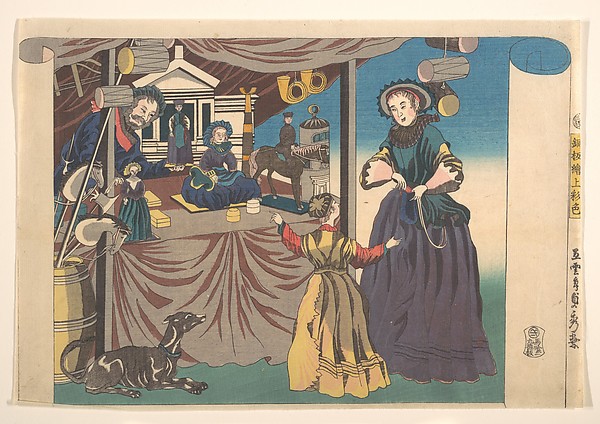
Color Print of a Copperplate Picture of a Toy Shop, 1860, Woodblock print; ink and color on paper. The Metropolitan Museum of Art, Bequest of William S. Lieberman, 2005, accession 2007.49.114.
Look closer: this is a woodblock print of 1860, not a tin toy. It is here as a reminder that shops selling toys to foreign customers were already a subject for Japanese artists when the first tin copies were made.
Image: The Metropolitan Museum of Art, Open Access (CC0)
Tin Plate at the Desk
At the time of writing the house holds tin plate from several decades. Among them are a prewar wind-up racing car from the mid-1930s, a Bandaiya friction Packard of the 1950s, an ALPS battery-operated space tank with its box and an Asahi friction spacecraft. Stock changes; the shelf page shows what is here now.
Answered plainly
What is a tin plate toy?
A toy made of thin steel sheet coated with tin, stamped into shape and printed by lithography, usually with a clockwork, friction or battery mechanism.
When did Japan begin making tin toys?
Collectors Weekly and the Yokohama museum both place the start in the 1880s to the Meiji era, with copies of Western toys.
What does Made in Occupied Japan mean?
The Journal of Antiques says goods exported during the Allied occupation, 1945 to 1952, were so marked. It is a sign of an early post-war piece.
Where can I see tin toys in Japan?
The Yokohama Museum of Tin Toys in the Yamate district, founded in 1986 by Teruhisa Kitahara.
Are old Japanese tin toys valuable?
Most sell for about 30 to 300 dollars according to the Journal of Antiques, while rare robots have reached six figures.
What is the most expensive Japanese tin robot sold?
A boxed Masudaya Machine Man, reported at 130,000 dollars plus premium, or 160,000 dollars by another report, in a September 2020 sale.
How can I tell if a tin toy is a reproduction?
Look for overly bright paint and tin, missing wear patterns and a China stamp, according to the Journal of Antiques.
Where can I see Japanese tin toys?
At the Yokohama Museum of Tin Toys, which shows about 3,000 toys and opens daily.
Why are boxes so important?
Boxes can be worth as much as the toy, and for battery toys they hold instructions and maker names, says the Journal of Antiques.
Why did tin toys decline?
Plastic, rising labour costs and tighter safety rules, according to the Journal of Antiques and Wikipedia.
What is the difference between friction and wind-up?
A friction toy has a flywheel and is revved along the floor; a wind-up has a spring that is wound with a key.
Where next
Sources and image credits
- Japanese Tin Toys: A Craze That Rebuilt Post-War Japan, Bruce Elsass, Journal of Antiques, 20 September 2023
- Japan's Best Postwar Export? Tinplate Cars, interview with Philippe de Lespinay, Collectors Weekly, 9 July 2010
- Attack of the Vintage Toy Robots, interview with Justin Pinchot, Collectors Weekly, 18 November 2010
- Yokohama Museum of Tin Toys, Yokohama 150
- Yokohama Museum of Tin Toys, Toy Tales
- Mechanical Marvels: Japanese Tin Toys, All About Japan, updated 27 July 2018
- Tin toy, Wikipedia
- Museum of Tin Toys, Wikipedia
- Metal House Robots, Wikipedia
- Marusan Shōten, Wikipedia
- Bandai, Wikipedia
- Yonezawa Toys, Carters
- Chapter 1, Lofty Ambitions, Takara Tomy company history
- Machine Man robot record, Antiques Trade Gazette, October 2020
- Boxed Machine Man record at Morphy's, Art Daily
- Yokohama History Museum announcement, Wrapped in Showa Time, 2026
- Object record, File:Osaka Tin Toy Institute The Tin Age Collection Cragstan Yonezawa Reproduction Mr. Atomic Side.jpg, Wikimedia Commons
- Object record, File:Tintoy museum.JPG, Wikimedia Commons
- Object record, File:Masudaya Battery Powered Army Tank M-99 Tin Toy Attack!.jpg, Wikimedia Commons
- Object record, File:Masudaya Battery Powered Army Tank M-99 Tin Toy Front.jpg, Wikimedia Commons
- Object record, File:Tin toy DAF truck pic1.JPG, Wikimedia Commons
- Object record, File:Rocket USA – Masudaya – Tin Wind Up – Mini Shooting Giant Robot (ミニ シューティング ジャイアント ロボット) – Gang of Six!! – Back Side.jpg, Wikimedia Commons
- Object record, File:Masudaya – Battery Operated – Tin UFO – Galaxy Flying Saucer X-7 (銀河円盤 X-7) – Close Up.jpg, Wikimedia Commons
- Object record, File:QSH – Tin Wind Up – South Pole Explorer B-17 – Back Side.jpg, Wikimedia Commons
- Object record, File:Ha Ha Toy – Tin Wind Up – High Wheel Robot – Chrome Version – Side.jpg, Wikimedia Commons
- Object record, File:Masudaya Battery Powered Army Tank M-99 Tin Toy Box Art.jpg, Wikimedia Commons
- Object record, Color Print of a Copperplate Picture of a Toy Shop, The Metropolitan Museum of Art


Last reviewed 28 October 2026. Pictures, where shown, are public-domain or open-access and credited beneath each one.
Looking for a particular tin toy, doll or figure, or a view on one you own? The concierge desk replies within one to three business days.
Browse Retro, Vintage, Antique and Modern Toys · Make a private request
Private concierge
Looking for something in particular?
Describe the piece or the project you have in mind. A senior advisor in Tokyo reads every case file personally and replies within two business days, with fees set out in writing before any work begins.