Japonista
Neon Genesis Evangelion Reversible Sukajan, EVA Unit-01 with Silver Dragon and Sakura, Japan Map Reverse
Neon Genesis Evangelion Reversible Sukajan, EVA Unit-01 with Silver Dragon and Sakura, Japan Map Reverse
Couldn't load pickup availability
Have a reasonable price in mind? Submit your best offer and our concierge will review it personally.
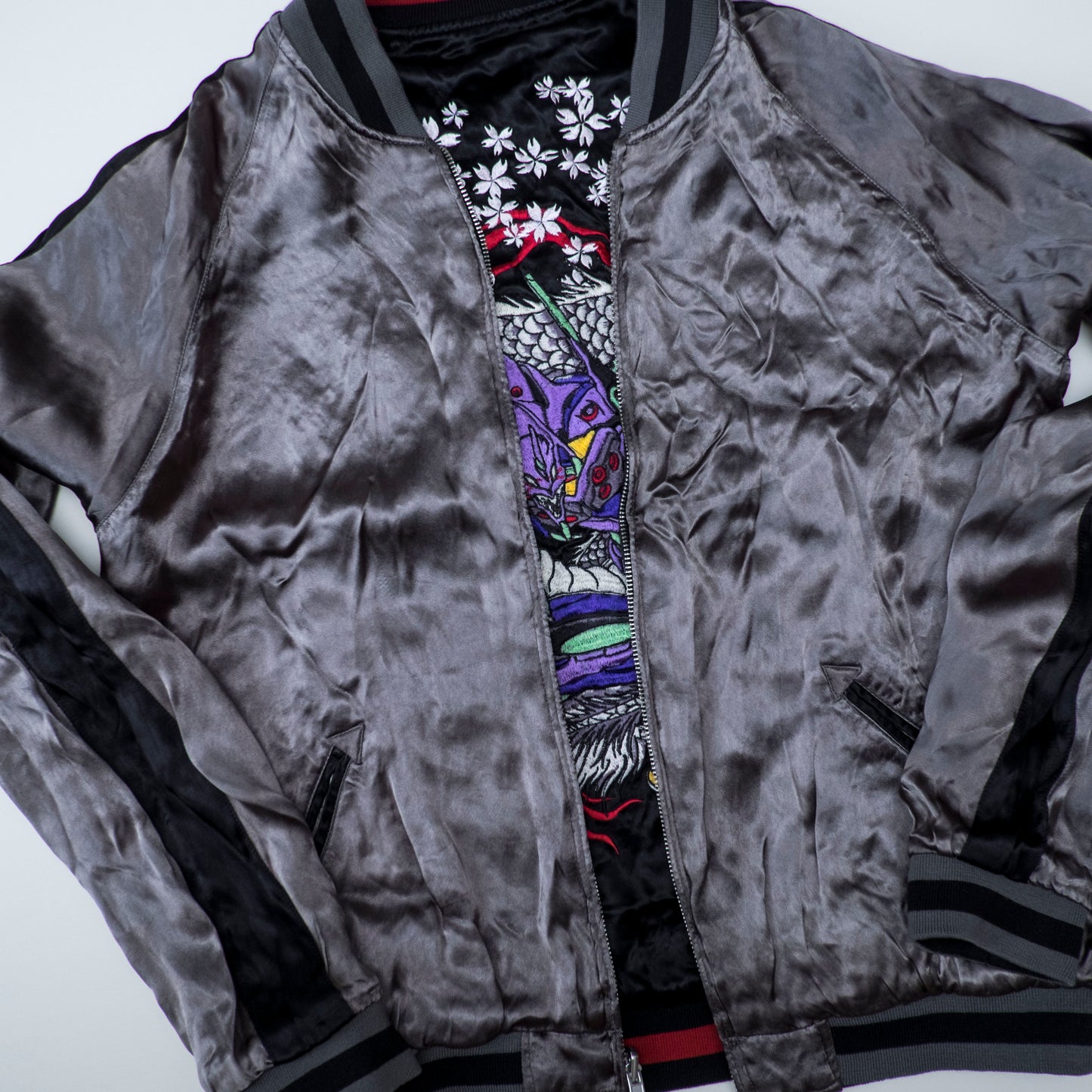
EVA Unit-01 crouches inside the coils of a silver-white dragon beneath a canopy of cherry blossoms, framed by crimson sleeves. Turn the jacket and the souvenir map of Japan returns as Evangelion geography, with Tokyo-3 marked in gold beneath an agency arch: a sukajan that keeps the tradition and rewires it.
The Piece
A dramatically embroidered reversible sukajan inspired by Neon Genesis Evangelion, combining the purple-and-green armor of EVA Unit-01 with a coiling Japanese dragon, scattered cherry blossoms and crimson flames, and pairing it with a second wearable face designed as an Evangelion-inflected souvenir map of Japan. One side is theatrical, mythic and character-driven; the other turns the classic embroidered map into a fictional geography of agencies, cities, secret facilities and Evangelion mythology. The imagery is not simply an anime graphic placed on a bomber: it has been reorganized through the grammar of sukajan embroidery, with monumental back design, contrasting sleeves, Japanese mythic motifs, map storytelling, color-coded ribbing and dense directional stitchwork.
The principal face is a deep black satin body framed by saturated crimson satin sleeves. EVA Unit-01 dominates the back in its recognizable purple, green, black, yellow and red color architecture: angular shoulder forms rise around the head, bright green panels divide limbs and torso, and intense red eyes and sharp contours define the mask-like face. The unit is shown crouching rather than standing, arms gathered around a narrow upright object that reads as blade, weapon, restraint or mechanical element, legs folded beneath, so it sits within the dragon’s circular movement, contained yet ready to break outward. A large silver-white dragon curls behind and around it, its densely scaled body forming an almost circular enclosure from the upper back to a head at lower right with open jaws, sharp teeth, flowing whiskers, backward-sweeping horns and a red mouth, its mane, brows, snout and ridges picked out in fine pale stitching. Clawed legs in pale thread with dark outlines reach around the figure. The scales echo armor plates and the claws echo the unit’s articulated hands, while crimson flames, stylized as long curved points rather than naturalistic fire, run between both forms and connect the red eyes, the dragon’s mouth, the sleeves and the ribbing, so dragon and machine read as one hybrid emblem.
White and pale-pink cherry blossoms, worked in white, ivory and pale blush thread, arch above the unit and dragon; branches cross the left shoulder onto the crimson sleeve, and open flowers, clustered buds and loose petals drift across the black body and down the arm, softening the mechanical and serpentine density without weakening it. Narrow black satin bands run along the sleeves, the opposite upper sleeve carries a darker black-and-purple crest or emblem partly visible in the photographs, and the collar, cuffs and waistband are black rib knit with a central red stripe. The sleeves shift between scarlet, wine, ruby and dark crimson with the light, framing the black center like two curtains opening on a stage.
The reverse is reflective gunmetal satin that reads as silver, pewter, charcoal, smoky brown-gray or gunmetal across its folds, restrained and archival in mood, with gray-and-black ribbing. Large white capitals arch across the shoulders reading “Special Government Agency”, above a cursive embroidered name, “Merv.”, preserved as stitched. Beneath, a stylized map of Japan is edged in vivid red with a narrower gold interior line, an embroidered emblem rather than a precise chart. White lettering marks Sapporo on the northern island, Aomori beside a small figure, Sendai, Osaka, Kure, Ube at the western end of Honshu, Shikoku within its red-and-gold outline, and Kagoshima at lower left; a pale-blue dot and lettering identify “Matushiro”, spelled as embroidered; and “Tokyo-3” appears in gold above a small gold circular marker near central Honshu. The figure is a small blue-haired woman in a red-and-white kimono with delicate white patterning and a vivid blue obi, standing beside a pale accessory, an Evangelion-inspired character in traditional dress. To the left, a large blue outlined pyramid-like structure, one plane filled with pale zigzag lines, sits beneath a gold celestial disk, evoking a headquarters, geofront or restricted facility, and white and pale-blue wave lines below suggest coastlines and sea currents.
The name sukajan is commonly understood as a contraction of “Yokosuka jumper”: the garment grew from embroidered souvenir jackets of Yokosuka and other postwar port communities, where American bomber and varsity construction met Japanese embroiderers and their dragons, tigers, eagles, maps, flowers and city names. This jacket keeps that logic, a guardian creature, Japanese flowers, a map of Japan, city names, tour-jacket lettering, contrasting satin and reversible construction, while replacing the tiger or eagle with Unit-01 and the military stations with Tokyo-3, like a souvenir from a Japan somewhere between the real archipelago and Evangelion’s imagined future. Its color blocking, large anime composition and map reverse appear consistent with 2000s to early-2010s Japanese anime streetwear and the Y2K-era revival of elaborately embroidered sukajan; no exact manufacturing year is visible, so it is presented as a vintage or vintage-era piece without an assigned date.
Details
- Subject: EVA Unit-01 with a silver-white dragon, cherry blossoms, falling petals and red flames; reverse stylized map of Japan with city names, Tokyo-3, a blue pyramid-like structure, a blue-haired kimono figure and agency lettering
- Maker: No manufacturer label visible in the photographs
- Era: Appears consistent with the 2000s to early 2010s; no dated label visible
- Origin: Japan
- Material: Rayon satin; cotton ribbing; embroidery thread
- Color: Black body with crimson-red sleeves and black-and-red ribbing; reverse gunmetal gray with gray-and-black ribbing. Thread in silver-white, purple, green, lavender, yellow, gold, red, pale blue and ivory
- Construction: Reversible satin-finish souvenir bomber with two complete back compositions; raglan-style sleeves; striped rib-knit collar, cuffs and waistband; extensive machine embroidery. Front zipper, pocket openings, maker label and size label are not visible in the photographed views
- Inscriptions: “Special Government Agency”; “Merv.”; Sapporo, Aomori, Sendai, “Matushiro”, Tokyo-3, Osaka, Kure, Ube, Shikoku, Kagoshima
- Fit: Unisex
Condition
- Vintage pre-owned condition with visible creasing, satin rippling, reflective variation and age-appropriate handling or storage character; both embroidered backs remain visually strong and retain substantial color, detail and impact.
- Black body: natural folds, pressure lines and changes in sheen; it may read black, charcoal, blue-black or dark brown-gray with the light. Localized rippling is visible around the dense Unit-01 and dragon embroidery, characteristic of heavily embroidered satin rather than a sign of printing.
- Crimson sleeves: natural creasing and directional sheen, color still vivid; light surface variation and small handling marks may be present.
- Gray map face: pronounced tonal movement, wrinkling and reflective variation, especially across the shoulders, sleeves and open areas around the map; the fabric shifts from pale silver to charcoal and brown-gray.
- Unit-01 embroidery: the figure, dragon scales, head, claws, flames, blossoms and petals remain clearly legible, with no major missing section; minor raised fibers, small thread irregularities, light edge wear or isolated loose threads may be present.
- Map embroidery: the agency lettering, cursive name, map outline, city names, Tokyo-3, kimono figure, pyramid, sun disk and sea lines remain substantially intact and readable, with no extensive embroidery loss visible.
- Ribbing is structurally present, with possible gentle waviness, softening, light pilling or relaxation; no major missing rib section or extensive unraveling visible. Back panels, raglan seams, sleeves, waistband and embroidery fields appear structurally intact, with no large hole, severe tear, seam separation or missing panel visible. Not presented as factory-new.
Fit and Sizing
No manufacturer size tag is visible and no flat measurements are recorded. The recommended measurement points are A, pit-to-pit chest width; B, back length from the base of the collar to the lower waistband; C, sleeve length from the base of the collar along the upper sleeve to the cuff, as the raglan-style construction has no conventional shoulder seam; D, relaxed waistband width; and E, cuff width or another relevant fit point.
Japanese vintage sizing does not correspond consistently with contemporary Western sizing, varying with production period, bomber silhouette, reversible construction, body length, sleeve fullness and ribbing tension; compare flat measurements with a jacket that already fits. The garment suits masculine, feminine and gender-neutral styling, worn compact or slightly oversized.
Styling, Display, Preservation
Wear the Unit-01 face with black trousers, dark denim, cargo pants or minimal monochrome layers so the dragon and sakura can dominate; the crimson sleeves also coordinate with black denim, red accessories, heavy boots, platform footwear and silver jewelry. The map reverse works with gray, black, cream, burgundy and faded blue and is the quieter everyday face. Both suit Y2K, visual-kei, gothic, punk and stage wardrobes, and under directional light the black-and-red face turns dramatic while the gray side throws shifting metallic highlights.
Either face can be displayed as a complete embroidered panel; alternate the visible face during long display to balance light exposure. Specialist dry cleaning for embroidered vintage satin is recommended; do not machine wash, soak, bleach, wring, scrub or tumble dry, and do not iron over the embroidery. Turn the jacket slowly, supporting the sleeves and the embroidered back, and store it on a broad padded hanger in a breathable cover, away from sunlight, humidity, smoke, perfume and prolonged compression.
Authenticity & Care
No manufacturer, licensing, collaboration, edition or authentication marking is visible in the photographed areas. The jacket is offered for its identifiable Evangelion-themed imagery and Japanese sukajan construction, without representing it as an officially licensed edition. Every piece is examined and documented in Japan before dispatch and is offered with the Japonista authenticity guarantee.
Delivery from Japan
Packed by hand in Japan and shipped insured and tracked by EMS or an equivalent express service. Import duties and taxes, where applicable, are payable on arrival. Returns follow our published policy.
Considered offers are welcome through Send an Offer, and each one is reviewed personally.
Continue browsing: Sukajan Souvenir Jackets · Amekaji & Wagara Fashion
Related pieces: Ukiyo-e Nebuta reversible sukajan · Satori GSJR-005 skull oiran and Hannya reversible sukajan · Shōki demon queller and tiger reversible sukajan
Yokosuka Archive
A particular size, motif or decade in mind? Postwar souvenir jackets and heritage amekaji surface in Japan one at a time. Name the maker, the embroidery and the chest measurement, and the Hunting Salon™ watches for it on your behalf. Request a jacket search →
Collectors also search: evangelion sukajan · eva unit 01 sukajan · evangelion japan map jacket · tokyo-3 souvenir jacket · evangelion dragon sakura jacket · reversible anime sukajan · y2k anime bomber jacket · evangelion embroidered jacket